
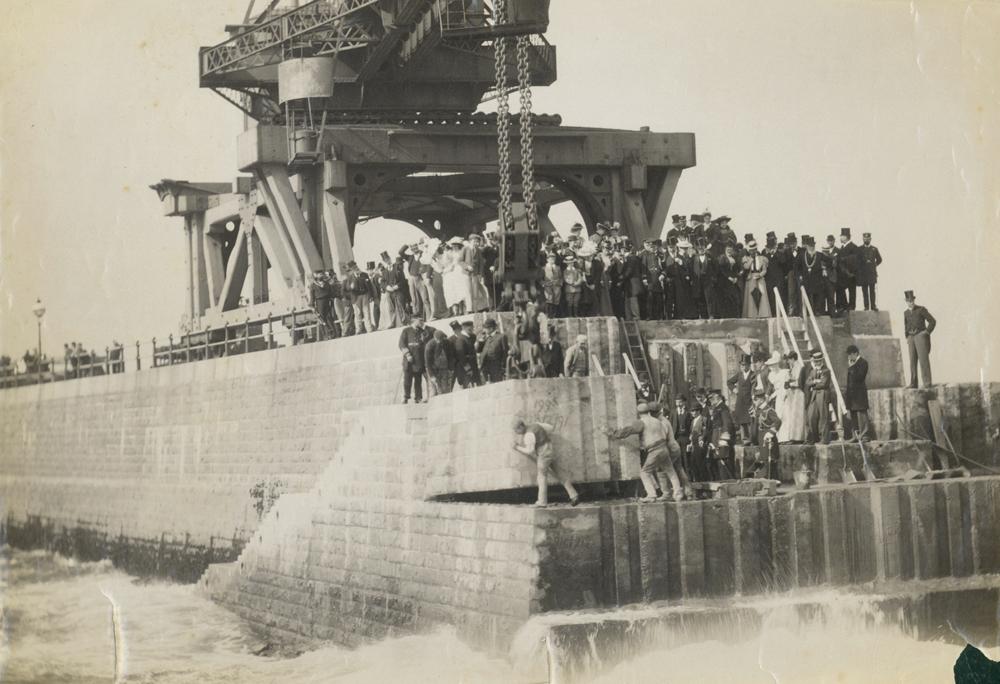
Roker Pier, Sunderland, 1895. Public domain.
All Saints, Monkwearmouth · Story · Featured Study
Sunderland and Alexander Boddy
A vicar of the Church of England brought the Pentecostal movement to his parish and edited its British magazine for eighteen years.
- Where
- Monkwearmouth, Sunderland
- Who
- Mary Boddy, Thomas Barratt
- When
- 1907 to 1926
Boddy came home from Norway and wrote, “My four days in Christiania cannot easily be forgotten.”
Tongues, then, are a sign, not for believers, but for unbelievers. Prophecy, however, is for believers, not for unbelievers.
Summary
Alexander Boddy was vicar of All Saints at Sunderland. He brought Thomas Barratt to his parish in 1907. For seven years his meetings at Whitsuntide gathered the British movement. His magazine Confidence carried its news.
- A woman in South London spoke in tongues eight months before Sunderland.
- Boddy went to Norway in March and spoke in tongues only in December.
- Smith Wigglesworth spoke in tongues at the vicarage that autumn.
- Boddy stayed in the Church of England, and others took the movement after the war.
The Texts of the Sign
The convention's ticket and Boddy's own prayer both spoke of a sign.
The ticket to the first convention asked each visitor to sign a declaration of sympathy with “the Sign of the Tongues”. Boddy wrote that he had asked for the sign given at Caesarea.
For they heard them speaking in tongues and exalting God. Then Peter said,
This verse tells of Caesarea, where Boddy's prayer looked for the sign.
Acts 10:46BSB
Do all have gifts of healing? Do all speak in tongues? Do all interpret?
Paul asks whether all speak in tongues, and Boddy would not answer for others.
Who Received, and When
The vicar spoke in tongues after his wife and his daughters, eleven months after Mrs Price in Brixton.
The movement reached Boddy's house before it reached Boddy.
| Who | Where | When, that year | The record |
|---|---|---|---|
| Mrs Price, a sister in South London | 14 Akerman Road, Brixton | 8 January, by Malcolm Taylor's dating | Boddy names her the first in Great Britain to receive with the sign |
| Alexander Boddy | Torvegaden 7, Kristiania | 5 March | A baptism of the Spirit, with no tongues |
| Two seekers, or a few | The Revival Library has the vestry | The night of 1 September | Boddy has two and leaves them unnamed, and they spoke after Barratt preached |
| Mary Boddy | Sunderland | 11 September | She received at Barratt's hands |
| Mary and Jane Boddy, the daughters | Sunderland | 21 September | Barratt wrote that May's words were distinctly Norwegian, and he is the only witness |
| Wigglesworth | The vicarage | Late October | He tells it in Confidence a year later |
| Alexander Boddy | Sunderland | 2 December | Tongues at last, with no laying on of hands |
From Ton-y-Pandy to the Vestry
Boddy went to Wales during its revival and to Norway, and then he asked Barratt to Sunderland.
Boddy had trained as a solicitor, and he wrote travel books as a Fellow of the Royal Geographical Society. He came to All Saints as curate in 1884 under a vicar debarred from preaching for drunkenness, and he took full charge two years later.
He stood with Evan Roberts in the pulpit at Ton-y-Pandy and carried Roberts's message home to Sunderland. His procession went to sing beside Roker football ground, and a paper he later reprinted says about fifteen thousand were at the match, their cheers breaking into the singing. He wrote later that Wales “was intended by the Lord as a preparation” for the Baptism of the Holy Ghost.
At the start of March he crossed the North Sea and went on through Germany, Denmark and Sweden to Kristiania, now Oslo. He knelt in the upper room of the mission and received his baptism there. He was in eight meetings over four days and wrote that the scenes there “were more supernatural” than those in Wales.
That summer he took a pamphlet, Pentecost for England, to the Keswick Convention, and Taylor says it was coolly received. Boddy wrote in it that “not more than perhaps half-dozen persons in Great Britain” were known to him to have the experience.
Barratt arrived on Saturday 31 August. The meeting of the next night ran until four in the morning. Two seekers, Boddy wrote in a leaflet Taylor quotes, “entered right in and went right through into Pentecost”. Barratt stayed about six weeks by Boddy's reckoning and seven by Taylor's.
The Sunderland Echo reported the meetings on 30 September, and the London papers followed. The Daily Chronicle of 8 October wrote of one seeker, “He writhed like an animal in pain, but nothing came of his raving”, as Taylor quotes it. Boddy wrote of the reporters, “We did not want them, but could not help it”, and he said cranks and mischief-makers came too.
Taylor writes that Barratt names 17 who spoke and that there were no more than 50 by December. Boddy's own later counts for all Great Britain are “Perhaps 800” a year on and “probably more than a thousand” in 1910, and they have no list behind them.
Wigglesworth at the Vicarage
Wigglesworth, the Bradford plumber and mission preacher, told of his first tongues in Boddy's magazine.
He came from Bradford with a friend and reached Sunderland on a Saturday. He wrote that he had “gone with an open mind” and that he would have left and protested if he had found anything against the glory of God.
On the Tuesday morning at All Saints' Vicarage he asked a sister to help him, and she laid hands on him and was then called from the room. In her absence, he wrote, he found himself “speaking in other tongues clearly”. His book of 1924 names her as Mrs Boddy.
His testimony prints no year and its printed days disagree, and his later book agrees on the year.
The Conventions and Confidence
Visitors came from across Britain and abroad, and the magazine carried their reports.
The first convention ran from 6 to 11 June 1908. Barratt, Jonathan Paul, Wigglesworth and the Jeffreys brothers came in those years, and Cecil Polhill first met Boddy at the first of them.
Confidence reported perhaps 300 delegates from out of town in 1912, with others turned away at night, and no tally stands behind that. Boddy gave no count for 1908.
Confidence began that April as a free monthly. Taylor counts 141 issues to 1926 and writes that it never went above 6,000 copies. The Pentecostal Missionary Union followed the next January, with Polhill at its head and Boddy as its editorial secretary.
The Vicar Who Stayed
He kept his living in the Church of England, and the war divided him from many Pentecostals.
He wrote in 1912 that “We do not ask them to leave their Churches”. His daughter said that Wigglesworth and others pressed him in 1922 to start a denomination, and that he felt he could not leave the Church of England. Taylor writes that his Pentecostal work went on without resistance from his bishop, Handley Moule.
He backed the war on the ground of the promise to Belgium, and the parish hall became a military hospital. He pointed conscientious objectors to an article against their view. Taylor writes that this patriotic stand alienated many Pentecostals, and his son James was shot down over France in 1917.
In 1922 he moved to the quieter parish of Pittington, and he warned from 1923 that each issue might be the last. He had granted in 1910 that “Some have been permitted to go back”, and in 1914 that others had gone into fanaticism. He died at Pittington in 1930.
How the Key Verse Was Taught
Three writers on Paul's saying that tongues are a sign for unbelievers.
Theophylact of Ohrid (died 1107)
Commentary on 1 Corinthians
Theophylact of Ohrid took the sign as a wonder that teaches no one.
“A sign amazes, but does not instruct and does not bring benefit, and often even harms, like a tongue without interpretation”
Patristic
Matthew Henry (1662 to 1714)
Commentary on the Whole Bible
Matthew Henry pictured the visitor who walks in on such a meeting.
“If, when they were all assembled for Christian worship, their ministers, or all employed in public worship, should talk unintelligible language, and infidels should drop in, they would conclude them to be mad, to be no better than a parcel of wild fanatics. Who in their right senses could carry on religious worship in such a manner?”
on 1 Corinthians 14:22Puritan
John Wesley (1703 to 1791)
Explanatory Notes upon the New Testament
John Wesley took the sign as a summons to the hearer.
“To engage their attention, and convince them the message is of God. Whereas prophecy is not so much for unbelievers, as for the confirmation of them that already believe.”
Evangelical
In Their Own Words
The vicar, his wife and the Bradford preacher, in print within two years of the meetings.
Alexander A. Boddy (1854 to 1930)
Letter to the North Mail, reprinted in The Apostolic Faith
To an outsider
“At times the noise is strangely awesome, almost appalling to an ‘outsider.’”
Church of England vicar and Pentecostal editor
About this saying1 paragraph
Boddy wrote this in 1907 of the meetings at Kristiania.
Alexander A. Boddy
Confidence
The way the Lord led
“I dare not lay down any rule for others. I can only say this is the way the Lord has led me.”
Church of England vicar and Pentecostal editor
About this saying1 paragraph
Boddy wrote this in 1909 straight after claiming the sign for himself.
Smith Wigglesworth (1859 to 1947)
Testimony in Confidence
Twenty years
“Almost am I led to believe that 20 years is not too long to wait for the Holy Anointing of God the Holy Ghost.”
British Pentecostal
About this saying1 paragraph
Wigglesworth set this in 1908 beside his words that he was now speaking with new tongues.
Mary Boddy
Testimony in The Apostolic Faith
For the Holy Ghost
“I did not ask for ‘tongues’ but for the Holy Ghost, and He ‘gave me utterance,’ and the joy of praising God in the Spirit is truly wonderful.”
British Pentecostal
About this saying1 paragraph
In 1907 the paper printed her name as Mrs. A. A. Body.
Where Readers Disagree
Critics of the first year, the Union's own minutes and a historian of 2009 put three questions to Sunderland.
Is tongues the one sign?2 paragraphs
Boddy claimed it for himself and made no rule for others. The Union's council said in May 1916 that tongues is “not the only evidence”, and it softened the words further that summer. Wigglesworth reported that several assemblies were unhappy, and in December the council wrote “expect”, which Boddy accepted.
Taylor writes in one place that Boddy weakened on the sign and in another that he stayed committed to it.
Was it of God?2 paragraphs
Boddy held that it was. He printed the Mülheim conference's answer to Berlin in October 1909, and in November seven leaders met in Regents Park and issued a London Declaration, and Taylor concludes Boddy was among them.
Reader Harris called the movement a “satanic counterfeit” in 1907, as Taylor reports it, and the Berlin Declaration of 15 September 1909 called it “from below”. Confidence itself named War on the Saints in 1913 as “a book of warning against the Pentecostal Movement”.
Was the Union narrow?1 paragraph
David Bundy, as William Kay's review of Visions of Apostolic Mission reports him, charges that the nationalism of Boddy and Polhill betrayed Barratt's larger vision, and Kay disputes it.
Books to Read Next
Publish and Be Blessed
Malcolm J. Taylor · 1994
Taylor's Birmingham thesis studies Confidence and its years in close detail.
Read Taylor free at the University of BirminghamConfidence
Alexander A. Boddy, editor · 1908 to 1926
The Flower Pentecostal Heritage Center holds the magazine's pages.
Read Confidence free at the Flower Pentecostal Heritage CenterWhat Sunderland Left
The Whitsuntide meetings made one Anglican parish the place of pilgrimage for British Pentecostal leaders, and their churches grew up outside it.
Sources
Scripture is the Berean Standard Bible.
- The Holy Bible, Berean Standard Bible (read 2026)
- Confidence, edited by Alexander A. Boddy (Sunderland and Pittington, 1908 to 1926), the issues of April, October and November 1908, January, February, October, November and December 1909, August 1910, March and June 1912, January 1913, February and October 1914, January 1915, August 1916 and May 1917.
- The Apostolic Faith (Los Angeles), February to March, May and October 1907.
- Malcolm J. Taylor, Publish and Be Blessed: A Case Study in Early Pentecostal Publishing History, 1906-1926 (PhD, University of Birmingham, 1994)
- Smith Wigglesworth, Ever-Increasing Faith (South Pasadena, 1924), pages 101 to 102.
- "Alexander Boddy", the Revival Library.
- Theophylact of Ohrid, Commentary on 1 Corinthians; Matthew Henry, Commentary on the Whole Bible (1710); John Wesley, Explanatory Notes upon the New Testament (1755)
- Tyne and Wear Sitelines, HER 4789, All Saints' Church, Monkwearmouth.
- William K. Kay, review of David Bundy, Visions of Apostolic Mission (2009)