
Wonsan, Korea, August 1903 · Story · Featured Study
Wonsan, 1903
A week of Bible study among missionaries at Wonsan began meetings of public confession that moved through the Korean missions for three years.
In his thirteenth year in Korea, Robert Hardie confessed his pride before a Korean congregation.
- Where
- Wonsan, Kaesong, Seoul, Pyongyang
- Who
- Robert A. Hardie, M. C. White, F. Franson, Yun Seong-geun
- When
- August 1903 to 1906
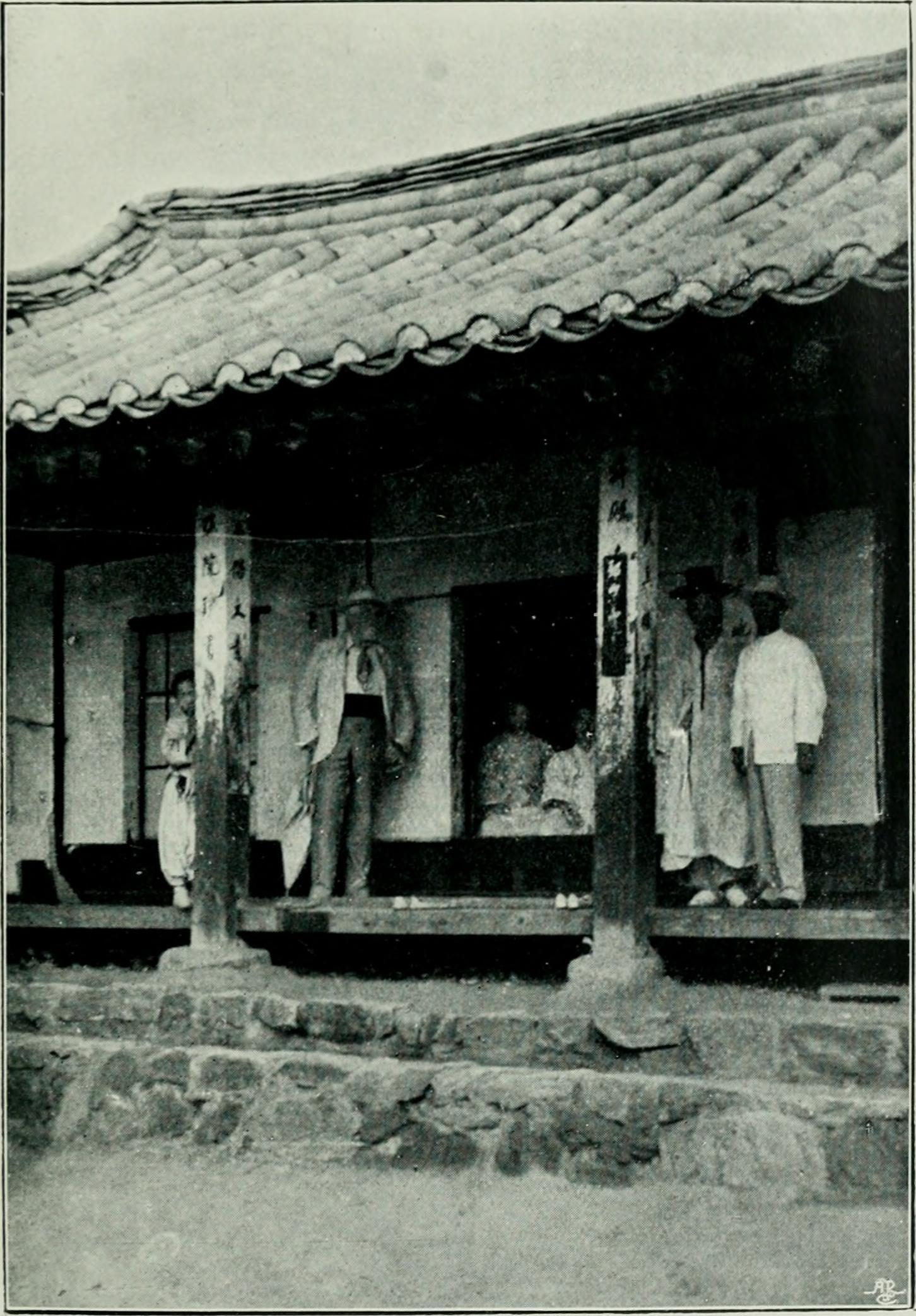
The Korean post office at Wonsan, a plate in Charles Henry Hawes, In the Uttermost East (1903), no known copyright restrictions
Therefore confess your sins to each other and pray for each other so that you may be healed. The prayer of a righteous man has great power to prevail.
Summary
Robert Hardie, a Southern Methodist doctor, led the study and then took meetings through two Methodist missions until he went home on furlough. Other Southern Methodists and a council of six missions carried them on.
- Five missionaries set the class, one of them Miss M. C. White, a visitor from China.
- Hardie himself counted the revival from a year after the class.
- Historians differ on whether his confession caused the revival or came out of it.
The Texts of the Confession
Young-Hoon Lee names the verse that stopped Hardie, and Acts 19:18 stands beside the confessions that followed.
Lee writes that Hardie reached Luke 11:13 while preparing a report on prayer for the Wonsan meeting. The meetings that followed took up the practice of James 5:16.
So if you who are evil know how to give good gifts to your children, how much more will your Father in heaven give the Holy Spirit to those who ask Him!”
Lee writes that this verse showed Hardie he had counted too much on his own effort.
Luke 11:13BSB
Many who had believed now came forward, confessing and disclosing their deeds.
Believers at Ephesus came forward and told their deeds aloud, as members of the Korean churches did.
Acts 19:18BSB
Where the Meetings Went
Lee Deok-ju, in the Encyclopedia of Korean Culture, gives the meetings Hardie led or shared.
The meetings moved from Wonsan through Hardie's own mission to the Northern Methodists and then the Presbyterians.
| When | Where | The field | Who led |
|---|---|---|---|
| 24 August 1903 | Wonsan, the missionaries' class | Southern Methodist | Hardie led the Bible study |
| September and October 1903 | Wonsan, the church officers, then meetings under F. Franson | Southern Methodist | Hardie, then F. Franson, then Hardie |
| January to April 1904 | The Kaesong district class; the Saesulmak and Jigyeongteo churches at Gimhwa; the Jagol church in Seoul | Southern Methodist | Hardie |
| September to November 1904 | The Jeongdong First Church in Seoul; the Pyongyang district; the Incheon district | Northern Methodist | Hardie |
| August 1906 | Pyongyang, the missionaries' class | Presbyterian and others | Hardie |
From the Class to the Congregation
A week among missionaries ended the next Sunday before a Korean church.
By the summer of the class Hardie, a medical missionary, was worn down by poor results. That summer Miss White, a Southern Methodist working in China, visited Wonsan and set a week's class with the missionaries Carroll, Knowles, Hounshell and McCully.
They asked Hardie to lead the Bible study. As he led it, the encyclopedia says, he found the cause of his failure in himself and repented. He received the fullness of the Spirit and assurance of faith, and the other missionaries told of the same experience.
On the Sunday after the class he stood before the Korean congregation. Young-Hoon Lee, citing Donald Owens's Revival Fires in Korea of 1977, says he confessed "that his own pride, hardness of heart, and lack of faith had brought shame and confusion upon his ministry".
The encyclopedia calls this the pattern of repentance and says it drew out the public confession of the Korean members.
The sins they named were embezzlement, theft, adultery, rape, hypocrisy, hatred and envy. Members who had hated each other were reconciled, and what had been stolen was paid back.
The conscience money1 paragraph
Yun Seong-geun, an evangelist of the Saesulmak church, attended a Wonsan meeting and remembered government money he had kept when he worked at the Incheon mint. He raised the sum and paid it back to the Ministry of Finance, and he was nicknamed "conscience money".
After the meetings in the Northern Methodist field Hardie went home on furlough, and other Southern Methodists led meetings the next year at Kaesong, Wonsan and Seoul.
In September 1905 the General Council of six Presbyterian and Methodist missions resolved to run its yearly classes as union revival meetings. They met in January and February 1906 at Seoul, Wonsan and Pyongyang.
Korea Before the Class
Protestant work in Korea was twenty years old when the class met, and its missionaries were discouraged.
They had not seen the results they had looked for. The Boxer rising of 1900 in China had spread a mood against missionaries.
The great famine of 1901 ruined many households, and the coming war between Russia and Japan was already unsettling the country.
What Is Not Known
The sources leave the words of the confession and the year of the revival unsettled.
No copy of The Korea Methodist of 1904 and 1905 has been found, and no account of the confession in Hardie's own words.
Bonjour Bay dates the class 24 to 30 August 1903, and the encyclopedia opens it on 24 August. Hardie's report of June 1907 counts the revival three years back, which gives 1904.
The two dates fit together if the class came first and the revival Hardie saw reaching past his own mission came a year later. Bay places a second round at Wonsan in January of that year, with A. F. Robb.
From Wonsan to Pyongyang
A line runs from the Wonsan years to the class at Pyongyang.
James S. Gale wrote in 1909 that in telling the missionaries at Pyongyang in 1906 "of the work of grace that God had wrought in his own soul" Hardie "aroused more intense and deeper longing than ever".
A month after that week, Lee Deok-ju writes, Howard Agnew Johnston brought news of Wales and India. Three months of prayer followed, and in January 1907 the confessions began in the class at Pyongyang.
He names three results of the Wonsan years. Repentance passed from a missionary to Korean leaders to members, the movement crossed from one mission's field to others, and dawn prayer and praying aloud together appeared as native forms of faith.
How the Key Verse Was Taught
Three writers of three centuries on confessing to one another.
John Wesley (1703 to 1791)
Explanatory Notes upon the New Testament, on James 5:16
John Wesley answered the question of who should hear a confession.
“He does not say, to the elders: this may, or may not, be done; for it is nowhere commanded. We may confess them to any who can pray in faith: he will then know how to pray for us, and be more stirred up so to do.”
Evangelical
Adam Clarke (1762 to 1832)
Commentary on the Bible, on James 5:16
Adam Clarke looked to what the practice does among believers.
“This is a good general direction to Christians who endeavor to maintain among themselves the communion of saints. This social confession tends much to humble the soul, and to make it watchful.”
Methodist
Dietrich Bonhoeffer (1906 to 1945)
Life Together
Dietrich Bonhoeffer taught what the one who hears a confession stands for.
“He hears the confession of our sins in Christ's stead, and he forgives our sins in Christ's name. He keeps the secret of our confessions as God keeps it. When I go to my brother to confess, I am going to God.”
on James 5:16Confessing Church
In Their Own Words
These sentences come from the missions' journal.
Robert A. Hardie (1865 to 1949)
"Evangelistic Work on the East Coast", The Korea Mission Field 3:6, p. 95
Abiding and fruitful
“The results of the revival which began in Wonsan three years ago have been abiding and fruitful.”
Methodist missionary
About this saying1 paragraph
In this sentence of 1907 Hardie dates the revival from Wonsan.
Robert A. Hardie
"Evangelistic Work on the East Coast", The Korea Mission Field 3:6, p. 95
A fresh baptism
“In the union class (Presbyterian, Baptist, and Methodist) held in Wonsan God was present with us in great power, and not a few of the natives as well as most of the missionaries received a fresh baptism of the Holy Spirit, for which we and an ever increasing number will praise God throughout eternity.”
Methodist missionary
About this saying1 paragraph
The same report of 1907 tells of a class held at Wonsan by three missions.
Graham Lee
"How the Spirit Came to Pyeng Yang", The Korea Mission Field 3:3, p. 33
Helped us greatly
“Dr. Hardie of Won San came and helped us greatly. At that meeting was born the desire in our hearts that God's Spirit would take complete control of our lives and use us mightily in His service.”
Presbyterian missionary
About this saying1 paragraph
Graham Lee, a Presbyterian at Pyongyang, wrote this in March 1907 of the missionaries' week of August 1906.
Cause, Effect and Politics
Writers differ over what started the movement and over what it did to the church's public life.
What started it?3 paragraphs
Young-Hoon Lee, Bay and Lee Deok-ju all tell Wonsan as the first link of a chain that runs to Pyongyang, with Hardie's confession at its head.
Kim Chil-sung, in Mission Theology of 2013, answers that the repentance was the effect of the Wonsan revival, since Hardie confessed after the experience of the Spirit.
Sung-Deuk Oak calls the years 1903 to 1907 "the first revival" of colonial Korea and maps its later lineage from there.
A retreat from politics?2 paragraphs
The encyclopedia records a critical view: in the war of 1904 and the treaty of 1905 Christians turned from the political and social facts around them, and the church grew less political.
Oak traces that reading to nationalist and minjung theologians of the 1970s and 1980s, and his paper stresses "the nationalistic, reformative and indigenous elements of revivalism" while keeping the negative legacy in view.
Books to Read Next
Korea in Transition
James S. Gale · 1909
Gale was a missionary in Korea and writes of Hardie at page 201.
Free at the Internet ArchiveThe Korea Mission Field 3:6
Robert A. Hardie and others · 1907
Hardie's report on the east coast work stands at page 95.
Free at the Internet ArchiveWhat Wonsan Left
Wonsan left the Korean churches a pattern, in which a teacher named his own failure before those he taught and they then named theirs.
Sources
Scripture is the Berean Standard Bible.
- The Holy Bible, Berean Standard Bible (read 2026)
- 이덕주 (Lee Deok-ju), "원산부흥운동", Encyclopedia of Korean Culture, article E0076578 (2015, revised 17 July 2023), in Korean.
- Young-Hoon Lee, "Korean Pentecost: The Great Revival of 1907", Asian Journal of Pentecostal Studies 4:1 (2001), pages 74 and 75, citing Donald D. Owens, Revival Fires in Korea (1977)
- Bonjour Bay, "The Pyongyang Great Revival in Korea and Spirit Baptism", Evangelical Review of Theology 31:1 (2007), pages 6 and 7.
- Robert A. Hardie, "Evangelistic Work on the East Coast", The Korea Mission Field 3:6 (June 1907), page 95.
- Graham Lee, "How the Spirit Came to Pyeng Yang", The Korea Mission Field 3:3 (March 1907), page 33.
- James S. Gale, Korea in Transition (New York: Young People's Missionary Movement, 1909), page 201.
- Kim Chil-sung (김칠성), "Hardie’s Repentance, Is It Cause or Effect for the Korean Revival?", Mission Theology 32 (February 2013), pages 175 to 199, the abstract.
- Sung-Deuk Oak, "Major Protestant Revivals in Korea, 1903-35", Studies in World Christianity 18.3 (2012), pages 269 to 290, the abstract.
- The Korea Methodist (1904 to 1905), no copy found.
- John Wesley, Explanatory Notes upon the New Testament, on James 5:16.
- Adam Clarke, Commentary on the Bible, on James 5:16.
- Dietrich Bonhoeffer, Life Together.
Keep Studying
People and groups7
Church history8
Values3