
Liaoyang and Mukden, February 1908 · Story · Featured Study
The Manchurian Revival of 1908
Jonathan Goforth's meetings at Liaoyang and Mukden in February 1908 turned to public confession.
At Mukden no one prayed at the first services, and within days the elders were offering to resign.
- Where
- Liaoyang, Mukden, Pyongyang
- Who
- Jonathan Goforth, Liu Ch'uen Yao, George Douglas, James Webster
- When
- February 1908
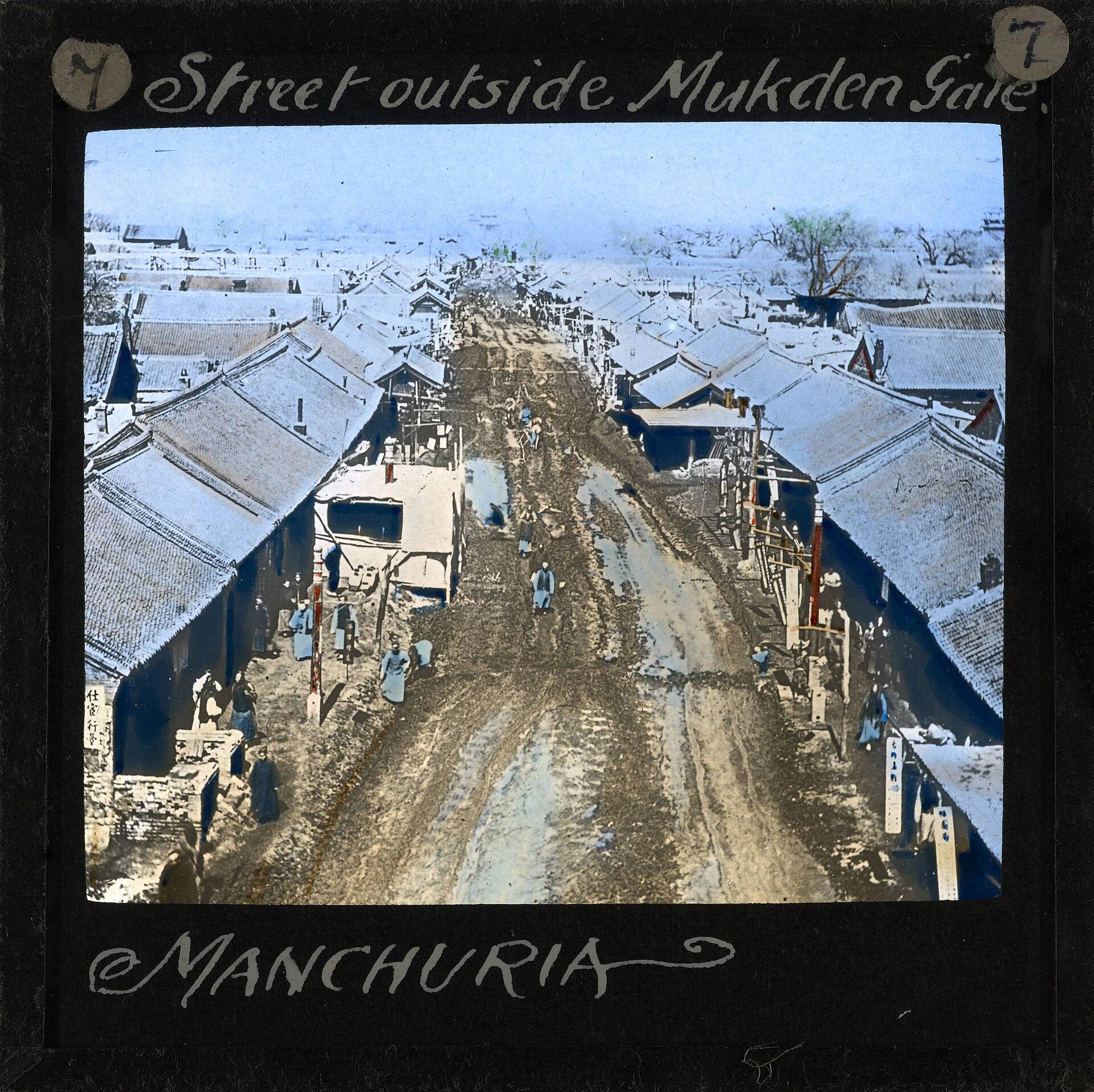
Street Outside Mukden Gate, Mukden, 1882 to 1936. Public domain.
So he said to me, “This is the word of the LORD to Zerubbabel: Not by might nor by power, but by My Spirit, says the LORD of Hosts.
Summary
The Canadian missionary preached a week at Liaoyang and then went on to Mukden in Manchuria. Church members named their sins in public.
- Two men from Liaoyang had seen the revival in Korea shortly before.
- The witnesses differ on whether it came from Korea or was already stirring in China.
- Webster and Goforth tell the story of an elder and the Boxer money in two ways.
The Texts of the Meetings
Zechariah was the theme of the mission, and other texts stand beside what happened at Mukden.
Webster wrote that Goforth's message in Manchuria rested on one truth from Zechariah 4:6, repeated in many forms.
Call to Me, and I will answer and show you great and unsearchable things you do not know.
Goforth says this verse answered him in his room after the opening service at Mukden.
He who conceals his sins will not prosper, but whoever confesses and renounces them will find mercy.
The proverb joins confession to renouncing, and the elder in Goforth's telling promised full restitution.
Many who had believed now came forward, confessing and disclosing their deeds.
The congregations at Liaoyang and Mukden did what Luke records at Ephesus.
Acts 19:18BSB
Proverbs 28:13, Acts 19:18
The Elder and the Boxer Money, Told Twice
Webster's book and Goforth's book each tell of an elder and money from the Boxer year.
The two witnesses differ on the setting and on the history of the money.
| The question | Webster (1910) | Goforth, By My Spirit |
|---|---|---|
| Who came | An ex-elder, named only by a letter | An elder who had been the church's treasurer in the Boxer year |
| When | Monday morning, immediately after breakfast | Early on the morning after the opening day |
| Before whom | The missionary writing the account, in private, then Goforth in his room | Goforth alone, then all the people after the address |
| The money | A deacon's trust money his firm stood security for, cancelled by the church and then paid to him by the family | Church funds he swore he had never received, after the Boxers destroyed the books |
| What he promised | To pay when he had sold some property | To confess before the church and make full restitution |
Webster printed his account in 1910. Goforth's book came out in 1929, and Rosalind Goforth's foreword says he told a revival story in great pain while their son typed. Webster's account is the nearer, and both men were interested parties.
From Korea to Liaoyang and Mukden
Goforth carried the story of Korea north and came back the next February for meetings in two cities.
Goforth went to Korea in the summer of 1907 with R. P. MacKay, the Foreign Mission Secretary of his church, and they went home by "the northern route through Manchuria". He wrote, "He was surely just as willing to bless China as Korea."
At Mukden he told the story of Korea on a Sunday morning. He writes that the congregation asked him back in February of the next year, and Webster says that nothing was then arranged.
In the latter part of 1907 George Douglas of Liaoyang sent two workers named Chang and Liu to Korea. Graham Lee of Pyongyang wrote that, being from China, they "could understand nothing". He added that they took what information they received through the Chinese character, and that "What they did get was the spirit of the meeting". This Liu is not shown to be the pastor of Mukden.
Goforth's mission at Liaoyang began on 10 February 1908 and ran for a week. Douglas reported that outsiders said, "Yamen torture could not draw confessions such as these from human lips".
After Goforth had gone, Chinese deputies carried the meetings to the out-stations, and a second week followed at Liaoyang.
At Mukden Goforth came to the large Chinese congregation of the Scottish mission under its pastor, Liu Ch'uen Yao.
He had asked that the Scottish and Irish Presbyterians of the city unite for the services and that the way be prepared by prayer. He wrote that "not one extra prayer-meeting had been held" and that "the two Presbyterian bodies had not united".
Webster writes that on the first Sunday eight to nine hundred people came in the morning, and no one prayed when the time was given. No one prayed at night either.
The fourth morning, as Goforth tells it2 paragraphs
Goforth is the one source for this morning. He writes that an elder he does not name stood before the congregation and cried, "I have committed adultery. I have tried three times to poison my wife", and laid his bracelets and ring on the collection plate.
The whole session then offered to resign, and the deacons after them. The pastor said, "I'm not fit to be your pastor any longer." Goforth writes that the congregation called out that it appointed him again.
Webster records a morning meeting at which Liu presided and four elders and a number of deacons confessed. Liu asked prayer for himself and for all who worked for the missionaries. A foreign voice broke in, "And please include the missionaries themselves in your supplication".
At the farewell meeting, Goforth wrote, offerings were read out as "proofs of repentance". He gives them: "One man offers 500 strings of cash; another the rent of two small houses. One elder brings 300 dollars".
After Goforth left, Webster writes of Liu, the conduct of the movement was "entirely in his hands, so far as human instrumentality is concerned".
The Church at Mukden Before the Meetings
Webster names the prayer and the teaching that went before the meetings.
Webster calls Liu Ch'uen Yao "one of the early fruits of a mission begun thirty-five years ago". John Ross, the senior missionary, was the last survivor of those who had planted it in the early seventies.
For two years the ladies of the mission had met once a fortnight to pray for revival.
He agrees with Goforth that no special prayer meetings were held at Mukden. He adds that Liu used the ordinary course of worship to press the importance of prayer on the people.
What Is Not Known
Pastor Liu speaks only through missionaries, and the counts that survive are local.
Webster gives nearly two hundred applicants for baptism in one village, ninety-six inquirers at Mopanshan and thirty-five patients who asked for baptism in three months. No witness gives a total of those saved.
The account of Mukden rests on mission writers. The one Chinese hand is Lin Yun Sheng's letter from Liaoyang, which Webster prints, and Liu's dates are not known.
What the Witnesses Said Remained
Webster's twelfth chapter gathers impressions from eighteen months after the meetings.
John Ross, principal of the Theological College at Mukden, was away on furlough in the year of the meetings. Webster says Ross wrote of the effects on the students.
The letter Webster prints at the close of that chapter, which he introduces as Ross's, counts "four new pastors, ordained as the outcome of the Revival". One of them was a colleague to Pastor Liu.
The same letter says "The excitement of Revival times has disappeared, as was natural". It names what remained as a spiritual elevation, the knowledge that God is near, greater giving and greater zeal in service.
It closes, "the work is still going on, though sporadically, and with less external excitement".
Goforth wrote that hundreds of members who had drifted away returned in the year of the meetings.
How the Key Verse Was Taught
Three commentaries of the eighteenth and nineteenth centuries on the word to Zerubbabel.
John Wesley (1703 to 1791)
Explanatory Notes upon the Old Testament, on Zechariah 4:6
John Wesley took the word to Zerubbabel as a picture of the church.
“in an emblem prefigures what a church it is, how precious, how full of light, how maintained by God himself.”
Evangelical
Adam Clarke (1762 to 1832)
Commentary on the Bible, on Zechariah 4:6
Adam Clarke carried the word from the Temple to the Church.
“This prince was in a trying situation, and he needed especial encouragement from God; and here it is: Not by might, (of thy own), nor by power, (authority from others), but by my Spirit - the providence, authority, power, and energy of the Most High. In this way shall my temple be built; in this way shall my Church be raised and preserved.”
Methodist
Jamieson, Fausset & Brown (1802 to 1910)
Commentary Critical and Explanatory on the Whole Bible, on Zechariah 4:6
Jamieson, Fausset and Brown spoke to the weakness of those who heard it.
“man's weakness is no obstacle, for God's might will perfect strength out of weakness”
Evangelical
In Their Own Words
Goforth, Douglas, a Chinese hospital assistant and Webster's book speak of the meetings.
Jonathan Goforth (1859 to 1936)
By My Spirit, "The Beginning of the Movement in Manchuria", chapter III
But I had no method
“But I had no method. I did not know how to conduct a Revival. I could deliver an address and let the people pray, but that was all.”
Presbyterian missionary
About this saying1 paragraph
Goforth set this at the head of his chapter on Manchuria in By My Spirit, printed in 1929.
George Douglas
"Stirring Times in Manchuria", The Chinese Recorder and Missionary Journal 39:4, pp. 231 to 232
They came back on fire
“Mr. Goforth, of the Canadian Presbyterian Mission, came amongst us to conduct a week's special meetings. In view of these I had sent two of our Christians to see something of the work of grace in Korea, and they came back on fire.”
United Free Church of Scotland
About this saying1 paragraph
George Douglas wrote this from Manchuria, and The Chinese Recorder printed it in April 1908 under the heading "Stirring Times in Manchuria".
Lin Yun Sheng
Letter to Mrs. Macintyre, in James Webster, The Revival in Manchuria, p. 53
They owned their faults
“Through the help of the Spirit they did it very well. The effect was so great that all the Church members got roused. Their eyes brightened so that they could see the dirt as of a leper all over them. They went up to Jesus one by one, cried for mercy, and owned their faults and sins.”
United Free Church of Scotland
About this saying1 paragraph
Lin Yun Sheng, an assistant in the Liaoyang hospital, wrote this in English in 1908 to his old teacher at Haicheng, and Webster says he prints the letter verbatim.
James Webster
The Revival in Manchuria, p. 47
We did nothing
“So, if the question be asked: ‘What did you do beforehand in the way of making preparation for this great movement?’ my answer must be: ‘We did nothing!’ We may have been wrong; I think we were very wrong. We have received much: one wonders how much we have lost by neglecting the very necessary previous heart-searching, repentance, and prayer.”
United Free Church of Scotland
About this saying1 paragraph
The book of 1910 puts the question to its own mission at Mukden.
Where It Came From, and What It Was
Witnesses traced it to Korea, to a stirring across China or to God's sovereign work, and opponents traced it to the devil.
Korea's fire, or a wider stirring?3 paragraphs
Douglas credited the two men back from Korea, and Goforth called Korea "God's plan for setting the world aflame". George Heber Jones and W. Arthur Noble wrote in 1910, "The great revival which has visited Manchuria is known as the 'Korean Revival.'"
Webster's book cuts against a single line from Korea. At the Presbytery of 1906, he writes, "we heard with profound interest of remarkable spiritual movements in other parts of China". Walter B. Sloan's introduction says Howard Agnew Johnston's account of India brought an awakening in at least one centre in China in 1906.
The men who called it Korea's fire were invested in Korea.
A sovereign work over poor means?2 paragraphs
Goforth heard a voice ask him, "Is it your work or Mine? Can I not do a sovereign work?" He had also set terms for his coming, and Webster records prayer and teaching that went before.
That the Spirit moved at Mukden is the witnesses' claim and the confession of their churches.
From God or from the devil?2 paragraphs
Chinese leaders at Chefoo "agreed beforehand to discountenance all public confession", Goforth writes, for they held that such movements "could only be from the devil". He also reports an evangelist at Peking who told him, "You were led by the devil in your meetings in Manchuria".
Both reports come from the man they opposed. Douglas himself wrote of "great emotion", and the excitement faded by the witnesses' own word.
Books to Read Next
The Revival in Manchuria
James Webster · 1910
Webster gives the mission's own account, with his notebook of the days at Mukden and Lin Yun Sheng's letter.
Free at the Internet ArchiveBy My Spirit
Jonathan Goforth · 1929
Goforth tells the meetings from the pulpit side in his third chapter.
Free at the Internet ArchiveThe Chinese Recorder and Missionary Journal, April 1908
Various · 1908
The issue prints Douglas's letter and Graham Lee's words on the two men sent to Korea.
Free at the Internet ArchiveWhat the Meetings at Mukden Left
The witnesses at Mukden left a record of confession and of money paid back. They disagreed among themselves on how it came.
Sources
Scripture is the Berean Standard Bible.
- The Holy Bible, Berean Standard Bible (read 2026)
- James Webster, The Revival in Manchuria (London: Morgan and Scott, 1910), with an introduction signed by Walter B. Sloan, pages 9 to 12, 20 to 24, 46 to 48, 51 to 56 and 125 to 127.
- Jonathan Goforth, By My Spirit (1929), the foreword and chapters II, III, X and XI, in a transcription that states no edition.
- The Chinese Recorder and Missionary Journal 39:4 (April 1908), page 179 and pages 231 to 232.
- George Heber Jones and W. Arthur Noble, The Korean Revival (New York: Board of Foreign Missions of the Methodist Episcopal Church, 1910), page 42.
- John Wesley, Explanatory Notes upon the Old Testament, on Zechariah 4:6.
- Adam Clarke, Commentary on the Bible, on Zechariah 4:6.
- Jamieson, Fausset and Brown, Commentary Critical and Explanatory on the Whole Bible (1871), on Zechariah 4:6.
Keep Studying
Read it4
People and groups10
Church history7
Values1