
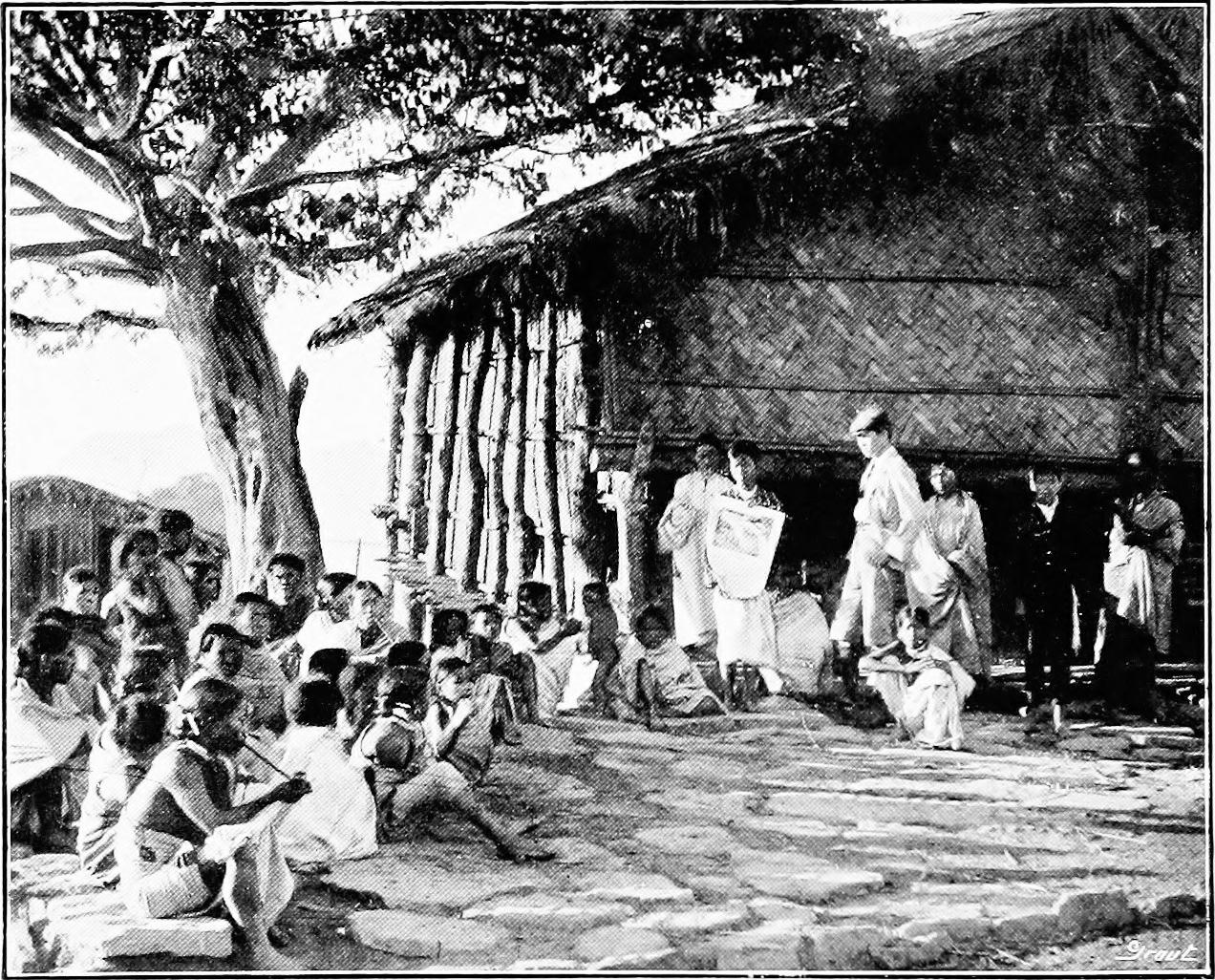
Preaching in a Lushai Village, in Grace R. Lewis, 1907. Public domain.
Mairang to Aijal · Story · Featured Study
The Mizo Revival of 1906
A small party of Christians carried a revival home to the Lushai Hills from a Khasi Assembly.
- Where
- Mairang, Aijal, Mizoram
- Who
- D. E. Jones, J. H. Lorrain, Chhuakhama, J. Hughes Morris
- When
- 9 April 1906
The census in these hills once entered a boy of five as an Animist because he failed to say grace.
The people walking in darkness have seen a great light; on those living in the land of the shadow of death, a light has dawned.
Summary
The revival began at Aijal, in the Lushai Hills of north-east India, on 9 April. Those hills are now the state of Mizoram.
- Chhuakhama, an evangelist, became the first Lushai minister.
- The New Testament in Lushai came out in 1916, made with the Baptists.
- Mizo is the people's own later name for themselves.
The Verses Joined to the Story
The witnesses name no verse used at Aijal, so these are a compiler's and a missionary's choices.
Helen Dyer set the key verse over her Lushai chapter, and that is the only verse the record joins to the subject as a whole.
And when He comes, He will convict the world in regard to sin and righteousness and judgment:
Dyer wrote that the Spirit, according to Christ's promise, was convincing men of sin as they confessed.
John 16:8BSB
Anyone who loves his father or mother more than Me is not worthy of Me; anyone who loves his son or daughter more than Me is not worthy of Me;
J. H. Lorrain's letter, in Grace Lewis's book, quotes this verse of converts whose parents' old ways set claims against Christ's.
Two Counters, a Hundred and Ten Years
The Census of India counted everyone, and the mission counted its own field.
The Christian share rose from under one in a thousand to nearly half in thirty years.
5 columns, scroll sideways
| Year | Christians, by the Census | All people, by the Census | Share | The mission's own count |
|---|---|---|---|---|
| 1901 | 45 | 82,434 | 0.05 percent | 57 members at the end of 1904 |
| 1911 | 2,461 | 91,204, by subtraction | 2.7 percent | 1,800 converts |
| 1921 | 27,720 | 98,406 | 28.17 percent | 25,145 adherents |
| 1931 | 59,123 | 124,404 | 47.52 percent | 38,550 adherents in 1929 |
| 2011 | 956,331 | 1,097,206 | 87.16 percent | No mission count; the row is for Mizoram |
From Mairang to Aijal
For five days after the party came home no breaking down came.
In 1905 the Lushai Christians held nightly prayer meetings for a time, and Dyer writes that “the fire died down”. At the end of 1904 the Welsh mission had one church in its field, with 32 communicants.
Nine went to the Assembly at Mairang the next March, four men and two women from the north and three men from the south. J. Edwin Orr prints ten and gives their names. J. Hughes Morris, the mission's historian, says the road took a fortnight. At the Sunday service the crowd prayed for them to carry the fire back. A quarrel broke out among them on the way home, and Dyer blames Satan for it.
They reached the first Christian community in Lushai on 4 April and held a meeting that night, and the others “seemed harder than ever”. On 9 April a farewell was held for those going on to the south. As they shook hands to part, Dyer writes, “the power of the Spirit was felt”.
A young woman began to confess her sins, and others followed until a large number lay on the ground crying for mercy. The meeting began at eight in the morning and closed at two, with people swaying and keeping time with their feet.
A schoolboy carried the fire to his village and came back with forty-four names. Morris counts 89 baptised within a few months and 400 enrolled as adherents.
Chiefs fined those who went to hear, and Morris says converts who would not join the village dances were beaten. Then a movement called Puma Zai swept the Hills for two years. Orr calls it an anti-revival that mimicked the revival in form. Heath reports that most scholars now take a kinder view of it.
The bamboos seeded in 1911 and 1912, and rats ate almost the whole rice crop. Morris counts 4,832 adherents soon after and 7,886 in 1915, and bands of young men calling themselves “Kraws Sipai,” Soldiers of the Cross, went preaching.
The Presbytery organised a campaign in the spring of 1918, and Morris's count reached 17,838 in 1919. Joanna Heath has three far-apart villages breaking out on the same day that July, and she dates the drum in worship from that wave. Heath gives the usual count as four waves, this first one and those of 1913 to 1915, 1919 to 1923 and 1930.
Baptists, Welsh and Khasis Before 1906
The field was Baptist first and then Welsh, with Khasi helpers from the start.
Dyer says the Hills opened to mission work in 1891. J. H. Lorrain and Savidge began at Aijal in December 1893 by Morris's date and in 1894 by B. C. Allen's. Before they had to leave in 1897 they had translated Luke, John and Acts and made a grammar and a dictionary. They had also put the language into writing.
D. E. Jones of the Welsh mission arrived on the last day of August 1897 with Rai Bhajur, a Khasi evangelist. He baptised the first two, Khuma and Khara, on 25 June 1899. He retired in 1927 after thirty years.
What the Census Officer Doubted
The author of the report suspected his enumerators and was told the error ran the other way.
G. T. Lloyd, who wrote the report for Assam, had suggested that “zealous Christian enumerators” might have entered their wishes. Mr. Scott, the Superintendent of the Hills, tested many entries himself. Scott also told him of a mad woman of an Animist family entered as a Christian because she joined in the hymns.
Lloyd wrote that only here in the province had “mass or group conversion” taken place. The Census of 1951 repeats a report that some Christians in the Hills had gone back to their old sacrifices. It says the extent was not examined.
The last figure covers the whole state, including people who are not Mizo. Heath writes that the Mizo people claim to be wholly Christian.
How the Key Verse Was Taught
Four teachers from the third century to the nineteenth on the people who walked in darkness.
Origen of Alexandria (died 253)
Commentary on the Gospel of John 13:134, on Isaiah 9:2
Origen took the darkness of the verse in its spiritual sense.
“An example of the spiritual meaning occurs in the statement ‘The people who sat in darkness … and in the shadow of death, light has dawned on them.’”
Early Church
Leo the Great (died 461)
Sermon 25:3, on Isaiah 9:2
Leo the Great read the verse as Christ coming to people who had never known him.
“Although he filled all things with his invisible majesty, [Christ] came, nevertheless, to those who had not known him, as if from a very remote and deep seclusion.”
Patristic
John Wesley (1703 to 1791)
Explanatory Notes upon the Old Testament, on Isaiah 9:2
John Wesley widened the darkness past any single trouble.
“The expression is general and so may well comprehend both calamity and ignorance, idolatry and profaneness, in which those parts were eminently involved.”
Evangelical
Albert Barnes (1798 to 1870)
Notes, Explanatory and Practical, on the Old and New Testaments (1832 to 1869), on Isaiah 9:2
Albert Barnes explained it by the people's distance from the temple and its worship.
“They were represented as walking in darkness, because they were far from the capital, and from the temple; they had few religious privileges”
Presbyterian
In Their Own Words
A Baptist pioneer, a census officer and the mission's historian, since the converts' own words reach us only through them.
J. H. Lorrain
Letter in Grace R. Lewis, The Lushai Hills (London: Baptist Missionary Society, 1907), the chapter on the converts
The heart of a tree
“The Lushais say, in their picturesque way, that the baptized converts are like the heart of a tree — firm and immovable; while the mere adherents are more like the bark which is easily peeled off.”
Baptist pioneer missionary
About this saying1 paragraph
Lorrain passed on what the Lushais themselves said of the baptized, as his Society printed it in 1907.
G. T. Lloyd
Census of India 1921, volume 3, Assam, part 1, the chapter on religion
A sort of revivalist wave
“There has been a sort of revivalist wave over the whole Lushai population.”
Census of India
About this saying1 paragraph
A census officer gave this in 1921 as his finding on the decade.
J. Hughes Morris
The Story of Our Foreign Mission (Presbyterian Church of Wales)
The zeal of the converts
“Much of the success of the work must be attributed to the zeal of the converts themselves”
Welsh Calvinistic Methodist historian
About this saying1 paragraph
The mission's own historian gave the credit away from the missionaries in 1930.
Helen S. Dyer
Revival in India, chapter 16, The Lushai and Jantia Hills
All kinds of sins
“All kinds of sins were confessed. Some had been full of doubts; others had disobeyed Christ; some had been unwilling to witness for Him; others had neglected the means of grace; some had given way to impurity; others had been stealing or untruthful.”
Evangelical
About this saying1 paragraph
Helen Dyer printed this in 1907 of the meeting on 9 April.
What Moved the Hills, and Whose Movement It Was
The mission, a friend of revival, an official and a modern thesis weigh the causes differently.
Revival, famine or fashion?2 paragraphs
Morris and Orr give the revival as the cause, and the first count of any size follows April 1906. Orr, after J. Meirion Lloyd's On Every High Hill, also says that Christians shared food in the famine and that this ended the pagan revival, while Morris does not mention the famine at all.
Lloyd wrote in 1921 that “At present it is quite the fashion to be a Christian and even the Chiefs are joining the movement”. The objection is that the great jump came years after the famine, and that conversion cost people dear in the early years.
Was it Welsh or Mizo?2 paragraphs
A. G. McCall, a former Superintendent hostile to the movement, wrote in 1949 of the trembling motion in chapel that “It is a product from outside, possibly Wales”. The Census of 1921 credits the Welsh Mission at Aijal and “a snowball system of preaching by local converts”.
Heath argues that the circle dance of the third wave came from Mizo tradition, with no such dancing in Wales or the Khasi Hills. McCall warned that the day would come when Lushai leaders would deny their European teachers the final ruling on Scripture.
How much went wrong?2 paragraphs
Morris wrote in 1930 that “Many thousands have been swept into the churches, whose knowledge of the essentials of Christianity is exceedingly small”. D. E. Jones reported in 1924, as Heath quotes him, that people held there could be “no religion” without “singing, dancing, quaking and swooning”. Heath says the revival of 1930 is remembered for its worship and for the sectarian behaviour it inspired, with sexual disorder and a return to rice beer in some sects.
McCall tells of revivalists at Kelkang who said no one need farm because God would rain rice from the skies, and of a Government force sent with Assam Rifles to put them down. He gives no year, and he has an interest of his own.
Books to Read Next
Revival in India
Helen S. Dyer · 1907
Her chapter is the nearest account of the party and of 9 April.
Read Dyer free at the Internet ArchiveThe Lushai Hills
Grace R. Lewis · 1907
Signed in May 1907, this account of the Baptist pioneers, with Lorrain's letters, does not mention the revival.
Read Lewis free at the Internet ArchiveLengkhawm Zai
Joanna Heath · 2013
This Durham thesis follows the song and worship of the Mizo church through the four waves.
Read Heath free at Durham UniversityWhat the Revival Left
The Census of 2011 finds Christians to be most of the state. It cannot say how far the walk to Mairang made them so, since a census counts names.
Sources
Scripture is the Berean Standard Bible.
- The Holy Bible, Berean Standard Bible (read 2026)
- Helen S. Dyer, Revival in India (London: Morgan and Scott, 1907), chapter 16, The Lushai and Jantia Hills.
- J. Hughes Morris, The Story of Our Foreign Mission (Presbyterian Church of Wales) (Liverpool: Hugh Evans, 1930), the chapter on the Lushai Hills.
- Grace R. Lewis, The Lushai Hills: The Story of the Lushai Pioneer Mission (London: Baptist Missionary Society, 1907)
- B. C. Allen, Assam District Gazetteers, volume 10 (1906)
- J. McSwiney, Report for Assam, Census of India 1911, volume 3.
- Census of India 1921, volume 3, Assam, parts 1 and 2, G. T. Lloyd.
- Census of India 1931, volume 3, Assam, part 2, C. S. Mullan, Table XVI.
- Census of India 1951, volume 12, part 1-A.
- Census of India 2011, table C-01, State of Mizoram.
- J. Edwin Orr, The Flaming Tongue, second edition (1975), with its notes on J. Meirion Lloyd, On Every High Hill.
- Joanna Heath, Lengkhawm Zai, MA thesis, Durham University (2013)
- A. G. McCall, Lushai Chrysalis (1949)
- Origen of Alexandria, Commentary on the Gospel of John 13:134.
- Leo the Great, Sermon 25:3.
- John Wesley, Explanatory Notes upon the Old Testament (1765), on Isaiah 9:2.
- Albert Barnes, Notes, Explanatory and Practical, on the Old and New Testaments (1832 to 1869), on Isaiah 9:2.
Keep Studying
Read it1
People and groups10