
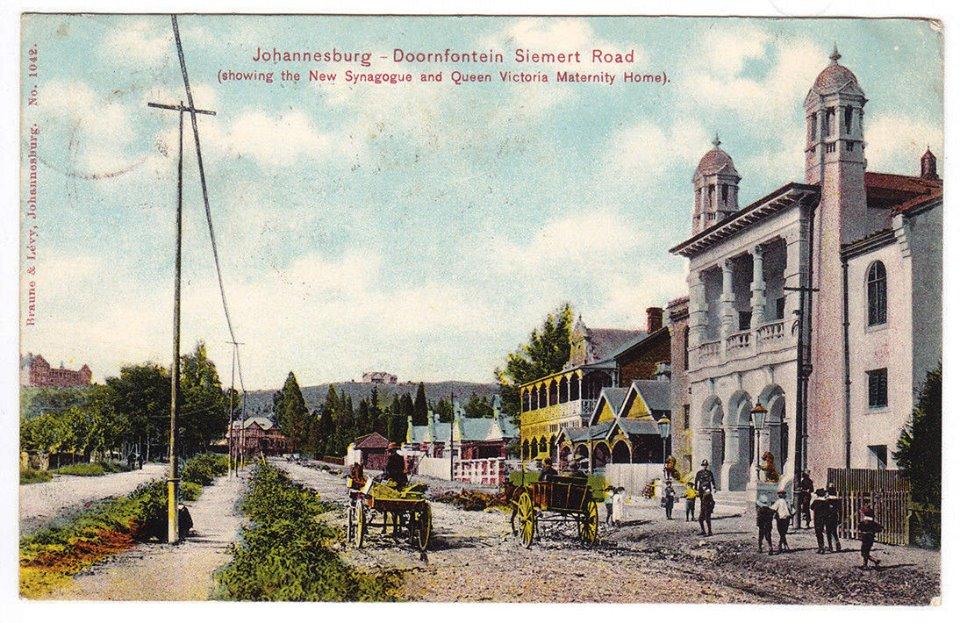
Doornfontein, Siemert Road, Johannesburg, 1905. Public domain.
Johannesburg and the Apostolic Faith Mission · Story · Featured Study
John G. Lake in South Africa
Lake's letters, the minutes of the Apostolic Faith Mission and the charges of Barry Morton give three accounts of his five years.
- Where
- Johannesburg, Doornfontein, Wakkerstroom
- Who
- John G. Lake, Thomas Hezmalhalch, Pieter le Roux, Daniel Nkonyane
- When
- Five years to February 1913
Lake wrote to Sister Smock, “Johannesburg is unquestionably the greatest field for missionary work in the known world.”
Is any one of you sick? He should call the elders of the church to pray over him and anoint him with oil in the name of the Lord.
Summary
John G. Lake, an American from Zion City, reached Johannesburg by May 1908. The Apostolic Faith Mission grew from his party and from the Zionists there.
- White seekers crowded black worshippers out of the first meetings, Lehman wrote.
- The minutes separated baptism by race within months.
- One of the party said that healing reports were exaggerated.
- Barry Morton calls Lake a fraud, and Marius Nel grants part of the case.
The Texts of Healing and the Line
Healing and baptism are the two matters on which the Mission's record turns.
The party's letters speak of the sick, and the minutes set rules for the water.
they will pick up snakes with their hands, and if they drink any deadly poison, it will not harm them; they will lay their hands on the sick, and they will be made well.”
This verse promises what the movement practised on the sick.
Mark 16:18BSB
There is neither Jew nor Greek, slave nor free, male nor female, for you are all one in Christ Jesus.
This verse states the oneness in Christ against which the Mission's minutes on separate baptism are read.
What Each Telling Says
On five questions the record of Lake's own years stands beside what was printed long after his death.
The early record and the later tellings on five questions.
| The question | The early record | The later telling | What the sources show |
|---|---|---|---|
| What was Lake before Africa? | “A business man in Chicago and making good money” (The Pentecost) | $100,000 in the bank and a seat on the Board of Trade (Liardon and Reidt, as Morton quotes them) | Morton finds him in no Chicago directory of 1905 to 1907 and no Board of Trade record |
| When were the first services? | Lake's letter of 30 May already has services twice a day | 25 May, the Mission's birthdate by tradition | Lake's letter fits a first service on 25 May ill, and it stands with Nel's account that the Zionist assembly invited him to preach that day |
| Where were they? | A native church (Lake, Kerr, Lehman), which Lake says the Congregational American Mission owned and Kerr places in Doornfontein | A Zionist assembly (Nel, 2015; Kgatle), or the Bree Street Tabernacle (Nel, 2005) | The three witnesses agree on a native church |
| The size of the work | 500 ministers, 350 of them black, by Lake's count of 1911 as Mofokeng and Madise cite it | 1,250 part-time preachers, 625 congregations and 100,000 converts at his leaving (Copeland, 1994, as Nel cites it) | De Wet calls Lindsay's 125 white and 500 black assemblies “a little exaggerated” |
| When was the Mission founded? | The trustees' minute book begins in the first year | Registration was decided on 2 August 1913 (De Wet) | The founding stands in the first year by tradition, and the registration later |
From Indianapolis to Doornfontein
The party's letters of May and June reached The Pentecost by August.
Lake was born on 18 March 1870 at St Mary's, Ontario. At Zion City, Dowie's town in Illinois, his allegiance went to Charles Parham in late 1906, Morton writes. Thomas Hezmalhalch had been at Los Angeles and wrote from Zion City by the middle of 1907.
The Pentecost says they were to leave about the first of April, and De Wet has them leave in April. The Pentecost counts thirteen in the party, and Morton and De Wet count seventeen. Lake wrote that his tickets were given and that he left with $3.50, and that a passenger handed him 40 pounds at Cape Town.
An American woman met him off the train at Johannesburg with a furnished house, he wrote, and Morton reads that as arranged beforehand.
His letter of 30 May says that on the Sabbath before five hundred were present and “two hundred and fifty broke out in prayer aloud”. W. J. Kerr's report of 1908 also has the first meetings in “a little Native Church in Doornfontein”.
By 8 June they had been offered the Zion Tabernacle, which became the Bree Street Central Tabernacle and the Mission's headquarters for five years. The first minute is headed Trustees of the Apostolic Faith Mission, on 17 September. Hezmalhalch was its first president and Lake its vice-president, De Wet writes.
Lake's wife Jennie died on 23 December by De Wet's account, and Nel notes that some sources put it later.
The Zionists Already There
The Zionist work had reached Wakkerstroom before Lake, and its people would not give up the name.
Johannes Büchler was Dowie's first agent, from 1897, and Daniel Bryant followed him, landing at Durban on 22 April 1904, De Wet writes. Pieter le Roux, a Dutch Reformed missionary at Wakkerstroom, taught healing with Büchler, was warned by Andrew Murray and resigned in March 1903.
The number who left with him is printed as 500 by De Wet, as 400 by the Dictionary of African Christian Biography and as about 150 by Kgatle. Bryant baptized at Wakkerstroom in 1904, 141 by Nel's count and 27 Africans by Lukhaimane's as Kgatle quotes it.
Le Roux came to Lake within weeks and joined him. The compromise was “The Zion Branch of the Apostolic Faith Mission”, Nel writes. Nel and De Wet give no count of the Africans who moved over.
Daniel Nkonyane, who held the Wakkerstroom work, left in 1910 and founded a church of his own. Nel has the earliest recorded secession in 1917, when Elias Mahlangu founded the Zion Apostolic Church, and Kgatle dates the Mahlangus to about the year of Nkonyane's leaving. Nel writes that Engenas Lekganyane's Zion Christian Church seceded from Lion's church around 1925.
The Charges
A healing report, a court case and the Executive's minutes each bear on Lake's word.
A subheading in J. O. Lehman's healing report of the party's first December reads “No Exaggeration”. In January 1909 Louie Schneiderman of the party resigned over “very sad exaggerations in cases of healing”. Morton and Nel both quote the council's minute of 22 January, which found “only too much truth in the letter”. The council resolved “to admit to the public that many mistakes had been made”, as Nel quotes it.
Lake reported that month that he and his fellow workers had been asked to oversee thirty-five thousand native people and five thousand Dutch and Germans in one locality. Confidence said that December that it had withheld “the charges made against Mr. Lake, as we had no opportunity of hearing both sides”, and that G. D. Studd now wrote that Lake had satisfied friends in America that he would keep clear of those things.
In court in November 1910 Hezmalhalch said a man named Bowie was charged because he had facts “that Lake did not want to come before the congregation”, as Morton quotes the Rand Daily Mail. Hezmalhalch lost his office by March 1911. Morton grants that he “was given several opportunities” to bring evidence and failed to do so, and he writes that Lake was “eventually exonerated by his hand-picked AFM leadership”.
Lake left for America after five years and never came back, and De Wet, Nel and Morton give no witness's reason. Le Roux became president that November. Morton writes that Lake later claimed over 100,000 healings at Spokane and elsewhere and was arrested in 1921 over securities. Lake died at Spokane on 16 September 1935.
The Colour Line in the Minutes
The minutes moved from mixed baptisms to separate ones within fifteen months.
The first months' baptisms were mixed, Kgatle writes from Horn. That September Lake asked for a place in Doornfontein especially for the coloured people, and De Wet writes that its lease closed the back doors, the water and the latrines to them. On 6 November the trustees “decided that the baptism of Natives shall in future take place after the baptism of the white people”, De Wet quotes.
The next February the Executive required a white superintendent over the black work. On 30 July the Executive wrote, “In future, the baptism of Whites, Coloured and Natives shall be separate”, as Nel quotes it.
Mofokeng and Madise write that from 1917 to 1961 the mission's governing council was whites only.
How the Key Verse Was Taught
Three writers of three eras on the elders, the oil and the sick.
Bede (died 735)
Commentary on the Catholic Epistles
Bede saw the apostles' practice carried on in the church of his day.
“We read that the apostles did this in the Gospel, and now the custom of the Church holds that the sick are anointed with consecrated oil by the presbyters, and are healed with accompanying prayer.”
Patristic
John Wesley (1703 to 1791)
Explanatory Notes upon the New Testament
John Wesley set the verse against extreme unction as a rite of cure.
“This was the whole process of physic in the Christian church, till it was lost through unbelief. That novel invention among the Romanists, extreme unction, practiced not for cure, but where life is despaired of, bears no manner of resemblance to this.”
on James 5:14Evangelical
Smith Wigglesworth (1859 to 1947)
Ever Increasing Faith, Chapter 5: "I Am the Lord That Healeth Thee"
Smith Wigglesworth, who preached in Lake's generation, left the outcome with the Lord.
“If you are sick, your part is to call for the elders of the church. It is their part to anoint and pray for you in faith, and then the whole situation rests with the Lord.”
on James 5:14 to 15British Pentecostal
In Their Own Words
Lake, Lehman and Hezmalhalch, in letters that their American papers printed the same year.
John G. Lake (1870 to 1935)
Letter in The Pentecost
A native tabernacle
“My heart was drawn out toward the native work very intensely and the Lord at once opened a native tabernacle, the property of the Congregational American Mission where we have held services twice a day.”
Pentecostal
About this saying1 paragraph
In 1908 this was how the native work opened, as he told it.
John G. Lake
A Call for Helpers, in The Pentecost
In the compounds
“They live in the compounds and on any Sunday forenoon you can address 2500 natives in most of the compounds.”
Pentecostal
About this saying1 paragraph
Lake wrote this of the men in the mine compounds, in a letter asking for helpers in 1908.
J. O. Lehman
Letter in The Pentecost
Crowded out
“We began our first continued meetings in the colored church, and notwithstanding the prejudice that exists with the white people against the natives, when God began to work the white people came in such crowds that the natives became timid and were crowded out.”
American Pentecostal missionary to South Africa
About this saying1 paragraph
Lehman, who had spent five years in Johannesburg before this, wrote this on 8 June 1908.
Thomas Hezmalhalch
Letter in The Latter Rain Evangel
The Native Hospital
“I have just left the Native Hospital after having prayed with twenty-one patients.”
American Pentecostal missionary to South Africa
About this saying1 paragraph
Hezmalhalch wrote this from Natal on 26 August 1908.
Where Scholars Disagree
South African scholars and Lake's critic differ on his honesty, on whose church it was and on who drew the line.
Fraud, or a real work?2 paragraphs
Barry Morton holds that “the initial spread of Pentecostalism and Zionism in southern Africa was facilitated by the systematic use of fraud and deception”. He holds the business story against the census of 1900, which has Lake a carpenter, and he sets the council's minute and Hezmalhalch's testimony beside it. He writes that exorcisms at Zion City in 1907 killed at least three, grants that Lake and Hezmalhalch were not directly involved, and reads their leaving as flight. He states that he begins as a materialist and that every miracle Lake claimed is bogus.
Marius Nel grants “valid points of criticism” and concerns about Lake's integrity. He answers that Morton's presuppositions preclude miracles, that the deaths gave no ground for flight, that Morton's Tribune citations of 1900 do not serve, and that the reports Morton cites from co-workers are not extant. Morton replies with the Tribune of 21 September 1907. Nel prints the same minute as the church correcting itself. C. R. de Wet, an Apostolic Faith scholar writing before Morton, allows that many reported healings could be exaggerated and would not stand testing, and that their effect on the black community was great.
Whose church was it?2 paragraphs
The Mission's tradition, through Burger and De Wet, dates its birth from Lake's party, and its minute books begin with the Americans.
M. S. Kgatle argues that “there was already a group of Black Zionists” at Wakkerstroom, and that this congregation gave birth to the Mission.
Who drew the line?2 paragraphs
De Wet writes, “That Lake was a proponent of racial segregation is clear”. Kgatle writes that it is “possibly correct to conclude that the pioneers deviated from non-racialism because of white racist pressure rather than theological conviction”. Through Horn, he notes that Afrikaans-speaking brothers joined the council at the end of 1908.
The stories of Lake embracing Elias Letwaba come from Burton (1934), whom Morton follows, and Copeland (1994), whom Nel follows.
Books to Read Next
The Apostolic Faith Mission in Africa 1908-1980
C. R. de Wet · 1989
De Wet's Cape Town thesis reads the Mission's minutes from the first year.
Read De Wet free at the University of Cape TownYes, John G Lake was a Con Man
Barry Morton · 2017
Morton sets out his charges and answers Nel.
Read Morton free at Studia Historiae EcclesiasticaeJohn G. Lake as a Fraud, Con Man and False Prophet
Marius Nel · 2016
Nel answers Morton and grants part of his case.
Read Nel free at Studia Historiae EcclesiasticaeWhat Lake Left
The Mission he helped to start outlived his five years in it, and so did the churches that left it and its colour line.
Sources
Scripture is the Berean Standard Bible.
- The Holy Bible, Berean Standard Bible (read 2026)
- The Pentecost (Indianapolis, edited by J. R. Flower), volume 1, numbers 1 and 4, August and December 1908.
- The Latter Rain Evangel (Chicago), November 1908.
- Confidence (Sunderland), February, March and December 1909.
- C. R. de Wet, The Apostolic Faith Mission in Africa 1908-1980 (PhD, University of Cape Town, 1989)
- Barry Morton, "The Devil Who Heals", African Historical Review 44(2), 2012, pages 98 to 118.
- Barry Morton, "Yes, John G Lake was a Con Man", Studia Historiae Ecclesiasticae 43(2), 2017.
- Marius Nel, "PL le Roux, Dutch Reformed missionary, Zionist preacher", Studia Historiae Ecclesiasticae 31 (2005)
- Marius Nel, "Remembering and commemorating the theological legacy of John G. Lake", Studia Historiae Ecclesiasticae (2015)
- Marius Nel, "John G. Lake as a fraud, con man and false prophet", Studia Historiae Ecclesiasticae 42(1), 2016.
- M. S. Kgatle, "Zionism and Pentecostalism: Black Zionist Roots in the AFM of SA", Studia Historiae Ecclesiasticae, and his article in Verbum et Ecclesia.
- The Apostolic Faith (Los Angeles), November 1906 and February and June 1907.
- "Pieter Louis le Roux", Dictionary of African Christian Biography.
- M. S. Kgatle, "Pentecostal Experiences in the Ministry of Ignatius (Engenas) Lekganyane", Studia Historiae Ecclesiasticae.
- Barry Morton, "Elias Letwaba, the Apostolic Faith Mission, and the Spread of Black Pentecostalism in South Africa".
- Bede, Commentary on the Catholic Epistles; John Wesley, Explanatory Notes upon the New Testament (1755); Smith Wigglesworth, Ever Increasing Faith (1924)
- Mofokeng and Madise, "The Evangelicalisation of Black Pentecostalism in the AFM", Studia Historiae Ecclesiasticae.
Keep Studying
People and groups7
Subjects1