
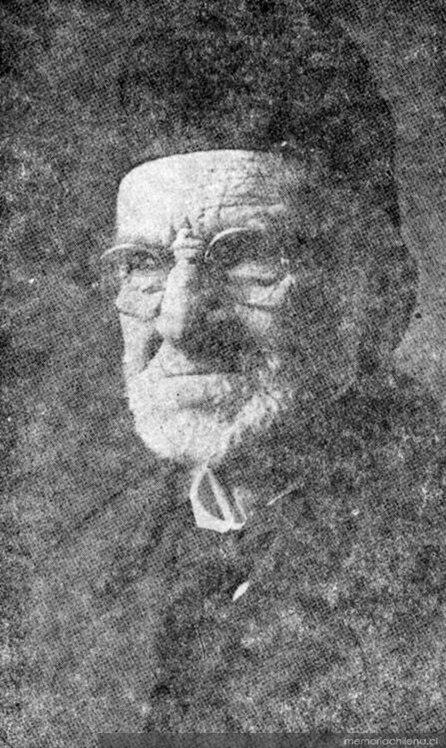
Unknown photographer, Willis C. Hoover, about 1920. Public domain.
1906 to 2010 · Subject · Featured Study
The Pentecostal South
The Pentecostals of Brazil were counted in millions within sixty years of their founding, and each count was made by a different body.
More than half of the Methodist congregation at Valparaíso went with Willis Hoover when he left to form a new church.
This promise belongs to you and your children and to all who are far off—to all whom the Lord our God will call to Himself.”
This promise belongs to you and your children and to all who are far off—to all whom the Lord our God will call to Himself.”
- Books
- Acts, Revelation
- Hold in memory
- Acts 2:39, Revelation 7:9
Summary
The movement in South America had two roots. One was a split in a Methodist church, and the other was two Swedish missionaries. Churches, scholars and research centres have each counted its growth in their own way.
- Hoover's group in Chile broke away as its own church.
- The Assemblies of God of Brazil began at Belém.
- In 1969 Walter Hollenweger put Brazil's Pentecostals at about four million.
- In 2010 the Pew Research Center put the world's pentecostal Christians at about 279 million.
The Promise to All Who Are Far Off
Three verses on the reach of the Spirit's promise.
Peter told the crowd at Pentecost that the promise of the Spirit was for their children and for those far away. The Lord had named the ends of the earth, and John saw the nations before the throne.
The reach of the promise
But you will receive power when the Holy Spirit comes upon you, and you will be My witnesses in Jerusalem, and in all Judea and Samaria, and to the ends of the earth.”
The Lord sends His witnesses in the Spirit's power to the ends of the earth.
Acts 1:8BSB
After this I looked and saw a multitude too large to count, from every nation and tribe and people and tongue, standing before the throne and before the Lamb. They were wearing white robes and holding palm branches in their hands.
John's vision of the nations before the throne is the end toward which the promise reaches.
The Counts in Order, 1906 to 2010
Seven counts, from a mission paper to a world estimate.
The counts run from seventeen founders at Belém to an estimate of 279 million pentecostal Christians in 2010, each made by a different body.
- Something like 13,000 had received the gospel in five years1906The Azusa mission's paper, The Apostolic Faith, with no method given
- Seventeen founders of the Assembleia de Deus at Belém1911Emilio Conde, writing in 1960
- Seven thousand on the Belém church's roll1955Conde, from the church's own figures
- About four million Pentecostals in Brazil, about seventy percent of its Protestants1969Walter Hollenweger, naming no counting body
- Fourteen percent of the people of Chile1969Hollenweger, with no year of count
- Twenty-four million Pentecostals in Brazil2006The World Christian Database, as a church news item of 2009 reports it
- About 279 million pentecostal and 305 million charismatic Christians2010The Pew Research Center in 2011, on the estimates of the Center for the Study of Global Christianity
A timeline of the counts, each row naming who made it and how.
The Pentecostal churches' own page sets out their bodies and statements of faith.
Chile and Brazil: From a Congregation to Two Churches
How the Methodist Pentecostal Church and the Assembleias de Deus began.
The Methodist board's report for 1910 dates Hoover's withdrawal from its ministry to 1 April and calls the body he formed an independent church.
J. B. A. Kessler's table of the Chilean churches, printed in 1967, names it the Iglesia Metodista Pentecostal. His table also records a Pentecostal separation from the Methodist churches of Santiago in 1909, and a division in 1933 that formed the Iglesia Evangélica Pentecostal.
Gunnar Vingren and Daniel Berg landed at Belém in November, by Conde's history, and he dates the church's founding there to 18 June of the next year, 1911.
Conde dates the Congregação Cristã, the other early Pentecostal church of Brazil, to Louis Francescon's work from 20 April of the year Vingren and Berg landed.
Reading the Counts
The counts differ in whom they count and how they were made.
A church roll counts enrolled members of one congregation or body. A scholar's figure may name no source, and Hollenweger's for Brazil names none.
The Pew figures set pentecostal and charismatic Christians apart, and both are estimates. No total is drawn here from figures made by different bodies in different years.
In Their Own Words
Willis Hoover told the revival at Valparaíso and the new church in The Latter Rain Evangel of April and July 1911.
Willis Collins Hoover (1858 to 1936)
"The Wonderful Works of God in Chili", The Latter Rain Evangel (1911), April, the section The Droppings
Visions and dreams
“The people began to laugh, to see visions, to dream dreams.”
Methodist Pentecostal pastor in Chile
About this saying1 paragraph
Hoover wrote this in April 1911 of the all-night meetings at Valparaíso in the first half of 1909.
Willis Collins Hoover
"The Wonderful Works of God in Chili", The Latter Rain Evangel (1911), April, the section The Shower
More than one hundred
“In the course of about three months, more than one hundred fell to the floor under the power of the Spirit, nearly half of them speaking in tongues.”
Methodist Pentecostal pastor in Chile
About this saying1 paragraph
Later in the April article he counted those who fell under the power of the Spirit in 1909.
Willis Collins Hoover
"The Wonderful Works of God in Chili", part two, The Latter Rain Evangel (1911), July, page 21
The church of my birth
“So I resigned from the church of my birth and choice, and remained with the congregation which God had used me to lead to a living faith in the whole Word of God, and on May 1st we formed an independent, self-supporting body; the third in point of time of separation, but first as being, humanly speaking, the origin of the movement, largest numerically, and having an ordained minister.”
Methodist Pentecostal pastor in Chile
About this saying1 paragraph
He told his break with the Methodist Episcopal Church in 1910 in part two of the article, printed in July 1911.
Willis Collins Hoover
"The Wonderful Works of God in Chili", part two, The Latter Rain Evangel (1911), July, page 23
The first year apart
“We have received approximately one hundred and fifty new members on probation in the year of our separate life.”
Methodist Pentecostal pastor in Chile
About this saying1 paragraph
In July 1911 he gave this count of the new church's first year.
Books to Read Next
A Study of the Older Protestant Missions and Churches in Peru and Chile
J. B. A. Kessler Jr. · 1967
Kessler tells the Methodist mission in Chile, Hoover's church and its divisions.
Free at the Internet ArchiveHistória das Assembléias de Deus no Brasil
Emilio Conde · 1960
Conde tells the history of the Assembleias de Deus from its founding to 1960, in Portuguese.
Free at the Internet ArchiveAnnual Report of the Board of Foreign Missions for 1910
The Methodist Episcopal Church · 1910
The board surveys each of its mission fields, Chile among them.
Free at the Internet ArchiveWhat the South Shows
Two Pentecostal churches of South America began, one from a divided congregation and one from two missionaries. Each figure for what grew from them is read with its maker and its year.
Sources
Scripture is the Berean Standard Bible.
- The Holy Bible, Berean Standard Bible (read 2026)
- Willis C. Hoover, "The Wonderful Works of God in Chili", The Latter Rain Evangel (Chicago: The Stone Church), April 1911, pages 19 and 20, and part two, July 1911, pages 21 and 23.
- Annual Report of the Board of Foreign Missions of the Methodist Episcopal Church for the year 1910, page 39.
- J. B. A. Kessler Jr., A Study of the Older Protestant Missions and Churches in Peru and Chile (Goes: Oosterbaan and Le Cointre, 1967), the chronological table of Chile.
- Emilio Conde, História das Assembléias de Deus no Brasil (Rio de Janeiro, 1960), in a retyped edition whose page markers are not the printed pages.
- Walter J. Hollenweger, The Pentecostals (Minneapolis: Augsburg, 1972; German edition 1969), pages 64 and 65.
Keep Studying
People and groups4