
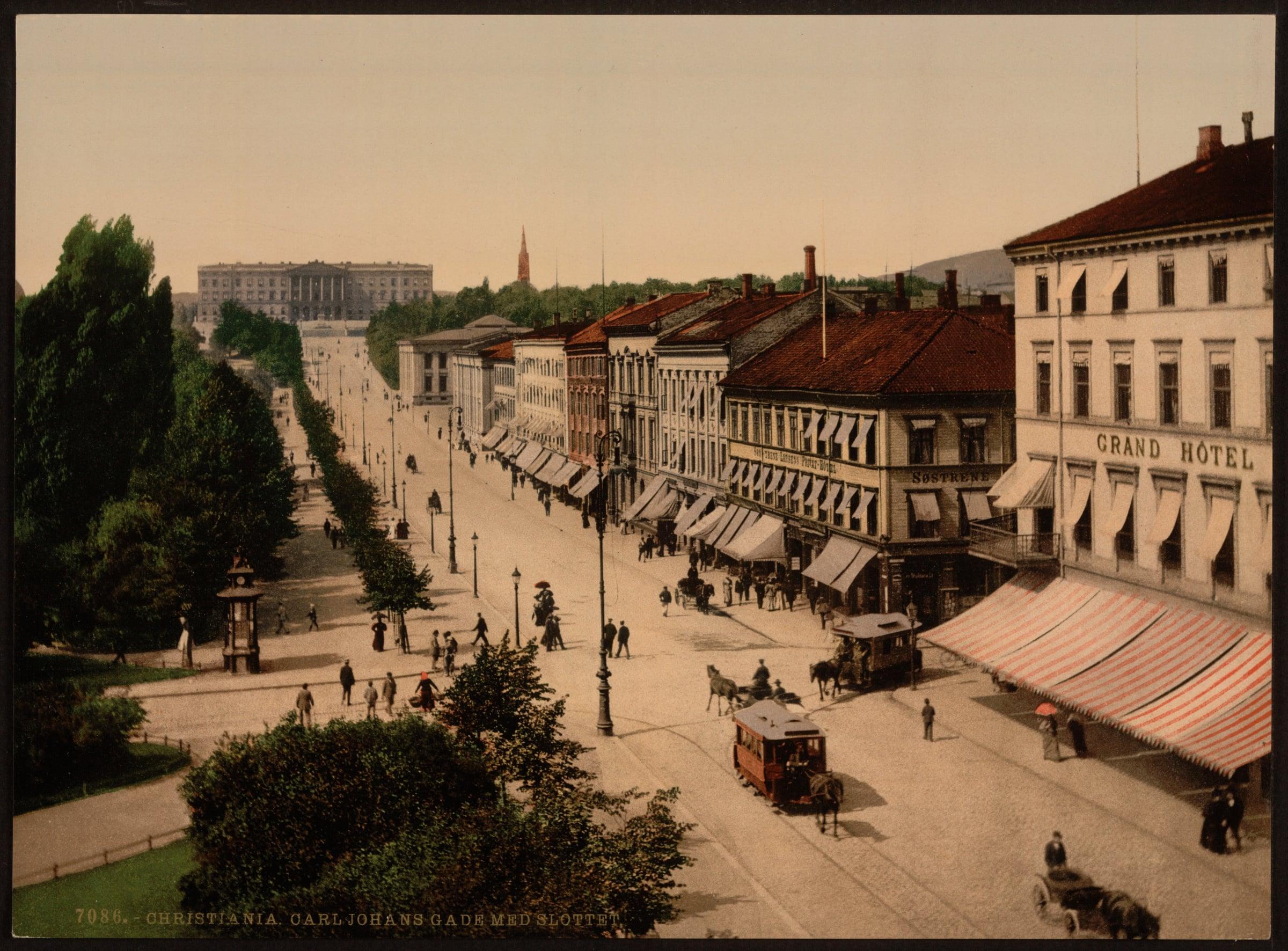
Carl Johans Gade, Christiania, 1890 to 1900. Public domain.
From America to Kristiania · Story · Featured Study
Thomas Barratt and Norway
A Methodist minister's letter to Los Angeles and his meetings at home drew visitors from across northern Europe.
- Where
- New York, Kristiania, Stockholm
- Who
- Thomas Barratt, Lucy Leatherman
- When
- 1906 to 1940
“The fire fell on the 7th of October,” Barratt wrote to his friends in Los Angeles, and then he prayed up to twelve hours a day for the sign.
both Jews and converts to Judaism; Cretans and Arabs—we hear them declaring the wonders of God in our own tongues!”
Summary
Thomas Barratt went to America to raise money for the Kristiania City Mission, in the city now called Oslo. He sailed home speaking in tongues.
- His letter to friends is the nearest account of what happened.
- Maud Williams and Lucy Leatherman laid hands on him in a little hall.
- Pethrus of Stockholm and Boddy of Sunderland came to him within months.
- He left the Methodist Church and later judged a mission board unbiblical.
The Texts of Hands and Witness
Hands were laid on Barratt, and his followers went abroad for decades.
His letter tells of prayer that night for Norway and all Scandinavia.
Then Peter and John laid their hands on them, and they received the Holy Spirit.
Peter and John laid hands on the believers at Samaria, and Barratt asked for the same.
Acts 8:17BSB
But you will receive power when the Holy Spirit comes upon you, and you will be My witnesses in Jerusalem, and in all Judea and Samaria, and to the ends of the earth.”
Lisbeth Mikaelsson writes of Norwegian Pentecostals who spent decades abroad, and this verse sends witnesses to the ends of the earth.
Acts 1:8BSB
Where It Went from Kristiania
Within a year the visitors and the workers had carried the meetings to four countries, and in 1910 missionaries went further.
Visitors came to Barratt, and workers went out from him.
| Place | Who | When | How |
|---|---|---|---|
| Stockholm | Lewi Pethrus | January | He read a Stockholm paper and went to Kristiania the next day, as Stanley Frodsham prints his words |
| Sunderland | Alexander Boddy, then Barratt himself | March and August | Boddy visited, and Barratt came to his parish |
| Copenhagen | Barratt himself | June | He came, and the actress Anna Larssen was converted |
| Hamburg and Kassel | Dagmar Engström and Agnes Thelle | Summer | Workers from Barratt's circle went south |
| India, China, Swaziland and Argentina | Nine missionaries | 1910 | Five women and four men left Norway |
New York, 1906
Barratt told the night himself in a letter to the mission's paper.
Barratt was born in Cornwall on 22 July 1862, and his family took him to Norway as a child. J. M. Lund's biography has him five, and Boddy has him four. He became a Methodist minister and a district superintendent. He founded the Kristiania City Mission and from 1904 published its paper, Byposten.
The collection for a headquarters building went badly. William Kay, reviewing David Bundy, writes that he was “stuck in New York” in a dispute among bishops, and Boddy wrote that “influences from the Los Angeles movement” reached him there.
On 7 October 1906 he felt the fire, and he wrote that he went on to seek the gift of tongues. He dated the night of tongues himself, in 1912, to 15 November.
It came at a meeting in a little hall. Maud Williams, who “got the blessing” in Ontario, laid hands on him, and he lay beside the platform. At about half past twelve he asked a brother and Sister Leatherman to lay hands on him, and he began to shout in what he took for a foreign language.
Nine people stayed until three o'clock, and he went on until four. He wrote that he sang a solo in a pure language and that the words came “like a cataract”.
Lucy Leatherman wrote to the same paper that year. No letter from him stands in the paper's issues of September, October and November.
Kristiania, the First Winter
The meetings filled a gymnasium within weeks, the papers mocked them, and a professor defended them.
He sailed on 8 December on a ship with missionaries bound for Africa. His journal, as Frodsham prints it, has ten who had “received their Pentecost” by 29 December and over twenty by 7 January, and those are his own counts.
On 29 January he wrote that he had held meetings for ten days in a gymnasium that would take “from 1,500 to 2,000 people” when crowded. He was estimating what the room would hold.
Lund writes that the comic papers mocked the meetings and that the newspapers told of fainting, screams and a mighty roar. The church papers warned against excess, and the theology professor Johannes Ording rejected the ecstasy and defended the revival.
Boddy came in March to the upper room at Torvegaden 7 and received a baptism of the Spirit there. Lisbeth Mikaelsson places the revival's centre in that room, in the assembly of the Free Friends.
The Break with the Methodists
Barratt stayed a Methodist for ten years after that night, and the record of any earlier end to his membership is thin.
He founded an alliance assembly at Møllergaten 38 while still a Methodist.
He was baptized as a believer by Lewi Pethrus at Stockholm in 1913, the year Pethrus's church was put out of the Swedish Baptist body. He set a congregational order at Møllergaten in 1916 and left the Methodist Church that year, and the assembly took the name Filadelfia in 1921.
Wikipedia and the Revival Library date an end of his membership to 1909, and Darrin Rodgers of the Assemblies of God says his credentials were revoked. Neither statement comes with a Methodist record.
Free Assemblies and the Mission
Barratt's teaching of the free assembly divided him from the Free Friends and later from his own mission board.
Barratt proposed a national mission at Skien in 1914, and it was founded in 1915 with a council. Many Free Friends were hostile to it, and his order at Møllergaten estranged them further. He came to judge that a mission board with power over the congregations' work was unbiblical, and he and his wife withdrew in 1930.
Of the fifteen Norwegian missionaries the historian Nilsen names for 1910 to 1913, four women married foreign missionaries and dropped from view, and one man died in China. E. N. Bell criticized travelling evangelists of Barratt's kind for not staying with non-Christian peoples.
From India he owned that a prophecy of disaster at Colombo “was a mistake”. Barratt died on 29 January 1940.
How the Key Verse Was Taught
Three writers on the crowd at Pentecost who heard the wonders of God in their own tongues.
John Chrysostom (died 407)
Homily on Acts 4
Chrysostom had the speakers learn the language from the hearers, the reverse of Barratt's judging by sound.
“This nerved the Apostles: for, what it was to speak in the Parthian tongue, they knew not but now learnt from what those said.”
Patristic
Matthew Henry (1662 to 1714)
Commentary on the Whole Bible
Matthew Henry took the subject of the wonders of God to be Christ and redemption.
“It is probable that the apostles spoke of Christ, and redemption by him, and the grace of the gospel; and these are indeed the great things of God, which will be for ever marvellous in our eyes.”
Puritan
John Wesley (1703 to 1791)
Explanatory Notes upon the New Testament
John Wesley read those wonders as the works of Christ and the gift of the Spirit.
“Probably those which related to the miracles, death, resurrection, and ascension of Christ, together with the effusion of his Spirit, as a fulfilment of his promises, and the glorious dispensations of Gospel grace.”
Evangelical
In Their Own Words
Barratt in three letters, and Boddy on him, as the papers of the movement printed them.
Alexander A. Boddy (1854 to 1930)
Letter to the North Mail, reprinted in The Apostolic Faith
His parish
“Eventually he became a missioner of the Methodist Episcopal Church, but he has practically detached himself from many church ties, and the world he feels is his parish.”
Church of England vicar and Pentecostal editor
About this saying1 paragraph
Boddy said this in 1907 of the man whose meetings he had just seen.
Thomas Ball Barratt (1862 to 1940)
Letter in The Apostolic Faith
Seven or eight languages
“I must have spoken seven or eight languages, to judge from the various sounds and forms of speech used.”
Norwegian Methodist minister
About this saying1 paragraph
Barratt wrote this to Los Angeles in 1906 of the night of tongues in New York.
Thomas Ball Barratt
Letter from India in Confidence
Mistakes
“Of course, mistakes have been made here in India as elsewhere.”
Norwegian Methodist minister
About this saying1 paragraph
Barratt answered his critics with this from India in 1908.
Thomas Ball Barratt
Confidence
Still there
“The Fire is still there, and the Tongues as well.”
Norwegian Methodist minister
About this saying1 paragraph
In 1912, six years on, Barratt held to both the fire and the tongues.
Where the Tellings Differ
The later tellings move the night of tongues, and historians question the story of one man.
Where did the night of tongues happen?2 paragraphs
His letter of 1906, the nearest source, puts it in a little hall among friends.
Anne Stensvold has him alone in his room, from his memoirs of 1941, and G. H. Lang, from a tract of Boddy's, says fifteen were present.
Was it one man's story?2 paragraphs
Stanley Frodsham's telling sets Barratt at the head of the Scandinavian movement.
Anne Stensvold calls the story of one man an “emic and biographical narrative”, and she traces the roots to migrant ties with America.
Were they languages?2 paragraphs
Barratt judged them by their sound, and he wrote that some of those spoken at Kristiania were European.
Lang, a hostile witness, answers that “No proof is offered that the sounds were languages”. Neither Barratt nor Lang records a test.
Books to Read Next
Charismatic Christianity in Finland, Norway, and Sweden
Jessica Moberg and Jane Skjoldli, editors · 2018
This open volume sets Barratt among the Free Friends and the mission boards, in chapters by Stensvold and Mikaelsson.
Read the volume free at SpringerThe Apostolic Faith, December 1906
The Azusa Street mission's paper, Los Angeles · 1906
The mission's paper gives his first account in this issue.
Read the paper free at the Flower Pentecostal Heritage CenterWhat Barratt Left
Under Barratt, Filadelfia grew into what Lund calls the largest free-church congregation in Norway.
Sources
Scripture is the Berean Standard Bible.
- The Holy Bible, Berean Standard Bible (read 2026)
- The Apostolic Faith (Los Angeles), September, October, November and December 1906 and February to March 1907.
- Confidence (Sunderland), June 1908, August 1910, November 1912 and February 1914.
- J. M. Lund, "Thomas Barratt", Norsk biografisk leksikon.
- "Thomas Ball Barratt", Store norske leksikon.
- Jessica Moberg and Jane Skjoldli, editors, Charismatic Christianity in Finland, Norway, and Sweden (Palgrave, 2018), chapters by Anne Stensvold and Lisbeth Mikaelsson.
- Stanley Frodsham, With Signs Following (about 1926), the chapter printed by the Revival Library.
- G. H. Lang, The Earlier Years of the Modern Tongues Movement (no date printed)
- William K. Kay, review of David Bundy, Visions of Apostolic Mission (2009)
- Joel Halldorf, Lewi Pethrus romantiska ecklesiologi, Svensk Teologisk Kvartalskrift 91 (2015)
- John Chrysostom, Homily on Acts 4; Matthew Henry, Commentary on the Whole Bible (1710); John Wesley, Explanatory Notes upon the New Testament (1755)
- "Thomas Ball Barratt", Wikipedia, and the Revival Library's page on him.
- "This Week in AG History", the Assemblies of God's news service, 20 October 2017.