
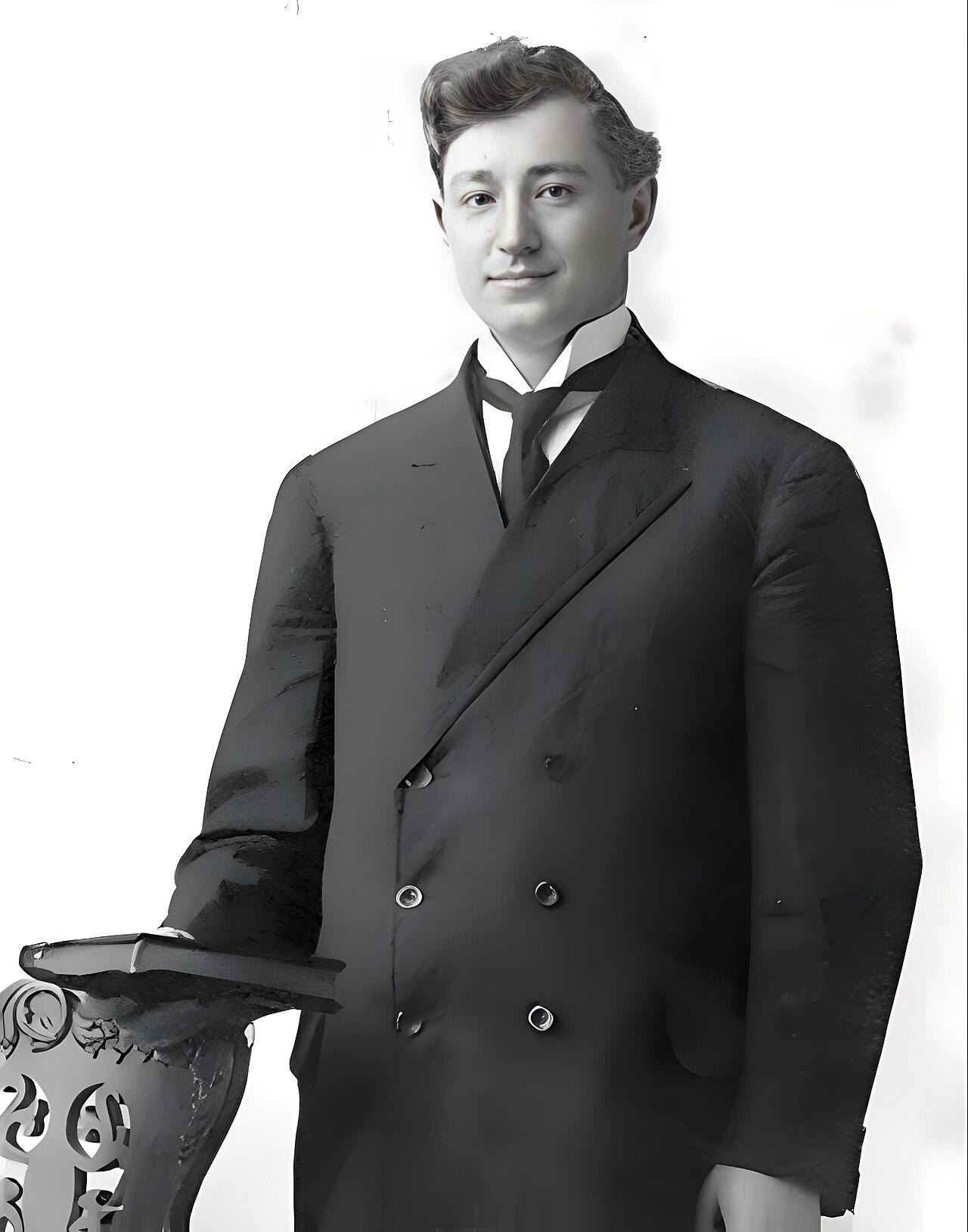
Unknown photographer, Gunnar Vingren, 1908. Public domain.
1906 to 1916 · Subject · Featured Study
The Streams of Pentecost
Pentecostal teaching split into the Holiness, Finished Work and Oneness streams within ten years of Azusa Street.
On 2 May 1911 Frank Bartleman found the doors of the old Azusa Mission locked with chain and padlock against William Durham.
And they were all filled with the Holy Spirit and began to speak in other tongues as the Spirit enabled them.
Summary
Every Pentecostal church teaches a baptism in the Spirit, shown by speaking in tongues. In their first ten years the churches came to differ on two questions. One was sanctification. The other was the name used in baptism.
- The Holiness stream taught that sanctification comes first, before the baptism in the Spirit.
- William Durham preached the Finished Work. He taught that the work of redemption was finished on the cross.
- The Oneness stream traces its start to a camp meeting sermon on baptism in the name of Jesus.
The Family Tree of the First Decade
From the first meetings to the churches of today.
Two roots gave three streams by 1913, and each stream stands in churches with pages of their own.
The roots
- TopekaParham's students settle on tongues as the sign, December 1900
- Azusa StreetSeymour's meetings, from April 1906
The streams
- The Holiness streamThree works of grace
- The Finished Work streamHoliness pursued on the ground of the cross
- The Oneness streamBaptism in the name of Jesus
The churches
- The Church of God in ChristHoliness stream
- The Church of God (Cleveland)Holiness stream
- The Assemblies of GodFinished Work stream
- The Oneness churchesOneness stream
A tree in three generations, each church a door to its own page.
The Pentecostal churches' own page tells the movement's beginnings, statements and counts at length.
The Holiness Stream: Three Works of Grace
The Azusa mission and the Holiness churches that received its message kept sanctification as a second work.
The creed the Azusa mission printed in 1906 named justification the first work of grace and sanctification the second. It set the baptism with the Holy Ghost upon the sanctified life.
Holiness churches that already taught a second work took the baptism as a third experience. Charles H. Mason of the Church of God in Christ received it at Los Angeles in March 1907, by his own account in the church's book of 1920.
G. B. Cashwell, a preacher from Azusa Street, preached on the baptism in the Spirit at the Church of God's third General Assembly in January 1908, by the account of the Church of God of Prophecy.
The Finished Work and the Oneness Question
Durham preached a finished work, and the Assemblies of God later divided over the Oneness question.
William Durham came from Chicago and began meetings at the old Azusa Mission in February 1911, while Seymour was in the east. Frank Bartleman, who was there, writes that the crowds came back to the mission.
Seymour, back from the east, and his trustees shut Durham out, and Durham moved his meetings to a building at Seventh and Los Angeles Streets.
Durham's message, as Bartleman gives it, was that the work of redemption was fully accomplished on the cross. The Assemblies' Statement of 1916 later set entire sanctification as a goal to pursue.
About 300 men and women formed the Assemblies of God at Hot Springs, Arkansas, in April 1914. Darrin Rodgers, the fellowship's archivist, writes that most of its founders held the Finished Work view.
R. E. McAlister told a baptismal service at a camp meeting at Arroyo Seco in April 1913 that the apostles baptized in the name of Jesus. Frank Ewart began about a year later to teach baptism in that name alone.
The Assemblies' Statement of Fundamental Truths of 1916 confessed the Trinity. Rodgers writes that it resulted in the departure of the Oneness ministers.
In Their Own Words
William J. Seymour (1870 to 1922)
"The Precious Atonement", The Apostolic Faith 1:1, in the Apostolic Faith Church's transcription of the article signed W. J. Seymour
Seymour asked the messengers to preach all of the atonement.
“We that are the messengers of this precious atonement ought to preach all of it, justification, sanctification, healing, the baptism with the Holy Ghost, and signs following.”
Pentecostal
About this saying1 paragraph
Seymour wrote this in The Apostolic Faith of 1906, listing the teachings a messenger should preach.
Frank Bartleman (1871 to 1935)
How Pentecost Came to Los Angeles (1925), on the Azusa Street meetings, found by text search in the 1980 reprint
Bartleman described Seymour at the Azusa meetings.
“Brother Seymour generally sat behind two empty shoe boxes, one on top of the other. He usually kept his head inside the top one during the meeting, in prayer. There was no pride there.”
Pentecostal
About this saying1 paragraph
Bartleman remembered how Seymour sat and prayed through the meetings in his book of 1925.
Charles Harrison Mason (died 1961)
The History and Life Work of Elder C. H. Mason, Chief Apostle, and His Co-Laborers, compiled by James Courts, chapter VII, pages 36 to 37
Mason told how a flame touched his tongue.
“When I opened my mouth to say glory, a flame touched my tongue which ran down in me. My language changed and no word could I speak in my own tongue.”
Pentecostal
About this saying1 paragraph
James Courts printed Mason's own account in chapter VII of the history he compiled in 1920.
Where the Streams Differ
The streams differ on the order of grace and on the Godhead and the baptismal formula.
The two questions of the first decade, with the answer each side gives.
| The question | One answer | The other answer |
|---|---|---|
| Is sanctification a second work of grace before the baptism in the Spirit? | Yes: the Azusa creed of 1906, the Church of God in Christ and the Church of God (Cleveland) | No, it rests on Christ's finished work and is pursued as a goal: Durham, and the Assemblies of God in 1916 |
| In whose name is the believer baptized, and how is God one? | The Father, the Son and the Holy Spirit, one God in three Persons: the Assemblies of God in 1916 | The name of Jesus Christ, the one God revealed as Father, Son and Spirit: McAlister, Ewart and the Oneness churches |
Books to Read Next
How Pentecost Came to Los Angeles
Frank Bartleman · 1925
Bartleman, who took part, tells the Los Angeles meetings from 1906 on.
Free at the Christian Classics Ethereal LibraryA Critical History of Glossolalia
Charles W. Shumway · 1919
Shumway writes as a critic and tells Topeka and the first weeks in Los Angeles from interviews with those present.
Free at the Internet ArchiveSources
Scripture is the Berean Standard Bible.
- The Holy Bible, Berean Standard Bible (read 2026)
- Frank Bartleman, How Pentecost Came to Los Angeles: As It Was in the Beginning (Los Angeles: F. Bartleman, 1925), pages 44, 144, 145 and 146.
- Charles W. Shumway, A Critical History of Glossolalia (thesis, Boston University, 1919), pages 112 to 116.
Keep Studying
People and groups6