
Augustine, Confessions, Books 3 to 9 · Story · Parenting and Its Trials
Monica and Augustine
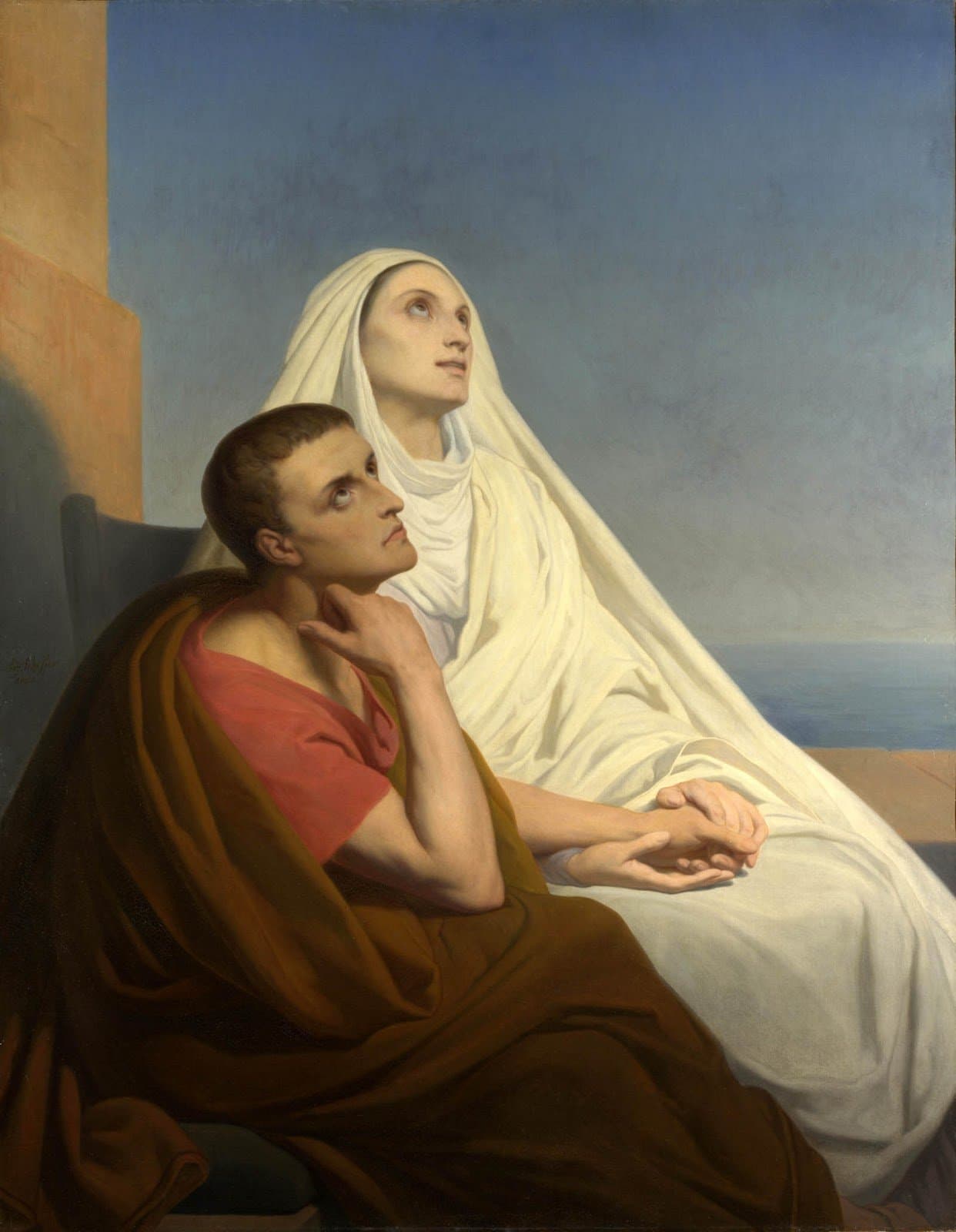
Monica of Tagaste was the mother of Augustine of Hippo, who told her story in his Confessions.
For nearly nine years after his mother's dream, Augustine wrote, he lay in the darkness of falsehood while she kept praying for him.
Instead, clothe yourselves with the Lord Jesus Christ, and make no provision for the desires of the flesh.
- Where
- Milan
- Who
- Augustine of Hippo
- When
- Augustine's conversion at Milan in September 386 and Monica's death at Ostia in the autumn of 387
Summary
Monica's hopes for her son were answered slowly, by way of a dream, a bishop's counsel, a long separation and at last an hour in a garden at Milan. Augustine set her life inside his confession to God, so the reader meets her through the son she prayed for. What she said and did stands in his words.
- Monica was born of Christian parents at Tagaste in North Africa (Catholic Encyclopedia, 1911).
- At Milan Monica heard Ambrose preach, and Augustine writes that “she loved that man as an angel of God” (Confessions 6.1).
- Monica died in the fifty-sixth year of her age, when Augustine was in his thirty-third (Confessions 9.11).
The Son of These Tears
Augustine begins his mother's part in the story with her weeping.
Monica and Augustine is a story of the trial of parenting from the history of the church. It asks what a believing mother did through the years her son spent far from the faith, and what came of her prayers, as the son himself tells it.
The study follows Augustine's own account in his Confessions, in J. G. Pilkington's translation of 1887, from his student years at Carthage to his mother's death at Ostia. It sets the dated events in order from the Catholic Encyclopedia, and it lets Augustine tell in his own words what his mother said and did.
At Carthage Augustine fell into the errors of the Manichaeans (Confessions 3).
Of that time he wrote to God that “my mother, Your faithful one, wept to you on my behalf more than mothers are wont to weep the bodily death of their children” (Confessions 3.11).
From Tagaste to Ostia
The Confessions give no years, and the Catholic Encyclopedia supplies them.
Monica lived to see her son's conversion and baptism and died within months of them.
- 13 November 354Augustine is born at TagasteCatholic Encyclopedia (1907)
- Toward the end of 370Augustine reaches Carthage as a studentCatholic Encyclopedia (1907)
- 383Augustine embarks for Italy by night, leaving his mother on the shoreCatholic Encyclopedia (1907); Confessions 5.8
- September 386Augustine is converted in the garden at MilanCatholic Encyclopedia (1907); Confessions 8.12
- Easter 387Ambrose baptizes Augustine at MilanCatholic Encyclopedia (1907); Confessions 9.6
- Autumn 387Monica dies at OstiaCatholic Encyclopedia (1907 and 1911); Confessions 9.11
A timeline of six dated events from Augustine's birth to Monica's death, each with its date and the accounts that give it.
The Dream and the Bishop
Confessions 3.11 and 3.12 record two answers Monica received while her son was still a Manichaean.
Augustine tells that his mother dreamed she stood grieving on a wooden rule, and a bright youth asked the cause of her daily weeping (Confessions 3.11).
The youth told her to look and see that where she was, there her son was also.
Augustine tried to read the dream the other way, that she would one day be what he was.
She answered at once, “No; for it was not told me that 'where he is, there shall you be,' but 'where you are, there shall he be'”.
She begged a bishop to reason with her son, and he refused (Confessions 3.12).
He told her to “leave him alone for a time” and “only pray God for him”, for her son would find out his error by reading.
When she pressed him again with tears, the bishop said, “Go your way, and God bless you, for it is not possible that the son of these tears should perish”.
Augustine writes that she took the answer “as though it were a voice from heaven”, and that she often spoke of it to him afterward.
Over Sea and Land
Augustine left his mother at the shore, and she came after him.
When Augustine resolved to teach at Rome, his mother went with him to the sea and tried to hold him back (Confessions 5.8).
He told her he must wait for a friend to sail, and that night he left while she was praying at an oratory in memory of Cyprian.
He confesses it plainly: “And I lied to my mother”.
She followed him “over sea and land”, Augustine writes, and on the voyage she comforted the sailors themselves, because she had been assured of a safe arrival in a vision (Confessions 6.1).
He told her he was no longer a Manichaean, though not yet a Catholic Christian (Confessions 6.1).
She answered, as he records, that “She believed in Christ, that before she departed this life, she would see me a Catholic believer”.
And the dead man sat up and began to speak! Then Jesus gave him back to his mother.Augustine wrote that his mother carried him forth upon the bier of her thoughts like the widow's son, waiting for Christ to give him back to her.
Take Up and Read
Confessions 8.12 tells the hour of Augustine's conversion and his mother's joy.
Weeping under a fig tree in the garden, Augustine heard a child's voice from a neighbouring house chanting, “Take up and read; take up and read”.
He opened the book of the apostle at Romans 13:13 to 14 and wrote, “No further would I read, nor did I need”.
Let us behave decently, as in the daytime, not in carousing and drunkenness, not in sexual immorality and debauchery, not in dissension and jealousy.The verse named the life Augustine had not been able to leave, and the next verse told him what to put on instead.
He and his friend Alypius went in to Monica and told her (Confessions 8.12).
Augustine writes that “she leaps for joy, and triumphs, and blesses You”, since God had given her more than she used to ask.
He saw her dream fulfilled, for he was now “standing in that rule of faith” on which she had seen him years before.
His later teaching on humility, in a letter of 410 to a student, is studied in Augustine's Three Answers.
At the Window in Ostia
Confessions 9.10 to 9.13 record Monica's last days and her son's request for her.
Resting at Ostia before the voyage to Africa, mother and son stood alone at a window over the garden of the house and spoke together of the eternal life of the saints (Confessions 9.10).
Then, Augustine records, she said, “Son, for myself, I have no longer any pleasure in anything in this life”.
She went on, “There was indeed one thing for which I wished to tarry a little in this life, and that was that I might see you a Catholic Christian before I died”.
A few days later she fell ill with fever (Confessions 9.11).
She said to Augustine and his brother, “Lay this body anywhere, let not the care for it trouble you at all. This only I ask, that you will remember me at the Lord's altar, wherever you be”.
Augustine ends Book 9 by asking all who read the Confessions to “remember Monica, Your handmaid, together with Patricius, her sometime husband” at the altar of God (Confessions 9.13).
Sources
Scripture is the Berean Standard Bible.
- Augustine of Hippo, Confessions, translated by J. G. Pilkington, Nicene and Post-Nicene Fathers, First Series, volume 1, edited by Philip Schaff (Buffalo: Christian Literature Publishing Co., 1887), Books 3, 5, 6, 8 and 9.
- Eugène Portalié, “Life of St. Augustine of Hippo”, The Catholic Encyclopedia, volume 2 (New York: Robert Appleton Company, 1907)
- Hugh Pope, “St. Monica”, The Catholic Encyclopedia, volume 10 (New York: Robert Appleton Company, 1911)
Keep Studying
Studies1
In this trial7
People and groups2
Places1