
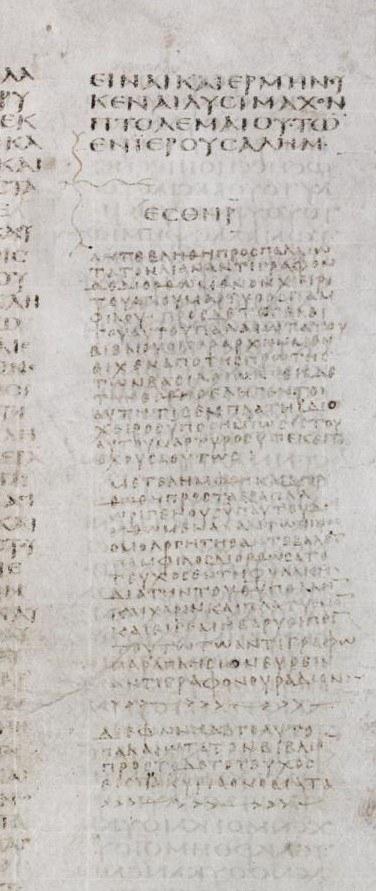
Codex Sinaiticus, fourth century. Public domain.
Additions to Esther 10:4 to 16:24 · Book · Apocrypha, a study resource beside the canon
The Additions to Esther
The Greek text of Esther carries passages the Hebrew book lacks, 105 verses in all.
The Greek Esther opens with a dream of two dragons.
For Mordecai the Jew was second only to King Xerxes, preeminent among the Jews and highly favored by his many kinsmen, seeking the good of his people and speaking peace to all his countrymen.
For Mordecai the Jew was second only to King Xerxes, preeminent among the Jews and highly favored by his many kinsmen, seeking the good of his people and speaking peace to all his countrymen.
- Date
- by its closing note, the fourth year of Ptolemy and Cleopatra, which Gregg reckoned 114 BC (probable)
- Occasion
- The Greek translation of the book of Esther, which its closing note dates.
- Edition
- The Additions to Esther in the King James Version Apocrypha, 1769 text (eBible.org); the Berean Standard Bible for the canon
Summary
The site reads the Additions beside the canon as a study resource and rests no doctrine on them.
- Codex Sinaiticus, a Greek Bible of the fourth century, ends Esther with the note on its translator.
- The King James text has seven chapters, and the first begins at verse 4.
- Gregg's introduction and notes fill pages 665 to 684 of Charles's first volume.
The Additions to Esther
Their chapter numbers continue from the last chapter of Esther.
The English Apocrypha titles them The Rest of the Chapters of the Book of Esther, Which are Found Neither in the Hebrew, nor in the Chaldee.
The site holds the sixty-six books of the Bible as Scripture and quotes the Additions from the King James Version Apocrypha.
Where Each Passage Belongs
Read in the Greek order, the book runs differently from its printed chapters.
Mordecai's dream opens the Greek book, and its meaning closes it.
- Mordecai's dream and the plot he uncoversAdditions to Esther 11:2 to 12:6, before Esther 1:1
- The king's letter against the JewsAdditions to Esther 13:1 to 7, after Esther 3:13
- The prayers of Mordecai and EstherAdditions to Esther 13:8 to 14:19, after Esther 4:17
- Esther before the kingAdditions to Esther 15:1 to 15:16, in the place of Esther 5:1 to 2
- The king's letter for the JewsAdditions to Esther 16:1 to 24, after Esther 8:12
- The dream explained and the closing noteAdditions to Esther 10:4 to 11:1, after Esther 10:3
Each row gives a passage, its chapters, and its place in the Hebrew story.
Where the Additions Came From
The Greek translation carries its own date, which Gregg turned into a year BC.
The last passage ends with a note. It names the fourth year of Ptolemy and Cleopatra, when Dositheus, who called himself a priest and Levite, brought the letter of Purim. It says that Lysimachus son of Ptolemy, of Jerusalem, had translated it (Additions to Esther 11:1).
Gregg introduced the Additions in R. H. Charles's Apocrypha and Pseudepigrapha of 1913. He held that the translation of canonical Esther dates from not later than 114 BC.
Gregg judged that the passages “are not translations, and Greek was their original language”.
Who Receives the Additions
Two rulings, a translator and a printing each gave the passages a place.
Trent and Article VI differ on whether the passages are Scripture.
| When | Who | What they do with the Additions |
|---|---|---|
| In the Vulgate | Jerome, in his Latin translation | sets the passages after the Hebrew book and marks them with an obelus |
| 1546 | The Council of Trent, session 4 | lists Esther among the books received, entire with all their parts |
| 1571 | The Church of England, which wrote Article VI | names The rest of the Book of Esther among the books read for example of life, and not to establish doctrine |
| The 1769 text | The King James Version | prints the passages among the Apocrypha, as chapters 10 to 16 |
So the Additions stand inside the Roman canon by Trent's ruling and outside the Protestant one.
The Voices
Jerome wrote a note on the passages he set apart.
Jerome (died 420)
Jerome wrote that he had expressed what is found in the Hebrew “with complete accuracy”, and that the passages which follow he found in the common edition in the Greek language and letters.
Books to Read Next
Three works on the Additions are free to read.
The Rest of the Chapters of the Book of Esther
The King James translators, the standardized text · 1769
It gives all six passages in the order Jerome left them.
Read it in the readerThe Apocrypha and Pseudepigrapha of the Old Testament, vol. I
R. H. Charles, ed.; the Additions to Esther by Gregg · 1913
Gregg sets out the passages' date, language and purpose, and annotates the text.
Read it free at archive.orgJerome, Notes on the Additions to Esther
Translated by Kevin P. Edgecomb · 2006
It gives his notes in an English translation of 2006.
Read it free at tertullian.orgRead Beside the Canon
A psalm of the return praises the LORD for great things.
The last passage in the Greek order credits God with the deliverance, and the canon answers with a psalm.
The LORD has done great things for us; we are filled with joy.Sources
Scripture is the Berean Standard Bible.
- Additions to Esther, King James Version Apocrypha, 1769 text (eBible.org USFX edition), public domain.
- The Additions to Esther (Gregg), in R. H. Charles (ed.), The Apocrypha and Pseudepigrapha of the Old Testament, vol. I, Oxford, 1913, pp. 665 to 684; public domain.
- Jerome, Notes on the Additions to Esther, translated by Kevin P. Edgecomb, 2006.
- The Council of Trent, session 4, 8 April 1546, tr. J. Waterworth, 1848.
- The Church of England, Articles of Religion, 1571, Article VI.
Keep Studying
Studies2
People and groups4