
Matthew 17:13
in Matthew 17Then the disciples understood that He was speaking to them about John the Baptist.
BSB
The same verse in ASV and KJV ▾
ASV
Then understood the disciples that he spake unto them of John the Baptist.
KJV
Then the disciples understood that he spake unto them of John the Baptist.
⋯
This verse in Matthew 17
Commentary
13 notes on this verseIt is enquired how, seeing that Herod and Herodias were they that killed John, it can be said that Jesus also was crucified by them, when we read that He was put to death by the Scribes and Pharisees? It must be answered briefly, that the party of the Pharisees consented to the death of John, and that in the Lord's crucifixion Herod united his approval, when having mocked and set Him at nought, he sent Him back to Pilate, that he should crucify Him.
This site's exposition
Elias must first come
on Matthew 17:10-13
The disciples' question rests on Malachi 4:5-6, Elijah promised before the great and terrible day of the Lord, and Jesus answers that Elijah has come already in the person of John the Baptist, whom they knew him not, but have done unto him whatsoever they listed, a plain reference to John's execution at Herod's hand. Some commentators read this as a full and complete answer to Malachi's promise; others hold a further literal appearance of Elijah still stands ahead, pointing to the tradition later associated with the two witnesses of Revelation 11. The exposition names both readings, since the disciples' own understanding in verse 13 settles only that John fulfilled the type, not that no future fulfillment remains.
The record, by era
The Church Fathers3 voices
That He says of John, Elias is already come, is not to be understood of the soul of Elias, that we fall not into the doctrine of metempsychosis, which is foreign to the truth of Church doctrine, but, as the Angel had foretold, he came in the spirit and power of Elias.
(Verse 13) And so the Son of Man will suffer at their hands. Then the disciples understood that he was speaking to them about John the Baptist. Now, as Herod and Herodias are said to have killed John, how can they also say that they crucified Jesus, when we read that he was killed by the scribes and Pharisees? The answer is that both the Pharisees were in agreement with the death of John, and Herod willingly participated in the killing of the Lord. He sent him, mocked and despised, to Pilate to be crucified.
A commentator
John ChrysostomHomily on the Gospel of Matthew 57 · Written in the 5th century.
proposed
Not then from the Scriptures did they know this, but the Scribes used to explain themselves, and this saying was reported abroad amongst the ignorant people; as about Christ also. Wherefore the Samaritan woman also said, "Messiah cometh; when He is come, He will tell us all things:" and they themselves asked John, "Art thou Elias, or the Prophet?" For the saying, as I said, prevailed, both that concerning the Christ and that concerning Elias, not however rightly interpreted by them. For the Scriptures speak of two advents of Christ, both this that is past, and that which is to come; and declaring these Paul said, "The grace of God, that bringeth salvation, hath appeared, teaching us, that, denying ungodliness and worldly lusts, we should live soberly, and righteously, and godly." Behold the one, hear how he declares the other also; for having said these things, he added, "Looking for the blessed hope and appearing of our great God and Saviour Jesus Christ." And the prophets too mention both; of the one, however, that is, of the second, they say Elias will be the forerunner. For of the first, John was forerunner; whom Christ called also Elias, not because he was Elias, but because he was fulfilling the ministry of that prophet. For as the one shall be forerunner of the second advent, so was the other too of the first. But the Scribes, confusing these things and perverting the people, made mention of that other only to the people, the second advent, and said, "If this man is the Christ, Elias ought to have come beforehand." Therefore the disciples too speak as follows, "How then say the Scribes, Elias must first come?" Therefore also the Pharisees sent unto John, and asked him, "Art thou Elias?" making no mention anywhere of the former advent. What then is the solution, which Christ alleged? […]
The Medieval Church2 voices
From the mention of His own passion which the Lord had often foretold to them, and from that of His forerunner, which they beheld already accomplished, the disciples perceived that John was set forth to them under the name of Elias; whence it follows; Then understood the disciples that he spake to them of John the Baptist.
Then the effect of this response is presented: then the disciples understood that he had spoken to them of John the Baptist. Then: when the Lord had spoken to them. The declaration of your words gives light and gives understanding to little ones, Psalm 118:130.
6 more voices on this verse
The Medieval Church1 voice
Then the disciples understood that He spake unto them of John the Baptist. Then the disciples became keener in perception and understood that He was calling John Elijah, as John was the Forerunner of the first coming, just as Elijah would be the forerunner of …
The Puritans and the Awakening2 voices
Note, When we return to the world again after an ordinance, it must be our care to take Christ with us, and then it may be our comfort that he is with us. As they came down, they talked of Christ. Note, When we are returning from holy ordinance, it is good to entertain ourselves and one another with discourse suitable to the work we have been about.
Then the disciples understood,....
The Nineteenth Century3 voices
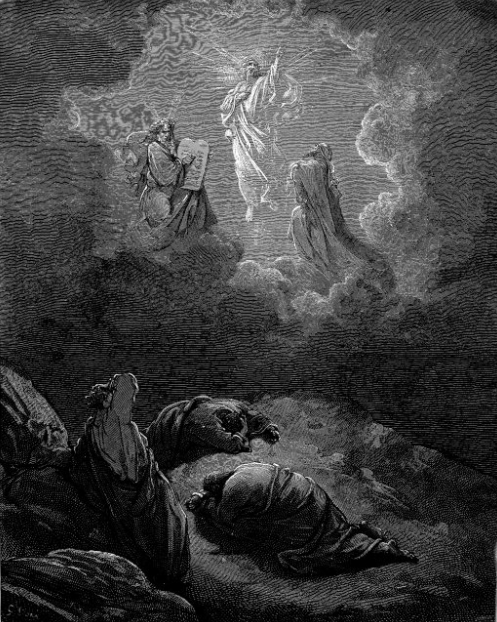
Then the disciples understood - When he spoke of the sufferings of this prophetic Elijah, and also of his own, which had been the subject of the conversation on the mount, during the transfiguration, they clearly apprehended that he spoke of John the Baptist.
These verses contain one of the most remarkable events in our Lord’s earthly ministry, the event commonly called the transfiguration. The order in which it is recorded is beautiful and instructive. The latter part of the last chapter showed us the cross; here we are graciously allowed to see something of the coming reward. The hearts which have just been saddened by a plain statement of Christ’s sufferings are at once gladdened by a vision of Christ’s glory. Let us mark this. We often lose much by not tracing the connection between chapter and chapter in the Word of God.
These verses contain one of the most remarkable events in our Lord’s earthly ministry, the event commonly called the transfiguration. The order in which it is recorded is beautiful and instructive. The latter part of the last chapter showed us the cross; here we are graciously allowed to see something of the coming reward. The hearts which have just been saddened by a plain statement of Christ’s sufferings are at once gladdened by a vision of Christ’s glory. Let us mark this. We often lose much by not tracing the connection between chapter and chapter in the Word of God. There are some mysterious things, no doubt, in the vision here described. It must needs be so. We are yet in the body. Our senses are conversant with gross and material things; our ideas and perceptions about glorified bodies and dead saints must necessarily be vague and imperfect. Let us content ourselves with endeavoring to mark out the practical lessons which the transfiguration is meant to teach us. In the first place we have in these verses a striking pattern of the glory in which Christ and his people will appear when he comes the second time. There can be little question that this was one main object of this wonderful vision. It was meant to encourage the disciples by giving them a glimpse of good things yet to come. That face “shining as the sun” and that raiment “white as the light” were intended to give the disciples some idea of the majesty in which Jesus will appear to the world when he comes the second time, and all his saints with him. The corner of the veil was lifted up to show them their Master’s true dignity. They were taught that if he did not yet appear to the world in the guise of a King, it was only because the time for putting on his royal apparel was not yet come. It is impossible to draw any other conclusion from St. Peter’s language when writing on the subject.
The words behind it
11 Greek wordsEvery Greek word of this verse in the order it stands, with what it means and the door to its own study. The last column counts the times a word stands in the whole Bible: the rarer the word, the more the places it appears belong together.
| Greek | Sound | Meaning | Word study | In the Bible |
|---|---|---|---|---|
| τότε | tote | Then | G5119 → | 160 times |
| συνῆκαν | sunekan | understood | G4920 → | 26 times |
| οἱ | hoi | the | G3588 → | 19766 times |
| μαθηταὶ | mathetai | disciples | G3101 → | 260 times |
| ὅτι | hoti | that | G3754 → | 1292 times |
| περὶ | peri | concerning | G4012 → | 332 times |
| Ἰωάννου | ioannou | John | G2491 → | 134 times |
| τοῦ | tou | the | G3588 → | 19766 times |
| βαπτιστοῦ | baptistou | Baptist | G910 → | 12 times |
| εἶπεν | eipen | He spoke | G2036 → | 925 times |
| αὐτοῖς.¶ | autois | to them. | G846 → | 5565 times |
τότεThen
toteG5119 →160 times
συνῆκανunderstood
sunekanG4920 →26 times
οἱthe
hoiG3588 →19766 times
μαθηταὶdisciples
mathetaiG3101 →260 times
ὅτιthat
hotiG3754 →1292 times
περὶconcerning
periG4012 →332 times
ἸωάννουJohn
ioannouG2491 →134 times
τοῦthe
touG3588 →19766 times
βαπτιστοῦBaptist
baptistouG910 →12 times
εἶπενHe spoke
eipenG2036 →925 times
αὐτοῖς.¶to them.
autoisG846 →5565 times
A shaded row is a word that stands 400 times or fewer in the Bible.
The walk
5 stopsEach card is a verse this one points to, and under it the verses that one points to in turn. Where several paths arrive at the same place, that place is listed first: the text keeps returning to it.
Through
Matthew 11:14And if you are willing to accept it, he is the Elijah who was to come.
it leads to
- Malachi 4:5
Behold, I will send you Elijah the prophet before the coming of the great and awesome Day of the LORD.
- Mark 9:11–13
And they asked Jesus, “Why do the scribes say that Elijah must come first?”
- Matthew 17:10–13
The disciples asked Him, “Why then do the scribes say that Elijah must come first?”
- Luke 1:17
And he will go on before the Lord in the spirit and power of Elijah, to turn the hearts of the fathers to their children and the disobedient to the wisdom of the righteous—to…
- John 1:21–23
“Then who are you?” they inquired. “Are you Elijah?” He said, “I am not.” “Are you the Prophet?” He answered, “No.”
- Malachi 4:5
Where this verse is studied
About Matthew
This page draws on 13 works. Open the list of works
This page draws on Adam Clarke, Commentary on the Bible; Albert Barnes, Notes, Explanatory and Practical, on the Gospels; J.C. Ryle, Expository Thoughts on the Gospels: Matthew; Jamieson, Fausset & Brown, Commentary Critical and Explanatory on the Whole Bible; Jerome, Catena Aurea by Aquinas; Jerome, Commentary on Matthew; John Chrysostom, Homily on the Gospel of Matthew 57; John Gill, Exposition of the New Testament (1746-1748); Matthew Henry, Commentary on the Whole Bible; Origen of Alexandria, Catena Aurea by Aquinas; Rabanus Maurus, Catena Aurea by Aquinas; Theophylact of Ohrid, Commentary on Matthew and Thomas Aquinas, Commentary on Matthew.