
Galatians 2:19
in Galatians 2For through the law I died to the law so that I might live to God.
BSB
The same verse in ASV and KJV ▾
ASV
For I through the law died unto the law, that I might live unto God.
KJV
For I through the law am dead to the law, that I might live unto God.
⋯
This verse in Galatians 2
Commentary
15 notes on this verse(Verse 19) For I through the law am dead to the law, that I might live unto God. To die to the law, is to die to the law as a rule of justification. Who dies to the law, lives to God. Before his conversion, the apostle found experience answer to the word of the Lord. The commandment, which was ordained to life, he found to be unto death. The same enlightening Spirit gives a sight of the hateful nature of sin, and the deceitfulness of the heart.
This site's exposition
through the law am dead to the law
on Galatians 2:19-20
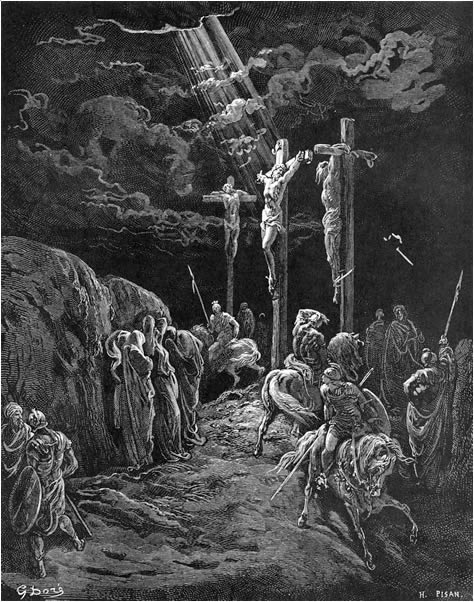
Through the law itself Paul died to the law, its own curse falling on him in Christ, so that he might live unto God, and verse 20 states the union in the first person: I am crucified with Christ, the letter's second beat of the crucifixion chain after the argument is set. Nevertheless I live, yet not I answers the death with a resurrection life, Christ living in him, and the life he now lives in the flesh he lives by faith of the Son of God, who loved me and gave himself for me, the most personal line in the whole letter.
The record, by era
The Church Fathers5 voices
"Yet I." I, he says, persuaded by that law itself, made myself dead to the law. For the law announced Christ to me, and to him indeed I am dead (for I no longer live according to that one), but I follow the doctrines of …
Whose grace, if not of that God from whom also came the law? Unless it be, forsooth, that the Creator intercalated His law for the mere purpose of producing some employment for the grace of a rival god, an enemy to Himself (I had almost said, a god unknown to Him), "that as sin had" in His own dispensation "reigned unto death, even so might grace reign through righteousness unto (eternal) life by Jesus Christ," His own antagonist! For this (I suppose it was, that) the law of the Creator had "concluded all under sin," and had brought in "all the world as guilty (before God)," and had "stopped every mouth," so that none could glory through it, in order that grace might be maintained to the glory of the Christ, not of the Creator, but of Marcion! I may here anticipate a remark about the substance of Christ, in the prospect of a question which will now turn up. For he says that "we are dead to the law." It may be contended that Christ's body is indeed a body, but not exactly flesh.
Now it is possible to see Paul as speaking of two laws—one of Moses, the other of Christ—so that he is saying he is dead to that law, which was given to the Jews, through the law that was given through Christ … that is, …
"For I through the Law died unto the Law." This may be viewed in two ways; it is either the law of grace which he speaks of, for he is wont to call this a law, as in the words, "For the law of the Spirit of life made me free:" (Rom. viii: 2) or it is the old Law, of which he says, that by the Law itself he has become dead to the Law. That is to say, the Law itself has taught me no longer to obey itself, and therefore if I do so, I shall be transgressing even its teaching. How, in what way has it so taught? Moses says, speaking of Christ, "The Lord God will raise up unto thee a Prophet from the midst of thee of thy brethren, like unto me; unto Him shall ye hearken." (Deut. xviii: 15) Therefore they who do not obey Him, transgress the Law. Again, the expression, "I through the Law died unto the Law," may be understood in another sense: the Law commands all its precepts to be performed, and punishes the transgressor; therefore we are all dead to it, for no man has fulfilled it. Here observe, how guardedly he assails it; he says not, "the Law is dead to me;" but, "I am dead to the Law;" the meaning of which is, that, as it is impossible for a dead corpse to obey the commands of the Law, so also is it for me who have perished by its curse, for by its word am I slain. Let it not therefore lay commands on the dead, dead by its own act, dead not in body only, but in soul, which has involved the death of the body. This he shows in what follows.
"Purify out the old leaven, that you may be a new lump," cries the apostle to us. And again in anger at such people he directs that we should "have no fellowship with anyone called a brother if he is a fornicator or covetous man or idolater or reviler or drunkard or robber; with such a man one ought not even to eat." "For I through the law am dead to the law," he says, "that I may live unto God. I am crucified with Christ; it is no longer I that live," meaning that I used to live according to my lusts, "but Christ lives in me," and I am pure and blessed by obeying the commandments; so that whereas at one time I lived in the flesh carnally, "the life which I now live in the flesh I live by faith in the Son of God."
8 more voices on this verse
The Medieval Church3 voices
He explains in what manner he abandoned the law, and says: through the law of grace and the Gospel I died to the law of Moses, or I died, he says, to the law through the law; that is, the law itself led me to …
Here the Apostle amplifies the solution given above. First, he explains the solution. Secondly, he concludes to his principal proposition (v. 21). It should be noted that the Apostle proceeds in a very thorough manner, leaving no doubt unexamined. Hence his words, although they seem …
This has a double meaning. For he speaks either of the law of grace, or only the old law, indicating that it is through this law that he died to the law. Actually what he says is this: The law itself led me to pay attention to him. If then in my attempt to pay attention to him I transgress it how and it what manner did Moses say the following, applying it to Christ, namely, That the Lord will raise a prophet from you from your brethren like me, and you shall listen to Him? So those who do not believe in Him, they transgress the Law. But what is the meaning of the statement, "I die to the Law?" Just as the dead are not subject to the commandments of the Law, likewise neither am I who, as one who has died to the curse of that Law. For the Law made all accursed those who did not fulfill the things of the Law. Indeed, no one was able to fulfill it completely.
The Puritans and the Awakening2 voices
For I through the law - Applied by the Spirit to my heart, and deeply convincing me of my utter sinfulness and helplessness. Am dead to the law - To all hope of justification from it. That I may live to God - Not continue in sin.
For I through the law am dead to the law,....
The Nineteenth Century3 voices
A commentator
Albert Barnes1798–1870
Notes, Explanatory and Practical, on the Old and New Testaments (1832-1869)
For I through the law - On this passage the commentators are by no means agreed. It is agreed that in the phrase “am dead to the law,” the Law of Moses is referred to, and that the meaning is, that Paul had become dead to that as a ground or means of justification. He acted as though it were not; or it ceased to have influence over him. A dead man is insensible to all around him. He hears nothing; sees nothing; and nothing affects him.
A commentator
Jamieson, Fausset & Brown1802–1910
Commentary Critical and Explanatory on the Whole Bible (1871)
For--But I am not a "transgressor" by forsaking the law. Proving his indignant denial of the consequence that "Christ is the minister of sin" (Ga 2:17), and of the premises from which it would follow. Christ, so far from being the minister of sin and death, is the establisher of righteousness and life.
For I through the law am dead to the law - In consequence of properly considering the nature and requisitions of the law, I am dead to all hope and expectation of help or salvation from the law, and have been obliged to take refuge in the Gospel of Christ. Or, probably the word νομος, Law, is here put for a system of doctrine; as if he had said, I through the Gospel am dead to the law. The law itself is consigned to death, and another, the Gospel of Christ, is substituted in its stead. The law condemns to death, and I have embraced the Gospel that I might be saved from death, and live unto God.
The words behind it
9 Greek wordsEvery Greek word of this verse in the order it stands, with what it means and the door to its own study. The last column counts the times a word stands in the whole Bible: the rarer the word, the more the places it appears belong together.
| Greek | Sound | Meaning | Word study | In the Bible |
|---|---|---|---|---|
| ἐγὼ | ego | I myself | G1473 → | 839 times |
| γὰρ | gar | for | G1063 → | 1039 times |
| διὰ | dia | through | G1223 → | 664 times |
| νόμου | nomou | [the] Law | G3551 → | 192 times |
| νόμῳ | nomo | to [the] Law | G3551 → | 192 times |
| ἀπέθανον, | apethanon | died, | G599 → | |
| ἵνα | ina | that | G2443 → | 668 times |
| θεῷ | theo | to God | G2316 → | 1312 times |
| ζήσω. | zeso | I may live. | G2198 → | 139 times |
ἐγὼI myself
egoG1473 →839 times
γὰρfor
garG1063 →1039 times
διὰthrough
diaG1223 →664 times
νόμου[the] Law
nomouG3551 →192 times
νόμῳto [the] Law
nomoG3551 →192 times
ἀπέθανον,died,
apethanonG599 →
ἵναthat
inaG2443 →668 times
θεῷto God
theoG2316 →1312 times
ζήσω.I may live.
zesoG2198 →139 times
A shaded row is a word that stands 400 times or fewer in the Bible.
The walk
8 stopsEach card is a verse this one points to, and under it the verses that one points to in turn. Where several paths arrive at the same place, that place is listed first: the text keeps returning to it.
Through
Romans 7:4Therefore, my brothers, you also died to the law through the body of Christ, that you might belong to another, to Him who was raised from the dead, in order that we might bear…
it leads to
- 1 Peter 2:24
He Himself bore our sins in His body on the tree, so that we might die to sin and live to righteousness. “By His stripes you are healed.”
Reached by 2 separate paths from here.
- Galatians 5:22–23
But the fruit of the Spirit is love, joy, peace, patience, kindness, goodness, faithfulness,
- Isaiah 54:5
For your husband is your Maker—the LORD of Hosts is His name—the Holy One of Israel is your Redeemer; He is called the God of all the earth.
- 1 Peter 2:24
Through
2 Corinthians 5:15And He died for all, that those who live should no longer live for themselves, but for Him who died for them and was raised again.
it leads to
- Colossians 3:17
And whatever you do, in word or deed, do it all in the name of the Lord Jesus, giving thanks to God the Father through Him.
Reached by 2 separate paths from here.
- Romans 14:7–9
For none of us lives to himself alone, and none of us dies to himself alone.
- 1 Peter 4:2–4
Consequently, he does not live out his remaining time on earth for human passions, but for the will of God.
- 1 Peter 1:14–15
As obedient children, do not conform to the passions of your former ignorance.
- Colossians 3:1
Therefore, since you have been raised with Christ, strive for the things above, where Christ is seated at the right hand of God.
- Colossians 3:17
Where this verse is studied
On this page
Studies5
About Galatians
This page draws on 15 works. Open the list of works
This page draws on Adam Clarke, Commentary on the Bible; Albert Barnes, Notes, Explanatory and Practical, on the Old and New Testaments (1832-1869); Clement of Alexandria, The Stromata Book 3; Gaius Marius Victorinus, EPISTLE TO THE GALATIANS 1.2.19; Jamieson, Fausset & Brown, Commentary Critical and Explanatory on the Whole Bible; Jerome, Commentary on Galatians; John Calvin, Commentary on Galatians; John Chrysostom, Homily on Galatians 2; John Damascene, Commentary (church-history corpus); John Gill, Exposition of the New Testament (1746-1748); John Wesley, Explanatory Notes upon the New Testament; Oecumenius, Commentary on Galatians; Tertullian, Against Marcion Book V; Theophylact of Ohrid, Commentary on Galatians and Thomas Aquinas, Commentary on Galatians.