
1 Samuel 3:4
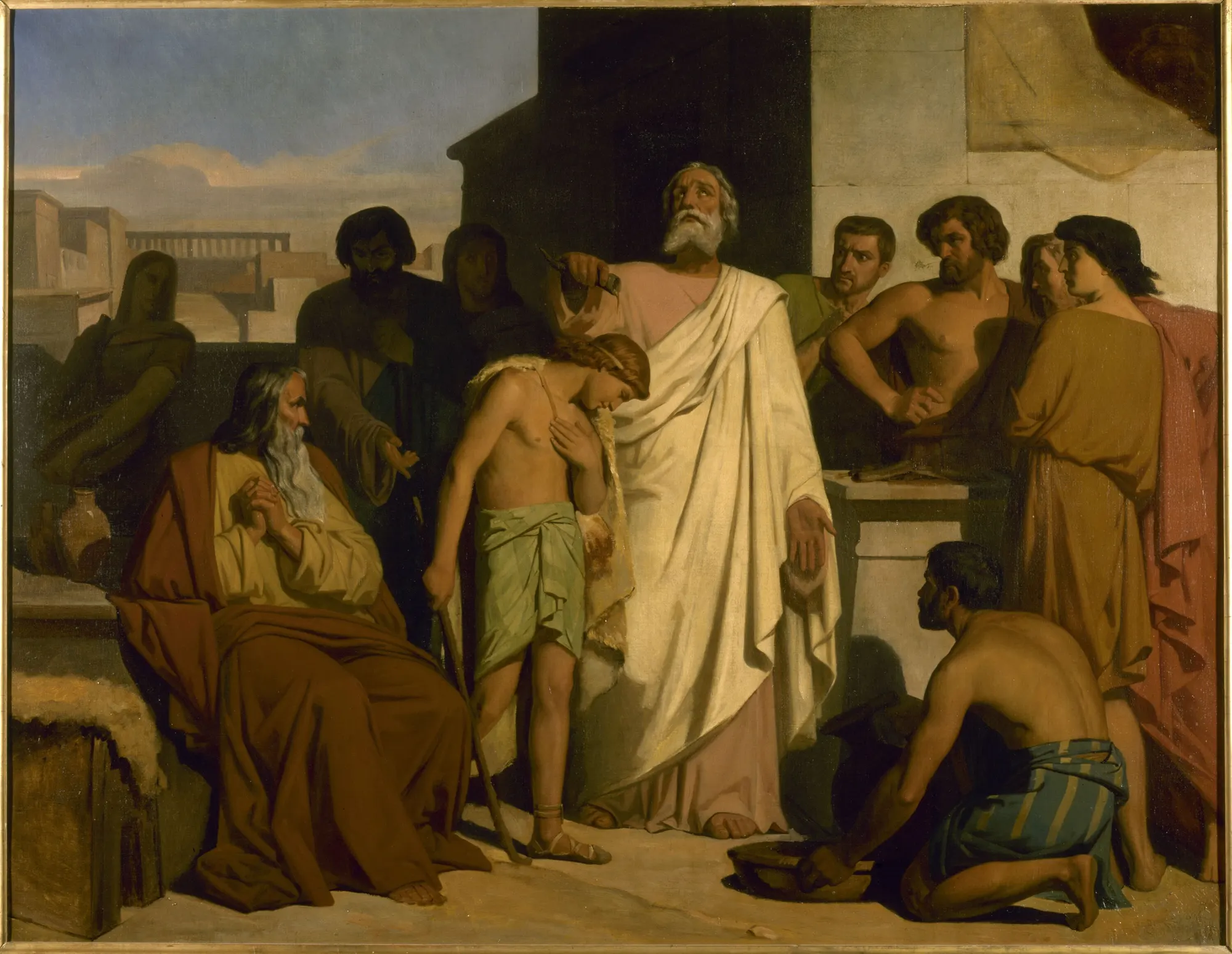
in 1 Samuel 3Then the LORD called to Samuel, and he answered, “Here I am.”
BSB
The same verse in ASV and KJV ▾
ASV
that Jehovah called Samuel: and he said, Here am I.
KJV
That the Lord called Samuel: and he answered, Here am I.
⋯
This verse in 1 Samuel 3
Commentary
12 notes on this verseA commentator
Charles Spurgeon1834–1892
The Metropolitan Tabernacle Pulpit, Sermon No. 3082: “'Here I Am!'” (lightly modernized text, CCEL edition) · Written before 1892.
SAMUEL was a model child. He was the son of a prayerful mother. Hannah is one of the most notable pietists mentioned in the Scriptures. She possessed a truly original mind, but she was yet more famous for her piety—a woman who knew how to take her griefs to the Mercy Seat and cast them upon her God. So Samuel came of good stock but, "that which is born of the flesh is flesh," and he would have been none the better for his godly parentage unless the Spirit of God had early in life renewed his heart.
This site's exposition
Then the LORD called to Samuel
on 1 Samuel 3:4-6
The LORD calls Samuel by name, and each time the boy runs to Eli, saying “Here I am, for you have called me”. Eli sends him back with “Go back and lie down” before his own perception catches up with what the boy has heard.
The record, by era
The Church Fathers2 voices
A commentator
Philoxenus of Mabbug13 Ascetic Discourses, Discourse 4 -- On Faith: First Discourse on Simplicity · Written before 523.
proposed
For Eli was sleeping with his sons inside the temple, and when the Lord desired to speak with the children of men, He forsook the old age which was trained in wisdom and exercised in the affairs of the world, and lusty manhood which had …
And therefore by no means let the ignorance or shallowness of one old man or of a few deter you and cut you off from that salutary path about which we have spoken and from the traditions of our forebears. The clever enemy misuses their gray hairs to deceive the young. But everything should be revealed to the elders without any obfuscating embarrassment, and from them one may confidently receive both healing for one's wounds and examples for one's way of life. Thanks to them we shall experience the same assistance and a like result if we strive to aim at nothing whatsoever by our own judgment and presumption.Finally, it is evident that this understanding is greatly pleasing to God, for not without reason do we find this same instruction even in holy Scripture. Thus, the Lord did not desire of himself to teach the boy Samuel through divine speech, once he had been chosen by his own decision, but he was obliged to return twice to the old man. He willed that one whom he was calling to an intimate relationship with himself should even be instructed by a person who had offended God, because he was an old man. And he desired that one whom he judged most worthy to be selected by himself should be reared by an old man so that the humility of him who was called to a divine ministry might be tested and so that the pattern of this subjection might be offered as an example to young men.
The Medieval Church3 voices
A commentator
Gregory the DialogistCommentary on 1 Kings, Book 2, Chapter 4 · Written before 604.
proposed
9. For to call is to rouse through the force of a greater grace. For the Lord calls one who is sleeping, because He stirs up those who are resting from earthly pursuits to an increase of heavenly knowledge. For while we keep watch through concern for outward things, we do not perceive what is inward and spiritual. The setting aside of earthly care, therefore, is our preparation for receiving heavenly grace, because in the elect the outpouring of the divine gift becomes more abundant in proportion as the mind has been purer through the keeping of interior meditation. There follows: (Verses 4–9.) And the Lord called Samuel. Who answering, said: Here I am, and he ran to Eli and said: For you called me. Who said: I did not call you, my son; go back and sleep. And he went away and slept. And the Lord again called Samuel once more. And rising up, he went to Eli and said: Here I am, for you called me. Who answered: I did not call you, my son; go back and sleep. Now Samuel did not yet know the Lord, nor had the word of the Lord been revealed to him. And the Lord called Samuel again a third time. Who rising up, went to Eli and said: Here I am, for you called me. Eli therefore understood that the Lord was calling the boy, and he said to Samuel: Go and sleep, and if He calls you henceforth, you shall say: Speak, Lord, for your servant is listening. 10. What is it then that almighty God introduces his calling with such skill that the mind of the one called is restrained from recognizing the one who calls him; that hearing God, he thinks this master is a man; that he sends forth the calling yet conceals the cause; that he allows him to go to his master, to return so many times to the quiet of sleep, and yet does not permit the sleeper to rest? […]
And the Lord called Samuel, etc. It's a challenging mode of speaking, how from time to time a father calls his son to know the secrets of his judgment; and he responds that he is present, who was born before time from the Father and …
A commentator
Gregory the DialogistCommentary on 1 Kings, Book 3, Chapter 1 · Written before 604.
proposed
(Verses 4, 5.) Who answering, said: "Here I am." And he ran to Eli and said: "For you called me." Who said: "I did not call you, my son; return and sleep." 8. Why did the one who heard the Lord calling him run to Eli, unless because he thought he had been called by Eli? And since we are following the order of typological explanation, how is Eli considered to be the one speaking when God speaks to the boy who was called?
5 more voices on this verse
The Puritans and the Awakening3 voices
Samuel lay awake in his bed, his thoughts, no doubt, well employed (as David's Ps. lxiii. 6 ), when the Lord called to him, bishop Patrick thinks out of the most holy place, and so the Chaldee paraphrase reads it, A voice was heard out of the temple of the Lord; but Eli, though it is likely he lay nearer, heard it not; yet possibly it might come some other way.
God's message to Eli, ver. 11-14. His faithful delivery of that message, and Eli's submission to God, ver. 15-18. The establishment of Samuel to be a prophet, ver. 19-21 Commentary on Chapter III
quarantine:anchor (2026-07-29) — cites-ver-15/19-anchored-1-10
That the Lord called Samuel,.... By a voice which came forth from the most holy place, from between the cherubim, the seat of the divine Majesty: and he answered, here am I; which was not intended to declare the place where he was, but to express his readiness and cheerfulness to do any thing that was required of him.
The Nineteenth Century2 voices
A commentator
Charles Spurgeon1834–1892
The Metropolitan Tabernacle Pulpit, Sermon No. 3082: “'Here I Am!'” (lightly modernized text, CCEL edition) · Written before 1892.
proposed
SAMUEL was a model child. He was the son of a prayerful mother. Hannah is one of the most notable pietists mentioned in the Scriptures. She possessed a truly original mind, but she was yet more famous for her piety—a woman who knew how to take her griefs to the Mercy Seat and cast them upon her God. So Samuel came of good stock but, "that which is born of the flesh is flesh," and he would have been none the better for his godly parentage unless the Spirit of God had early in life renewed his heart. May our dear children all grow up as Samuel did. And that they may do so, may they in their early life be such children as Samuel was! It is to be noticed how obedient Samuel was to his guardian who stood to him in the place of a parent. We do not read of any disobedience or discourtesy to Eli. On the contrary, we see that the greatest respect and attention were paid by the child to the aged man who had the care of him. There is nothing in a child more beautiful than obedience—and a young Christian should be careful to keep his proper place—and the more he knows what his privileges are in being a child of God, the better should he fulfill his duty as a child at home. The child Samuel was consecrated to God from his earliest days. His mother gave him to the Lord and He, Himself, confirmed the consecration. Happy is the child who is God's child and who can say as truly as Paul said, "For to me to live is Christ." Such Grace is seen even in children—may it be seen in all the children of all the families connected with this Church! Samuel also had the great privilege of growing up amid holy services. He saw the daily sacrifices offered in the sanctuary and he was probably not absent from any of the means of Grace of that day. Parents do their children grievous wrong when they do not allow them to go with them to the House of Prayer.
The Lord called Samuel - The voice probably came from the holy place, near to which Eli and Samuel were both lying.
The words behind it
6 Hebrew wordsEvery Hebrew word of this verse in the order it stands, with what it means and the door to its own study. The last column counts the times a word stands in the whole Bible: the rarer the word, the more the places it appears belong together.
| Hebrew | Sound | Meaning | Word study | In the Bible |
|---|---|---|---|---|
| וַיִּקְרָ֧א | vaiyikra' | and he called | H7121 → | 733 times |
| יְהוָ֛ה | yahweh | Yahweh | H3068 → | 6520 times |
| אֶל־ | ʾel- | to | H413 → | 5510 times |
| שְׁמוּאֵ֖ל | shemuel | Samuel | H8050 → | 141 times |
| וַיֹּ֥אמֶר | vaiyomer | and he said | H559 → | 5305 times |
| הִנֵּֽנִי׃ | hineni | here [am] I | H2005 → | 316 times |
וַיִּקְרָ֧אand he called
vaiyikra'H7121 →733 times
יְהוָ֛הYahweh
yahwehH3068 →6520 times
אֶל־to
ʾel-H413 →5510 times
שְׁמוּאֵ֖לSamuel
shemuelH8050 →141 times
וַיֹּ֥אמֶרand he said
vaiyomerH559 →5305 times
הִנֵּֽנִי׃here [am] I
hineniH2005 →316 times
A shaded row is a word that stands 400 times or fewer in the Bible.
The walk
8 stopsEach card is a verse this one points to, and under it the verses that one points to in turn. Where several paths arrive at the same place, that place is listed first: the text keeps returning to it.
Through
Isaiah 6:8Then I heard the voice of the Lord saying: “Whom shall I send? Who will go for Us?” And I said: “Here am I. Send me!”
it leads to
- Exodus 4:10–13
“Please, Lord,” Moses replied, “I have never been eloquent, neither in the past nor since You have spoken to Your servant, for I am slow of speech and tongue.”
- Acts 26:16–17
‘But get up and stand on your feet. For I have appeared to you to appoint you as a servant and as a witness of what you have seen from Me and what I…
- Ephesians 3:8
Though I am less than the least of all the saints, this grace was given me: to preach to the Gentiles the unsearchable riches of Christ,
- Acts 22:21
Then He said to me, ‘Go! I will send you far away to the Gentiles.’”
- Isaiah 65:1
“I revealed Myself to those who did not ask for Me; I was found by those who did not seek Me. To a nation that did not call My name, I said, ‘Here I…
- Exodus 4:10–13
Through
Genesis 22:1Some time later God tested Abraham and said to him, “Abraham!” “Here I am,” he answered.
it leads to
- Hebrews 11:17
By faith Abraham, when he was tested, offered up Isaac on the altar. He who had received the promises was ready to offer his one and only son,
- Deuteronomy 8:2
Remember that these forty years the LORD your God led you all the way in the wilderness, so that He might humble you and test you in order to know what was in your…
- James 2:21
Was not our father Abraham justified by what he did when he offered his son Isaac on the altar?
- Hebrews 11:17
Where this verse is studied
About 1 Samuel
Who and where
1 name in this verse with a page on the site.
This page draws on 11 works. Open the list of works
This page draws on Adam Clarke, Commentary on the Bible; Bede, Commentary on Samuel; Charles Spurgeon, The Metropolitan Tabernacle Pulpit, Sermon No. 3082: “'Here I Am!'” (lightly modernized text, CCEL edition); Gregory the Dialogist, Commentary on 1 Kings, Book 2, Chapter 4; Gregory the Dialogist, Commentary on 1 Kings, Book 3, Chapter 1; John Cassian, CONFERENCE 2.13.12-2.14; John Gill, Exposition of the Old Testament; John Gill, Exposition of the Old Testament (1748-1763); John Wesley, Explanatory Notes upon the Old Testament; Matthew Henry, Commentary on the Whole Bible and Philoxenus of Mabbug, 13 Ascetic Discourses, Discourse 4 -- On Faith: First Discourse on Simplicity.