
Psalm 84
12 verses · Pilgrim psalm of praise
For better is one day in Your courts than a thousand elsewhere. I would rather be a doorkeeper in the house of my God than dwell in the tents of the wicked.
Introduction
The sons of Korah, the Pilgrim Road, Book 3: The crisis of the throne, Poetry, Psalms Overview.
The sons of Korah, who kept the doors and led the singing at the sanctuary, wrote this song for pilgrims. Three times a year families walked for days to Jerusalem for the feasts, and this psalm belongs to those roads. It is a song of longing, written by men who loved the place where they worked and envied anyone who could stay there. Listen for the small birds, the dry valley and the doorway, each a picture a pilgrim would pass on the way up. Read it as the song of a traveller whose whole desire is to arrive and to stand before God.
Context
- Who
- Families walking for days to reach a festival
- What
- A pilgrim song of longing for the courts of the sanctuary.
- Where
- The pilgrim roads climbing to Jerusalem, and the temple courts at the end of them
- When
- The monarchy, while the sanctuary stood and the pilgrim feasts were kept, and no date is stated.
- Why
- To give travellers to the feasts words for their desire for God on the road to Zion.
Historical context
The psalm is headed for the sons of Korah, descendants of the man swallowed up in the wilderness rebellion, whose line survived him and served in the sanctuary as gatekeepers and singers. So when the psalm would rather stand at the threshold of the house of God, a gatekeeper is naming his own trade with pride. No year is given, and the psalm assumes the practice of the pilgrim feasts, when Israelite men were to appear before the LORD three times a year and the roads to Jerusalem filled up. People travelled in family and village companies for safety, camped along the way and sang as they climbed the last hills, so the walking was part of the worship. The sparrow and the swallow nested in the sanctuary stonework all year, and a first hearer caught the edge in the poet's envy, since he had a few days there. The Valley of Baca is a dry valley on a pilgrim route, its name tied to weeping or to a shrub of arid ground, and travellers dug into the wadi bed for seepage until the autumn rains, which came with the autumn feast, filled the pools.
Significance
For a family several days into a hard walk, this song said that the road itself was already worship, since the pilgrims go from strength to strength until each one appears before God in Zion. A walk that should have worn them out was described as building them up on the way.
This chapter in Jewish lifeWhat this chapter is in Jewish life and reading.
How it is read
Rashi reads this psalm from a time when the house it longs for is gone. The bird that finds a home in verse 4 he places in the ruins, where birds have nested. He then gives the reading of the Midrash beside it, which takes the verse of the Temple standing and the bird as the nation of Israel (Rashi on Psalms 84:4:1, citing Midrash Tehillim 84:2). The blessing of verse 5 becomes a hope rather than a report, for the man who will yet be worthy to live in God's house (Rashi on Psalms 84:5:1). The valley of weeping in verse 7 he reads severely, as the depth of Gehinnom for those who break God's law. The weepers there make the place a spring with their own tears (Rashi on Psalms 84:7:1 and 84:7:2). The going from strength to strength in verse 8 he reads of study, as going "from the study-hall to the synagogue", with the company appearing before God in Zion (Rashi on Psalms 84:8:2). The shield of verse 10 is the Temple itself, which protects the people, and the face of the anointed is David's, with his labour in building it remembered (Rashi on Psalms 84:10:1 and 84:10:2). On the famous verse 11 he gives the comparison in full, that one day in God's courts followed by death is better than a thousand years elsewhere (Rashi on Psalms 84:11:1). Ibn Ezra and Radak stand in the corpus here by reference alone. Rashi is quoted here from the Judaica Press complete Tanach with Rashi, translated by A. J. Rosenberg, under CC-BY.
What the rabbis say
The corpus records forty places where the Midrash and the Talmud draw on this psalm, cited here by reference. Verse 5, on those who dwell in God's house, is drawn into the Babylonian Talmud at Berakhot 4b:17 and 32b:21. Verse 8, the going from strength to strength, stands at Berakhot 64a:11 and 64a:12. Verse 7, the valley of weeping, is read at Eruvin 19a:4 and 19a:10, and at Vayikra Rabbah 17:1, Pesikta Rabbati 43:1 and Eikhah Rabbah 3:9. Verse 2, on the dwelling places, is carried into Menachot 53b:1 and Avot DeRabbi Natan, Recension B 43:20. Verse 11 is read at Bereshit Rabbah 62:1 and 92:2. Midrash Tehillim treats the psalm at 84:1 and cites its verses at 30:1.
Sources: Rashi, Rashi on Psalms 84:2 to 84:12, the Judaica Press complete Tanach with Rashi, translated by A. J. Rosenberg, CC-BY, 1040 to 1105; Midrash Tehillim, 84:1, 84:2 and 30:1, cited by reference; Babylonian Talmud, Berakhot 4b:17, 32b:21, 64a:11 and 64a:12, Eruvin 19a:4 and 19a:10, and Menachot 53b:1, cited by reference; Vayikra Rabbah, 17:1, cited by reference; The Sefaria corpus, scripts/data/sources/sefaria/psalms/84.json, fetched 2026-09-19, 2026.
Psalms 84:1-2
How lovely is Your dwelling place: The word behind lovely is yedid, the word for beloved, so the dwelling places are the ones God's people love. The longing takes the whole man, soul and heart and flesh together. The cry goes out for the living God.
Psalms 84:1
“How lovely is the sanctuary in the eyes of all that are truly sanctified! Gracious souls see a wonderful, an inexpressible, beauty in holiness, and in holy work. A tabernacle was a mean habitation, but the disadvantage of external circumstances makes holy ordinances not at all the less amiable; for the beauty of holiness is spiritual, and their glory is within.”
Matthew Henry · Commentary on the Whole Bible (1707-1721)puritan
1 more voice on this verseWhat preachers and commentators have said about this verse, in their own words.
Psalms 84:1
“To the choirmaster, for the winepresses, a psalm of the sons of Korah. There are three psalms which are inscribed "for the winepresses": the eighth, the eightieth, and the eighty-third. The eighth is inscribed to David, the eightieth is inscribed to Asaph, the eighty-third is inscribed as of the sons of Korah. I give you a certain rule, so that you may know what you ought to observe in the Scriptures. Whatever psalm is inscribed as of the sons of Korah has nothing sad in it, but always signifies joyful things.”
Jerome · written before 420 · Homily 16, on Psalm 83patristic
My soul longs, even faints: Albert Barnes traced longs to a word meaning to turn pale, used of a hungry lion at Psalm 17:12. Adam Clarke heard a Levite shut out from the temple. Jamieson, Fausset and Brown noted that cry out is literally sing for joy, though here it voices sorrow.
Psalms 84:2
“My heart and my flesh have exulted in the living God. Listen, heretic, to what he says. How beloved are your tabernacles, O Lord of hosts: he is speaking of the kingdom of heaven. "There are many dwelling-places with my Father," the Lord says in the Gospel. My soul longs and faints for the courts of the Lord: these are the courts in which the saints will dwell for eternity, which the prophet desires. My heart and my flesh. You see, then, that both the soul and the flesh alike desire the kingdom of heaven.”
Jerome · written before 420 · Homily 63, on Psalm 83 (Alternate Series)patristic
2 more voices on this verse
Psalms 84:2
“My soul longeth, it pines, and faints to meet with the saints in the Lord's house. The desire was deep and insatiable—the very soul of the man was yearning for his God. Yea, even fainteth; as though it could not long hold out, but was exhausted with delay. He had a holy lovesickness upon him, and was wasted with an inward consumption because he was debarred the worship of the Lord in the appointed place. For the courts of the Lord.”
Charles Spurgeon · The Treasury of David, Vol. 4 (1874)Particular Baptist
Psalms 84:2
“It was an intense desire; it was like the desire of the ambitious, or covetous, or voluptuous. He longed, he fainted, he cried out, importunate to be restored to his place in God's courts, and almost impatient of delay. Yet it was not so much the courts of the Lord that he coveted, but he cried out, in prayer, for the living God himself.”
Matthew Henry · Commentary on the Whole Bible (1707-1721)puritan
Psalms 84:3-4
the sparrow has found a home: A sparrow has a home and a swallow a nest, both of them set near God's own altars. The blessing of verse 4 falls on those who dwell in the house. Their praise is continual.
Psalms 84:3
“Yea, the sparrow hath found an house. He envied the sparrows which lived around the house of God, and picked up the stray crumbs in the courts thereof; he only wished that he, too, could frequent the solemn assemblies and bear away a little of the heavenly food. And the swallow a nest for herself, where she may lay her young. He envied also the swallows whose nests were built under the eaves of the priest's houses, who there found a place for their young, as well as for themselves.”
Charles Spurgeon · The Treasury of David, Vol. 4 (1874)Particular Baptist
1 more voice on this verse
Psalms 84:3
“For indeed the sparrow has found itself a home, and the turtledove a nest for itself where it may place its young. For the moment let us interpret it simply. See what he says. I desire, O Lord, your eternal tabernacles: my soul longs and faints for the courts of the Lord: I desire to have some seat and little nest for my soul and my body.”
Jerome · written before 420 · Homily 16, on Psalm 83patristic
How blessed are those who dwell: Adam Clarke tied this verse to the one before it. Those who dwell in the house have a settled home there, as the sparrow and swallow do. Albert Barnes named them as the priests and Levites, and John Wesley added devout worshippers like Anna in Luke 2:36 and 37.
Psalms 84:4
“Blessed are they who dwell in your house, O Lord: that is, in the Church, whether the present one, or "the church of the firstborn." Forever and ever they will praise you. See what kind of office the martyrs have: it is that of the angels too. What they do in heaven, then, this we imitate on earth. So when we are called to the psalms and neglect them, we despise the praises of God.”
Jerome · written before 420 · Homily 63, on Psalm 83 (Alternate Series)patristic
3 more voices on this verse
Psalms 84:4
“Blessed are they that dwell in thy house. Those he esteems to be highly favoured who are constantly engaged in divine worship—the canons residentiary, yea, the pew openers, the menials who sweep and dust. To come and go is refreshing, but to abide in the place of prayer must be heaven below. To be the guests of God, enjoying the hospitalities of heaven, set apart for holy work, screened from a noisy world, and familiar with sacred things—why this is surely the choicest heritage a son of man can possess. They will be still praising thee.”
Charles Spurgeon · The Treasury of David, Vol. 4 (1874)Particular Baptist
Psalms 84:4
“Blessed are those that dwell in thy house (not because they have good wages, a part of every sacrifice for themselves, which would enable them to keep a good table, but because they have good work): They will be still praising thee; and, if there be a heaven upon earth, it is in praising God, in continually praising him.”
Matthew Henry · Commentary on the Whole Bible (1707-1721)puritan
Psalms 84:4
“They-That constantly abide in thy house; the priests and Levites, or other devout Jews who were there perpetually, as Anna, Luke ii, 36-37. They will - They are continually employed in that blessed work.”
John Wesley · Explanatory Notes upon the Old Testament (1765)evangelical
Psalms 84:5-7
whose strength is in You: The blessing falls on the man already on the road, his strength in God and his heart set on the pilgrimage. Baca is a valley, and those who pass through it leave springs behind them, with the autumn rain filling the pools. They arrive stronger than they set out.
Psalms 84:5
“Blessed is the man whose strength is in thee. Having spoken of the blessedness of those who reside in the house of God, he now speaks of those who are favoured to visit it at appointed seasons, going upon pilgrimage with their devout brethren: he is not, however, indiscriminate in his eulogy, but speaks only of those who heartily attend to the sacred festivals. The blessedness of sacred worship belongs not to half hearted, listless worshippers, but to those who throw all their energies into it.”
Charles Spurgeon · The Treasury of David, Vol. 4 (1874)Particular Baptist
1 more voice on this verse
Psalms 84:5
“Blessed is the man whose help is from you. We indeed desire your tabernacles and courts and house: but this very thing, that we may be able to attain it, is not of our own strength, but of your help. He has arranged ascents in his heart. Who has arranged ascents in his heart? Blessed is the man whose help is from the Lord: he has arranged ascents in his heart. Whoever is holy is daily stretched out toward the things before, and forgets the things that are past.”
Jerome · written before 420 · Homily 16, on Psalm 83patristic
the Valley of Baca: Albert Barnes called this verse one of the hardest. The name Baca means weeping, and the old Greek and Latin versions read valley of tears. Adam Clarke took it as Bochim, the place of weeping in Judges 2, and Matthew Henry pictured pilgrims digging pits to hold the rain.
Psalms 84:6
“Who passing through the valley of Baca make it a well. Traversing joyfully the road to the great assembly, the happy pilgrims found refreshment even in the dreariest part of the road. As around a well men meet and converse cheerfully, being refreshed after their journey, so even in the vale of tears, or any other dreary glen, the pilgrims to the skies find sweet solace in brotherly communion and in anticipation of the general assembly above, with its joys unspeakable.”
Charles Spurgeon · The Treasury of David, Vol. 4 (1874)Particular Baptist
2 more voices on this verse
Psalms 84:6
“When they come up out of the country to worship at the feasts their way lies through many a dry and sandy valley (so some), in which they are ready to perish for thirst; but, to guard against that inconvenience, they dig little pits to receive and keep the rain-water, which is ready to them and others for their refreshment.”
Matthew Henry · Commentary on the Whole Bible (1707-1721)puritan
Psalms 84:6
“In the valley of tears, in the place which he has set. We read in the book of Judges, when the angel came and preached repentance to the people, saying, You have forsaken the Lord, and the Lord will forsake you; and when the people heard this they wept, and that place was called the Valley of Tears. We have recalled the old history, so that we might flee heresy. But by the valley of tears we can understand, spiritually, this present age.”
Jerome · written before 420 · Homily 63, on Psalm 83 (Alternate Series)patristic
from strength to strength: Albert Barnes read the line as pilgrims growing stronger as they go, until they appear before God. Charles Spurgeon saw the company grow larger along the road. Adam Clarke read the second half as the God of gods shall be seen in Zion, the rendering of the Greek version.
Psalms 84:7
“They go from strength to strength. So far from being wearied they gather strength as they proceed. Each individual becomes happier, each company becomes more numerous, each holy song more sweet and full. We grow as we advance if heaven be our goal. If we spend our strength in God's ways we shall find it increase. Every one of them in Zion appeareth before God. This was the end of the pilgrim's march, the centre where all met, the delight of all hearts.”
Charles Spurgeon · The Treasury of David, Vol. 4 (1874)Particular Baptist
1 more voice on this verse
Psalms 84:7
“The figure of the pilgrim is carried out. As such daily refit their bodily strength till they reach Jerusalem, so the spiritual worshipper is daily supplied with spiritual strength by God's grace till he appears before God in heaven. appeareth . . .”
Jamieson, Fausset & Brown · Commentary Critical and Explanatory on the Whole Bible (1871)reformed
Psalms 84:8-9
hear my prayer: The psalm turns from longing to a plain request, that God hear and give ear. Verse 9 sets the shield and the anointed in one line, and anointed is mashiach, a man set apart with oil for his office. The English word Messiah comes from it.
Psalms 84:8
“O Lord God of hosts, hear my prayer. Give me to go up to thy house, or if I may not do so, yet let my cry be heard. Thou listenest to the united supplications of thy saints, but do not shut out my solitary petition, unworthy though I be. Give ear, O God of Jacob. Though Jehovah of hosts, thou art also the covenant God of solitary pleaders like Jacob; regard thou, then, my plaintive supplication.”
Charles Spurgeon · The Treasury of David, Vol. 4 (1874)Particular Baptist
the face of Your anointed: Readers differ on who the anointed is. Matthew Henry and Adam Clarke read it of the Messiah, though Clarke noted that others apply it to David, Zerubbabel or Israel. Charles Spurgeon held both, a prayer for David that reaches to the Son of David.
Psalms 84:9
“Behold, O God our shield, and look upon the face of thine anointed. Here we have the nation's prayer for David; and the believer's prayer for the Son of David. Let but the Lord look upon our Lord Jesus, and we shall be shielded from all harm; let him behold the face of his Anointed, and we shall be able to behold his face with joy. We also are anointed by the Lord's grace, and our desire is that he will look upon us with an eye of love in Christ Jesus.”
Charles Spurgeon · The Treasury of David, Vol. 4 (1874)Particular Baptist
2 more voices on this verse
Psalms 84:9
“He has an eye to the Mediator; for of him I rather understand those words, Look upon the face of thy Messiah, thy anointed one, for of his anointing David spoke, Ps. xlv. In all our addresses to God we must desire that he would look upon the face of Christ, accept us for his sake, and be well-pleased with us in him.”
Matthew Henry · Commentary on the Whole Bible (1707-1721)puritan
Psalms 84:9
“Our protector, look, O God, and look upon the face of your Christ. See what he says, And look upon the face of your Christ. And a man prays, that the Father may look upon the face of the Son. But see what he says. Since the apostle said, "Do you seek proof of him who speaks in me, Christ?" and again the Savior himself said, "He who receives you receives me," therefore this is what he says: Look upon us: for in us you look upon your Son, who dwells in us.”
Jerome · written before 420 · Homily 16, on Psalm 83patristic
Psalms 84:10-12
better is one day in Your courts: One day in the courts outweighs a thousand anywhere else. The word rendered doorkeeper is histofef, to wait at the threshold, a place at the door of God's house over the tents of the wicked. Verse 11 gives sun and a shield, grace and glory, and no good thing withheld.
Psalms 84:10
“For a day in thy courts is better than a thousand. Of course the psalmist means a thousand days spent elsewhere. Under the most favourable circumstances in which earth's pleasures can be enjoyed, they are not comparable by so much as one in a thousand to the delights of the service of God. To feel his love, to rejoice in the person of the anointed Saviour, to survey the promises and feel the power of the Holy Ghost in applying precious truth to the soul, is a joy which worldlings cannot understand, but which true believers are ravished with.”
Charles Spurgeon · The Treasury of David, Vol. 4 (1874)Particular Baptist
1 more voice on this verse
Psalms 84:10
“For better is one day in your courts above thousands. See what he says, "one day." Someone thinks it should be understood thus: It is better for me to have a little in the kingdom of heaven, than here the whole, that is, in this world. This understanding, indeed, is not a bad one. But let us say: If it could happen that someone should be for one day in the kingdom of heaven, and afterward be cast down headlong, he would rightly say: Better is one day in your courts.”
Jerome · written before 420 · Homily 16, on Psalm 83patristic
a sun and a shield: Adam Clarke noted that none of the ancient versions took the word as sun. Albert Barnes kept the reading. Charles Spurgeon showed why pilgrims need both, the sun against the cold of the road and the shield against raiders who waylay the caravan.
Psalms 84:11
“For God loves mercy and truth. Two things God loves, mercy and truth. If he were only merciful, he would provoke us all to sins: if he loved only truth, no one would have hope of repentance. For this reason he seeks two things, and tempers the one by the other. If you are a sinner, hear that God is merciful, and do not despair, and do penance. But if you are righteous, do not be negligent, because God is clement: since God is also just, and loves truth. The Lord will give grace and glory.”
Jerome · written before 420 · Homily 16, on Psalm 83patristic
1 more voice on this verse
Psalms 84:11
“For the Lord God is a sun and shield. Pilgrims need both as the weather may be, for the cold would smite them were it not for the sun, and foes are apt to waylay the sacred caravan, and would haply destroy it if it were without a shield. Heavenly pilgrims are not left uncomforted or unprotected. The pilgrim nation found both sun and shield in that fiery cloudy pillar which was the symbol of Jehovah's presence, and the Christian still finds both light and shelter in the Lord his God.”
Charles Spurgeon · The Treasury of David, Vol. 4 (1874)Particular Baptist
the man who trusts in You!: Charles Spurgeon called this line the key of the psalm. The longing for the courts ends in trust in the God of the courts. Matthew Henry drew the comfort: a person barred from the house of the LORD may still go by faith to the Lord of the house.
Psalms 84:12
“O Lord of hosts. See what he says, O Lord of hosts. Therefore when we have any sins in us, God, who is the Lord of hosts, is not our Lord: because the Lord is not the Lord of sinners, but of the righteous. Blessed is the man who hopes in you. He hopes in the Lord, who has no conscience of sins, who lifts free eyes to heaven. This man hopes, who knows that he has not offended his Lord.”
Jerome · written before 420 · Homily 16, on Psalm 83patristic
2 more voices on this verse
Psalms 84:12
“O Lord of hosts, blessed is the man that trusteth in thee. Here is the key of the Psalm. The worship is that of faith, and the blessedness is peculiar to believers. No formal worshipper can enter into this secret. A man must know the Lord by the life of real faith, or he can have no true rejoicing in the Lord's worship, his house, his Son, or his ways. Dear reader, how fares it with thy soul?”
Charles Spurgeon · The Treasury of David, Vol. 4 (1874)Particular Baptist
Psalms 84:12
“Those are blessed who have the liberty of ordinances and the privileges of God's house. But, though we should be debarred from them, yet we are not therefore debarred from blessedness if we trust in God. If we cannot go to the house of the Lord, we may go by faith to the Lord of the house, and in him we shall be happy and may be easy.”
Matthew Henry · Commentary on the Whole Bible (1707-1721)puritan
How this psalm is built
The form: A psalm of the dwelling place held dear as a person is held dear, as Barnes classes it.
The patterns in this chapter
| Device | What it does | Where to see it |
|---|---|---|
| Blessed are they, said three times | The word stands at verse 4 of those who dwell in the house, at verse 5 of those whose strength is in God, and at verse 12 of the man who trusts in Him. The three sayings mark the three positions the psalm knows: at home in the courts, on the road toward them, and anywhere at all with trust. | Psalm 84:4, Psalm 84:5, Psalm 84:12 |
| The LORD of Hosts at the opening and at the close | The title stands at verse 1, at verse 3, at verse 8 and again in the last verse. The psalm begins by calling the dwelling place of the LORD of Hosts lovely and ends by calling the man who trusts in the LORD of Hosts blessed, so that the same name frames the whole. | Psalm 84:1, Psalm 84:12 |
| The sparrow and the swallow | Verse 3 names two small birds and gives each its own provision, a home for the one and a nest for the other where she places her young. The psalm sets the birds' settled possession of the altars against the speaker's longing, and it does so without explaining the comparison. | Psalm 84:3 |
| The valley turned into springs | Verse 6 has the pilgrims pass through the Valley of Baca and make it a place of springs, so that the dry place is changed by their passing through it rather than before they arrive. Verse 7 states the result as going from strength to strength, which reverses what a long road normally does to a traveller. | Psalm 84:6, Psalm 84:7 |
The psalm belongs to the Korah collection, Psalms 42 to 49 and 84 to 88, and it is the plainest of them about the desire to be at the sanctuary. Psalm 42 opens that collection with a soul panting for God as a deer pants for water, and Psalm 84 repeats the same longing with the temple in view rather than with the exile.
8 more paragraphs on the patterns
It also stands close to the songs of ascents in subject, since it is written from the road rather than from the building. Psalms 120 to 134 are the collection that carries pilgrimage as a heading, and Psalm 84 is the psalm that describes what the walking itself does to those on it.
Inside the psalm the pattern is a set of exchanges in which the smaller is chosen over the larger. One day is set against a thousand. The doorkeeper's post is set against the tents of the wicked. A bird's nest by an altar is set against whatever the speaker has at home. The psalm makes its case by arithmetic three times over, and every time the smaller quantity wins because of where it is.
The New Testament's use
No verse of Psalm 84 is quoted in the New Testament. Hebrews 11 describes those who sought a country and a city with foundations in the same terms the psalm uses of the pilgrim, and Augustine read verse 4 of the heavenly Jerusalem on that ground (On the Psalms, Psalm 84, 430), but the psalm itself is not cited.
The debated point
The Valley of Baca at verse 6 is disputed and the dispute is about a word. The name is read by some as a place on the pilgrim road, by others as a valley of weeping, and by others as a valley of balsam trees that grow where the ground is dry. John Gill traces it as a real stage on the road. The psalm's own sentence works on any of the three, since what it says is that the pilgrims make the valley into a place of springs, and the point stands whether the valley was named for its trees, its dryness or its tears.
Where to go deeper
The pilgrim road is set out at the songs of ascent. The house the psalm longs for is set out at the house, and the city at Zion and Jerusalem. The shield and sun of verse 11 stand with the whole armour.
Keep studying
Words12
Subjects1
Sources for this chapter
The summary
Jamieson, Fausset & Brown, Commentary Critical and Explanatory; John Calvin, Commentaries; John Wesley, Notes on the Old Testament and Matthew Henry, Complete Commentary.
The form and classifications
Albert Barnes, Notes, Explanatory and Practical, on the Old and New Testaments, 1832 to 1869, on Psalm 84:1; Augustine of Hippo, On the Psalms, Psalm 84, 430, on Psalm 84:4 and Jerome, Homily on Psalm 83, 420.
The exposition
Adam Clarke, Commentary on the Bible; Albert Barnes, Notes on the Book of Psalms; Charles Spurgeon, The Treasury of David; Franz Delitzsch, Biblical Commentary on the Psalms; Jamieson, Fausset & Brown, Commentary Critical and Explanatory on the Whole Bible; John Gill, Exposition of the Old Testament; John Wesley, Explanatory Notes upon the Old Testament and Matthew Henry, Commentary on the Whole Bible.
The painting
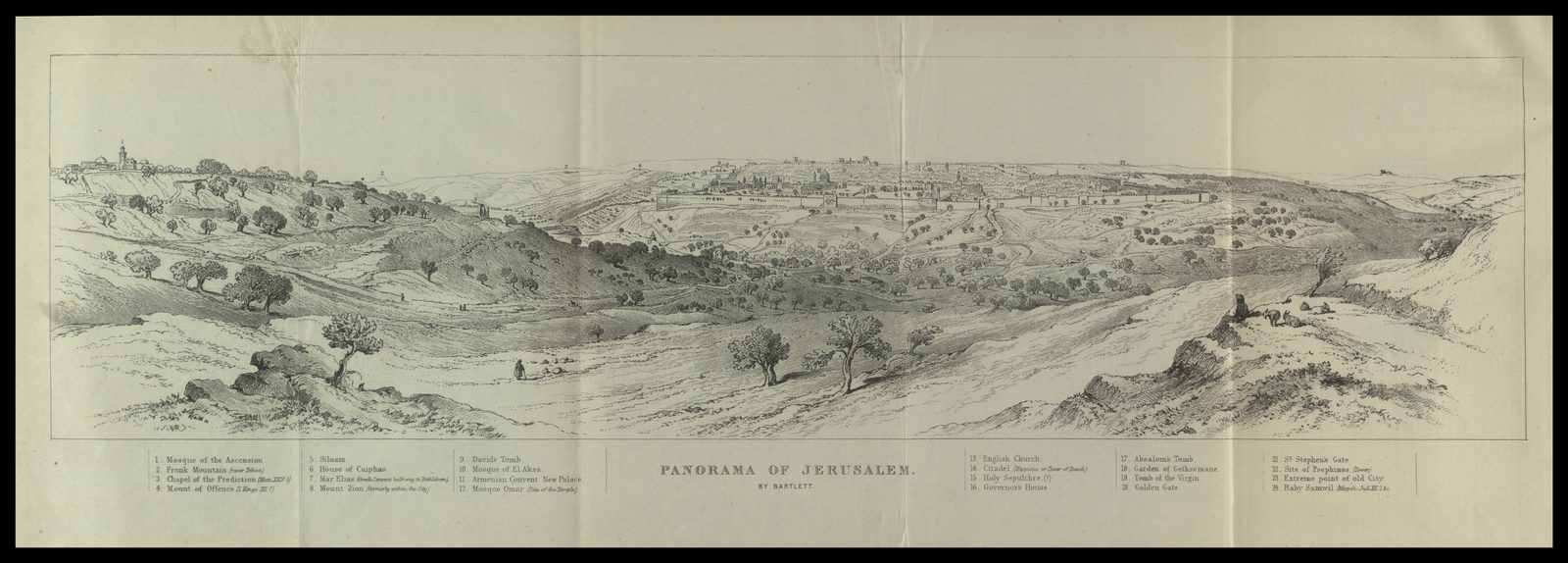
Panorama of Jerusalem. William Henry Bartlett, not stated on the file page. Wikimedia Commons. Public domain.