
Psalm 79
13 verses · Communal lament
Help us, O God of our salvation, for the glory of Your name; deliver us and atone for our sins, for the sake of Your name.
Introduction
Asaph, the Fallen City, Book 3: The crisis of the throne, Poetry, Psalms Overview.
Headed for Asaph, this psalm was sung in the ruins of Jerusalem after an enemy had defiled the temple and left the city's dead unburied. Most readers set it after the Babylonian destruction of 586 BC, and the psalm itself names no empire. It is a community's lament, and it asks for help on one ground above all, the honour of God's own name among the nations who mock Him. Listen for the honest admission of guilt inside the plea, and for the last line, where a broken people still call themselves the flock God tends.
Context
- Who
- Survivors of a national catastrophe, and captives waiting to be marched away
- What
- A communal lament over Jerusalem destroyed, the temple defiled and the dead left unburied.
- Where
- The ruins of Jerusalem.
- When
- After the fall of Jerusalem; the Babylonian destruction of 586 BC fits the scene best, and the psalm names no year.
- Why
- To ask God for forgiveness and rescue for the honour of His own name among the nations.
Historical context
The psalm carries Asaph's heading, and the scene it describes stands centuries after Asaph's own lifetime, which is why the heading is read of the guild that kept his name. The temple is defiled, the city is in heaps and the dead are unburied, which fits the Babylonian destruction of 586 BC more closely than any other event, although the psalm names no empire. Burial was a sacred duty in Israel, so leaving the dead in the open was the last humiliation an army could impose, and palace reliefs of the period put corpses and scavenging birds into their victory scenes. A defeated nation's god was assumed to have been defeated with it, so the taunt asking where Israel's God is was an argument about God Himself.
Significance
The psalm gave national grief a liturgy. Israel could sing its worst day in public without pretending it was undeserved and without letting go of the claim that it was still God's people, and it sang its last line, the sheep of God's pasture giving thanks from generation to generation, standing in the ruins.
This chapter in Jewish lifeWhat this chapter is in Jewish life and reading.
How it is read
Rashi opens on the problem every reader of this psalm meets. The heading calls it a song while the body describes Jerusalem in heaps, and he asks the question outright before answering it. God spent His fury, as Lamentations 4:11 says, by kindling a fire in Zion. Rashi calls that an occasion for singing, "for He poured out His fury on the wood and stones and did not utterly destroy His children" (Rashi on Psalms 79:1:1). That is the classical Jewish reading of the ruin in one sentence, and it is worth a Christian reader's attention. The second comment carries a ruling of the same kind. The dead are called God's pious ones in verse 2, and Rashi asks whether they were not wicked. His answer is that punishment received makes a man pious again, as a man lashed under Deuteronomy 25:3 is your brother as soon as he is lashed. He takes the reading from the Aggadah at Midrash Tehillim 79:4 (Rashi on Psalms 79:2:1). The plea of verse 11 he keeps concrete, asking that the prisoners be released and that the children of the mother killed for God's sake be spared (Rashi on Psalms 79:11:1 and 79:11:2). Ibn Ezra and Radak stand in the corpus on this psalm seventeen times between them, every comment cited by reference alone. Rashi is quoted here from the Judaica Press complete Tanach with Rashi, translated by A. J. Rosenberg, under CC-BY.
What the rabbis say
The corpus records forty places where the Midrash and the Talmud draw on this psalm, cited here by reference, and the lament literature carries most of them. Eikhah Rabbah reads the psalm at 1:37, 3:22, 4:14 and 5:2. Midrash Tehillim treats its verses at 6:2, 13:1, 22:12, 42:5, 106:2, 119:24 and 149:4. Verse 1, on the nations come into God's inheritance, is drawn into the Babylonian Talmud at Kiddushin 31b:3. Verse 12, asking that the reproach be repaid sevenfold, stands at Bereshit Rabbah 38:1, Pesikta DeRav Kahana 3:6 and Midrash Tanchuma, Ki Teitzei 9:1. Verse 6, on the wrath poured out on the nations that do not know God, is read at Midrash Tanchuma, Nitzavim 1:1 and its Buber recension at 3:1.
Sources: Rashi, Rashi on Psalms 79:1 to 79:11, the Judaica Press complete Tanach with Rashi, translated by A. J. Rosenberg, CC-BY, 1040 to 1105; Midrash Tehillim, 79:4, cited by Rashi, and 6:2, 13:1 and 22:12, cited by reference; Eikhah Rabbah, 1:37, 3:22, 4:14 and 5:2, cited by reference; Babylonian Talmud, Kiddushin 31b:3, cited by reference; The Sefaria corpus, scripts/data/sources/sefaria/psalms/79.json, fetched 2026-09-19, 2026.
Psalms 79:1-4
The nations, O God, have invaded Your inheritance: A foreign army holds the land, the temple is defiled, and Jerusalem is rubble. The Babylonian destruction of the city stands at 2 Kings 25:9. Bodies went to the birds and the beasts, and no one was left to bury the dead.
Psalms 79:1
“O God, the heathen are come into thine inheritance. It is the cry of amazement at sacrilegious intrusion; as if the poet were struck with horror. The stranger pollutes thine hallowed courts with his tread. All Canaan is thy land, but thy foes have ravaged it. "Thy holy temple have they defiled." Into the inmost sanctuary they have profanely forced their way, and there behaved themselves arrogantly. Thus, the holy land, the holy house, and the holy city, were all polluted by the uncircumcised.”
Charles Spurgeon · The Treasury of David, Vol. 4 (1874)Particular Baptist
the flesh of Your saints: Augustine noticed that each half of the verse repeats the other. Corpses answer to flesh and servants to saints, and only the birds and the beasts change places. Charles Spurgeon said the dead were left because too few Israelites survived to bury them.
Psalms 79:2
“The dead bodies of thy servants have they given to be meat unto the fowls of the heaven,.... For such there were, both at the time of the Babylonish captivity, and in the times of Antiochus, who were good men, and served the Lord, and yet suffered in the common calamity.”
They have poured out their blood like water: Spurgeon read blood poured out like water as the price the nations set on a life, worth no more than water. Augustine answered the grief over dead saints with no one to bury them. They will rise, he held, whatever became of their corpses.
Psalms 79:3
“Their blood have they shed like water round about Jerusalem - They have poured it out in such quantities that it seems to flow like water - not an uncommon occurrence in war. There was no event in the history of the Hebrews to which this description would be more applicable than to the Babylonian invasion.”
a scorn and derision to those around us: Barnes noted that these words match Psalm 44:13, as if one psalm borrowed from the other. Spurgeon heard the neighbors ask, Where is their God? Their scorn and derision took great suffering as proof of great sin.
Psalms 79:4
“We are become a reproach to our neighbours,.... That is, those that remained; so the Jews were to the Edomites, especially at the time of the Babylonish captivity, Psa 137:7, a scorn and derision to them that are round about us; as the Christians in all ages have been to the men of the world, and especially will be insulted and triumphed over when the witnesses are slain, Rev 11:10.”
1 more voice on this verse
Psalms 79:4
“But it has been the lot of the gospel-Israel to be made unjustly a reproach and derision; the apostles themselves were counted as the offscouring of all things.”
Matthew Henry · Commentary on the Whole Bible (1707-1721)puritan
Psalms 79:5-7
Will You be angry forever?: Three questions press for an end without naming a date, and the last asks whether God's jealousy will burn like fire. The prayer of verse 6 turns outward, and Gill reads its target by conduct, the nations that never call on His name. They devoured Jacob and devastated his homeland.
Psalms 79:5
“Some things mentioned in the Bible are not factual; some factual things are not mentioned; some nonfactual things receive no mention there; some things are both factual and mentioned. Do you ask for my proofs here? I am ready to offer them. In the Bible, God "sleeps," "wakes up," "is angered," "walks" and has a "throne of cherubim." Yet when has God ever been subject to emotion? When do you ever hear that God is a bodily being? This is a nonfactual, mental picture.”
Gregory of Nazianzus · written before 390 · On the Holy Spirit, Theological Oration 5[31].22patristic
on the kingdoms that refuse to call on Your name: Spurgeon heard Israel asking God to pour out His wrath past His erring children, on nations that never acknowledge Him. Those who call are set against those who refuse. Augustine took the words as prophecy foreseen by the Spirit, like the fate of Judas.
Psalms 79:6
"Pour out thy wrath upon the heathen that have not known thee." If thou must smite look further afield; spare thy children and strike thy foes. There are lands where thou art in no measure acknowledged; be pleased to visit these first with thy judgments, and let thine erring Israel have a respite. "And upon the kingdoms that have not called upon thy name." Hear us the prayerful, and avenge thyself upon the prayerless.
Charles Spurgeon · The Treasury of David, Vol. 4 (1874)Particular Baptist
devastated his homeland: Barnes read devoured as eaten, the nations consuming all the land produced. Augustine took the homeland of Jacob as Jerusalem and its holy temple, where the people gathered for sacrifice. Harvest and temple were both devastated.
Psalms 79:7
“For they have devoured Jacob,.... The posterity of Jacob, the people of the Jews, typical of the church of God, made havoc of by the Romish antichrist: and laid waste his dwelling place; both Jerusalem and the temple, which was done both by the Chaldeans and the Romans, and also in the times of Antiochus; see the Apocrypha: "38 Insomuch that the inhabitants of Jerusalem fled because of them: whereupon the city was made an habitation of strangers, and became strange to those that were born in her; and her own children left her.”
Psalms 79:8-9
Do not hold past sins against us: The prayer turns from the enemy to the people's own sins, and asks pardon before relief. The appeal rests on God's own name and His glory, the same ground Moses took at Exodus 32:12. Henry reads the two requests, rescue and pardon, as one.
Psalms 79:8
“Remember not against us former iniquities - Visit us not for the sins of our forefathers. Speedily prevent us - Let them go before us, and turn us out of the path of destruction; for there is no help for us but in thee. We are brought very low - Literally, “We are greatly thinned.” Few of us remain.”
Adam Clarke · Commentary on the Bible (1810-1826)evangelical
2 more voices on this verse
Psalms 79:8
“In the captivity of Babylon former iniquities were brought to account; but God promises not again to do so ( Jer. xxxi. 29, 30 ), and so they pray, "Remember not against us our first sins," which some make to look as far back as the golden calf, because God said, In the day when I visit I will visit for this sin of theirs upon them, Exod. xxxii.”
Matthew Henry · Commentary on the Whole Bible (1707-1721)puritan
Psalms 79:8
“Since we have become poor. Since you became poor for our sake, therefore we too have become poor. "The prayer of the poor man, when he is in anguish, and pours out his prayer before the Lord." Since you became poor, though you were rich, we too have become poor.”
Jerome · written before 420 · Homily 12, on Psalm 78patristic
atone for our sins: Jamieson, Fausset and Brown gave the Hebrew as a plea for God to provide atonement. The people own the sins that brought them low. Spurgeon said the defeat had tarnished God's name before the nations, so deliverance would restore the glory of His name.
Psalms 79:9
“Help us, O God our Savior. In the Hebrew it has "Help us, O God our Jesus." For wherever there is "Savior," there the Hebrew has "Jesus." Thus Gabriel, when he came to Mary, said, "And you shall call him Jesus: for he shall save his people." Help us, O God our Jesus. See what he says: "help." He who says "help" is himself also striving to be set free: for God does not help us while we sleep, but while we labor.”
Jerome · written before 420 · Homily 12, on Psalm 78patristic
Psalms 79:10-11
The taunt of the nations is the ground of the prayer, that God's vengeance for the bloodshed of His servants be made known. Verse 11 asks for the groans of the captives to reach Him and for those condemned to be preserved. Spurgeon reads the plea narrowing to the prisoners.
Psalms 79:10
“By making bare his everlasting arm on their behalf he would make unto himself an everlasting name; and their deliverance would be a type and figure of the great salvation, which in the fulness of time Messiah the Prince would work out, to the glory of God's name.”
Matthew Henry · Commentary on the Whole Bible (1707-1721)puritan
preserve those condemned to death: Clarke read those condemned to death as sons of death, deserving it for their sins and marked for it by their captors. Henry said that man's extremity is God's opportunity. The strength of His arm alone can preserve such captives.
Psalms 79:11
"Let the sighing of the prisoner come before thee." When thy people cannot sing, and dare not shout aloud, then let their silent sigh ascend into thine ear, and secure for them deliverance. These words are suitable for the afflicted in a great variety of conditions; men of experience will know how to adapt them to their own position and to use them in reference to others. "According to the greatness of thy power preserve thou those that are appointed to die."
Charles Spurgeon · The Treasury of David, Vol. 4 (1874)Particular Baptist
3 more voices on this verse
Psalms 79:11
“Let the groaning of the fettered enter into your sight. This is what those who follow the teachings of Origen are accustomed to say: The groaning of the fettered — that is, of the angels, they say, who have been fettered in bodies. For just as, if fetters are put on the feet, they weigh down the body and do not allow it to run; so also our bodies enclose souls — that is, angels — and weigh them down upon the earth. And with what words do they prove this?”
Jerome · written before 420 · Homily 12, on Psalm 78patristic
Psalms 79:11
“The sighing of the prisoner - The poor captive Israelites in Babylon, who sigh and cry because of their bondage. Those that are appointed to die - בני תמותה beney themuthah, “sons of death.” Either those who were condemned to death because of their crimes, or condemned to be destroyed by their oppressors. Both these senses apply to the Israelites: they were sons of death, i.e., worthy of death because of their sins against God; they were condemned to death or utter destruction, by their Babylonish enemies.”
Adam Clarke · Commentary on the Bible (1810-1826)evangelical
Psalms 79:11
“Let the sighing of the prisoner come before thee - The sighing of him who is bound. The allusion here is, doubtless, to those among the Hebrews who had been taken captives, and who “sighed” not only on account of the sufferings which they endured in their bondage, but because they had been taken from their country and home. The meaning is, “Hear those sighs, and come for the deliverance of those who are thus held in captivity.” According to the greatness of thy power - Margin, as in Hebrew, thine arm. The arm is the symbol of power.”
Psalms 79:12-13
Pay back into the laps of our neighbors: The psalm asks God to pay the reproach back sevenfold into the laps of the neighbors who hurled it at Him. The repaying is left to God. Then the sheep of His pasture vow thanks forever, and the shepherd picture returns at Psalm 80:1.
Psalms 79:12
“Render to our neighbors sevenfold into their bosom. It seems to me that he does not ask against them, but for them: that is, give them your sabbath. Now "sabbath" is interpreted as rest. What he says is this: make them rest in their wickedness. Or else, otherwise: render it to them here, and do not render it to them in the time to come.”
Jerome · written before 420 · Homily 12, on Psalm 78patristic
1 more voice on this verse
Psalms 79:12
“This prayer is a prophecy, of the same import with that of Enoch, that God will convince sinners of all their hard speeches which they have spoken against him ( Jude 15 ) and will return them into their own bosoms by everlasting terrors at the remembrance of them.”
Matthew Henry · Commentary on the Whole Bible (1707-1721)puritan
the sheep of Your pasture: Henry heard a plea inside the vow. Brought low as they were, the people were still the sheep of God's pasture, and they pleaded to be saved as His own. Spurgeon added that the church declares such deliverances from generation to generation.
Psalms 79:13
“But we your people and the sheep of your pasture. When he says "sheep," he signifies innocence. Sheep have nothing but a shepherd. We will give you thanks forever. We will confess: either we do penance, or, what is better, we glorify. From generation to generation; among the first people, and among the second people. Although according to the historical sense it is said otherwise in Ezekiel, nevertheless according to the spiritual understanding we say this, since these two peoples — that is, the two rods — are joined together in Ezekiel, and become one kingdom.”
Jerome · written before 420 · Homily 12, on Psalm 78patristic
1 more voice on this verse
Psalms 79:13
“So we thy people, and sheep of thy pasture - See the notes at Psa 74:1. Will give thee thanks for ever - Will praise thee always; will acknowledge thee as our God, and will evermore render thee thanksgiving. We will shew forth thy praise to all generations - Margin, as in Hebrew, to generation and generation. That is, We will make arrangements that the memory of these gracious acts shall be transmitted to future times; to distant generations.”
How this psalm is built
The form: A prophecy of what befell the city, sung before the thing had happened, as Hippo classes it.
The patterns in this chapter
| Device | What it does | Where to see it |
|---|---|---|
| The same loss said twice in every line | Verses 1 to 4 double each statement. The inheritance invaded is the temple defiled, the corpses given to the birds are the flesh given to the beasts, the reproach is the scorn and the derision. Augustine notes the repetition as the psalm's method and reads the second limb of each pair as the first said again.Augustine of Hippo, Exposition on Psalm 79, 430, on Psalm 79:2 and 4. | Psalm 79:1, Psalm 79:2, Psalm 79:4 |
| The name of God as the ground of every request | Verse 9 asks twice in one verse: deliver us for the glory of Your name, and atone for our sins for the sake of Your name. Verse 6 names the nations that refuse to call on that name and verse 10 gives the taunt, Where is their God. The psalm rests its whole case on what is owed to the name rather than on what is owed to the sufferers. | Psalm 79:6, Psalm 79:9, Psalm 79:10 |
| The turn from we to they and back | Verses 1 to 4 report what the nations did. Verses 5 to 9 speak to God as we. Verses 10 to 12 put the taunt of the nations into the psalm's own mouth and ask for it to be repaid. Verse 13 answers the whole psalm by naming who the speakers are, the sheep of God's pasture, and what they will do afterwards. | Psalm 79:4, Psalm 79:10, Psalm 79:13 |
The psalm sits in the Asaph group and it is the second of the pair with Psalm 74, which describes the same ruin of the sanctuary at greater length and asks the same question, how long. Read together the two psalms give the lament of the sanctuary twice over, and Psalm 79 is the shorter and the more terrible of them.
8 more paragraphs on the patterns
Verse 13 ties the psalm to the shepherd language that runs through this part of the Psalter. Psalm 74 calls the people the sheep of God's pasture, Psalm 78 ends with David brought from the sheepfolds to shepherd them, and Psalm 80 opens by calling God the Shepherd of Israel. Four consecutive psalms hold the same figure, and Psalm 79 puts it in the last line where it carries the whole weight of the promise.
The pattern inside the psalm is a steady movement outward. It begins with what was done to the temple, moves to what was done to the bodies, then to what the neighbours say, then to what the nations say, and ends with what the generations to come will say. The last voice in the psalm is the one furthest from the disaster.
The New Testament's use
No verse of Psalm 79 is quoted in the New Testament. Revelation 6:10 asks how long in the same form and on the same ground, the blood of God's servants unavenged, and the church has read the two together, but the psalm is not cited by chapter and verse anywhere in the New Testament.
The debated point
Verse 12 asks for a sevenfold repayment into the laps of the neighbours, and verse 6 asks for God's wrath to be poured out on the nations. Whether such a prayer may be prayed is the oldest dispute the psalm carries. Augustine holds that verse 6 is a prophecy foreseen by the Spirit and predicted rather than a wish of malice, and compares the foretelling of the evils to befall Judas. The other position takes the imprecation as a real prayer of a wronged people, lawful because vengeance is being handed to God rather than taken. Both positions are held by teachers the site cites, and neither treats the words as a mistake in the text.
Where to go deeper
The curse psalms as a class are set out at the imprecatory psalms, and how to pray them at praying the hard psalms. The fall of the city is set out at the exile and return.
Keep studying
Sources for this chapter
The summary
Jamieson, Fausset & Brown, Commentary Critical and Explanatory; John Calvin, Commentaries; John Wesley, Notes on the Old Testament and Matthew Henry, Complete Commentary.
The form and classifications
Augustine of Hippo, Exposition on Psalm 79, 430, on Psalm 79:1; Charles Spurgeon, The Treasury of David, Vol. 4, 1874, on Psalm 79:1 and Matthew Henry, Commentary on the Whole Bible, 1710, on Psalm 79:9.
The exposition
Adam Clarke, Commentary on the Bible; Albert Barnes; Augustine of Hippo; Charles Spurgeon; Franz Delitzsch, Biblical Commentary on the Psalms; Jamieson, Fausset & Brown, Commentary Critical and Explanatory on the Whole Bible; John Calvin, Commentary on the Book of Psalms; John Gill, Exposition of the Old Testament and Matthew Henry, Commentary on the Whole Bible.
The painting
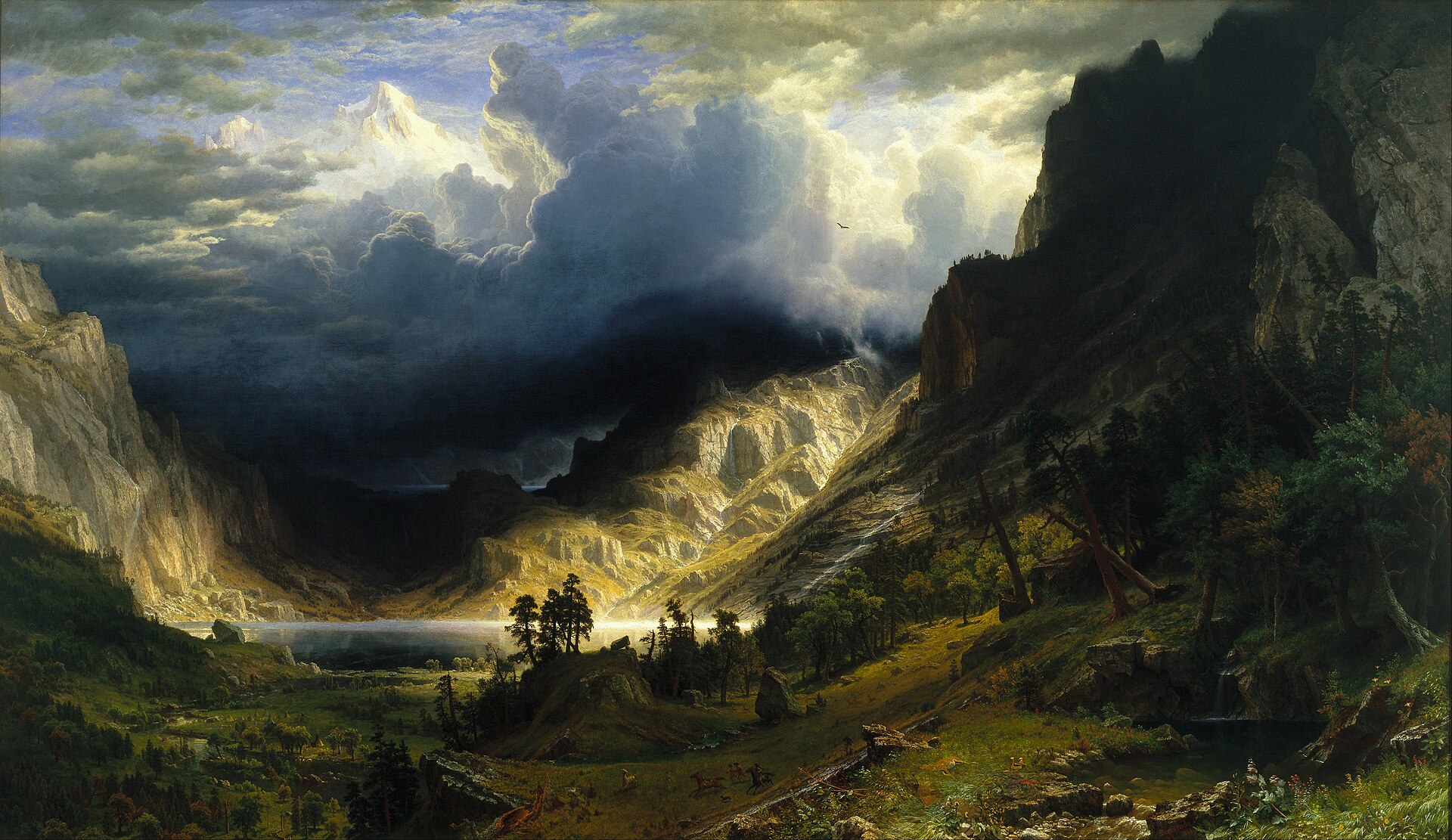
A Storm in the Rocky Mountains, Mt. Rosalie. Albert Bierstadt, 1866. Wikimedia Commons. Public domain.