
Psalm 44
26 verses · Psalm of lament
Wake up, O Lord! Why are You sleeping? Arise! Do not reject us forever.
Introduction
The sons of Korah, the National Lament, Book 2: The Elohistic Psalter, Poetry, Psalms Overview.
The sons of Korah wrote this for a nation that had lost a war and could not say why. It names no king, no enemy and no battle, so Israel could sing it after any defeat. The people had heard from their fathers how God won the land for them, and they insist they have kept the covenant since. Listen for the change from the old story to the present shame, and for the oath of innocence the people swear. The psalm ends with its prayer still open, and Paul quotes one of its lines in Romans 8 of believers who suffer.
Context
- Who
- Israelites who had kept the covenant and been beaten anyway
- What
- A national lament after a defeat, set against the story of how God won the land for Israel's fathers.
- Where
- Israel after a lost war, with its captives sold abroad and its neighbours mocking.
- When
- The date is unstated, and commentators place it in the monarchy, the divided kingdom or the Maccabean period.
- Why
- To bring before God a suffering the people could not explain, and to ask Him to rise and redeem them.
Historical context
The psalm is ascribed to the sons of Korah and titled a maskil, an instruction. It names no king, no enemy and no battle, which is why commentators have placed it in the monarchy, in the divided kingdom and in the Maccabean period without agreement, and it is also why the psalm could be used after any defeat. Verses 1 to 3 are the conquest told by a generation that heard it from its fathers, which was a duty laid on every household at Deuteronomy 6:20 to 25. Prisoners of war were sold as slaves, and the complaint of verse 12 is that the seller took no price. A beaten nation became a byword, a name used by its neighbours as a proverb for failure. Jackals lived in ruins, so the lair of jackals at verse 19 means a land gone back to waste after its people were taken off it. Spreading out the hands at verse 20 is the posture of prayer, so the oath of innocence is specifically about worship.
Significance
For the first hearers the psalm made a complaint they could not otherwise make. It swore that the covenant had been kept and then said that God had rejected them anyway, and it put both in the same poem. It ends with no turn to praise and no report of rescue, which let the psalm be sung by people whose trouble had not lifted.
This chapter in Jewish lifeWhat this chapter is in Jewish life and reading.
How it is read
Rashi reads this psalm as spoken by the sons of Korah for the generations after them, and he gives his reason from the psalm's own words:
From here you learn that the sons of Korah were speaking for the generations following them, for if it were for themselves, they should not say, “our fathers told us,” because they themselves witnessed the miracles of the desert, the Jordan, and Joshua’s war. (Rashi on Psalms 44:2:1)
The defeat the psalm complains of is therefore the defeat of a later Israel, and Rashi reads the crushing of the twentieth line as a test the people passed, at Rashi on Psalms 44:20:1, where a people humbled in a place of serpents still did not forget the name of their God. On the line about sheep for the slaughter, which the New Testament writers take up for the church under persecution, he writes six words and leaves it on Israel:
as sheep for the slaughter As sheep of slaughter. (Rashi on Psalms 44:23:1)
Ibn Ezra stands on this chapter at Ibn Ezra on Psalms 44:7:1, 44:8:1, 44:9:1, 44:13:1, 44:14:1, 44:15:1, 44:16:1, 44:17:1, 44:18:1, 44:19:1, 44:21:1, 44:22:1 and 44:24:1 and Malbim at Malbim on Psalms 44:1:1. Sefaria holds no English version of those references, so this card cites them without quotation.
What the rabbis say
The corpus records 40 places where the rabbinic literature takes up a line of this psalm, 35 of them in the Midrash. Rashi points to one of them himself at Rashi on Psalms 44:2:1, citing the Aggadah of the Psalms on this chapter for the reading that the sons of Korah spoke for the generations after them. The Midrash on the Psalms treats the psalm at Midrash Tehillim 44:1, 105:7, 9:8 and 119:11, Midrash Lekach Tov at Midrash Lekach Tov, Leviticus 26:45:1, Deuteronomy 30:10:1, Exodus 15:2:9 and Exodus 2:23:2 and Midrash Tanchuma Buber at Midrash Tanchuma Buber, Appendix to Devarim 8:1, Lech Lecha 11:1 and Behar 3:1. The Talmud takes up lines of the psalm at Taanit 24b:9, Bava Batra 123a:6, Jerusalem Talmud Berakhot 5:1:5, Temurah 30a:9 and Jerusalem Talmud Maaser Sheni 5:5:15.
Sources: Rashi, Rashi on Psalms, in The Judaica Press complete Tanach with Rashi, translated by A. J. Rosenberg, under a CC-BY licence; Ibn Ezra, Ibn Ezra on Psalms, cited at Ibn Ezra on Psalms 44:7:1, 44:8:1, 44:9:1, 44:13:1, 44:14:1, 44:15:1, 44:16:1, 44:17:1, 44:18:1, 44:19:1, 44:21:1, 44:22:1 and 44:24:1; Malbim, Malbim on Psalms, cited at Malbim on Psalms 44:1:1; Midrash Tehillim, the Midrash on the Psalms, cited at Midrash Tehillim 44:1, 105:7, 9:8 and 119:11; The Talmud, cited at Taanit 24b:9, Bava Batra 123a:6, Jerusalem Talmud Berakhot 5:1:5, Temurah 30a:9 and Jerusalem Talmud Maaser Sheni 5:5:15; MannaFest, the Sefaria corpus at scripts/data/sources/sefaria/psalms/44.json, fetched 2026-09-19, 2026.
Psalms 44:1-3
We have heard with our ears: The fathers told what God did in their days. His hand drove out the nations, and verse 3 puts the victory in God's right hand, His arm, and the light of His face. Delitzsch reads the denial of sword and arm as a correction of national pride.
Psalms 44:1
“The expression, We have heard with our ears, is not to be considered as a redundant form of speech, but one of great weight. It is designed to point out that the grace of God towards their fathers was so renowned, that no doubt could be entertained respecting it.”
John Calvin · Commentaries (1554)reformed
planted our fathers there: Jamieson, Fausset and Brown read the verb behind cast them out as send out or spread, with the fathers as its object. On that reading God spread the fathers in the land as He crushed the peoples. Clarke saw a bad tree uprooted and a good vine planted.
Psalms 44:2
“How thou didst drive out the heathen with thy hand. The destruction of the Canaanites from the promised land is the work here brought to remembrance. A people numerous, warlike, gigantic and courageous, firmly established and strongly fortified, were driven out by a far feebler nation, because the Lord was against them in the fight.”
Charles Spurgeon · The Treasury of David, Vol. 2 (1870)Particular Baptist
1 more voice on this verse
Psalms 44:2
“He fought for Israel, else they would have fought in vain; it was through him that they did valiantly and victoriously. It was God that planted Israel in that good land, as the careful husbandman plants a tree, from which he promises himself fruit. This is applicable to the planting of the Christian church in the world, by the preaching of the gospel.”
Matthew Henry · Commentary on the Whole Bible (1707-1721)puritan
the light of Your face: Clarke notes the fathers still had to fight for the land. Spurgeon agreed that the tribes fought with sword and arm, with the victory owed to the Lord alone. Barnes saw the memory as an appeal, for the God who gave them the land could save again.
Psalms 44:3
Our ancestors, as heirs and next of kin of the patriarchs, were planted in the promised land. They did not gain this by any merits of their own. It was not Moses who led them in, for fear they should attribute it to the Law and not to grace. For the Law examines our merits; but grace looks to faith. How excellently the apostle has followed the faith of his ancestors when he says, "he that plants is nothing, he that waters is nothing. It is God who gives the increase."
Ambrose of Milan · written before 397 · Commentary on Twelve Psalms 44:12patristic
Psalms 44:4-8
You are my King, O God: names the one who ordains victories for Jacob. The weapons are refused: I do not trust in my bow. Henry notes the boast in God stands before the complaint that follows.
Psalms 44:4
Thou art my King--literally, "he who is my King," sustaining the same covenant relation as to the "fathers."
Jamieson, Fausset & Brown · Commentary Critical and Explanatory on the Whole Bible (1871)reformed
through Your name we trample: Barnes and Clarke both note that the verb for repel pictures goring foes with horns. Clarke saw a bull tossing attacking dogs into the air. Spurgeon said the name of the Lord served the people instead of sword and bow.
Psalms 44:5
“Through thee will we push down our enemies. The fight was very close, bows were of no avail, and swords failed to be of service, it came to daggers drawing, and hand to hand wrestling, pushing and tugging. Jacob's God was renewing in the seed of Jacob their father's wrestling. And how fared it with faith then? Could she stand foot to foot with her foe and hold her own? Yea, verily, she came forth victorious from the encounter, for she is great at a close push, and overthrows all her adversaries, the Lord being her helper.”
Charles Spurgeon · The Treasury of David, Vol. 2 (1870)Particular Baptist
I do not trust in my bow: The voice shifts here from the people to a single speaker. Albert Barnes took the speaker as the psalmist, voicing the people's trust in God alone. Adam Clarke would put the verbs in the past tense, to match the story of the fathers.
Psalms 44:6
“For I will not trust in my bow,.... In any carnal weapon, in any creature help and assistance, or in an arm of flesh, but in the word of the Lord, and in his name; see Psa 20:7; neither shall my sword save me; that is, I will not ascribe salvation to it; the church's weapons are not carnal, but spiritual; not the sword of the civil magistrate, but the sword of the Spirit, which is the word of God; Christ's kingdom, being not of this world, is not supported and defended by worldly means, or carnal weapons.”
You save us from our enemies: Barnes reads the verse as past deliverance, the reason to trust neither bow nor sword. Henry named the judges as witnesses. Spurgeon saw God save His people and put their enemies to shame together, as when Israel passed through the sea and Pharaoh drowned.
Psalms 44:7
“But thou hast saved us from our enemies,.... Spiritual ones, and not we ourselves; and therefore will not trust in ourselves, nor in anything of ours, but in the Lord, and give him the glory of salvation; and hast put them to shame that hated us; the men of the world, the seed of the serpent, and the serpent himself, when his works were destroyed, and his principalities and powers spoiled by Christ upon the cross; hence the following boasting of the Lord, and glorying in him.”
In God we have boasted: Albert Barnes notes the Hebrew for boasted leans toward praise. Adam Clarke heard a risk in the boast: Israel had told the nations of its God, and without deliverance they would credit their own gods. Verse 9 then turns at once to complaint.
Psalms 44:8
“In God we boast all the day long,.... Or, as the Targum, "in the word of the Lord", in Christ, who is God over all, and who of God is made to his church and people wisdom, righteousness, sanctification, and redemption; so that there is always matter of glorying and boasting in him; and praise thy name for ever and ever; in this world, as long as life continues; and in the other world to all eternity; both for the works of providence and of grace; for deliverances commanded, and for salvation from all enemies wrought out.”
1 more voice on this verse
Psalms 44:8
“In God we boast all the day long. We have abundant reason for doing so while we recount his mighty acts. What blessed boasting is this! it is the only sort of boasting that is bearable. All other manna bred worms and stank except that which was laid up before the Lord, and all other boasting is loathsome save this glorying in the Lord, which is laudable and pleasing. And praise thy name for ever. Praise should be perpetual.”
Charles Spurgeon · The Treasury of David, Vol. 2 (1870)Particular Baptist
Psalms 44:9-12
You have rejected and humbled: Every verb here has God as its subject. He rejected them, sent them back from the foe, gave them up as sheep to be devoured, and scattered them among the nations. Gill reads the sale that brings no profit as the sharpest edge of the complaint.
Psalms 44:9
“But--contrasting, cast off as abhorrent (Ps 43:2). goest not forth--literally, "will not go" (2Sa 5:23). In several consecutive verses the leading verb is future, and the following one past (in Hebrew), thus denoting the causes and effects.”
Jamieson, Fausset & Brown · Commentary Critical and Explanatory on the Whole Bible (1871)reformed
1 more voice on this verse
Psalms 44:9
“But thou hast cast off, and put us to shame. Here the patriot bard begins to contrast the past glories of the nation's history with its present sadness and distress; which he does not ascribe to the death of some human champion, or to the accidents of war, but solely and alone to the withdrawal of Israel's God. It seemed to the mourner that Jehovah had grown weary of his people and put them away in abhorrence, as men lay aside leprous garments, loathing the sight of them.”
Charles Spurgeon · The Treasury of David, Vol. 2 (1870)Particular Baptist
made us retreat from the foe: Verse 5 drove foes back, and now the foe drives Israel back. Henry saw them flee before those who used to flee before them, while those who hate them have plundered the land. Barnes tied this to Nebuchadnezzar carrying the temple vessels to Babylon.
Psalms 44:10
“One who is carried off by people is not necessarily conquered. Take, for example, Paul. He rejoices in his sufferings. He glories in being let out through a window and lowered in a basket. Look at holy Jeremiah, holy Ezekiel, holy Daniel. These were led into captivity and plundered by the Assyrians. But their own personal faith was never taken captive. They never sinned against the Lord's covenant.”
Ambrose of Milan · written before 397 · Commentary on Twelve Psalms 44:35patristic
sheep to be devoured: Henry notes that the complaint looks past the enemy to God, who has given the people up. Chrysostom called the scattering among the nations hardest of all, with the Law impossible to keep exactly there. Sheep kept only for eating, he said, were least prized.
Psalms 44:11
“Thou hast given us like sheep appointed for meat. As sheep are slaughtered for food, so were the people slain in flocks, with ease, and frequency. Not with dignity of sacrifice, but with the cruelty of the shambles, were they put to death. God appeared to give them up like sheep allotted to the butcher, to abandon them as the hireling abandons the flock to wolves. The complaint is bitterly eloquent. And hast scattered us among the heathen. Many were carried into captivity, far off from the public worship of the temple of God, to pine as exiles among idolaters.”
Charles Spurgeon · The Treasury of David, Vol. 2 (1870)Particular Baptist
You sell Your people for nothing: Adam Clarke heard the language of a slave sale, with the people handed to their enemies as a gift. John Chrysostom pressed the point further. A thing given away for nothing is a thing valued at nothing.
Psalms 44:13-16
a reproach to our neighbors: The words pile up: a mockery, a byword among the nations, a reproach to our neighbors. Then it narrows to one face, shame has covered my face. Clarke reads the list as built from the nation's humiliation down to one man's shame, at the voice of the scorner.
a byword among the nations: Barnes notes the Hebrew for byword can mean a proverb or a mocking song. Clarke and Augustine both heard it used in curses among the nations: may you end like these people. God's people had become a warning to the peoples.
Psalms 44:14
“Thou makest us a byword among the Heathen,.... Among the Papists, as the Jews were among the Gentiles, Deu 28:37; calling them schismatics, heretics, fanatics, and what not? a shaking of the head among the people; by way of indignation, scorn, and contempt; see Psa 22:7.”
1 more voice on this verse
Psalms 44:14
“Thou makest us a byword among the heathen, a shaking of the head among the people. The lamentation is here repeated. They had sunk so low that none did them reverence, but universally and publicly they were treated as infamous and despicable. Those who reviled others dragged in Israel's name by the way as a garnish to their insults, and if perchance they saw one of the seed of Jacob in the street they used lewd gestures to annoy him. Those whose heads were emptiest wagged them at the separated people. They were the common butts of every fool's arrow.”
Charles Spurgeon · The Treasury of David, Vol. 2 (1870)Particular Baptist
shame has covered my face: Barnes and Spurgeon both take the single voice as the psalmist speaking for the whole nation. Spurgeon added that the better the heart, the greater its sympathy. Gill traced the shame on his face to the voice of the scorner in verse 16.
Psalms 44:15
“My confusion is continually before me,.... Meaning that which is the occasion of it; and the shame of my face hath covered me; not by reason of sin, which is often the cause of confusion and shame in God's people; see Jer 3:25; but on account of what follows.”
1 more voice on this verse
Psalms 44:15
“My confusion is continually before me. The poet makes himself the representative of his nation, and declares his own constant distress of soul. He is a man of ill blood who is unconcerned for the sorrows of the church of which he is a member, or the nation of which he is a citizen; the better the heart the greater its sympathy. And the shame of my face hath covered me.”
Charles Spurgeon · The Treasury of David, Vol. 2 (1870)Particular Baptist
bent on revenge: Albert Barnes notes the Hebrew for reviler covers both reproach of people and blasphemy of God, and he finds both here. Spurgeon read the revenge as payback for Israel's old victories. The conquests of verses 2 and 3 now return as insult.
Psalms 44:16
“For the voice of him that reproacheth and blasphemeth. It seems that from mocking the people of God, the adversaries advanced to reviling God himself, they proceeded from persecution to the sin which is next of kin, namely blasphemy. By reason of the enemy and avenger. The enemy boasted of avenging the defeats of their forefathers; they took revenge for the ancient victories of Israel, by insulting over the now fallen people.”
Charles Spurgeon · The Treasury of David, Vol. 2 (1870)Particular Baptist
1 more voice on this verse
Psalms 44:16
“There was therefore strong reason to believe that God would appear for them. As there is no trouble more grievous to a generous and ingenuous mind than reproach and calumny, so there is none more grievous to a holy gracious soul than blasphemy and dishonour done to God. 17 All this is come upon us; yet have we not forgotten thee, neither have we dealt falsely in thy covenant.”
Matthew Henry · Commentary on the Whole Bible (1707-1721)puritan
Psalms 44:17-19
we have not forgotten You: The claim is plain: we have not forgotten You, and the steps have not strayed from Your path. Yet they are crushed in the lair of jackals and covered with deepest darkness. Calvin reads it as affliction with no cause they can name.
Psalms 44:17
“All this is come upon us; yet have we not forgotten thee. Here the psalmist urges that Israel had not turned away from her allegiance to Jehovah. When in the midst of many griefs we can still cling to God in loving obedience, it must be well with us. True fidelity can endure rough usage. Those who follow God for what they get, will leave him when persecution is stirred up, but not so the sincere believer; he will not forget his God, even though the worst come to the worst. Neither have we dealt falsely in thy covenant.”
Charles Spurgeon · The Treasury of David, Vol. 2 (1870)Particular Baptist
Our hearts have not turned back: Heart and steps pair the inner life with the outer walk. Spurgeon read the claim as sincerity, free of willful sin and short of perfection. Barnes took it as the nation's general character, with no turn to a foreign god to explain its affliction.
Psalms 44:18
“Our heart is not turned back, neither have our steps declined from thy way. Heart and life were agreed, and both were true to the Lord's way. Neither within nor without had the godly sufferers offended; they were not absolutely perfect, but they were sincerely free from all wilful transgression.”
Charles Spurgeon · The Treasury of David, Vol. 2 (1870)Particular Baptist
the lair of jackals: Barnes links this verse to the one before: hearts and steps had kept faith too well to deserve being crushed in the lair of jackals. He notes the Hebrew word behind jackals can also mean serpent. Spurgeon put it plainly: better broken by God than from God.
Psalms 44:19
“Though thou hast sore broken us in the place of dragons. Though utterly crushed and rendered desolate and driven as it were to associate with creatures such as jackals, owls, serpents, which haunt deserted ruins, yet Israel remained faithful. To be true to a smiting God, even when the blows lay our joys in ruinous heaps, is to be such as the Lord delighteth in. Better to be broken by God than from God. Better to be in the place of dragons than of deceivers. And covered us with the shadow of death. The language is very strong.”
Charles Spurgeon · The Treasury of David, Vol. 2 (1870)Particular Baptist
Psalms 44:20-22
If we had forgotten the name: The oath is put to the one witness who knows the secrets of the heart. Hands spread to a foreign god would have been found out. Paul quotes verse 22 at Romans 8:36 for the sufferings of believers, sheep to be slaughtered.
Psalms 44:20
“An appeal is now made to the omniscience of God; he is himself called in to bear witness that Israel had not set up another God. If we have forgotten the name of our God. This would be the first step in apostasy; men first forget the true, and then adore the false. Or stretched out our hands to a strange god. Stretching out the hands was the symbol of adoration or of entreaty in prayer; this they had not offered to any of the idols of the heathens.”
Charles Spurgeon · The Treasury of David, Vol. 2 (1870)Particular Baptist
the secrets of the heart?: The argument runs from what God knows to the people's innocence. Spurgeon reasoned that God, who knows the secrets of the heart like a book, knew them faithful, so their affliction had another cause. Barnes drew the same conclusion.
Psalms 44:21
“Shall not God search this out? - That is, If this had been the case, it would be known to God. If, as a nation, we had been given to idolatry, or if our hearts had been secretly alienated from the true God, though there had been no open manifestation of apostasy, yet that could not have been concealed from him.”
4 more voices on this verse
Psalms 44:21
"Shall not God search this out? For He knoweth the secrets of the heart" (ver. 21). He "knows," and yet He "searches them out"? If He knows the secrets of the heart, what do the words, "Shall not God search it out," do there? He "knows" it in Himself; He "searches it out" for our sakes. For it is for this reason God sometimes "searches a thing out;" and speaks of that becoming known to Himself, which He is Himself making known to thee. He is speaking of His own work, not of His knowledge.
Augustine of Hippo · written before 430 · ON THE PSALMS, Psalm 44patristic
Psalms 44:21
“Shall not God search this out?....”
Psalms 44:21
“Shall not God search this out? Could such idolatry be concealed from him? Would he not with holy indignation have detected unfaithfulness to itself, even had it been hidden in the heart and unrevealed in the life? For he knoweth the secrets of the heart. He is acquainted with the inner workings of the mind, and therefore this could not have escaped him. Not the heart only which is secret, but the secrets of the heart, which are secrets of the most secret thing, are as open to God as a book to a reader.”
Charles Spurgeon · The Treasury of David, Vol. 2 (1870)Particular Baptist
Psalms 44:21
“Shall not God search this out? - We confidently appeal to the true Good, the searcher of hearts, for the truth of this statement.”
Adam Clarke · Commentary on the Bible (1810-1826)evangelical
for Your sake: Albert Barnes puts the weight of the verse on the words for Your sake. The suffering comes from loyalty to God, which in his reading makes the sufferers martyrs. Spurgeon heard the martyr's cry in these lines.
Psalms 44:22
“Yea, i.e., assuredly, certainly, for thy sake, not for our offences, but for obeying thee; the trials of these suppliants came upon them because they were loyal to their God. Are we killed all the day long. Persecution never ceased to hound them to the death, they had no respite and found no door of escape; and all in God's behalf, because they would not forsake their covenant God and King.”
Charles Spurgeon · The Treasury of David, Vol. 2 (1870)Particular Baptist
Cross references
Psalms 44:22
- Quoted inRomans 8:36As it is written: “For Your sake we face death all day long; we are considered as sheep to be slaughtered.”
'For thy sake we are killed all the day long' ('as it is written')
Psalms 44:23-26
Wake up, O Lord!: The psalm ends with its boldest words, Wake up, O Lord. The soul has sunk to the dust and the bodies cling to the earth, and the plea for help rests on God's loving devotion. Maclaren notes the prayer is left unanswered inside the psalm.
Psalms 44:23
“Awake, why sleepest thou, O Lord. God sleepeth not, but the psalmist puts it so, as if on no other theory he could explain the divine inaction. He would fain see the great Judge ending oppression and giving peace to the holy, therefore does he cry "Awake; "he cannot understand why the reign of tyranny and the oppression of virtue are permitted, and therefore he enquires "Why sleepest thou?" Arise. This is all thou needest to do, one move of thine will save us. Cast us not off for ever.”
Charles Spurgeon · The Treasury of David, Vol. 2 (1870)Particular Baptist
hide Your face: Barnes notes such questions borrow the language people use with one another, and in the Psalms they mark earnestness without irreverence. Gill held that God never forgets the affliction of His people. Spurgeon allowed such questions to the Lord, even while He seems to hide His face.
Psalms 44:24
“Wherefore hidest thou thy face?.... See Psa 10:1; and forgettest our affliction and our oppression. Not that the Lord does really forget either the persons of his people, which he cannot, since they are engraven on the palms of his hands, and a book of remembrance is written for them: nor the afflictions of his people; he knows their souls in adversity; he chooses them in the furnace of affliction; he makes all afflictions work together for good, and delivers out of them.”
2 more voices on this verse
Psalms 44:24
“Wherefore hidest thou thy face, and forgettest our affliction and our oppression? Not petulantly, but piteously and inquiringly, we may question the Lord when his dealings are mysterious. We are permitted to order our case with arguments, and plead the right before the face of the august Majesty. Why, Lord, dost thou become oblivious of thy children's woes? This question is far more easily asked than answered; it is hard, indeed, in the midst of persecution to see the reason why we are left to suffer so severely.”
Charles Spurgeon · The Treasury of David, Vol. 2 (1870)Particular Baptist
Psalms 44:24
“We cannot see God's face. But there is a place where, by faith, God shows himself to us. The place is with God; and if we were to stand on the rock—that is, in awareness of this flesh and in firmness of faith—we will see as much as can be allowed to us to see. We cannot see the fullness, but we can, in a certain sense, drink in some remnant of his light. Moses did not see the full and entire divinity that dwells in Christ corporeally. But he saw the back of Christ.”
Ambrose of Milan · written before 397 · Commentary on Twelve Psalms 44:91patristic
sunk to the dust: Augustine read the posture as the lowest humiliation there is. A man on his knees can sink further, but one whose body clings to the earth has nowhere lower to go. Clarke heard a plea for help in it: without help soon the soul would sink to death.
Psalms 44:25
“For our soul is bowed down to the dust,.... Which may signify great declension in spiritual things, much dejection of mind, and little exercise of grace, Psa 119:25; or a very low estate in temporals; subjection to their enemies; they setting their feet upon their necks, and obliging them to lick the dust of them: and even it may signify nearness to death itself; see Jos 10:24; our belly cleaveth to the earth; as persons that lie prostrate, being conquered and suppliants.”
on account of Your loving devotion: After the faithfulness claimed in verses 17 to 22, the psalm rests its plea on God's loving devotion alone. Chrysostom saw humility there, a people with much to plead who asked only for mercy. Henry added that only the hand that tears can redeem.
Psalms 44:26
“Arise for our help. A short, but sweet and comprehensive prayer, much to the point, clear, simple, urgent, as all prayers should be. And redeem us for thy mercies' sake. Here is the final plea. The favour is redemption, the plea is mercy; and this, too, in the case of faithful sufferers who had not forgotten their God. Mercy is always a safe plea, and never will any man find a better. Here ends this memorable Psalm, but in heaven its power ends not, but brings down deliverance for the tried people of God.”
Charles Spurgeon · The Treasury of David, Vol. 2 (1870)Particular Baptist
1 more voice on this verse
Psalms 44:26
God's mercy: " O redeem us for they mercies' sake; we depend upon the goodness of thy nature, which is the glory of thy name ( Exod. xxxiv. 6 ), and upon those sure mercies of David which are conveyed by the covenant to all his spiritual seed."
Matthew Henry · Commentary on the Whole Bible (1707-1721)puritan
How this psalm is built
The form: A national lament of the sons of Korah, made after a defeat the survivors could not explain, as Delitzsch classes it.
A Your hand drove out the nations and planted our fathers
Psalm 44:2
B You gave the victories of Jacob
Psalm 44:4
C In God we boast all day long
Psalm 44:8
D But You have rejected and humbled us
Psalm 44:9
C′ We are a byword among the nations
Psalm 44:14
B′ You send us back from the foe
Psalm 44:10
A′ You scatter us among the nations
Psalm 44:11
The patterns in this chapter
| Device | What it does | Where to see it |
|---|---|---|
| Then and now, set against each other by tense | Verses 1 to 8 are what God did in the days of old and verses 9 to 16 are what God has done now, and the two halves answer each other item for item. He drove out the nations and now gives His people up. He planted them in the land and now scatters them among the nations. He gave the victories of Jacob and now sends them back from the foe. The psalm's argument is made by the arrangement before it is made by any sentence.Franz Delitzsch, Biblical Commentary on the Psalms, on Psalm 44:9. | Psalm 44:2, Psalm 44:3, Psalm 44:9, Psalm 44:11 |
| Every verb in the middle has God as its subject | From verse 9 to verse 14 the psalm never blames an enemy. God rejected them, did not go out with their armies, sent them back, gave them up as sheep to be devoured, sold His people for nothing, and made them a byword. John Gill reads the sale that brings no profit as the sharpest edge of the complaint.John Gill, Exposition of the Old Testament, 1748 to 1763, on Psalm 44:12. | Psalm 44:9, Psalm 44:11, Psalm 44:12, Psalm 44:14 |
| The refusal of the sword, stated twice | Verse 3 says the fathers did not win the land by their own sword or arm, and verse 6 says I do not trust in my bow, nor does my sword save me. Delitzsch reads the first as a correction of national pride, and the psalm repeats it so the complaint that follows cannot be read as wounded confidence.Franz Delitzsch, Biblical Commentary on the Psalms, on Psalm 44:3. | Psalm 44:3, Psalm 44:6 |
| The oath of innocence, put to a witness who can check it | Verses 17 to 21 make a sworn claim: the heart has not turned back, the steps have not strayed, and if they had spread their hands to a foreign god, God would have found it out, since He knows the secrets of the heart. The psalm invites the audit rather than asking to be believed.John Calvin, Commentary on the Book of Psalms, 1557, on Psalm 44:21. | Psalm 44:17, Psalm 44:18, Psalm 44:20, Psalm 44:21 |
| Wake up, O Lord | Verse 23 tells God to rouse Himself and asks why He sleeps, which is the boldest imperative addressed to God in the Psalter. Alexander Maclaren notes that the prayer is left unanswered inside the psalm, so the last word of the poem is a request rather than a resolution.Alexander Maclaren, The Psalms, The Expositor's Bible, 1893, on Psalm 44:23. | Psalm 44:23, Psalm 44:26 |
The New Testament's use
8 more paragraphs on the patterns
Paul quotes verse 22 at Romans 8:36: For Your sake we face death all day long; we are considered as sheep to be slaughtered. He puts it inside the passage on what cannot separate believers from the love of Christ, so the apostle uses the psalm's hardest line about God's apparent abandonment as evidence that suffering is not abandonment. A student reading Romans 8 is reading this psalm at the point where the argument turns.
The quotation is exact and it is used without softening. Paul does not answer the psalm's complaint; he grants it and puts it under a larger claim.
The debated concept
The psalm raises the problem of undeserved national suffering, and the positions on it are old. Matthew Henry and the older commentators read the oath of verses 17 to 21 as relative rather than absolute, a claim of covenant loyalty rather than sinlessness, since the same Psalter confesses national sin elsewhere. John Calvin reads it more strongly, as affliction with no cause the sufferers can name, and holds that the psalm is given to the church precisely for the cases where no cause can be found. Both agree that the psalm is not claiming perfection, and neither explains the defeat away.
The date is also contested and the psalm does not settle it. The superscription assigns it to the sons of Korah and gives no event, and commentators have placed the defeat in the monarchy, in the years of the divided kingdom, and in the Maccabean period. Albert Barnes notes that nothing in the text names a king or a battle, so the psalm can be used after any defeat.
Inside the psalm
The boast of verse 8, in God we have boasted all day long, and the complaint of verse 22, for Your sake we face death all day long, use the same phrase. The psalm gives a day to praise and a day to dying in the same construction.
Selah stands once, after verse 8, at the end of the history and before the turn. The one pause in the psalm falls exactly where the argument breaks.
Keep studying
People and groups1
Sources for this chapter
The summary
Jamieson, Fausset & Brown, Commentary Critical and Explanatory; John Calvin, Commentaries; John Wesley, Notes on the Old Testament and Matthew Henry, Complete Commentary.
The form and classifications
Albert Barnes, Notes on the Book of Psalms, 1832 to 1869, on Psalm 44, title; Franz Delitzsch, Biblical Commentary on the Psalms, on Psalm 44; John Calvin, Commentary on the Book of Psalms, 1557, on Psalm 44:17 and Matthew Henry, Commentary on the Whole Bible, 1710, on Psalm 44.
The exposition
Adam Clarke, Commentary on the Bible; Albert Barnes; Alexander Maclaren, The Psalms, Expositor's Bible; Augustine of Hippo; Charles Spurgeon, The Treasury of David; Franz Delitzsch, Biblical Commentary on the Psalms; Jamieson, Fausset & Brown, Commentary Critical and Explanatory on the Whole Bible; John Calvin, Commentary on the Book of Psalms; John Chrysostom, Commentary on the Psalms; John Gill, Exposition of the Old Testament; John Wesley, Explanatory Notes upon the Old Testament and Matthew Henry, Commentary on the Whole Bible.
The painting
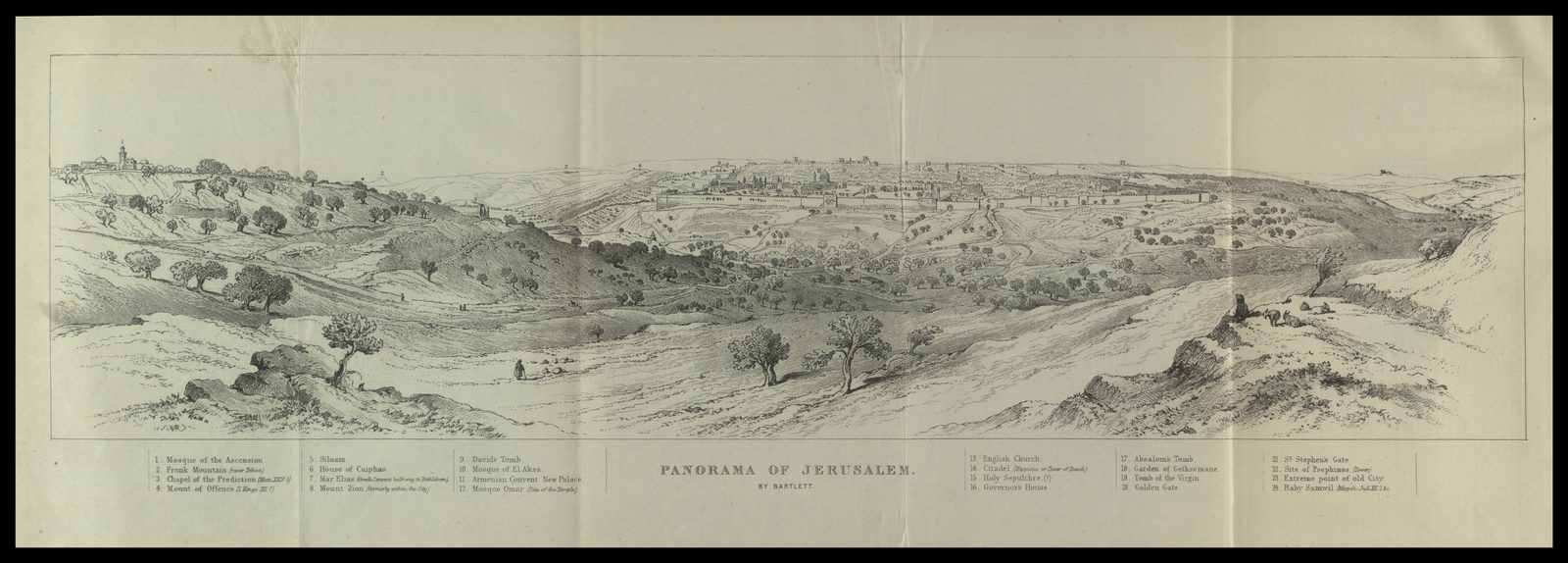
Panorama of Jerusalem. William Henry Bartlett, not stated on the file page. Wikimedia Commons. Public domain.