
Psalm 34
22 verses · Acrostic psalm of thanksgiving
Taste and see that the LORD is good; blessed is the man who takes refuge in Him!
Introduction
David, the Escape from Gath, Book 1: The book of David, Poetry, Psalms Overview.
David wrote this psalm after his escape from the Philistine king at Gath, the episode told in 1 Samuel 21. He was a fugitive from Saul, and he had saved his life by acting the madman before the king's servants. The praise comes from a man with no dignity left to guard. It was written for Israelites in trouble and for the young, whom its second half sits down to teach. The psalm runs the Hebrew alphabet, one verse to a letter. Listen for one man's rescue told first and then made a rule for all who revere God.
Context
- Who
- Israelites in trouble, and the young whom the psalm calls children and sits down to teach
- What
- An alphabetic psalm of thanksgiving in which one man's rescue becomes a lesson for all who fear the LORD.
- Where
- Gath, a Philistine city, and afterwards the cave of Adullam where David's men gathered
- When
- The reign of Saul, about 1015 BC, when David fled to Gath, the episode told at 1 Samuel 21:10 to 15.
- Why
- To turn one answered cry into a standing rule a hearer could claim, and to teach the young how to live.
Historical context
The psalm is David's by its title, and the title fixes it to a day. The narrative at 1 Samuel 21:10 to 15 tells the same episode with the Philistine king named Achish. David was a fugitive at the time. He had fled Saul, gone to the enemy city of Gath with Goliath's sword, been recognised by Achish's servants, and escaped by feigning madness. The praise in this psalm is written by a man who had just saved his life by making himself contemptible. Verse 7, the angel of the LORD encamping around those who fear Him, uses the language of a military camp thrown around a person. The psalm runs the Hebrew alphabet, one verse to a letter, with no line opening on waw and the last letter taking two verses.
Significance
For the first hearers the psalm did two things at once. It reported that a particular poor man cried and was heard at verse 6. At verse 17 it turned that one case into a standing rule for the righteous, so a hearer could put himself into the promise. From verse 11 it became a school. The subject named is the fear of the LORD, and the answer to who wants a good life is entirely practical.
This chapter in Jewish lifeWhat this chapter is in Jewish life and reading.
How it is read
Rashi reads the heading of this psalm against the story in Samuel where David feigns madness before a Philistine king, setting it beside I Samuel 21:14 and the changed speech and the saliva run down on the beard, at Rashi on Psalms 34:1:1. He then settles the name the heading gives that king, and reports what the Midrash made of it, at Rashi on Psalms 34:1:2, where Abimelech is given as the title of every Philistine king and Achish as this one's own name. On the boasting of the first lines he writes:
My soul boasts of the Lord I boast, and praise myself that I have a patron like this to save me and protect me. (Rashi on Psalms 34:3:1)
On the evils that fall on the righteous he writes:
Many evils befall the righteous Many evils and terrors befall him, and he is saved from all of them. (Rashi on Psalms 34:20:1)
On the promise that the bones of the righteous are kept he writes:
He guards The Holy One, blessed be He, [guards] all his bones. (Rashi on Psalms 34:21:1)
That line is where the Jewish reading and the Christian reading meet and part. This site's page on the Gospel of John sets the same line beside John 19:36, where the Gospel takes the unbroken bones of the righteous man as fulfilled in the death of Jesus. Ibn Ezra stands on this chapter at Ibn Ezra on Psalms 34:2:1, 34:4:1, 34:7:1, 34:8:1, 34:12:1, 34:13:1, 34:14:1, 34:16:1 and 34:19:1, and Sefaria holds no English version of those references, so this card cites them without quotation.
What the rabbis say
The corpus records 40 places where the rabbinic literature takes up a line of this psalm, 32 of them in the Midrash. Rashi points to one of them himself at Rashi on Psalms 34:1:2, citing the Midrash on the Psalms at its comment on this chapter's heading for the reading that the Philistine king was as righteous as the Abimelech of Genesis, since he refused to kill David when his men named him king of the land. The Midrash on the Psalms treats the psalm at Midrash Tehillim 142:1, 34:1, 32:1, 4:3, 32:2 and 34:2, and Aggadat Bereshit at Aggadat Bereshit 29:3, 77:2, 11:2, 84:2, 55:1, 82:4, 19:1, 69:2 and 52:1. The Talmud takes up lines of the psalm at Berakhot 48b:6, Berakhot 45a:6, Avot DeRabbi Natan, Recension B 32:23, Jerusalem Talmud Yevamot 1:6:5, Avodah Zarah 19b:9, Avodah Zarah 19b:10, Avot DeRabbi Natan 12:6 and Jerusalem Talmud Avodah Zarah 3:1:4.
Sources: Rashi, Rashi on Psalms, in The Judaica Press complete Tanach with Rashi, translated by A. J. Rosenberg, under a CC-BY licence; Ibn Ezra, Ibn Ezra on Psalms, cited at Ibn Ezra on Psalms 34:2:1, 34:4:1, 34:7:1, 34:8:1, 34:12:1, 34:13:1, 34:14:1, 34:16:1 and 34:19:1; Midrash Tehillim, the Midrash on the Psalms, cited at Midrash Tehillim 142:1, 34:1, 32:1, 4:3, 32:2 and 34:2; The Talmud, cited at Berakhot 48b:6, Berakhot 45a:6, Avot DeRabbi Natan, Recension B 32:23, Jerusalem Talmud Yevamot 1:6:5, Avodah Zarah 19b:9, Avodah Zarah 19b:10, Avot DeRabbi Natan 12:6 and Jerusalem Talmud Avodah Zarah 3:1:4; MannaFest, the Gospel of John, at /book/john, 2026; MannaFest, the Sefaria corpus at scripts/data/sources/sefaria/psalms/34.json, fetched 2026-09-19, 2026.
Psalms 34:1-3
I will bless the LORD: The resolve of verse 1 has no limit set on it, praise at all times and always on the lips. Verse 2 boasts in the LORD so that the oppressed hear it and rejoice. Verse 3 makes it a summons, magnify the LORD with me.
Psalms 34:1
“I will bless the Lord at all times. He is resolved and fixed, I will; he is personally and for himself determined, let others so as they may; he is intelligent in head and inflamed in heart—he knows to whom the praise is due, and what is due, and for what and when. To Jehovah, and not to second causes our gratitude is to be rendered. The Lord hath by right a monopoly in his creatures praise.”
Charles Spurgeon · The Treasury of David, Vol. 2 (1870)Particular Baptist
2 more voices on this verseWhat preachers and commentators have said about this verse, in their own words.
Psalms 34:1
“The Lord loves thankful people. They never cease to praise him, and they regularly thank him. In both good times and bad times they offer praise and thanksgiving to God. They worship the Lord, the God of times, without regard to what the times are like.”
Athanasius of Alexandria · written before 373 · Festal Letters 3:5patristic
Psalms 34:1
“In this former part of the psalm, I. David engages and excites himself to praise God. Though it was his fault that he changed his behaviour, yet it was God's mercy that he escaped, and the mercy was so much the greater in that God did not deal with him according to the desert of his dissimulation, and we must in every thing give thanks.”
Matthew Henry · Commentary on the Whole Bible (1707-1721)puritan
My soul boasts in the LORD: The Hebrew word for the oppressed here is anavim. John Calvin took it for people humbled and subdued by affliction, and Adam Clarke read it as the afflicted, such as David had been. They rejoice because a man like them was heard.
Psalms 34:2
“My soul shall make her boast in the Lord. Boasting is a very natural propensity, and if it were used as in this case, the more it were indulged the better. The exultation of this verse is no mere tongue bragging, "the soul" is in it, the boasting is meant and felt before it is expressed. What scope there is for holy boasting in Jehovah!”
Charles Spurgeon · The Treasury of David, Vol. 2 (1870)Particular Baptist
1 more voice on this verse
Psalms 34:2
“The Hebrew word nvym, anavim, which we have rendered humble, signifies not all the afflicted in general, but those who, being humbled and subdued by afflictions, instead of breathing the spirit of pride, are cast down, and ready to abase themselves to the very dust.”
John Calvin · Commentaries (1554)reformed
Magnify the LORD with me: Adam Clarke rendered the Hebrew as make greatness to Jehovah. Charles Spurgeon observed that the infinite God grows in manifested glory as He is made known to others. John Wesley read together as a meeting of hearts, since David was then banished from the place of public worship.
Psalms 34:3
“O magnify the Lord with me. Is this request addressed to the humble? If so it is most fitting. Who can make God great but those who feel themselves to be little? He bids them help him to make the Lord's fame greater among the sons of men. Jehovah is infinite, and therefore cannot really be made greater, but his name grows in manifested glory as he is made known to his creatures, and thus he is said to be magnified.”
Charles Spurgeon · The Treasury of David, Vol. 2 (1870)Particular Baptist
1 more voice on this verse
Psalms 34:3
“Together - Not in place, for David was now banished from the place of God's publick worship, but in affection: let our souls meet, and let our praises meet in the ears of the all-hearing God.”
John Wesley · Explanatory Notes upon the Old Testament (1765)evangelical
Psalms 34:4-7
I sought the LORD: The psalm moves from resolve to what happened, a man who sought the LORD, was answered, and was delivered from all his fears. Verse 5 gives the faces of those who look to Him, radiant and never ashamed. The angel of the LORD encamps around them as a guard.
Psalms 34:4
“I sought the Lord, and he heard me. It must have been in a very confused manner that David prayed, and there must have been much of self sufficiency in his prayer, or he would not have resorted to methods of such dubious morality as pretending to be mad and behaving as a lunatic; yet his poor limping prayer had an acceptance and brought him succour: the more reason for then celebrating the abounding mercy of the Lord. We may seek God even when we have sinned.”
Charles Spurgeon · The Treasury of David, Vol. 2 (1870)Particular Baptist
1 more voice on this verse
Psalms 34:4
“The whole life of the just person is filled with affliction.… But God delivers his saints from their afflictions. Though he does not leave them without trial, yet he bestows on them patient endurance. For if "tribulation works out endurance, and endurance tries virtue," he who excludes tribulation from himself deprives himself of his tried virtue. As no one is crowned without an adversary, so also he cannot be declared tried except through tribulations.”
Basil of Caesarea · written before 379 · Homilies on the Psalms 16:4 (Ps 34)patristic
radiant with joy: Jamieson, Fausset and Brown read radiant as brightened, the face of joy set against the downcast look of the ashamed. Matthew Henry pointed to Hannah, whose face was no longer sad after she prayed. Adam Clarke noted manuscripts reading the verb as a command.
Psalms 34:5
“They looked unto him, and were lightened. The psalmist avows that his case was not at all peculiar, it was matched in the lives of all the faithful; they too, each one of them on looking to their Lord were brightened up, their faces began to shine, their spirits were uplifted. What a means of blessing one look at the Lord may be! There is life, light, liberty, love, everything in fact, in a look at the crucified One.”
Charles Spurgeon · The Treasury of David, Vol. 2 (1870)Particular Baptist
1 more voice on this verse
Psalms 34:5
“It has wonderfully revived and comforted them; witness Hannah, who, when she had prayed, went her way, and did eat, and her countenance was no more sad. When we look to the world we are darkened, we are perplexed, and at a loss; but, when we look to God, from him we have the light both of direction and joy, and our way is made both plain and pleasant.”
Matthew Henry · Commentary on the Whole Bible (1707-1721)puritan
This poor man called out: After verse 5 spoke of all who look to Him, David points back to himself. Albert Barnes took the Hebrew word for poor, ani, as afflicted, crushed and forsaken, and Adam Clarke rendered the phrase this afflicted man. Barnes heard more feeling in this than in a plain I.
Psalms 34:6
“This poor man cried. Here he returns to his own case. He was poor indeed, and so utterly friendless that his life was in great jeopardy; but he cried in his heart to the protector of his people and found relief.”
Charles Spurgeon · The Treasury of David, Vol. 2 (1870)Particular Baptist
1 more voice on this verse
Psalms 34:6
“Poverty is not always praiseworthy, but only that which is practiced intentionally according to the evangelical aim. Many are poor in their resources but very grasping in their intention; poverty does not save these; on the contrary, their intention condemns them. Accordingly, not he who is poor is by all means blessed, but he who has considered the command of Christ better than the treasures of the world.”
Basil of Caesarea · written before 379 · Homilies on the Psalms 16:5 (Ps 34)patristic
The angel of the LORD encamps: Charles Spurgeon saw the covenant angel, the Lord Jesus, at the head of heaven's hosts. Albert Barnes took it for any angel the LORD sends. Encamps is the language of an army, though Adam Clarke preferred the picture of a watchman going round his circuit.
Psalms 34:7
“The angel of the Lord. The covenant angel, the Lord Jesus, at the head of all the bands of heaven, surrounds with his army the dwellings of the saints. Like hosts entrenched so are the ministering spirits encamped around the Lord's chosen, to serve and succour, to defend and console them. Encampeth round about them that fear him. On every side the watch is kept by warriors of sleepless eyes, and the Captain of the host is one whose prowess none can resist. And delivereth them.”
Charles Spurgeon · The Treasury of David, Vol. 2 (1870)Particular Baptist
1 more voice on this verse
Psalms 34:7
“God makes use of the attendance of the good spirits for the protection of his people from the malice and power of evil spirits; and the holy angels do us more good offices every day than we are aware of.”
Matthew Henry · Commentary on the Whole Bible (1707-1721)puritan
Psalms 34:8-10
Taste and see that the LORD: Goodness is offered here as something to be tasted. 1 Peter 2:3 picks the words up, now that you have tasted that the Lord is good. Verse 10 sets the young lions going hungry beside those who seek the LORD and lack no good thing.
Psalms 34:8
“O taste and see. Make a trial, an inward, experimental trial of the goodness of God. You cannot see except by tasting for yourself; but if you taste you shall see, for this, like Jonathan's honey, enlightens the eyes. That the Lord is good. You can only know this really and personally by experience.”
Charles Spurgeon · The Treasury of David, Vol. 2 (1870)Particular Baptist
1 more voice on this verse
Psalms 34:8
“In Christ we possess everything. Let every soul approach him, whether it is sick with the sins of the flesh, infixed by the nails of worldly desires, admittedly still imperfect, progressing by intense medication or already perfect in its many virtues. Everyone is in the Lord's power, and Christ is all things to us.”
Ambrose of Milan · written before 397 · Concerning Virginity 16:99patristic
Fear the LORD, you His saints: Matthew Henry joined this verse to the one before, since those who taste that the LORD is good must also remember He is great. This fear draws a man toward God. Charles Spurgeon read the promise as God's pledge to supply real needs, while many whims and wishes go unmet.
Psalms 34:9
“O fear the Lord, ye his saints. Pay to him humble childlike reverence, walk in his laws, have respect to his will, tremble to offend him, hasten to serve him. Fear not the wrath of men, neither be tempted to sin through the virulence of their threats; fear God and fear nothing else. For there is no want to them that fear him. Jehovah will not allow his faithful servants to starve. He may not give luxuries, but the promise binds him to supply necessaries, and he will not run back from his word.”
Charles Spurgeon · The Treasury of David, Vol. 2 (1870)Particular Baptist
1 more voice on this verse
Psalms 34:9
“Unless fear disciplines our life, it is impossible successfully to attain holiness in body.… In him who fears there is not want, that is, he is failing with regard to no virtue who is prevented by fear from every absurd act, since he falls short of nothing good that belongs to human nature.”
Basil of Caesarea · written before 379 · Homilies on the Psalms 16:6 (Ps 34)patristic
Young lions go lacking and hungry: The Hebrew for young lions is kephirim, and Adam Clarke noted that the Septuagint and Vulgate follow the reading cabbirim, powerful men. That reading sets the rich beside the seekers of God. John Gill cited the Targum for those who seek the teaching of the LORD.
Psalms 34:10
“The young lions do lack, and suffer hunger,.... According to Apollinarius, "the needy rich, whom famine presses;'' see Job 4:10; but they that seek the Lord; by prayer, diligently, with their whole heart, and in the sincerity of their souls; the Targum is, "that seek the doctrine of the Lord"; that seek instruction from him, and to be taught by him: these shall not want any good thing: which God has purposed to bestow upon them, which he has promised unto them, and provided for them; nor any thing that shall be for their good.”
2 more voices on this verse
Psalms 34:10
“The young lions do lack, and suffer hunger. They are fierce, cunning, strong, in all the vigour of youth, and yet they sometimes howl in their ravenous hunger, and even so crafty, designing, and oppressing men, with all their sagacity and unscrupulousness, often come to want; yet simple minded believers, who dare not act as the greedy lions of earth, are fed with food convenient for them. To trust God is better policy than the craftiest politicians can teach or practice. But they that seek the Lord shall not want any good thing.”
Charles Spurgeon · The Treasury of David, Vol. 2 (1870)Particular Baptist
Psalms 34:10
“Wealth is unstable and like a wave accustomed to change hither and thither by the violence of the wind.… God himself is absolute Good, and they who seek him will not be without him.”
Basil of Caesarea · written before 379 · Homilies on the Psalms 16:7 (Ps 34)patristic
Psalms 34:11-14
Come, children, listen to me: The psalm turns from praise to teaching on the fear of the LORD. Verse 12 asks who wants life and good days, and verses 13 and 14 answer with the tongue, the lips, and what a man does. Peter quotes both verses at 1 Peter 3:10 and 11.
Psalms 34:11
“David was a famous musician, a statesman, a soldier; but he does not say to the children, "I will teach you to play on the harp, or to handle the sword or spear, or to draw the bow, or I will teach you the maxims of state policy;" but I will teach you the fear of the Lord, which is better than all arts and sciences, better than all burnt-offerings and sacrifices.”
Matthew Henry · Commentary on the Whole Bible (1707-1721)puritan
Who is the man who delights in life: The question expects every hearer to answer that he does. Matthew Henry drew the distinction between many days and good ones, since well-being makes a life. Charles Spurgeon saw the promise of good days as the bait that draws the young to the teaching.
Psalms 34:12
But are ye so devoid of fear, or rather of faith, as not to believe the Lord Himself, or Paul, who in Christ's stead thus entreats: "Taste and see that Christ is God?" Faith will lead you in; experience will teach you; Scripture will train you, for it says, "Come hither, O children; listen to me, and I will teach you the fear of the Lord." Then, as to those who already believe, it briefly adds, "What man is he that desireth life, that loveth to see good days?"
Clement of Alexandria · written before 215 · Exhortation to the Heathenpatristic
1 more voice on this verse
Psalms 34:12
“Life spent in happiness is the desire of all, and he who can give the young a receipt for leading a happy life deserves to be popular among them. Mere existence is not life; the art of living, truly, really, and joyfully living, it is not given to all men to know. To teach men how to live and how to die, is the aim of all useful religious instruction. The rewards of virtue are the baits with which the young are to be drawn to morality.”
Charles Spurgeon · The Treasury of David, Vol. 2 (1870)Particular Baptist
Cross references
Psalms 34:12
- Quoted in1 Peter 3:10“For, “Whoever would love life and see good days must keep his tongue from evil and his lips from deceitful speech.”
'He that will love life... let him refrain his tongue from evil'
Keep your tongue from evil: Thomas Aquinas saw two faults named here, open evil in the tongue and deceit hidden in fair words on the lips. The teacher had just escaped Gath by pretending to be mad. Charles Spurgeon read the warning against guile as coming from a man who had tried that way himself.
Psalms 34:13
“If … anger has got the start, and has already taken possession of your mind and mounted into your heart, forsake not your ground. Your ground is patience, it is wisdom, it is reason, it is the allaying of indignation. And if the stubbornness of your opponent rouses you and his perverseness drives you to indignation: if you cannot calm your mind, check at least your tongue. For so it is written: "Keep your tongue from evil, and your lips that they speak no guile. Seek peace and pursue it." … First, then, calm your mind.”
Ambrose of Milan · written before 397 · On the Duties of the Clergy 1.21.92patristic
1 more voice on this verse
Psalms 34:13
“Keep thy tongue from evil. Guard with careful diligence that dangerous member, the tongue, lest it utter evil, for that evil will recoil upon thee, and mar the enjoyment of thy life. Men cannot spit forth poison without feeling some of the venom burning their own flesh. And thy lips from speaking guile. Deceit must be very earnestly avoided by the man who desires happiness. A crafty schemer lives like a spy in the enemy's camp, in constant fear of exposure and execution.”
Charles Spurgeon · The Treasury of David, Vol. 2 (1870)Particular Baptist
seek peace and pursue it: Augustine pressed the second command hard, since a man who steals nothing has still to clothe the naked. Basil of Caesarea called turning from evil a beginner's step. John Wesley read pursue as following hard after peace when it seems to run away.
Psalms 34:14
“Mere abstinence from evil is not a characteristic of a perfect person, but for one recently instructed in basic principles it is fitting to turn aside from the impulse to evil and, being delivered from the habits of a depraved life as from a bad road, to pursue the performance of good.”
Basil of Caesarea · written before 379 · Homilies on the Psalms 16:10 (Ps 34)patristic
1 more voice on this verse
Psalms 34:14
“Do good - Be ready to perform all good offices to all men. Seek - Study by all means possible to live peaceable with all men. Pursue it - Do not only embrace it gladly when it is offered, but follow hard after it, when it seems to flee away from thee.”
John Wesley · Explanatory Notes upon the Old Testament (1765)evangelical
Psalms 34:15-18
His ears are inclined: Eyes, ears and face divide the LORD's attention, on the righteous and against those who do evil. Verse 17 makes the cry of verse 6 a standing rule, heard whenever the righteous cry out. Verse 18 puts Him nearest the brokenhearted.
Psalms 34:15
“The eyes of the Lord are upon the righteous. He observes them with approval and tender consideration; they are so dear to him that he cannot take his eyes off them; he watches each one of them as carefully and intently as if there were only that one creature in the universe. His ears are open unto their cry. His eyes and ears are thus both turned by the Lord towards his saints; his whole mind is occupied about them: if slighted by all others they are not neglected by him.”
Charles Spurgeon · The Treasury of David, Vol. 2 (1870)Particular Baptist
the face of the LORD is against those who do evil: Albert Barnes noted a change of preposition in the Hebrew, from eyes on the righteous to a face set against evildoers. Matthew Henry contrasted the passages where God turns His face away from sinners, as at Jeremiah 18:17. Here He sets it against them.
Psalms 34:16
“The face of the Lord is against them that do evil. God is not indifferent to the deeds of sinners, but he sets his face against them, as we say, being determined that they shall have no countenance and support, but shall be thwarted and defeated. He is determinately resolved that the ungodly shall not prosper; he sets himself with all his might to overthrow them. To cut off the remembrance of them from the earth. He will stamp out their fires, their honour shall be turned into shame, their names forgotten or accursed.”
Charles Spurgeon · The Treasury of David, Vol. 2 (1870)Particular Baptist
2 more voices on this verse
Psalms 34:16
“The face of the Lord is against them that do evil,.... Not against everyone that sins; for the righteous are not without sin; they have sin in them, and they do no good without it; but against them that live in sin, whose course of life is a series of wickedness, and they are workers of iniquity; and have no sense of sin, nor sorrow for it, go on in it without shame or fear; against these the face of the Lord is, he shows his resentment, and stirs up his wrath.”
Psalms 34:16
“Sometimes God is said to turn his face from them ( Jer. xviii. 17 ), because they have forsaken him; here he is said to set his face against them, because they have fought against him; and most certainly God is able to out-face the most proud and daring sinners and can frown them into hell.”
Matthew Henry · Commentary on the Whole Bible (1707-1721)puritan
The righteous cry out, and the LORD hears: Adam Clarke observed that the Hebrew text as it stands has no word for righteous, though every ancient version keeps it. He thought it dropped out beside the similar verb for cry. Basil of Caesarea read the deliverance as victory over troubles.
Psalms 34:17
“The cry of the just is a spiritual one, having its loudness in the secret recess of the heart, able to reach even to the ears of God.… They sought after nothing petty, nothing earthly, nothing lowly. For this reason the Lord received their voice, and he delivered them from all their tribulations, not so much freeing them from their troubles as making them victorious over the circumstances.”
Basil of Caesarea · written before 379 · Homilies on the Psalms 16:12 (Ps 34)patristic
near to the brokenhearted: Adam Clarke read the Hebrew as a heart broken to shivers and a spirit beaten out, both words implying a hammer. Augustine drew the lesson that the high God comes down to the lowly. Charles Spurgeon added that the brokenhearted often think God far away.
Psalms 34:18
“The Lord is nigh unto them that are of a broken heart. Near in friendship to accept and console. Broken hearts think God far away, when he is really most near them; their eyes are holden so that they see not their best friend. Indeed, he is with them, and in them, but they know it not. They run hither and thither, seeking peace in their own works, or in experiences, or in proposals and resolutions, whereas the Lord is nigh them, and the simple act of faith will reveal him. And saveth such as be of a contrite spirit.”
Charles Spurgeon · The Treasury of David, Vol. 2 (1870)Particular Baptist
2 more voices on this verse
Psalms 34:18
“He who has despised present things, and has given himself to the word of God and is using his mind for thoughts that are above and are more divine, he would be the one who has a contrite heart and has made it a sacrifice that is not despised by the Lord. For "a contrite and humbled heart, O God, you will not despise." … He who has no vanity and is not proud of anything human, he is the one who is contrite in heart and humble of spirit.”
Basil of Caesarea · written before 379 · Homilies on the Psalms 16:12 (Ps 34)patristic
Psalms 34:18
“Nigh - Ready to hear and succor them. To - Those whose spirits are truly humbled under the hand of God, and the sense of their sins, whose hearts are subdued, and made obedient to God's will and submissive to his providence.”
John Wesley · Explanatory Notes upon the Old Testament (1765)evangelical
Psalms 34:19-22
Many are the afflictions: Verse 19 grants many afflictions to the righteous and promises deliverance out of all of them. John 19:36 quotes verse 20 at the cross as Not one of His bones will be broken. The Passover law at Exodus 12:46 forbids breaking the lamb's bones.
Psalms 34:19
“Many are the afflictions of the righteous. Thus are they made like Jesus their covenant Head. Scripture does not flatter us like the story books with the idea that goodness will secure us from trouble; on the contrary, we are again and again warned to expect tribulation while we are in this body. Our afflictions come from all points of the compass, and are as many and as tormenting as the mosquitoes of the tropics.”
Charles Spurgeon · The Treasury of David, Vol. 2 (1870)Particular Baptist
1 more voice on this verse
Psalms 34:19
“One who does not suffer trial, therefore, is not just.”
Jerome · written before 420 · Brief Commentary on Psalm 34patristic
not one of them will be broken: Charles Spurgeon noted that good men have broken limbs like others, so he applied the promise to the soul's lasting safety. Augustine made the bones the faith and patience that hold up the inner man. Basil saw them as the steady believers who carry the weak.
Psalms 34:20
“There should also be certain bones of the inner person in which the bond of union and harmony of spiritual powers is collected. Just as the bones by their own firmness protect the tenderness of the flesh, so also in the church there are some who through their own constancy are able to carry the infirmities of the weak.”
Basil of Caesarea · written before 379 · Homilies on the Psalms 16:13 (Ps 34)patristic
1 more voice on this verse
Psalms 34:20
“He keepeth all his bones: not one of them is broken. David had come off with kicks and cuffs, but no broken bones. No substantial injury occurs to the saints. Eternity will heal all their wounds. Their real self is safe; they may have flesh wounds, but no part of the essential fabric of their being shall be broken.”
Charles Spurgeon · The Treasury of David, Vol. 2 (1870)Particular Baptist
ConnectionsJohn 19:36
Evil will slay the wicked: The evil a man practises turns on him. Albert Barnes saw the ruin as the natural fruit of sin, and Adam Clarke said the thing the wicked delight in becomes their bane. Matthew Henry read condemned as held guilty and forsaken for ever.
Psalms 34:21
“Evil shall slay the wicked. Their adversaries shall be killing; they are not medicine, but poison. Ungodly men only need rope enough and they will hang themselves; their own iniquities shall be their punishment. Hell itself is but evil fully developed, torturing those in whom it dwells. Oh! happy they who have fled to Jesus to find refuge from their former sins, such, and such only will escape. And they that hate the righteous shall be desolate. They hated the best of company, and they shall have none; they shall be forsaken, despoiled, wretched, despairing.”
Charles Spurgeon · The Treasury of David, Vol. 2 (1870)Particular Baptist
1 more voice on this verse
Psalms 34:21
“Those that are wicked themselves often hate the righteous, name and thing, have an implacable enmity to them and their righteousness; but they shall be desolate, shall be condemned as guilty, and laid waste for ever, shall be for ever forsaken and abandoned of God and all good angels and men; and those that are so are desolate indeed.”
Matthew Henry · Commentary on the Whole Bible (1707-1721)puritan
The LORD redeems His servants: Albert Barnes gave the primary sense of redeem as to buy loose or ransom, though he read it here as rescue by God's power. Charles Spurgeon held both together, redemption with price and with power. Adam Clarke rendered condemned literally as held guilty.
Psalms 34:22
“The Lord redeemeth the soul of his servants —with price and with power, with blood and with water. All providential helps are a part of the redemption by power, hence the Lord is said still to redeem. All thus ransomed belong to him who bought them—this is the law of justice and the verdict of gratitude. Joyfully will we serve him who so graciously purchases us with his blood, and delivers us by his power. And none of them that trust in him shall be desolate.”
Charles Spurgeon · The Treasury of David, Vol. 2 (1870)Particular Baptist
1 more voice on this verse
Psalms 34:22
“Those that are God's faithful servants, that make it their care to please him and their business to honour him, and in doing so trust him to protect and reward them, and, with good thoughts of him, refer themselves to him, have reason to be easy whatever befals them, for they are safe and shall be happy.”
Matthew Henry · Commentary on the Whole Bible (1707-1721)puritan
How this psalm is built
The form: An alphabetical psalm of thanksgiving that turns into instruction at verse 11, as Delitzsch classes it.
The patterns in this chapter
| Device | What it does | Where to see it |
|---|---|---|
| The alphabet, one line to a letter | The psalm walks the Hebrew alphabet with a single verse to each letter. The scheme is not complete: no line of the psalm opens with waw, and the last letter, taw, takes two verses at 21 and 22, so the psalm ends with a line standing outside the alphabet. Psalm 25 has the same two features, which is why the two are read together. | Psalm 34:1, Psalm 34:6, Psalm 34:22 |
| The turn at verse 11, where praise becomes a class | For ten verses the psalm reports. At verse 11 it stops and speaks to an audience: Come, children, listen to me. What follows is a curriculum with a named subject, the fear of the LORD, and a test question at verse 12, who among you desires life.Matthew Henry, Commentary on the Whole Bible, 1710, on Psalm 34:11 to 14. | Psalm 34:11, Psalm 34:12 |
| The eyes, the ears and the face of the LORD | Verses 15 and 16 divide God's attention by three organs: His eyes are on the righteous, His ears are inclined to their cry, and His face is against those who do evil. The same three are how a man attends to another man, and the psalm uses them to say that the attention is real.Charles Spurgeon, The Treasury of David, Vol. 2, 1870, on Psalm 34:15. | Psalm 34:15, Psalm 34:16 |
| This poor man cried, made into a standing rule | Verse 6 reports one event, a poor man who cried and was heard and saved out of all his troubles. Verse 17 turns the same sentence into a permanent arrangement: the righteous cry out, the LORD hears, and He delivers them from all their troubles. The psalm moves from a case to a law by repeating itself.John Gill, Exposition of the Old Testament, 1748 to 1763, on Psalm 34:17. | Psalm 34:6, Psalm 34:17 |
The New Testament's use
7 more paragraphs on the patterns
The psalm is quoted twice in the New Testament and both quotations are load bearing. Peter takes verse 8 at 1 Peter 2:3, now that you have tasted that the Lord is good, and he takes verses 12 to 16 nearly whole at 1 Peter 3:10 to 12 as the rule for a Christian's tongue. A student reading 1 Peter is reading this psalm at length.
John takes verse 20 to the cross. At John 19:36 the fact that none of Jesus' bones were broken is said to fulfil Scripture, and the law behind it stands at Exodus 12:46, where the Passover lamb's bones are not to be broken. The psalm's promise about the righteous man and the Passover law arrive at the same point.
Inside the psalm the images pair off. Verse 5 gives radiant faces that are never ashamed, and verse 16 gives the face of the LORD set against evildoers. Verse 10 sets young lions going hungry beside those who seek the LORD and lack no good thing, so the strongest hunter in the land is the one that goes without.
The debated concept
Verse 20 promises that the LORD protects all the bones of the righteous man, and John 19:36 reads the unbroken bones of Jesus as the fulfilment of Scripture. Commentators divide on which Scripture John means. Some take the Passover law of Exodus 12:46 alone, some take this verse alone, and many take both together, since John's wording matches neither exactly. Albert Barnes holds that the psalm states a general providence which the event fulfils in a particular way, and Charles Spurgeon reads the psalm's promise as deliberately prophetic. The Evidence Standard requires the claim be put as John makes it, that the event fulfils Scripture, without deciding for the reader which text is quoted.
The feature pages
The psalm belongs to two collections the site carries as feature pages, the acrostic psalms and the thirteen psalms with historical superscriptions. The first is built; the second is owed and listed in docs/lanes/FEATURE-PAGES-OWED.md.
Key words
The words this chapter repeats, each one a lemma of the store’s tagged Hebrew however the chapter inflects it, with the verses it stands in. The grammar words are struck out, and the eight terms the psalm says the word of God by stand in the figure above the patterns rather than here. Every row opens that word’s own page.
| Word | Said | No.Strong’s | Meaning | Where it stands |
|---|---|---|---|---|
| אָשַׁם | ʼâsham | H816 | be guilty | 21, 22 |
| חָסָה | châçâh | H2620 | to seek refuge | 8, 22 |
| יָרֵא | yârêʼ | H3373 | afraid | 7, 9 |
| צָרָה | tsârâh | H6869 | dearth | 6, 17 |
| צַדִּיק | tsaddîyq | H6662 | righteous | 15, 19, 21 |
| נָצַל | nâtsal | H5337 | to rescue | 4, 17, 19 |
Show the next 11 words
| Word | Said | No.Strong’s | Meaning | Where it stands |
|---|---|---|---|---|
| יְהֹוָה | Yᵉhôvâh | H3068 | LORD | 1, 2, 3, 4, 6, 7 and 10 more |
| רַע | raʻ | H7451 | bad | 13, 14, 16, 19, 21 |
| שָׁבַר | shâbar | H7665 | to break | 18, 20 |
| דָּרַשׁ | dârash | H1875 | to seek | 4, 10 |
| יָשַׁע | yâshaʻ | H3467 | to save | 6, 18 |
| טוֹב | ṭôwb | H2896 | pleasant | 10, 12, 14 |
| שָׁמַע | shâmaʻ | H8085 | to hear | 2, 6, 11, 17 |
| נֶפֶשׁ | nephesh | H5315 | soul | 2, 22 |
| רָאָה | râʼâh | H7200 | to see | 8, 12 |
| פָּנִים | pânîym | H6440 | face | 5, 16 |
| עָשָׂה | ʻâsâh | H6213 | to make | 14, 16 |
Keep studying
Studies6
Words12
Subjects1
Sources for this chapter
The summary
Jamieson, Fausset & Brown, Commentary Critical and Explanatory; John Calvin, Commentaries; John Wesley, Notes on the Old Testament and Matthew Henry, Complete Commentary.
The form and classifications
Albert Barnes, Notes on the Book of Psalms, 1832 to 1869, on Psalm 34, title; Charles Spurgeon, The Treasury of David, Vol. 2, 1870, on Psalm 34; Franz Delitzsch, Biblical Commentary on the Psalms, on Psalm 34 and Matthew Henry, Commentary on the Whole Bible, 1710, on Psalm 34.
The exposition
Adam Clarke, Commentary on the Bible; Albert Barnes; Augustine of Hippo, Exposition on Psalm 34; Basil of Caesarea, Homilies on the Psalms; Cassiodorus, Explanation of the Psalms; Charles Spurgeon, The Treasury of David; Franz Delitzsch, Biblical Commentary on the Psalms; Jamieson, Fausset & Brown, Commentary Critical and Explanatory on the Whole Bible; John Calvin, Commentaries; John Gill, Exposition of the Old Testament; John Wesley, Explanatory Notes upon the Old Testament; Matthew Henry, Commentary on the Whole Bible and Thomas Aquinas, Exposition on the Psalms of David.
The painting
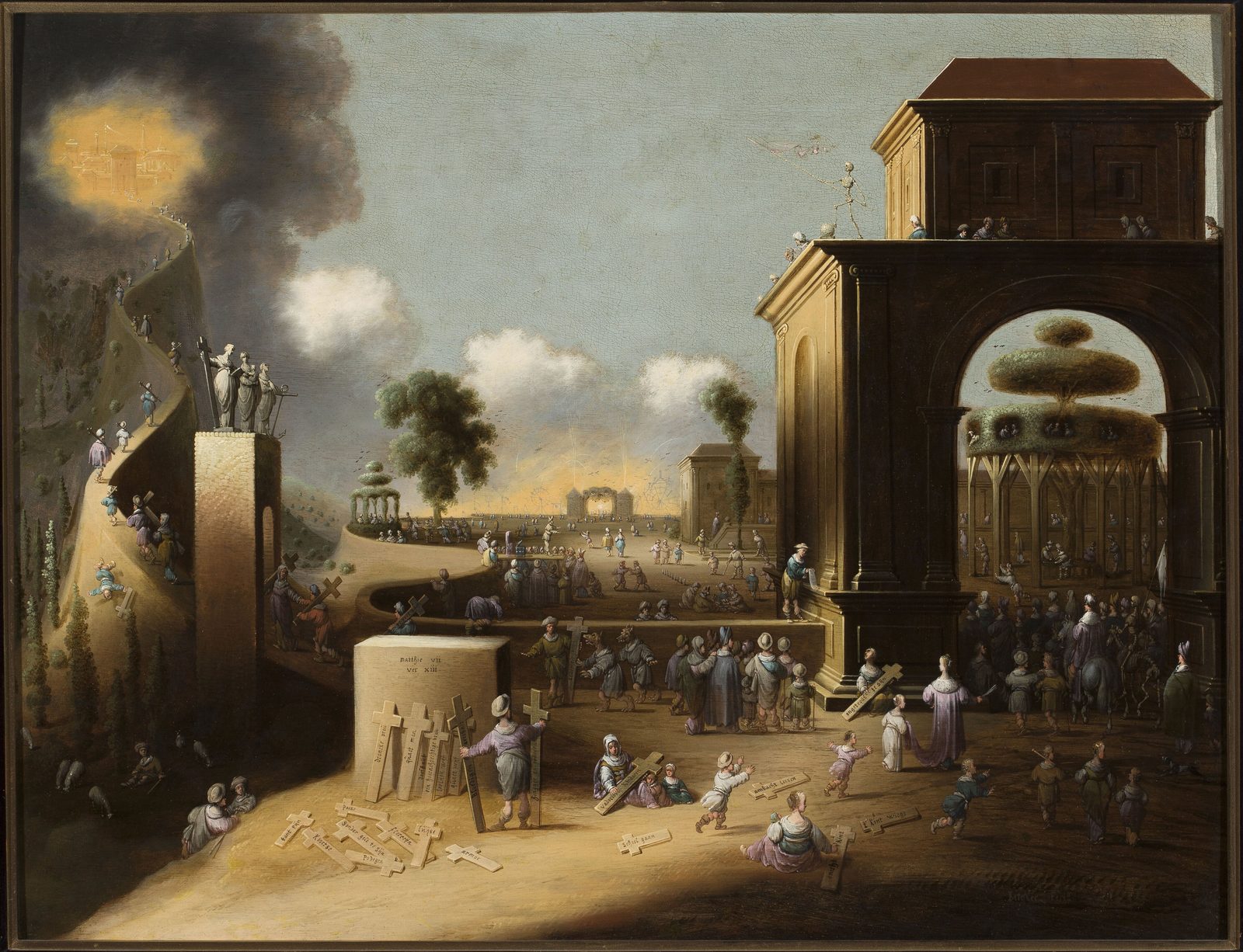
Narrow Road of Virtue and Wide Road of Sin. Jan Micker, not stated on the file page. National Museum in Warsaw. Public domain.