
Psalm 102
28 verses · Lament, a penitential psalm
In the beginning You laid the foundations of the earth, and the heavens are the work of Your hands.
Introduction
Author unstated, the Afflicted Man's Prayer, Book 4: The LORD reigns, Poetry, Psalms Overview.
The heading calls this the prayer of an afflicted man at the point where his strength gives out, and it names no writer. It was written for anyone in that condition, and it holds a private sickness and a ruined city in the same prayer. The first part is complaint with nothing held back. Then the singer lifts his eyes from his own shortening life to the God whose years have no end, and from there he looks ahead to people who will praise God after he is gone. Listen for that turn, and for how long the lament is allowed to run before it comes.
Context
- Who
- The afflicted, and a generation not yet created for whom verse 18 says the record is written
- What
- The prayer of a man worn down by sickness and grief, which turns to the God who outlasts him and to the rebuilding of Zion.
- Where
- Judah, with Jerusalem lying in ruins.
- When
- Undated; a time when Zion lay in ruins and its rebuilding was still awaited, most likely the exile of the sixth century BC.
- Why
- To give the afflicted words for their trouble and to fix their hope on a God whose years never end.
Historical context
The psalm speaks as one sick man and as a nation at once. Verses 3 to 11 describe a failing body and verses 13 to 22 describe a city waiting to be rebuilt, with no break between them. The desert owl, the owl among the ruins and the lone bird on a roof are birds of empty places, where no household lived. Ashes for bread describes mourning practice, since a mourner sat in ashes and put them on his head, and here the mourning has gone so far that the ashes have become the food. Verse 14 pictures people standing in the rubble of a city they knew, whose love reaches even its broken stones and dust. Writing for the generation to come at verse 18 draws on an ordinary practice, since documents were kept and read aloud to later hearers.
Significance
The psalm gave a sufferer leave to describe the trouble in full, and it lets eleven verses of it stand. Its turn at verse 12 gave relief in the one form open to a man whose days were shortening: a throne that outlasts him and a city that will be rebuilt after him.
This chapter in Jewish lifeWhat this chapter is in Jewish life and reading.
How it is read
Rashi reads the poor man of the title as the whole people. On the first verse he writes that the prayer is for "Israel, who is a poor people", and from that decision the sickness, the ashes and the lengthening shadow of the psalm are read as the state of the nation in exile (Rashi on Psalms 102:1:1, Rashi on Psalms, The Judaica Press complete Tanach with Rashi, translated by A. J. Rosenberg, CC-BY).
The loneliness of verse 8 he keeps as a picture and presses it, glossing the line as a man pondering about himself and finding himself "like a lonely bird on a roof, sitting alone without a mate" (Rashi on Psalms 102:8:1, same edition). On verse 11 he reads the complaint as a charge that the fall was made worse by the height, since God picked the people up first and then cast them down (Rashi on Psalms 102:11:1).
The turn at verse 13 is read as a claim on a promise rather than as a hope. Rashi has God enthroned forever and bound by His own oath, so that mercy on Zion at the set time follows from Deuteronomy 32:36, which he cites and then applies, saying that their power is indeed gone (Rashi on Psalms 102:13:1 and 102:14:1, same edition).
Malbim reads verse 22 forward to the gathering of the nations, holding that men will declare the name of the Lord in Jerusalem "when all nations and kingdoms gather together to serve the Lord", and that the name will be declared in Zion because the wise men and the priests reside there (Malbim on Psalms 102:22:1, Malbim on Psalms, Rabbi Mike Feuer, Jerusalem Anthology, CC-BY). Ibn Ezra carries six comments for which Sefaria holds no English version, and they are cited by reference (Ibn Ezra on Psalms 102:2:1 and the five references beside it).
What the rabbis say
Rashi passes on one aggadic tradition here in full. On the love of Zion's stones in verse 15 he reports from the Midrash Aggadah that when Jeconiah and his exile left, "they carried with them some of the stones and the earth of Jerusalem to build a synagogue for themselves there in Babylon" (Rashi on Psalms 102:15:1, same edition). The site reports it as what the rabbis taught.
The corpus records forty places where the Midrash and the Talmud cite this psalm, thirty five under Midrash and five under Talmud, and it carries the locator for each one with no text. The Babylonian Talmud cites the first verse at Avodah Zarah 7b:14 and verse 14 at Menachot 87a:18, and the Jerusalem Talmud cites verse 15 at Sheviit 4:7:2, verse 17 at Peah 1:1:39 and verse 26 at Chagigah 2:1:17.
Midrash Tehillim treats the psalm at 102:3, 102:4, 102:5 and 102:6, and Pirkei DeRabbi Eliezer reads verse 25 three times, at 3:7, 18:1 and 46:3. Bereshit Rabbah reads verse 17 at 56:10 and verse 26 at 1:15. The site reports where the rabbis cite the verse and reports no saying, because the locator carries none.
Sources: Rashi, Rashi on Psalms 102, in The Judaica Press complete Tanach with Rashi, translated by A. J. Rosenberg, CC-BY; Malbim, Malbim on Psalms 102, in Rabbi Mike Feuer, Jerusalem Anthology, CC-BY; Ibn Ezra, Ibn Ezra on Psalms 102, cited by reference; Sefaria holds no English version; The Midrash and the Talmud, the forty locators on Psalms 102 in scripts/data/sources/sefaria/psalms/102.json.
Psalms 102:1-2
let my cry for help come: He asks for two things, a face turned toward him and an ear bent down to hear. Distance and deafness are what a sufferer fears first, and this is his day of distress. The answer he wants is a quick one.
Psalms 102:1
“Hear my prayer, O Lord. Or O Jehovah. Sincere supplicants are not content with praying for praying's sake, they desire really to reach the ear and heart of the great God. It is a great relief in time of distress to acquaint others with our trouble, we are eased by their hearing our lamentation, but it is the sweetest solace of all to have God himself as a sympathizing listener to our plaint. That he is such is no dream or fiction, but an assured fact.”
Charles Spurgeon · The Treasury of David, Vol. 4 (1874)Particular Baptist
1 more voice on this verseWhat preachers and commentators have said about this verse, in their own words.
Psalms 102:1
“Prayer of the poor man, when he is in anguish, and pours out his supplication before the Lord. He speaks of a poor man, not of this world, but of the one about whom it is written: 'Blessed are the poor in spirit.' When he is in anguish: when he calls to mind his sins, both past and present. Pours out: with his whole heart, not with his lips. But who is able to pour out his prayer before the Lord? Who is able not to be stung by his own conscience?”
Jerome · written before 420 · Homily 28, on Psalm 101patristic
Do not hide Your face: To hide the face is the mark of judgment at Deuteronomy 31:17, where the LORD warns He will hide His face from Israel. Psalm 69:17 makes the same cry to be answered quickly in distress. Verse 3 gives the reason for haste.
Psalms 102:2
“Hide not thy face from me in the day when I am in trouble. Do not seem as if thou didst not see me, or wouldst not own me. Smile now at any rate. Reserve thy frowns for other times when I can bear them better, if, indeed, I can ever bear them; but now in my heavy distress, favour me with looks of compassion. Incline thine ear unto me. Bow thy greatness to my weakness.”
Charles Spurgeon · The Treasury of David, Vol. 4 (1874)Particular Baptist
1 more voice on this verse
Psalms 102:2
“Turn not away your face from me. If anyone prays with a pure heart, and is not accused by his own conscience, he can say this. For the sinner does not dare to say, turn not away your face from me: but rather he says: 'Turn away your face from my sins.'”
Jerome · written before 420 · Homily 28, on Psalm 101patristic
Psalms 102:3-7
my days vanish like smoke: The body is described first, days going off like smoke and bones burning like coals until he forgets to eat. Then come three birds, a desert owl, an owl among ruins, and a lone bird awake on a roof. Each one is alone, and each place named is empty.
Psalms 102:3
“For my days have failed away like smoke. For example, I was a little child, and while I know it not, I came into the age of youth, and again into full age, and while I know it not, I have grown old: and my days have failed away like smoke. But some people think themselves to be everlasting, and they persevere in their sin. And my bones are withered like a dry twig for kindling. By 'bones' he means strength itself.”
Jerome · written before 420 · Homily 28, on Psalm 101patristic
1 more voice on this verse
Psalms 102:3
“For my days are consumed like smoke. My grief has made life unsubstantial to me, I seem to be but a puff of vapour which has nothing in it, and is soon dissipated. The metaphor is very admirably chosen, for, to the unhappy, life seems not merely to be frail, but to be surrounded by so much that is darkening, defiling, blinding, and depressing, that, sitting down in despair, they compare themselves to men wandering in a dense fog, and themselves so dried up thereby that they are little better than pillars of smoke.”
Charles Spurgeon · The Treasury of David, Vol. 4 (1874)Particular Baptist
My heart is afflicted: Afflicted translates a Hebrew verb for being struck. The heart is pictured as grass struck by the sun until it has withered, and the same grass returns in verse 11. Isaiah 40:7 says the grass withers when the breath of the LORD blows on it.
Psalms 102:4
“I am smitten like grass, and my heart is withered. Just as it is also written elsewhere: 'Man, his days are like grass.' For such is the life of men: it is green, and quickly it withers. Because I have forgotten to eat my bread. He did not say, I had no desire to eat, or I despised eating. To such a degree did the memory of my sins come upon me, and such penance did I do, that I even forget to eat, having my longing set on God, and considering him alone.”
Jerome · written before 420 · Homily 28, on Psalm 101patristic
1 more voice on this verse
Psalms 102:4
My heart is smitten, like a plant parched by the fierce heat of a tropical sun, and withered like grass, which dries up when once the scythe has laid it low. The psalmist's heart was as a wilted, withered flower, a burned up mass of what once was verdure. His energy, beauty, freshness, and joy, were utterly gone, through the wasting influence of his anguish. So that I forget to eat my bread, or "because I forget to eat my bread."
Charles Spurgeon · The Treasury of David, Vol. 4 (1874)Particular Baptist
my flesh clings to my bones: The groaning has worn him down until only skin and bone remain. Job used the same picture of his own wasting at Job 19:20, and Lamentations 4:8 says it of the people of Jerusalem in the siege. It follows from the forgotten bread of verse 4.
Psalms 102:5
“By reason of the voice of my groaning my bone has cleaved to my flesh. Let those who do penance learn how they ought to do penance. For I so dried myself up, that I was without flesh, and my skin clung to my bones. He said 'flesh' for 'skin.'”
Jerome · written before 420 · Homily 28, on Psalm 101patristic
1 more voice on this verse
Psalms 102:5
“By reason of the voice of my groaning my bones cleave to my skin. He became emaciated with sorrow. He had groaned himself down to a living skeleton, and so in his bodily appearance was the more like the smoke-dried, withered, burnt-up things to which he had previously compared himself. It will be a very long time before the distresses of the church of God make some Christians shrivel into anatomies, but this good man was so moved with sympathy for Zion's ills that he was wasted down to skin and bone.”
Charles Spurgeon · The Treasury of David, Vol. 4 (1874)Particular Baptist
like an owl among the ruins: Both birds stand in the list of unclean birds at Leviticus 11:17 to 18. The desert owl, qaat in Hebrew, returns at Isaiah 34:11 as a bird that takes over a ruined land. The sufferer sees himself among such haunts.
Psalms 102:6
“I am like a pelican of the wilderness, a mournful and even hideous object, the very image of desolation. I am like an owl of the desert; loving solitude, moping among ruins, hooting discordantly.”
Charles Spurgeon · The Treasury of David, Vol. 4 (1874)Particular Baptist
1 more voice on this verse
Psalms 102:6
“I have become like the pelican of the wilderness. There are said to be two kinds of these birds. One lives in the waters, and its food is fish; and one lives in the wilderness, and its food is venomous creatures, that is, serpents and crocodiles and lizards. Now these birds are called in Latin 'onocrotali.' To that one therefore have I become like, which lives in the wilderness, which eats venomous creatures: that is, my food was to me as it were poison. I have become like the night-raven in its dwelling-place.”
Jerome · written before 420 · Homily 28, on Psalm 101patristic
a lone bird on a housetop: Lie awake translates shaqad, the verb for keeping watch at Jeremiah 1:12. Houses in Israel had flat roofs, and a bird alone on the housetop sits in plain view all night. The owls of verse 6 keep the same hours among the ruins.
Psalms 102:7
“I watch, and am like a sparrow alone upon the house top: I keep a solitary vigil as the lone sentry of my nation; my fellows are too selfish, too careless to care for the beloved land, and so like a bird which sits alone on the housetop, I keep up a sad watch over my country. The Psalmist compared himself to a bird, —a bird when it has lost its mate or its young, or is for some other reason made to mope alone in a solitary place.”
Charles Spurgeon · The Treasury of David, Vol. 4 (1874)Particular Baptist
Psalms 102:8-11
my enemies taunt me: The taunting is public and lasts all day. Ashes belong to mourning, and here they have become his bread, his drink mixed with tears. He lays the cause on God's own indignation and wrath, and his days lengthen into evening shadows.
Psalms 102:8
“Mine enemies reproach me all the day. Their rage was unrelenting and unceasing, and vented itself in taunts and insults, the Psalmist's patriotism and his griefs were both made the subjects of their sport. Pointing to the sad estate of his people they would ask him, "Where is your God?" and exult over him because their false gods were in the ascendant. Reproach cuts like a razor, and when it is continued from hour to hour, and repeated all the day and every day, it makes life itself undesirable. And they that are mad against me are sworn against me.”
Charles Spurgeon · The Treasury of David, Vol. 4 (1874)Particular Baptist
2 more voices on this verse
Psalms 102:8
“Mine enemies reproach me all the day,.... For his principles and practices, being different from theirs; for his religion, and preciseness in it; for his faith and profession of it, and for his holy walk and conversation.”
Psalms 102:8
“In this they were unwearied; they did it all the day; it was a continual dropping. His enemies were very outrageous: They are mad against me, and very obstinate and implacable. They are sworn against me; as the Jews that bound themselves with an oath that they would kill Paul; or, They have sworn against me as accusers, to take away my life.”
Matthew Henry · Commentary on the Whole Bible (1707-1721)puritan
I have eaten ashes like bread: Job sat among the ashes at Job 2:8, and the mourners of Isaiah 61:3 are promised beauty in place of ashes. Psalm 42:3 and Psalm 80:5 also make tears the food and drink of grief. Here both are his daily bread.
Psalms 102:9
“For I have eaten ashes like bread. He had so frequently cast ashes upon his head in token of mourning, that they had mixed with his ordinary food, and grated between his teeth when he ate his daily bread. One while he forgot to eat, and then the fit changed, and he ate with such a hunger that even ashes were devoured. Grief has strange moods and tenses. And mingled my drink with weeping. His drink became as nauseous as his meat, for copious showers of tears had made it brackish.”
Charles Spurgeon · The Treasury of David, Vol. 4 (1874)Particular Baptist
2 more voices on this verse
Psalms 102:9
“For I have eaten ashes like bread. I dipped my bread in ashes, and so ate it. If therefore the prophet says this, what should we do? And I mingled my drink with weeping. Nothing was sweet to me, neither bread, nor drink: but I longed only for the heavenly bread, that is, Christ.”
Jerome · written before 420 · Homily 28, on Psalm 101patristic
Psalms 102:9
“Bread - The sense is, dust and ashes are as familiar to me as the eating of my bread; I cover my head with them; I sit, yea, lie down in them, as mourners often did.”
John Wesley · Explanatory Notes upon the Old Testament (1765)evangelical
picked me up and cast me aside: A thing picked up high falls harder. Job 30:22 uses the picture of a man lifted on the wind and tossed in the storm. The indignation and wrath of this verse meet their answer in verse 13, where the LORD will rise up in compassion for Zion.
Psalms 102:10
“Because of thine indignation and thy wrath: for thou hast lifted me up and cast me down. A sense of the divine wrath which had been manifested in the overthrow of the chosen nation and their sad captivity led the Psalmist into the greatest distress. He felt like a sere leaf caught up by a hurricane and carried right away, or the spray of the sea which is dashed upwards that it may be scattered and dissolved.”
Charles Spurgeon · The Treasury of David, Vol. 4 (1874)Particular Baptist
1 more voice on this verse
Psalms 102:10
“Because of the face of your wrath and indignation. And all these things I did, considering your coming and the judgment to come. Because lifting me up you have dashed me down. Let those say this who were once holy, and fell: for having been exalted in their virtues, afterward they fell. Since indeed the saints say: because lifting me up you held me.”
Jerome · written before 420 · Homily 28, on Psalm 101patristic
My days are like lengthening shadows: Lengthening shadows mark the last hour of the day, as Jeremiah 6:4 says of the evening. Psalm 109:23 uses the same picture for a life fading away. The withered grass of verse 4 returns to close the lament.
Psalms 102:11
“My days have declined like a shadow. If my days, how much more my nights? that is, if the light, how much more the darkness? And I have withered like grass. For as grass, so man passes away, and is dried up.”
Jerome · written before 420 · Homily 28, on Psalm 101patristic
1 more voice on this verse
Psalms 102:11
“My days are like a shadow that declineth. His days were but a shadow at best, but now they seem to be like a shadow which was passing away. A shadow is unsubstantial enough, how feeble a thing must a declining shadow be? No expression could more forcibly set forth his extreme feebleness. And I am withered like grass. He was like grass, blasted by a parching wind, or cut down with a scythe, and then left to be dried up by the burning heat of the sun.”
Charles Spurgeon · The Treasury of David, Vol. 4 (1874)Particular Baptist
sit enthroned forever: The psalm turns here. Against smoke and grass and a lengthening shadow it sets the LORD sitting enthroned forever, and His renown reaching every generation. The Hebrew word behind renown is remembrance, what later generations keep of Him.
Psalms 102:12
“Now the writer's mind is turned away from his personal and relative troubles to the true source of all consolation, namely, the Lord himself, and his gracious purposes towards his own people. But thou, O Lord, shalt endure for ever. I perish, but thou wilt not, my nation has become almost extinct, but thou art altogether unchanged. The original has the word "sit, "—"thou, Jehovah, to eternity shalt sit:" that is to say, thou reignest on, thy throne is still secure even when thy chosen city lies in ruins, and thy peculiar people are carried into captivity.”
Charles Spurgeon · The Treasury of David, Vol. 4 (1874)Particular Baptist
1 more voice on this verse
Psalms 102:12
“Contrast with man's frailty (compare Ps 90:1-7). thy remembrance--that by which Thou art remembered, Thy promise. Hence it is here adduced. for--or, "when." the set time, &c.--the time promised, the indication of which is the interest felt for Zion by the people of God.”
Jamieson, Fausset & Brown · Commentary Critical and Explanatory on the Whole Bible (1871)reformed
Psalms 102:13-17
have compassion on Zion: The appointed time has come. The prayer leaves the sufferer and turns to Zion, where what servants love is her stones and dust, affection reaching as far as the rubble. The destitute man's own prayer is heard too, and the nations and their kings see the glory.
Psalms 102:13
“You, rising up, will have mercy on Sion. From this little verse it is manifest that this psalm is spoken in the person of Sion, and not in the person of the prophet. Now Sion is she who is set upon a watchtower, and looks out upon the things which come from afar. This Sion therefore, who is set on high and on a lofty place, has fallen. Therefore 'let him who stands take heed lest he fall.' Because it is the time to have mercy on her, because the time has come.”
Jerome · written before 420 · Homily 28, on Psalm 101patristic
2 more voices on this verse
Psalms 102:13
“Thou shalt arise, and have mercy upon Zion. He firmly believed and boldly prophesied that apparent inaction on God's part would turn to effective working. Others might remain sluggish in the matter, but the Lord would most surely bestir himself. Zion had been chosen of old, highly favoured, gloriously inhabited, and wondrously preserved, and therefore by the memory of her past mercies it was certain that mercy would again be showed to her.”
Charles Spurgeon · The Treasury of David, Vol. 4 (1874)Particular Baptist
Psalms 102:13
“The hope of deliverance is built upon the goodness of God--"Thou wilt have mercy upon Zion, for she has become an object of thy pity;" and upon the power of God--"Thou shalt arise and have mercy, shalt stir up thyself to do it, shalt do it in contempt of all the opposition made by the church's enemies." The zeal of the Lord of hosts shall do this.”
Matthew Henry · Commentary on the Whole Bible (1707-1721)puritan
delight in her stones: The opening For gives the reason for verse 13, and the longing of the servants is a sign that the time of favor has come. Nehemiah wept over the broken walls at Nehemiah 1:3 to 4. At Nehemiah 4:2 Sanballat mocked the same stones lying in heaps of rubble.
Psalms 102:14
“For thy servants take pleasure in her stones, and favour the dust thereof. They delight in her so greatly that even her rubbish is dear to them. It was a good omen for Jerusalem when the captives began to feel a home-sickness, and began to sigh after her. We may expect the modern Jews to be restored to their own land when the love of their country begins to sway them, and casts out the love of gain.”
Charles Spurgeon · The Treasury of David, Vol. 4 (1874)Particular Baptist
1 more voice on this verse
Psalms 102:14
“For its stones have pleased your servants. The stones are the saints: but the earth, that is, sinners, stand in need of the Lord's mercy.”
Jerome · written before 420 · Homily 28, on Psalm 101patristic
the nations will fear the name: Isaiah 59:19 joins the same pair, the name of the LORD feared in the west and His glory in the east. Solomon prayed at 1 Kings 8:43 that all the peoples of the earth would fear the LORD. The rebuilding of Zion opens that fear to the nations.
Psalms 102:15
“So the heathen shall fear the name of the Lord. Mercy within the church is soon perceived by those without. When a candle is lit in the house, it shines through the window. When Zion rejoices in her God, the heathen been to reverence his name, for they hear of the wonders of his power, and are impressed thereby. And all the kings of the earth thy glory. The restoration of Jerusalem was a marvel among the princes who heard of it, and its ultimate resurrection in days yet to come will be one of the prodigies of history.”
Charles Spurgeon · The Treasury of David, Vol. 4 (1874)Particular Baptist
1 more voice on this verse
Psalms 102:15
“It will be a happy means perhaps of their conversion, at least of their conviction; for so the heathen shall fear the name of the Lord, shall have high thoughts of him and his people, and even the kings of the earth shall be affected with his glory.”
Matthew Henry · Commentary on the Whole Bible (1707-1721)puritan
the LORD will rebuild Zion: Both verbs are perfect in the Hebrew, and the LORD's rebuilding of Zion is told as if already done. He has appeared in glory as at Exodus 40:34, when the cloud filled the tabernacle. The nations will fear that glory in verse 15.
Psalms 102:16
“When the Lord shall build up Zion, he shall appear in his glory. As kings display their skill and power and wealth in the erection of their capitals, so would the Lord reveal the splendour of his attributes in the restoration of Zion, and so will he now glorify himself in the edification of his church. Never is the Lord more honourable in the eyes of his saints than when he prospers the church.”
Charles Spurgeon · The Treasury of David, Vol. 4 (1874)Particular Baptist
2 more voices on this verse
Psalms 102:16
“This is expected from the favour of God; that will set all to rights, and nothing but that, and therefore Daniel prays ( Dan. ix. 17 ), Cause thy face to shine upon thy sanctuary, which is desolate. The building up of Zion is as great a favour to any people as they can desire.”
Matthew Henry · Commentary on the Whole Bible (1707-1721)puritan
Psalms 102:16
“When the Lord shall build--or better, "Because the Lord hath built," &c., as a reason for the effect on others; for in thus acting and hearing the humble, He is most glorious.”
Jamieson, Fausset & Brown · Commentary Critical and Explanatory on the Whole Bible (1871)reformed
the prayer of the destitute: Destitute translates arar, a rare word that Jeremiah 17:6 uses for a bare shrub in the desert. The one praying is stripped to nothing. Psalm 22:24 uses the same verb, despise, and says the LORD heard the afflicted when he cried.
Psalms 102:17
“OBSERVE that the verse which precedes the text describes the Lord as appearing in His Glory. His Zion is to be built up and therefore her King puts on the robes of His splendor. The imagery sets forth the Lord as a great Monarch, superintending with great pomp and state, the building of a sumptuous palace. We see Him commanding the architects and the workmen, and passing from point to point amid attending courtiers. Trumpets are sounding, banners are displayed, princes and nobles glitter in their array and the King appears in His Glory.”
Psalms 102:18-22
written for the generation to come: The record is written for readers not yet born. The looking down from the sanctuary answers the hidden face of verse 2. What He looks for is a prisoner's groaning and men condemned to death, and He releases them.
Psalms 102:18
“This shall be written for the generation to come. A note shall be made of it, for there will be destitute ones in future generations, —"the poor shall never cease out of the land, "—and it will make glad their eyes to read the story of the Lord's mercy to the needy in former times. Registers of divine kindness ought to be made and preserved; we write dcwn in history the calamities of nations, —wars, famines, pestilences, and earthquakes are recorded; how much rather then should we set up memorials of the Lord's lovingkindness!”
Charles Spurgeon · The Treasury of David, Vol. 4 (1874)Particular Baptist
1 more voice on this verse
Psalms 102:18
“Many that are now unborn shall, by reading the history of the church, be wrought upon to turn proselytes. The people that shall be created anew by divine grace, that are a kind of first-fruits of his creatures, shall praise the Lord for his answers to their prayers when they were more destitute.”
Matthew Henry · Commentary on the Whole Bible (1707-1721)puritan
the heights of His sanctuary: The sanctuary here is in heaven, the dwelling Deuteronomy 26:15 asks the LORD to look down from. At Exodus 3:7 He saw the misery of His people in Egypt and heard their cry. Verse 20 names what He hears now.
Psalms 102:19
“For he hath looked down from the heights of his sanctuary, or "leaned from the high place of his holiness, " from heaven did the Lord behold the earth, looking out like a watcher from his tower. What was the object of this leaning lrom the battlements of heaven? Why this intent gaze upon the race of men? The answer is full of astounding mercy; the Lord does not look upon mankind to note their grandees, and observe the doings of their nobles, but to hear the groaning of the prisoner; to loose those that are appointed to death.”
Charles Spurgeon · The Treasury of David, Vol. 4 (1874)Particular Baptist
those condemned to death: are sons of death in the Hebrew, an idiom for men marked to die. Psalm 79:11 joins the same two, the groan of the prisoner and the men appointed to die. Many readers take both as the exiles in Babylon.
Psalms 102:20
“To hear the groaning - By sin, all the inhabitants of the earth are miserable. They have broken the Divine laws, are under the arrest of judgment, and all cast into prison, They have been tried, found guilty, and appointed to die; they groan under their chains, are alarmed at the prospect of death, and implore mercy.”
Adam Clarke · Commentary on the Bible (1810-1826)evangelical
proclaim the name of the LORD in Zion: The released prisoners return to Zion. Isaiah 35:10 pictures the ransomed of the LORD returning to Zion with singing. Their praise answers verse 18, which looks to a people not yet created.
Psalms 102:21
“To declare the name of the Lord in Zion, and his praise in Jerusalem. Great mercy displayed to those greatly in need of it, is the plainest method of revealing the attributes of the Most High. Actions speak more loudly than words; deeds of grace are a revelation even more impressive than the most tender promises. Jerusalem restored, the church re-edified, desponding souls encouraged, and all other manifestations of Jehovah's power to bless, are so many manifestoes and proclamations put up upon the walls of Zion to publish the character and glory of the great God.”
Charles Spurgeon · The Treasury of David, Vol. 4 (1874)Particular Baptist
peoples and kingdoms assemble: Israel and the nations meet at one gathering here. Zechariah 8:22 foresees many peoples coming to seek the LORD, and Isaiah 2:3 has them going up to the house of the God of Jacob. Verse 15 promised their fear; here they serve.
Psalms 102:22
“When the people are gathered together, and the kingdoms, to serve the Lord. The great work of restoring ruined Zion is to be spoken of in those golden ages when the heathen nations shall be converted unto God; even those glorious times will not be able to despise that grand event, which, like the passage of Israel through the Red Sea, will never be eclipsed and never cease to awaken the enthusiasm of the cliosen people.”
Charles Spurgeon · The Treasury of David, Vol. 4 (1874)Particular Baptist
1 more voice on this verse
Psalms 102:22
“But it may look further, at the conversion of the Gentiles to the faith of Christ in the latter days. Christ has proclaimed liberty to the captives, and the opening of the prison to those that were bound, that they may declare the name of the Lord in the gospel-church, in which Jews and Gentiles shall unite.”
Matthew Henry · Commentary on the Whole Bible (1707-1721)puritan
Psalms 102:23-24
broken my strength on the way: He says God broke his strength on the way and cut his days short. The plea is to be spared the midst of a life. Against his own shortened days he sets the years of God, which run through every generation.
Psalms 102:23
“He weakened my strength in the way. Here the Psalmist comes down again to the mournful string, and pours forth his personal complaint. His sorrow had cast down his spirit, and even caused weakness in his bodily frame, so that he was like a pilgrim who limped along the road, and was ready to lie down and die. He shortened my days. Though he had bright hopes for Jerusalem, he feared that he should have departed this life long before those visions had become realities; he felt that he was pining away and would be a shortlived man.”
Charles Spurgeon · The Treasury of David, Vol. 4 (1874)Particular Baptist
2 more voices on this verse
Psalms 102:23
“And then what becomes of the promise that Shiloh should arise out of Judah, the star out of Jacob, and the Messiah out of the family of David? If these fail, the promise fails. This the psalmist speaks of as in his own person, and it is very applicable to two of the common afflictions of this time:-- 1.”
Matthew Henry · Commentary on the Whole Bible (1707-1721)puritan
Psalms 102:23
“God's eternal existence is a pledge of faithfulness to His promises. in the way--of providence. weakened--literally, "afflicted," and made fearful of a premature end, a figure of the apprehensions of the Church, lest God might not perform His promise, drawn from those of a person in view of the dangers of early death (compare Ps 89:47).”
Jamieson, Fausset & Brown · Commentary Critical and Explanatory on the Whole Bible (1871)reformed
in the midst of my days!: Take translates a Hebrew verb for making something go up, as a life is lifted away before its time. Hezekiah voiced the same fear at Isaiah 38:10, going to the gates of Sheol in the middle of his days. The years of God lead into the hymn of verse 25.
Psalms 102:24
“I said, O my God, take me not away in the midst of my days. He betook himself to prayer. What better remedy is there for hcart-sickness and depression? We may lawfully ask for recovery from sickness and may hope to be heard. Good men should not dread death, but they are not forbidden to love life: for many reasons the man who has the best hope of heaven may nevertheless think it desirable to continue here a little longer, for the sake of his family, his work, the church of God, and even the glory of God itself.”
Charles Spurgeon · The Treasury of David, Vol. 4 (1874)Particular Baptist
2 more voices on this verse
Psalms 102:24
That which is said is also fulfilled in the saint: "I will recall you from there in the end." For the end is considered to be the perfection of things and the consummation of virtues. Indeed for this reason also another saint said, "Don't recall me in the midst of my days." And again the Scripture bestows testimony on the great patriarch Abraham since "Abraham died full of days."
Origen of Alexandria · written before 253 · Homilies on Genesis 15:6patristic
Psalms 102:24
“I said - Do not wholly destroy thy people Israel. In the midst - Before they come to a full possession of thy promises and especially of that fundamental promise of the Messiah.”
John Wesley · Explanatory Notes upon the Old Testament (1765)evangelical
Psalms 102:25-27
You laid the foundations of the earth: The earth has a beginning and the heavens are made things, and both will wear out like clothing while God stays the same. Hebrews 1:10 addresses them to the Son: In the beginning, O Lord, You laid the foundations of the earth. The complaint becomes a hymn.
Psalms 102:25
Therefore the Image of the unalterable God must be unchangeable; for "Jesus Christ is the same yesterday, today and forever." And David in the psalm says of him, "You, Lord, in the beginning have laid the foundation of the earth, and the heavens are the work of your hands. They shall perish, but you remain; and they all shall grow old as does a garment. And you shall fold them up as a piece of clothing, and they shall be changed, but you are the same, and your years shall not fail."
Athanasius of Alexandria · written before 373 · Discourses Against the Arians 1.10.36patristic
2 more voices on this verse
Psalms 102:25
“Of old hast thou laid the foundation of the earth. Creation is no new work with God, and therefore to "create Jerusalem a praise in the earth" will not be difficult to him. Long ere the holy city was laid in ruins the Lord made a world out of nothing, and it will be no labour to him to raise the walls from their heaps and replace the stones in their courses.”
Charles Spurgeon · The Treasury of David, Vol. 4 (1874)Particular Baptist
Psalms 102:25
“The apostle quotes these verses ( Heb. i. 10-12 ) and tells us, He saith this to the Son, and in that exposition we must acquiesce. It is very comfortable, in reference to all the changes that pass over the church, and all the dangers it is in, that Jesus Christ is the same yesterday, to-day, and for ever.”
Matthew Henry · Commentary on the Whole Bible (1707-1721)puritan
Cross references
Psalms 102:25
- Quoted inHebrews 1:10“And: “In the beginning, O Lord, You laid the foundations of the earth, and the heavens are the work of Your hands.”
'Thou, Lord, in the beginning hast laid the foundation of the earth'
wear out like a garment: Isaiah 51:6 uses the same garment. Hebrews 1:11 quotes this verse of the Son, who will change the heavens like clothing, and 2 Peter 3:13 promises new heavens and new earth. A garment worn out is changed for a new one.
Psalms 102:26
“They shall perish, but thou shalt endure. The power which made them shall dissolve them, even as the city of thy love was destroyed at thy command; yet neither the ruined city nor the ruined earth can make a change in thee, reverse thy purpose, or diminish thy glory. Thou standest when all things fall. Yea, all of them shall wax old like a garment; as a vesture shalt thou change them, and they shall be changed. Time impairs all things, the fashion becomes obsolete and passes away.”
Charles Spurgeon · The Treasury of David, Vol. 4 (1874)Particular Baptist
1 more voice on this verse
Psalms 102:26
“But when a man falls asleep, he does not rise until the heaven is sewn. This seems to indicate that until the heaven is renewed; for there will be a new heaven and a new earth, as it is written. For what is sewn is old: what is old will be changed. Lastly, listen to David saying: In the beginning you founded the earth, O Lord, and the works of your hands are the heavens.”
Ambrose of Milan · written before 397 · Interrogation of Job and Davidpatristic
But You remain the same: You remain the same reads You are He in the Hebrew, the LORD's own words at Deuteronomy 32:39 and Isaiah 43:10. Hebrews 1:12 ends its quotation here, on years that never end. Hebrews 13:8 says the same of Jesus Christ, yesterday, today and forever.
Psalms 102:27
“But thou art the same, or, "thou art he." As a man remains the same when he has changed his clothing, so is the Lord evermore the unchanging One, though his works in creation may be changed, and the operations of his providence may vary.”
Charles Spurgeon · The Treasury of David, Vol. 4 (1874)Particular Baptist
1 more voice on this verse
Psalms 102:27
“Christ will be the same in the performance that he was in the promise, the same to his church in captivity that he was to his church at liberty. Let not the church fear the weakening of her strength, or the shortening of her days, while Christ himself is both her strength and her life; he is the same, and has said, Because I live you shall live also.”
Matthew Henry · Commentary on the Whole Bible (1707-1721)puritan
The children of Your servants: The man who feared being taken in the midst of his days is answered with a household that keeps going. The children of God's servants dwell securely, and their descendants stand established before Him. The psalm that began in smoke ends in a settled line.
Psalms 102:28
“The children of thy servants shall continue. The Psalmist had early in the psalm looked forward to a future generation, and here he speaks with confidence that such a race would arise and be preserved and blessed of God. Some read it as a prayer, "let the sons of thy servants abide." Any way, it is full of good cheer to us; we may plead for the Lord's favour to our seed, and we may expect that the cause of God and truth will revive in future generations.”
Charles Spurgeon · The Treasury of David, Vol. 4 (1874)Particular Baptist
How this psalm is built
The form: A prayer of the afflicted, when he is overwhelmed and pours out his complaint before the LORD, as Clarke classes it.
The patterns in this chapter
| Device | What it does | Where to see it |
|---|---|---|
| The three solitary birds | Verses 6 and 7 name a desert owl, an owl among ruins and a lone bird on a housetop. Augustine sets out the pattern behind the list, three birds and three places, and notes that each place named is empty: the wilderness, the ruined walls and the rooftop.Augustine of Hippo, Exposition on Psalm 102, c. 430. | Psalm 102:6, Psalm 102:7 |
| The turn at But You | Eleven verses describe a body failing, and verse 12 opens with But You, O LORD, sit enthroned forever. The psalm never returns to the illness in the same terms, and everything after the turn is either about Zion or about the years of God.Matthew Henry, Commentary on the Whole Bible, 1710, on Psalm 102:12. | Psalm 102:11, Psalm 102:12 |
| Smoke, grass and a lengthening shadow | The psalm measures the man's life three times and each measure is shorter than it looks: days that vanish like smoke at verse 3, a heart withered like grass at verse 4, and days like lengthening shadows at verse 11. The three pictures are the ground the eternity of verse 12 is set against.Albert Barnes, Notes, Explanatory and Practical, on the Old and New Testaments, 1832 to 1869, on Psalm 102:3. | Psalm 102:3, Psalm 102:4, Psalm 102:11 |
| The garment that is changed | Verse 26 says the heavens will wear out like a garment and that God will change them like clothing. The comparison makes the heavens the changeable thing and their maker the constant one, which is the reverse of the way a reader looking up would rank them.Matthew Henry, Commentary on the Whole Bible, 1710, on Psalm 102:26. | Psalm 102:26, Psalm 102:27 |
The prophecy and the New Testament's use
10 more paragraphs on the patterns
Hebrews 1:10 to 12 quotes verses 25 to 27 whole and does something the psalm does not do on its own face. In the psalm the words are addressed to the LORD by a dying man; in Hebrews they are spoken by the Father and addressed to the Son, as part of the argument that the Son is greater than the angels. Matthew Henry states the effect plainly, that the complaint becomes a hymn to the Son.
This is the strongest single reason to read the chapter. A psalm about a man whose days are cut short ends with a statement about the maker of heaven and earth, and the New Testament takes that statement as a statement about Christ.
The debated point
What is contested is the ground of the Hebrews reading, since the psalm gives the words to the LORD and Hebrews gives them to the Son. The commentators do not treat this as a difficulty but as the point. Matthew Henry reads the quotation as evidence of who the LORD addressed in the psalm was, and the site carries that as the church's reading rather than as a disputed inference, while naming that the psalm itself does not distinguish the persons.
Where it comes from
The pictures are the common stock of Israelite lament. Days like smoke stand at Psalm 37:20, the withering grass at Psalm 90:5 and 6 and at Psalm 103:15, and a heart like grass at Psalm 102:4 is answered three psalms later by the same figure used of all men. The appointed time of verse 13 is the language of a promise expected to arrive rather than hoped for.
In the Psalter
Psalm 102 stands between the king's vow of Psalm 101 and the blessing of Psalm 103, and it is the darkest chapter in the run. Its closing figure, the heavens wearing out like a garment, is the figure Psalm 103:15 and 16 turn on men instead.
The door
The penitential psalms carries the seven and the church's use of them, and this psalm is the fifth.
Keep studying
Sources for this chapter
The summary
Jamieson, Fausset & Brown, Commentary Critical and Explanatory; John Calvin, Commentaries; John Wesley, Notes on the Old Testament and Matthew Henry, Complete Commentary.
The form and classifications
Adam Clarke, Commentary on the Bible, 1832, on Psalm 102:1 and Matthew Henry, Commentary on the Whole Bible, 1710, on Psalm 102:25.
The exposition
Adam Clarke, Commentary on the Bible; Albert Barnes, Notes on the Book of Psalms; Charles Spurgeon, The Treasury of David; Franz Delitzsch, Biblical Commentary on the Psalms; John Gill, Exposition of the Old Testament and Matthew Henry, Commentary on the Whole Bible.
The painting
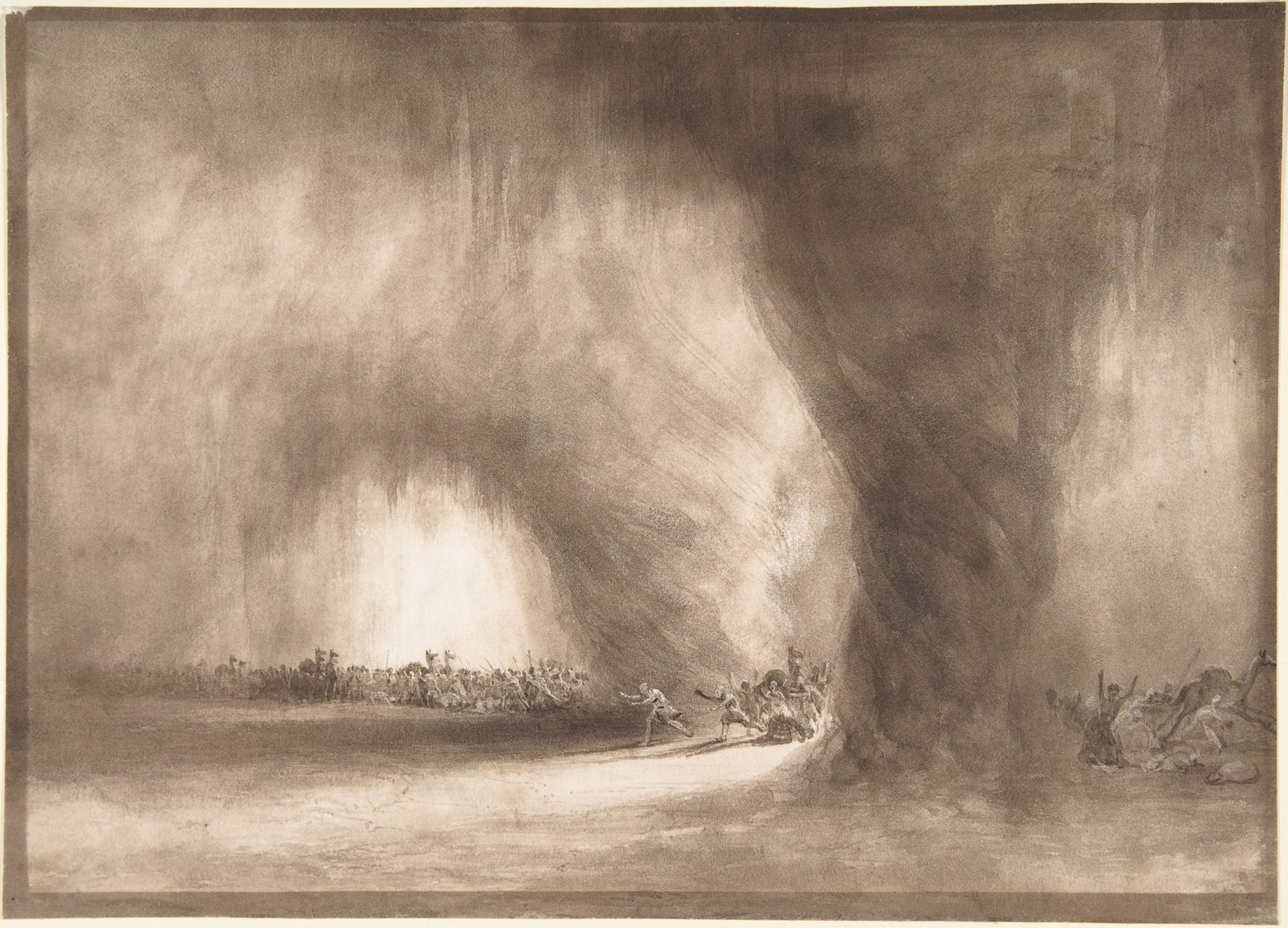
A Column of Oriental Travelers Scattered by a Dust Storm. William West, 1820-40. Wikimedia Commons. CC0.