
Nehemiahchapter 7
73 verses · Nehemiah · 5th century BC · History
Then my God put it into my heart to assemble the nobles, the officials, and the people to be enrolled by genealogy. I found the genealogical register of those who had first returned, and I found the following written in it:
Introduction
Nehemiah, History, Nehemiah Overview.
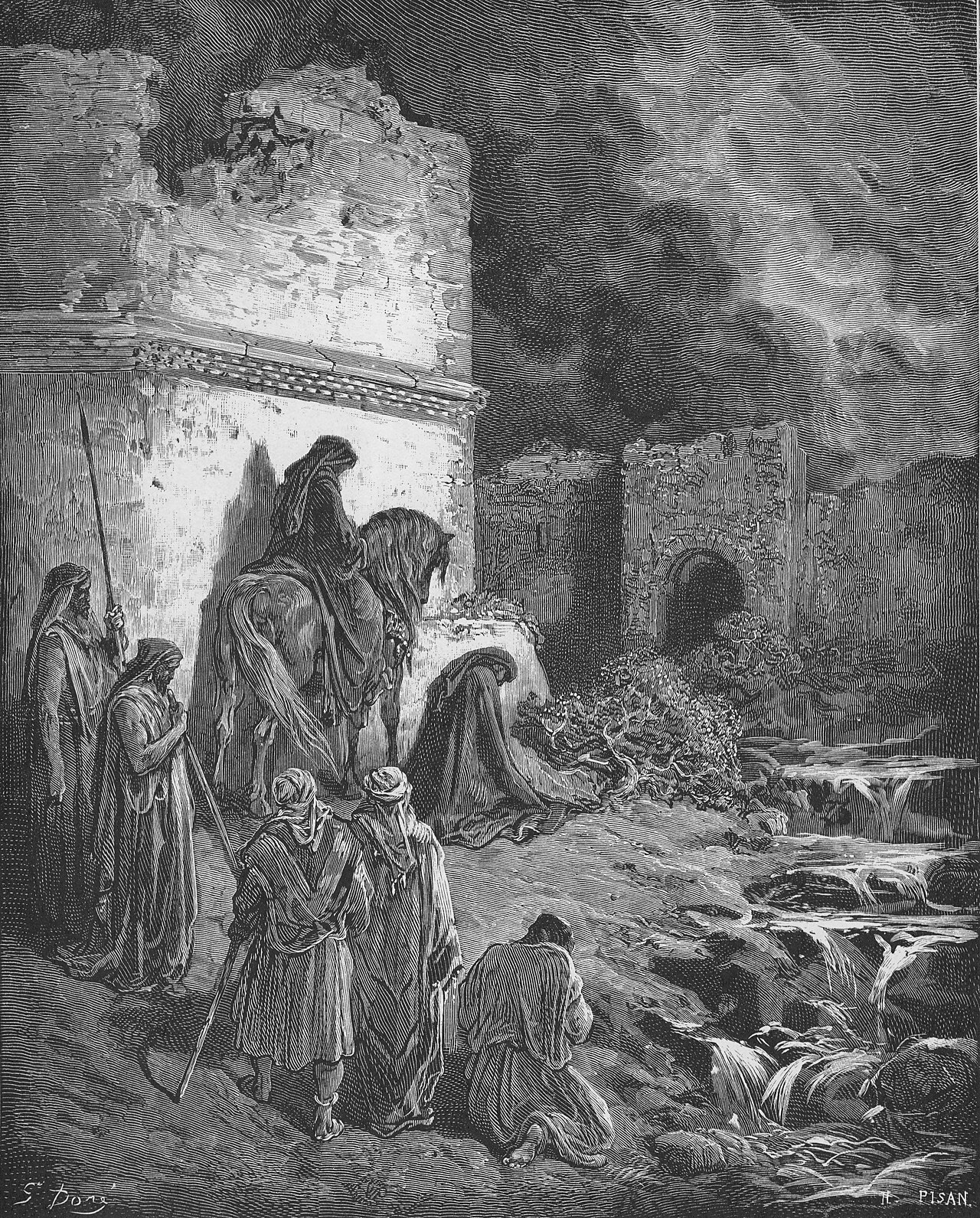
Nehemiah wrote this as the governor of a walled city that was nearly empty. His hearers were descended from the families who had first returned from Babylon, and many would have found their own houses named in the record he copies. The chapter moves from the guarding of the gates to the question of who would live inside them. Most of it is a register, the same roll found in Ezra 2 with small differences in the numbers. Listen for how the chapter treats this old list as the charter of the community. It prepares the way for the resettling of Jerusalem in chapter 11.
Context
- Who
- A governor discovering that the wall was the easy part
- What
- The appointment of gatekeepers and guards, and the register of the families who returned with Zerubbabel.
- Where
- Jerusalem, a large city with few people and few houses built.
- When
- 445 BC, just after the wall was completed, with the register reaching back to the first return about 538 BC.
- Why
- To secure the finished city and to set out the families from whom Jerusalem would be resettled.
Historical context
The security orders are the first thing. Gatekeepers, singers and Levites appointed; the gates not opened at first light as any normal city would but kept shut until the sun was hot, then barred while the keepers were still on duty; and residents posted as watchmen, each opposite his own house. Ancient cities opened at dawn; Jerusalem's late opening is the order of a man who expects trouble at the hour when everyone is still sleepy.
Show the rest of the historical context, 2 more paragraphs
Then he states the problem: "the city was large and great, but the people were few therein, and the houses were not builded." A wall around an empty city is a shell. The Jerusalem of this period was small and thinly settled, a fraction of the pre-exilic town.
So he finds the register of those who came up at the first return and copies it out, the same list as Ezra 2, with the small numerical variations you expect between two ancient copies of a long list of numbers. It ends with the note about the priests whose genealogy was missing and the governor's ruling that they wait for a priest with Urim and Thummim.
Significance
Reproducing the old roll was a deliberate act. The people who had come back first, before there was a wall or a temple or a governor, were the community's charter, and the new city was going to be filled from those families.
Show the rest of the significance, 1 more paragraph
It also set up the next move. With the register in hand, chapter 11 could cast lots to bring one family in ten into Jerusalem to live. The list was not nostalgia; it was the population plan.
This chapter in Jewish lifeWhat this chapter is in Jewish life and reading.
What is done
This chapter has no place in the synagogue year. The site's own table in src/lib/hebraic/readings.ts printed parashot total 0 and haftarah uses total 0 for Nehemiah, and no festival reading.
The list of the returned families is a register of descent, and Rashi reads it so. Under the sixty-first verse the corpus carries Kiddushin 70a:5 and 70a:7 and Yevamot 122a:13, with Ein Yaakov at Kiddushin 4:2 and 4:3 in both of its editions. Under the sixty-fifth it carries Jerusalem Talmud Sanhedrin 1:3:6. Rashi reads the fifth verse, Nehemiah's plan to register the people, as a search for their lineage (Rashi on Nehemiah 7:5:1).
How it is read
Rashi is the one commentator on this chapter whose English the corpus carries, quoted here from The Judaica Press complete Tanach with Rashi, translated by A. J. Rosenberg, which Sefaria reports as CC-BY. His notes stop early, at the seventh verse. The Levites were now appointed over their stations as gatekeepers and singers in the Temple (Rashi on Nehemiah 7:1:1). The gates of Jerusalem were not to be opened until the sun was hot, which he reads as midday because the day was long (Rashi on Nehemiah 7:3:1). The city was wide and large, and the people in it were few (Rashi on Nehemiah 7:4:1).
His note on the sixth verse tells a reader how far the list runs. It runs until the lots cast for the wood offering at 10:35 (Rashi on Nehemiah 7:6:1). He reads everything from here to the covenant of chapter 10 as one document. The people he names at the head of it came up from the captivity with Zerubbabel (Rashi on Nehemiah 7:7:1).
The corpus carries seventeen further notes on this chapter without an English text, each marked linked because Sefaria holds no English version of the ref. They stand cited and unquoted at Metzudat David on Nehemiah 7:8:1, 7:11:1, 7:21:1, 7:33:1, 7:34:1, 7:39:1, 7:42:1, 7:43:1, 7:45:1, 7:46:1, 7:57:1, 7:61:1, 7:63:1, 7:64:1, 7:65:1, 7:66:1 and 7:67:1.
What the rabbis say
The corpus carries thirty-six rabbinic locators on this chapter and the text of none, so each is cited and linked here rather than quoted. On the third verse it holds Megillah 16b:18. On the seventh it holds Ein Yaakov (Glick Edition), Megillah 1:42, Ein Yaakov, Megillah 1:49, Ein Yaakov, Menakhot 6:2, Jerusalem Talmud Shekalim 5:1:1, Jerusalem Talmud Shekalim 5:1:8, Menachot 65a:3 and Sifrei Aggadah on Esther, Midrash Panim Acherim, Version II 6:27. On the tenth it holds Jerusalem Talmud Taanit 4:4:1.
On the twenty-seventh verse the corpus holds Bamidbar Rabbah 20:20, Midrash Tanchuma, Balak 13:1, Otzar Midrashim, Midrash Yelamdeinu, Last Composition from Midrash Yelamdenu 43 and Vayikra Rabbah 10:5. On the thirty-ninth it holds Jerusalem Talmud Taanit 4:2:8. On the fifty-second it holds Tractate Soferim 7:4. On the fifty-fifth it holds Bamidbar Rabbah 16:10, Midrash Tanchuma Buber, Sh'lach 10:1, Midrash Tanchuma Buber, Shemot 1:3 and Midrash Tanchuma, Sh'lach 6:1.
On the sixtieth verse the corpus holds Jerusalem Talmud Kiddushin 4:1:6 and Kohelet Rabbah 2:7:1. On the sixty-first it holds Ein Yaakov (Glick Edition), Kiddushin 4:2, Ein Yaakov (Glick Edition), Kiddushin 4:3, Ein Yaakov, Kiddushin 4:2, Ein Yaakov, Kiddushin 4:3, Kiddushin 70a:5, Kiddushin 70a:7 and Yevamot 122a:13. On the sixty-fifth it holds Jerusalem Talmud Sanhedrin 1:3:6, Yalkut Shimoni on Torah 773:7 and Yalkut Shimoni on Torah 785:31. On the sixty-sixth it holds Bamidbar Rabbah 2:11, Bava Metzia 28a:17 and Yalkut Shimoni on Torah 386:6.
On the seventy-second verse the corpus holds Bava Metzia 28a:18 and Introductions to Tanaitic Literature, Introductions to Tractates of the Mishnah, Shekalim 6. What each of them teaches is a saying of the rabbis, and is reported as theirs wherever this site quotes one. The quotations wait on a fetch that carries the text.
Sources: Rashi, Rashi on Nehemiah 7:1:1 to 7:7:1, The Judaica Press complete Tanach with Rashi, translated by A. J. Rosenberg, reported CC-BY; Metzudat David, Metzudat David on Nehemiah 7:8:1, 7:11:1, 7:21:1, 7:33:1, 7:34:1, 7:39:1, 7:42:1, 7:43:1, 7:45:1, 7:46:1, 7:57:1, 7:61:1, 7:63:1, 7:64:1, 7:65:1, 7:66:1 and 7:67:1, cited by ref because the corpus carries no English text; The Sefaria corpus, scripts/data/sources/sefaria/nehemiah/7.json, the 36 Talmud and Midrash locators of this chapter; The site's own files, src/lib/hebraic/readings.ts, printing no portion, no Haftarah and no festival reading for this book.
The heads below are this chapter's scenes. The numbered points under each are its verses.
Gates shut till the sun is hot, a great city with few people
Nehemiah 7:1-2
When the wall had been rebuilt: The first act after the doors are set is to appoint "the gatekeepers, singers, and Levites." Nehemiah puts the city in the hands of Hananiah, because "he was a faithful man who feared God more than most" (7:2). Character decides, ahead of rank, who guards a rebuilt Jerusalem.
Nehemiah 7:1
“Since the watch of the temple had hitherto been kept by porters, singers, and Levites 1 Chr. 26:1-19, so now the watch of the entire city was committed to men of the same three classes, their experience pointing them out as the most suitable persons.”
put my brother Hanani in charge: Hanani is the brother who brought the report, so the man who first told of the ruin now governs the rebuilt city. Hananiah commands the fortress, likely the temple citadel. Adam Clarke and Jamieson, Fausset and Brown both read the handover as preparation for Nehemiah's return to the Persian court.
Nehemiah 7:2
“My brother Hanani - This was the person who gave Nehemiah the account of the desolate state of the Jews, Neh 1:2. He is now made ruler of Jerusalem, probably because Nehemiah was about to return to the Persian court. And he found this man to be one in whom he could trust: 1. Because he was a faithful man - one who had a proper belief in God, his government, and his protection; and being devoted to the interests of his people, would be faithful in the discharge of his office.”
Adam Clarke · Commentary on the Bible (1810-1826)evangelical
1 more voice on this verse
Nehemiah 7:2
“I gave my brother Hanani . . . charge over Jerusalem--If, as is commonly supposed, Nehemiah was now contemplating a return to Shushan according to his promise, it was natural that he should wish to entrust the custody of Jerusalem and the management of its civic affairs to men on whose ability, experience, and fidelity, he could confide.”
Jamieson, Fausset & Brown · Commentary Critical and Explanatory on the Whole Bible (1871)reformed
Nehemiah 7:3-4
The gates stay shut "until the sun is hot," a city defending itself street by street. Verse 4 states the problem the roster answers. The wall had outrun the population, and Nehemiah moves to number who is there.
Nehemiah 7:3
“Until the sun be hot - The meaning of this is, the gates were not to be opened before sunrise, and always shut at sunset. This is the custom to the present day in many of the cities of the East if a traveler arrives after sunset, he finds the gates shut; and on no consideration will they open them till the next morning, so that those who come late are obliged to lodge in the plain, or under the walls.”
Adam Clarke · Commentary on the Bible (1810-1826)evangelical
1 more voice on this verse
Nehemiah 7:3
“The city, in compass, was large and great. The walls enclosed the same ground as formerly; but much of it lay waste, for the houses were not built, few at least in comparison with what had been; so that Nehemiah walled the city in faith, and with an eye to that promise of the replenishing of it which God had lately made by the prophet, Zech. viii.”
Matthew Henry · Commentary on the Whole Bible (1707-1721)puritan
the city was large and spacious: Barnes counts the people against the size of the city: 42,360 came up with Zerubbabel, and fewer than 2,000 with Ezra. Jamieson, Fausset and Brown describe the houses as rough sheds. Lots later bring one in ten of the people into the city to live, 11:1.
Nehemiah 7:4
“The people were few - The number of those who returned with Zerubbabel was no more than 42,360 Neh 7:66. Less than 2,000 people had come with Ezra Ezra 8:1-20.”
1 more voice on this verse
Nehemiah 7:4
“This extent, in the then state of Jerusalem, was the more observable as the population was comparatively small, and the habitations of the most rude and simple construction--mere wooden sheds or coverings of loose, unmortared stones.”
Jamieson, Fausset & Brown · Commentary Critical and Explanatory on the Whole Bible (1871)reformed
The register of those who came up at the first
Nehemiah 7:5-7
my God put it into my heart: Nehemiah uses a document already on file, "the genealogical register of those who had first returned" (7:5). The list names Zerubbabel, Jeshua and ten other leaders and largely repeats Ezra 2 with different numbers. The commentators hold two explanations, copyists' drift in the numerals and separate stages of one register.
Nehemiah 7:5
“It is argued by some that the entire catalogue which follows Neh. 7:7-73 is not the register of them “which came up ‘at the first’,” but of the Jewish people in Nehemiah’s time. Neh 7:7 and Ezr 2:2 are, however, very positive in their support of the usual view; and some of the arguments against it are thought to be met by considering the Nehemiah of Neh 7:7 and Ezr 2:2 a person different from Nehemiah the governor; and “Tirshatha” an official title likely to have belonged to others besides Nehemiah (see the Ezr 2:63 note.)”
2 more voices on this verse
Nehemiah 7:5
“Note, Whatever good motion is in our minds, either prudent or pious, we must acknowledge it to come from God. It was he that put it into our hearts; for every good gift and every good work are from above. He gives knowledge; he gives grace; all is of him, and therefore all must be to him.”
Matthew Henry · Commentary on the Whole Bible (1707-1721)puritan
Nehemiah 7:5
“It is transcribed in the following verses, and differs in some few particulars from that given in Ezr 2:1-61. But the discrepancy is sufficiently accounted for from the different circumstances in which the two registers were taken; that of Ezra having been made up at Babylon, while that of Nehemiah was drawn out in Judea, after the walls of Jerusalem had been rebuilt.”
Jamieson, Fausset & Brown · Commentary Critical and Explanatory on the Whole Bible (1871)reformed
the people of the province who came up: The verse copies Ezra 2:1 almost word for word, the opening of the genealogical register Nehemiah found. Matthew Henry offers one account of the differences: one may record the exiles as they left Babylon, the other as they returned to Jerusalem. Verse 73 settles each man in his own town.
Nehemiah 7:6
“Or perhaps one was the account of them when they set out from Babylon with Zerubbabel, the other when they came to Jerusalem. The sum totals are all just the same there and here, except of the singing-men and singing-women, which there are 200, here 245.”
Matthew Henry · Commentary on the Whole Bible (1707-1721)puritan
accompanied by Zerubbabel, Jeshua, Nehemiah: Twelve leaders head the column here, where Ezra 2:2 names eleven and has no Nahamani. Spellings also shift, Mispereth for Mispar and Nehum for Rehum. Albert Barnes records the view that this Nehemiah, who came up with Zerubbabel, is a different man from the governor who writes the book.
Nehemiah 7:7
“Who came with Zerubbabel - The register which he found was that of the persons only who came long before Zerubbabel, Ezra, and Joshua the son of Josedek, which register could not answer in every respect to the state of the people then. Several persons and families were no doubt dead, and others had arrived since. Nehemiah probably altered it only in such parts, leaving the body of it as it was before; and this will account for the difference between it and the register that is found in Ezra, chap. 2.”
Adam Clarke · Commentary on the Bible (1810-1826)evangelical
1 more voice on this verse
Nehemiah 7:7
“So it is no wonder that the number of the monies, and other things here contributed, differ from that Ezra ii, 68, 69, because this is another collection.”
John Wesley · Explanatory Notes upon the Old Testament (1765)evangelical
Nehemiah 7:8-25
the descendants of Parosh: Eighteen verses run through clan after clan, each counted by its ancestor's name and a number. The register works by descent through the father's line. A list that reads as bare arithmetic is doing legal work, fixing each household's place in Israel by the name it can prove.
Nehemiah 7:8
“The children of Parosh - As this chapter is almost entirely the same with the second chapter of the book of Ezra, it is not necessary to add any thing to what is said there; and to that chapter, and the accompanying notes, the reader is requested to refer.”
Adam Clarke · Commentary on the Bible (1810-1826)evangelical
the descendants of Shephatiah: The Shephatiah family counts 372, the same figure Ezra 2:4 gives. A second company of 80 men from this family came up later with Ezra under Zebadiah son of Michael, Ezra 8:8. The same name heads a separate family at verse 59.
the descendants of Arah: Arah's descendants number 652 here against 775 at Ezra 2:5. Adam Clarke accounts for such gaps by an old register brought up to date, with some families dead and others newly arrived. Tobiah married into this family, according to 6:18.
the descendants of Pahath-moab: Pahath-moab's line comes through two branches, Jeshua and Joab, and counts 2,818, six more than Ezra 2:6. Hasshub son of Pahath-moab repaired a section of the wall and the Tower of the Ovens at 3:11. The family also sealed the covenant at 10:14.
the descendants of Elam, 1,254: The Elam family counts 1,254, matching Ezra 2:7 exactly. The same figure returns at verse 34 for the other Elam, which points to two clans bearing one name. Six men of Elam appear among those with foreign wives at Ezra 10:26.
the descendants of Zattu: Zattu's family counts 845, one hundred fewer than Ezra 2:8 gives. Jamieson, Fausset and Brown account for such differences by where the lists were drawn up, Ezra's at Babylon and Nehemiah's in Judea. Zattu's name is sealed again at 10:14.
the descendants of Zaccai: Zaccai's descendants count 760, the same number Ezra 2:9 records. Among the eighteen lay families of verses 8 to 25, five match Ezra in both name and number: Parosh, Shephatiah, Elam, Zaccai and Ater. The other thirteen differ in one or the other.
the descendants of Binnui: Binnui stands where Ezra 2:10 has Bani, and the descendants rise from 642 to 648. Shelomith son of Josiphiah led 160 more men of the descendants of Bani back with Ezra, Ezra 8:10. The two registers spell the family differently.
the descendants of Bebai: Bebai counts 628 here and 623 at Ezra 2:11, a gap of five. Twenty-eight more men of this family came with Ezra under Zechariah son of Bebai, Ezra 8:11. Four of its men had married foreign wives, Ezra 10:28.
the descendants of Azgad: Azgad's descendants count 2,322 here against 1,222 at Ezra 2:12, the widest gap in the lay register at 1,100. Johanan son of Hakkatan later brought 110 more of the family with Ezra, Ezra 8:12. Azgad seals the covenant at 10:15.
the descendants of Adonikam: Adonikam counts 667 here and 666 at Ezra 2:13, a difference of one person. Sixty more men, the later descendants of Adonikam, came up with Ezra under three named heads at Ezra 8:13. Bezai at verse 23 shows the same gap of one.
the descendants of Bigvai: Bigvai's descendants number 2,067 here and 2,056 at Ezra 2:14. The same name stands among the leaders of verse 7, and Uthai and Zaccur brought seventy more of the family with Ezra at Ezra 8:14. Bigvai seals at 10:16.
Nehemiah 7:19
“The children of Bigval, two thousand threescore and seven - Some MSS. read two thousand and sixty-six, as in Ezr 2:14.”
Adam Clarke · Commentary on the Bible (1810-1826)evangelical
the descendants of Adin: Adin's count is 655 here and 454 at Ezra 2:15, a rise of 201. Ebed son of Jonathan brought fifty more of the family with Ezra, Ezra 8:6. The name recurs on the covenant roll.
the descendants of Ater (through Hezekiah): Ater's family is traced through Hezekiah, the only lay entry besides Pahath-moab given a named branch. Both this verse and Ezra 2:16 count 98, and at 10:17 Ater and Hezekiah stand side by side on the covenant roll. A gatekeeping family of Ater appears at verse 45.
the descendants of Hashum: Hashum's family counts 328, where Ezra 2:19 gives 223, a gap of 105. Seven men of Hashum appear among those with foreign wives at Ezra 10:33. A Hashum stood at Ezra's left at 8:4.
the descendants of Bezai: Bezai counts 324 here and 323 at Ezra 2:17. The two lists also place the family differently, Ezra before Jorah and Hashum, Nehemiah after Hashum and before Hariph. Bezai seals the covenant at 10:18.
the descendants of Hariph: Hariph stands where Ezra 2:18 names Jorah, and both lists count 112. The count agrees while the name differs. Hariph is the name the covenant roll carries at 10:19, among the leaders of the people.
the descendants of Gibeon: Gibeon takes the place of Gibbar at Ezra 2:20, with 95 in each list. Gibeon was the town whose people won a treaty of peace from Joshua in Joshua 9:15. Its men also rebuilt the wall at 3:7.
Nehemiah 7:26-38
the men of Bethlehem and Netophah: The register changes its axis: from verse twenty-six the roll counts men by the town they returned to rather than the ancestor. Genealogy and geography together are one register's two halves, the household traced by blood and then set back down on the map it left.
the men of Anathoth: Anathoth was a town of priests in Benjamin, the home of Jeremiah by Jeremiah 1:1. Jeremiah bought a field there from his cousin Hanamel as Babylon closed in, Jeremiah 32:9. Its 128 men match Ezra 2:23.
the men of Beth-azmaveth: Beth-azmaveth is the fuller form of the name Ezra 2:24 gives as Azmaveth, and both lists count 42. The singers later built villages for themselves around Geba and Azmaveth, according to 12:29. The town lay close enough to serve Jerusalem.
the men of Kiriath-jearim, Chephirah, and Beeroth: Kiriath-jearim kept the ark for twenty years after the Philistines sent it back, 1 Samuel 7:1-2. Chephirah and Beeroth were Gibeonite cities, named with Gibeon and Kiriath-jearim at Joshua 9:17. The count of 743 matches Ezra 2:25.
the men of Ramah and Geba: Ramah and Geba both stand in Isaiah 10:29 on Assyria's line of march toward Jerusalem. King Asa fortified Geba with the stones Baasha had used at Ramah, 1 Kings 15:22. Both lists count 621.
the men of Michmash: number 122, as in Ezra 2:27, and they stand beside the men of Ramah and Geba in the register. Jonathan crossed the pass between Michmash and Geba to attack the Philistines, 1 Samuel 14:4-5. Assyria later stored supplies there.
the men of Bethel and Ai: number 123 in this register, and Ezra 2:28 counts 223 men of the same two towns. Abram built an altar to the LORD between Bethel and Ai at Genesis 12:8. Joshua burned Ai at Joshua 8:28.
the men of the other Nebo: Adam Clarke notes that the word other is missing from Ezra 2:29 and from many manuscripts. He records the view that this Nebo is Nob in Benjamin, a town of priests, 1 Samuel 22:19. The men of Nebo number 52 in both registers.
Nehemiah 7:33
“The men of the other Nebo - The word other is not in the parallel place, Ezr 2:29, and is wanting in many of Kennicott’s and De Rossi’s MSS. This Nebo is supposed to be the same as Nob or Nobah, in the tribe of Benjamin.”
Adam Clarke · Commentary on the Bible (1810-1826)evangelical
the descendants of the other Elam: number 1,254, the very figure given for Elam at verse 12. Ezra 2:31 repeats the same figure, so both registers carry it. The word other marks a second family of Elam.
Nehemiah 7:34
“The other Elam - To distinguish him from the Elam mentioned Neh 7:12.”
Adam Clarke · Commentary on the Bible (1810-1826)evangelical
the descendants of Harim, 320: This lay family of Harim, 320 strong, is distinct from the priestly Harim of verse 42. Men of both lines appear among those with foreign wives, the priests at Ezra 10:21 and the laymen at Ezra 10:31. Malchijah son of Harim rebuilt a section at 3:11.
the men of Jericho, 345: Jericho's 345 match Ezra 2:34, though Ezra places the town after Lod, Hadid and Ono. Joshua had laid a curse on whoever rebuilt Jericho, Joshua 6:26. Its men built next to the high priest at 3:2.
the men of Lod, Hadid, and Ono: Ono gave its name to the plain where Sanballat and Geshem tried to draw Nehemiah out to harm him, 6:2. The three towns count 721 here, against 725 at Ezra 2:33. The gap is four men.
the descendants of Senaah: Senaah is the largest single entry in the register at 3,930. Ezra 2:35 gives three hundred fewer. The sons of Hassenaah, a name very close to this one, rebuilt the Fish Gate at 3:3.
Priests, Levites, singers, porters, and Nethinim
Nehemiah 7:39-45
the descendants of Jedaiah: The register turns from the laity to the temple. Only four of the priestly courses David organized returned from Babylon, and those four were later divided to restore the full twenty-four. Luke's Gospel finds one of the restored courses, "the priestly division of Abijah," serving centuries later.
Nehemiah 7:39
“The priests--It appears that only four of the courses of the priests returned from the captivity; and that the course of Abia (Lu 1:5) is not in the list. But it must be noticed that these four courses were afterwards divided into twenty-four, which retained the names of the original courses which David appointed.”
Jamieson, Fausset & Brown · Commentary Critical and Explanatory on the Whole Bible (1871)reformed
the descendants of Immer: Immer is the second of the four priestly families, 1,052 strong in both registers. Pashhur son of Immer, the chief official who had Jeremiah beaten and put in the stocks, came from this house, Jeremiah 20:1-2. Zadok son of Immer rebuilt opposite his house, 3:29.
the descendants of Pashhur: number 1,247, as at Ezra 2:38, one of the four houses of priests who came up from the captivity. The name Pashhur is absent from the courses of priests, and Jamieson, Fausset and Brown hold that the priests who came up were divided again.
the descendants of Harim, 1,017: Harim closes the priests at 1,017, and the four priestly families together number 4,289, about one in ten of the whole assembly of 42,360. Harim held the third of David's courses, 1 Chronicles 24:8. The priests came back in strength.
the descendants of Jeshua: through Kadmiel make up all 74 Levites, a small company beside the priests of verses 39 to 42. Ezra met the same shortage years later, finding no Levites at the Ahava canal until he sent for them, Ezra 8:15. Ezra 2:40 spells Hodevah as Hodaviah.
the descendants of Asaph, 148: The singers, the descendants of Asaph, number 148, twenty more than Ezra 2:41. Asaph's sons had already praised the LORD with cymbals when the foundation of the house was laid, Ezra 3:10. David's order of singers returned with them.
the descendants of Shallum: Six gatekeeping families return, 138 men in all, against 139 at Ezra 2:42. Shallum heads the list, and the other five houses follow in the same order as Ezra. The six names match.
Nehemiah 7:46-60
the descendants of Ziha: The temple servants and the "descendants of the servants of Solomon" close the temple household, though no descent from Israel is claimed for them. Their place in the register beside priests and Levites gives the lowest servants of the house a fixed place and a recorded name.
the descendants of Keros: Keros, Sia and Padon continue the temple servants, the families who did the heavy labour of the house. Sia stands where Ezra 2:44 has Siaha, one of several small spelling shifts in this part of the list. Each family keeps its name.
the descendants of Lebanah: Between Hagabah and Shalmai, Ezra 2:45-46 includes Akkub and Hagab, two families this list omits. Three names remain here. The next verse resumes Ezra's order with Hanan.
the descendants of Hanan: Hanan, Giddel and Gahar follow the same order in Ezra 2:46-47. Matthew Henry notes that the temple servants, though of lowly office, are counted with the rest of the returning people. Their names stand beside the priests' in one register.
the descendants of Reaiah: Reaiah, Rezin and Nekoda stand together in both lists. Rezin shares its name with the king of Aram who marched against Jerusalem in the days of Ahaz, Isaiah 7:1. The family bears a king of Aram's name.
the descendants of Gazzam: Gazzam, Uzza and Paseah match Ezra 2:48-49 name for name. A Joiada son of Paseah repaired the Jeshanah Gate at 3:6, a name matching this family. Temple servants and their kin worked on the wall.
the descendants of Meunim: Meunim matches the Meunites whom God helped Uzziah defeat at 2 Chronicles 26:7, which points to descendants of foreign origin among the temple servants. Ezra 2:50 adds the descendants of Asnah here and spells the last name Nephusim. The registers differ by one family.
the descendants of Bakbuk: Bakbuk, Hakupha and Harhur stand in the same order at Ezra 2:51. This stretch of the two lists agrees exactly, name for name. The temple servants kept their family names across the exile without any claim to descent from Israel.
the descendants of Bazlith: Bazlith here is Bazluth at Ezra 2:52, a difference of one vowel. Mehida and Harsha agree in both lists. Small spelling shifts of this kind run through the whole register, in lay and temple families alike.
Nehemiah 7:54
“The children of Mehida - Many of Kennicott’s and De Rossi’s MSS., have Mehira.”
Adam Clarke · Commentary on the Bible (1810-1826)evangelical
the descendants of Sisera: Sisera is also the name of the Canaanite commander of Jabin's army in Judges 4:2. A Canaanite name stands among the temple servants. Matthew Henry notes that the list gives these lowest servants of the house a recorded place.
the descendants of Neziah: Neziah and Hatipha close the temple servants at thirty-two families, three fewer than Ezra 2:43-54 names. Both closing names match Ezra 2:54 exactly. The shorter roll still keeps each household by name.
The descendants of the servants of Solomon: The servants of Solomon descend from the peoples Solomon conscripted as forced labourers, the Amorites, Hittites and others left in the land, 1 Kings 9:20-21. Perida here is Peruda at Ezra 2:55. They kept their place at the house Solomon built.
the descendants of Jaala: Jaala, Darkon and Giddel match Ezra 2:56. Giddel also names a family of temple servants at verse 49, so one name belonged to two households in two groups. The register keeps them apart.
the descendants of Pochereth-hazzebaim: The last of Solomon's servants include Shephatiah, the same name a lay family bears at verse 9, and Amon, where Ezra 2:57 has Ami. Pochereth-hazzebaim is the longest name in the list. Names crossed between groups.
numbered 392 in all: The total of 392 matches Ezra 2:58, though this list names three fewer families of temple servants. The two groups, temple servants and Solomon's servants, are counted together as one body. The sum held while the names shifted.
Those with no pedigree, and the gifts given for the work
Nehemiah 7:61-65
but could not prove that their families were descended from Israel: Some families "could not prove that their families were descended from Israel" (7:61). Three priestly families "searched for their family records, but they could not find them and so were excluded from the priesthood as unclean" (7:64). The genealogy is the standard by which office is kept or lost.
the descendants of Delaiah: These families count 642 here and 652 at Ezra 2:60. Nekoda, one of the three names, also belongs to a family of temple servants at verse 50. They came from Babylonian towns and could name those towns, yet had no record of their descent from Israel.
the descendants of Barzillai: Barzillai the Gileadite was the wealthy old man who supplied David at Mahanaim, 2 Samuel 19:31-32. A priest who married his daughter took the family name, and his descendants lost the record of their priestly line. A famous name cost them their proof.
searched for their family records: Numbers 3:10 limits the priesthood to Aaron and his sons, so a man without proof of descent could not serve. Hakkoz held the seventh of David's courses, 1 Chronicles 24:10. Yet a Meremoth son of Uriah, son of Hakkoz, repairs the wall, and Ezra 8:33 calls Meremoth a priest.
The governor ordered them: The governor's order stands word for word at Ezra 2:63, so the governor is the one who first received the exiles who came up. Barnes treats Tirshatha, the title behind the word governor, as one held by others besides Nehemiah. The Urim and Thummim sat in the priest's breastpiece.
Nehemiah 7:66-69
The whole assembly numbered 42,360: 0," with servants, singers and livestock counted after it, down to "6,720 donkeys" (7:69). Ezra's parallel register gives the same total, though the family sums in neither book add up to that number. A remnant this small is still counted to the animal.
245 male and female singers: The servants number 7,337, as in Ezra 2:65. The singers here are 245 against 200 in Ezra, the one difference Matthew Henry finds among the grand totals of the two lists.
They had 736 horses, 245 mules: Adam Clarke notes that the whole verse is missing from many Hebrew manuscripts and from the Syriac. The parallel at Ezra 2:66 counts the same 736 horses and 245 mules. The Berean text keeps the horses and mules.
435 camels, and 6,720 donkeys: The camels and donkeys match Ezra 2:67. Clarke reports that Jerome added a line to the Vulgate after this verse, marking where the written register ends and Nehemiah's own history resumes. No Hebrew text carries that line.
Nehemiah 7:69
“Their camels, four hundred thirty and five - After this verse St. Jerome has inserted the following words in the Vulgate: - Hucusque refertur quid in commentario scriptum fuerit; exin Nehemiae historia texitur. “Thus far do the words extend which were written in the register; what follows belongs to the history of Nehemiah.” But this addition is not found either in the Hebrew or any of the ancient versions. It is wanting also in the Complutum and Paris Polyglots, but is in the Editio Prima of the Vulgate.”
Adam Clarke · Commentary on the Bible (1810-1826)evangelical
Nehemiah 7:70-73
The governor gave to the treasury: Three groups fund the work: the governor gives "1,000 darics of gold," then come the heads of families and the rest of the people. The last clause sets the calendar: "by the seventh month the Israelites had settled in their towns," the month that opens chapter 8.
Nehemiah 7:70
“Their donations consisted principally in garments. This would appear a singular description of gifts to be made by any one among us; but, in the East, a present of garments, or of any article of use, is conformable to the prevailing sentiments and customs of society. drams of gold--that is, darics. A daric was a gold coin of ancient Persia, worth £1 5s.”
Jamieson, Fausset & Brown · Commentary Critical and Explanatory on the Whole Bible (1871)reformed
1 more voice on this verse
Nehemiah 7:70
“The Tirshatha gave - The Septuagint, particularly the copy in the Codex Alexandrinus, intimates that this sum was given to the Tirshatha, or Nehemiah: Και τῳ Αθερσαθᾳ εδωκαν εις θησαυρον, And to the Athersatha they gave for the treasure, etc. For the meaning of the word Tirshatha, see on Ezr 2:63 (note).”
Adam Clarke · Commentary on the Bible (1810-1826)evangelical
heads of the families gave to the treasury: The heads of the families give 20,000 darics of gold, and Clarke notes the Septuagint gives 2,300 minas of silver where the Hebrew has 2,200. Ezra 2:69 records other sums, and John Wesley explains why. The gifts there belong to another collection.
Nehemiah 7:71
“Two thousand and two hundred pounds - The Septuagint has two thousand Three hundred minae of silver.”
Adam Clarke · Commentary on the Bible (1810-1826)evangelical
The rest of the people gave: The people's gold matches the heads' gift exactly, 20,000 darics each. With the governor's 1,000, the chapter's gifts come to 41,000 darics, 4,200 minas of silver and 597 priestly garments. A daric was a Persian gold coin, as Jamieson, Fausset and Brown note.
Nehemiah 7:72
“And that which the rest of the people gave was twenty thousand drachms of gold,.... Worth as many pounds of our money, and somewhat more: and two thousand pound of silver; of which See Gill on Neh 7:71, and threescore and seven priests' garments; having been so long in Babylon, and no use of sacrifices, and so not of garments to minister in, no care was taken to provide any; which seems to be the reason why so many were given, when they returned to their own land, and sacrificed.”
settled in their own towns: Clarke explains why the genealogical register mattered for priests, Levites and Israelites: it showed each family which towns belonged to it under the old division. The verse's last words repeat Ezra 3:1, where the same line opens the rebuilding of the altar. John Gill makes the same link.
Nehemiah 7:73
“So the priests and the Levites, and the porters, and the singers, and some of the people, and the Nethinims, and all Israel, dwelt in their cities,.... The same is said in Ezr 2:70; see Gill on Ezr 2:70, and, when the seventh month came, the children of Israel were in their cities; the month Tisri, answering to part of September, in which month was the feast of tabernacles; at this time of the year they were in their cities when they came forth out of Babylon, and so they were now; see Ezr 3:1.”
1 more voice on this verse
Nehemiah 7:73
“All Israel, dwelt in their cities - It was in reference to this particularly that the public registers were examined; for by them they found the different families, and consequently the cities, villages, etc., which belonged to them, according to the ancient division of the lands.”
Adam Clarke · Commentary on the Bible (1810-1826)evangelical
How this psalm is built
The patterns in this chapter
How this chapter is built
1 more paragraph on the patterns
The chapter falls into two parts. Verses 1 to 5 set the watch on the gates and state the problem of an empty city. Verses 6 to 73 copy the register of the first return, which also stands in Ezra 2. The register counts the people by family and by town, then the priests, the Levites, the singers, the gatekeepers and the temple servants. It then names those who could not prove their descent and ends with the gifts given for the work.
Keep studying
Studies2
People and groups5
Sources for this chapter
The summary
Jamieson, Fausset & Brown, Commentary Critical and Explanatory; John Wesley, Notes on the Old Testament and Matthew Henry, Complete Commentary.
The exposition
Adam Clarke, Commentary on the Bible; Albert Barnes, Notes, Explanatory and Practical, on the Old and New Testaments (1832-1869); Jamieson Fausset and Brown, Commentary Critical and Explanatory on the Whole Bible; Jamieson, Fausset & Brown, Commentary Critical and Explanatory on the Whole Bible; John Gill; John Wesley, Explanatory Notes upon the Old Testament; Keil, The Books of Ezra, Nehemiah, and Esther; Matthew Henry, Commentary on the Whole Bible and W. F. Adeney, Ezra, Nehemiah and Esther (Expositor's Bible).