
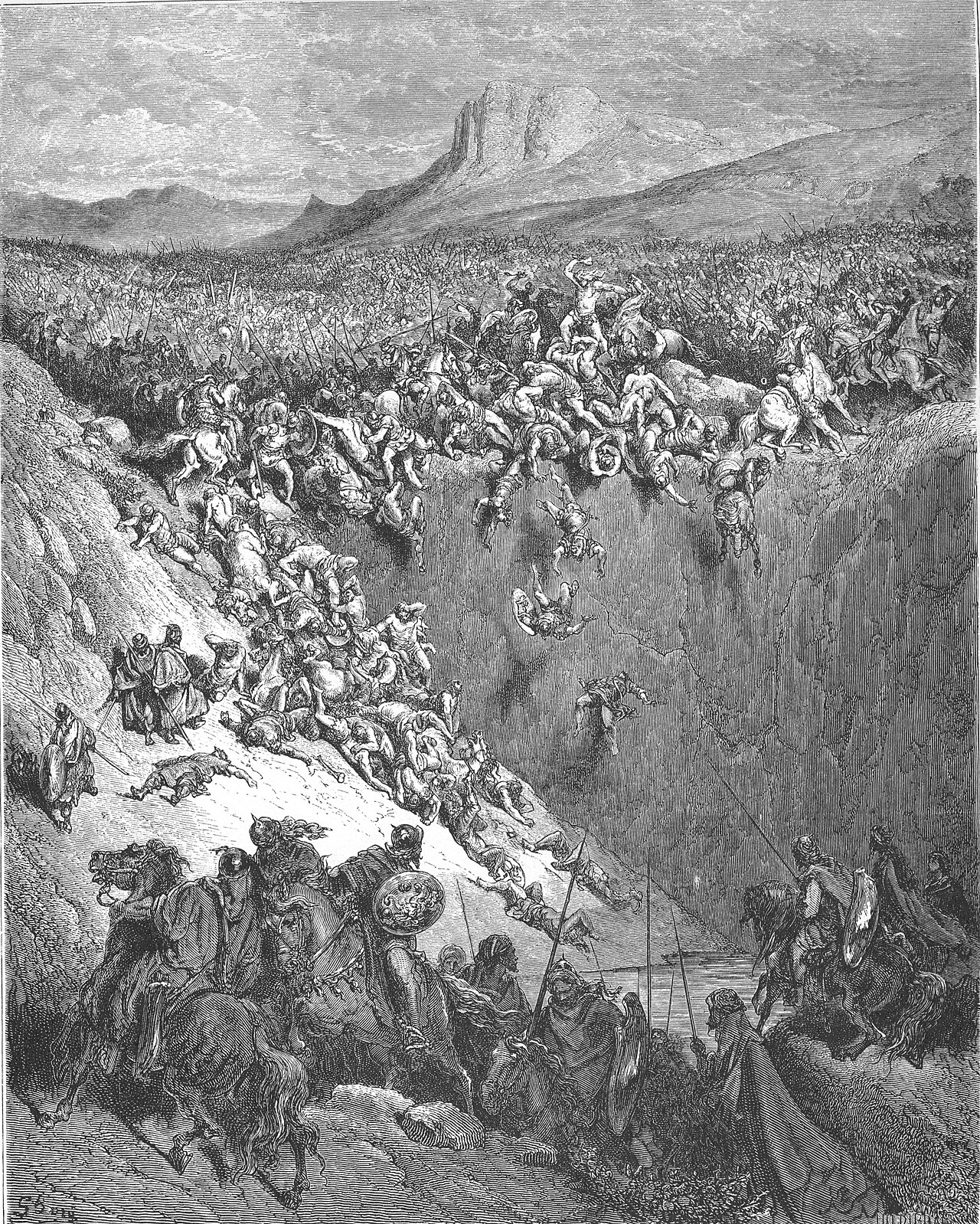
Judgeschapter 15
20 verses · Samuel, by tradition · 11th century BC · History
And Samson went and caught three hundred foxes, and took firebrands, and turned tail to tail, and put a firebrand in the midst between two tails.
Introduction
Samuel, by tradition, History, Judges Overview.
This chapter was written for Israelites who lived beside Philistine towns and paid for the arrangement, and tradition gives the book to Samuel. It carries a private quarrel on until it becomes a border war. It asks what a deliverer looks like when his own people would rather keep the peace with their rulers. Listen for the way each act of revenge answers the one before it. Notice where the men of Judah stand, and what the Spirit of the LORD does once they have given up. The chapter ends with a prayer, a spring of water and a count of the years he judged.
Context
- Who
- Israelites who knew what it was to live beside Philistine towns and pay for the arrangement
- What
- An account of Samson's revenge on the Philistines for his lost bride, Judah's surrender of him, and his victory at Lehi with the jawbone of a donkey.
- Where
- The Sorek valley on the border of Judah and Philistia, the rock of Etam in Judah, and the ridge at Lehi.
- When
- About 1080 to 1060 BC on the traditional reckoning, during the twenty years Samson judged Israel.
- Why
- To show the LORD delivering Israel through one man while the men of Judah accepted Philistine rule.
Historical context
This is Samson's account, and he is the sixth and last of the book's deliverers. He is a Danite, raised at Zorah, and 13:5 had said he would begin to deliver Israel out of the hand of the Philistines rather than finish the work.
Show the rest of the historical context, 4 more paragraphs
The years are the forty of Philistine rule that 13:1 records, and verse 20 dates his own term at twenty years within them. The twenty years are given again at 16:31 after his burial.
The ground is the low hill country where Judah's farmland runs down into the Philistine plain. Timnah, Etam and Lehi all sit within a short walk of each other, which is why a quarrel in one town brings an army to the next.
The occasion is the wheat harvest at verse 1. That fixes the season in late spring, and it also supplies the fuel, because the cut grain is standing dry in the fields when Samson arrives.
A first hearer knew things a reader now has to be told. A marriage was made in stages. A bride could still be living in her father's house between the betrothal and the taking home, which is why the father at verse 2 can offer a younger sister in her place. Burning a family's standing grain, vineyards and olive trees was a loss that ran past one season, since an olive tree takes years to bear again. And the Philistines held the iron trade and the coast road, so Judah's men at verse 11 were stating a fact of their working lives when they said the Philistines ruled over them.
Significance
An Israelite hearing this read knew that the men of Judah in the chapter were his own tribe, and that they went up the rock to hand over the one man fighting for them. The account gives their reason in their own words, that the Philistines were their rulers.
Show the rest of the significance, 1 more paragraph
The cry for help that opened every earlier round of the book is missing from this one. A hearer who knew the pattern would notice that nobody asked for a deliverer, and that God sent one into the middle of a private quarrel anyway.
This chapter in Jewish lifeWhat this chapter is in Jewish life and reading.
How it is read
Rashi reads the chapter as a sequence of reprisals and glosses the working of each one. On Samson's declaration before he begins he gives the sense as "I shall be justified in inflicting injury upon them" (Rashi on Judges 15:3:1, the Metsudah Tanach series, Lakewood, N.J., CC-BY). On the foxes he explains the verb as tying each tail into the next, and he sets out the grammar that makes the form mean turning another rather than turning oneself (Rashi on Judges 15:4:1, same edition). On the slaughter at Etam he follows the Targum and reads the two words of the Hebrew as "Horsemen and foot soldiers", explaining that the one rides supported by the calf of the leg in the stirrup and the other stands on the thigh (Rashi on Judges 15:8:1, same edition). On the men of Judah who came down to bind him he reads their protest as the answer of a people already under the Philistines, "Are we not enslaved by you?", and their own terms as a promise to hand him over alive, "We shall not execute you, but merely tie you down" (Rashi on Judges 15:10:1 and 15:13:1, same edition). On the Spirit at Lehi he gives the Targum's rendering, "A spirit of power, emanating from Adonoy", and on Samson's cry over the jawbone he follows the Targum again in reading the wordplay as heaping the slain into mounds (Rashi on Judges 15:14:1 and 15:16:1, same edition). On the water given at Lehi he explains the hollow place as a socket shaped like a mortar (Rashi on Judges 15:19:1, same edition). Malbim, Radak and Metzudat David comment across the chapter and the corpus holds no English version of them here, so they stand as citations: Malbim on Judges 15:1:1, Malbim on Judges 15:2:1, Radak on Judges 15:5:1, Radak on Judges 15:11:1, Radak on Judges 15:17:1, Radak on Judges 15:20:1, Metzudat David on Judges 15:12:1 and Metzudat David on Judges 15:18:1.
What the rabbis say
The corpus records forty rabbinic locators on this chapter, thirty-one of them Midrash and nine Talmud, each a locator without text. The foxes and their tails draw Sotah 10a:4, Yoma 22b:3, Midrash Tehillim 8:5, Midrash Sekhel Tov, Shemot 1:20:2, Bereshit Rabbati, Parashat Vayetze 33, Ein Yaakov, Sotah 1:31 and Ein Yaakov (Glick Edition), Sotah 1:25. The burning of the standing grain, the vineyards and the olive groves draws Bava Metzia 87b:10, Berakhot 35a:14 and Jerusalem Talmud Peah 7:3:7. The three thousand men of Judah and the binding draw Bereshit Rabbah 98:14, Kohelet Rabbah 9:1:1, Midrash Tehillim 18:6, Pesikta DeRav Kahana 26:1, Midrash Tanchuma, Achrei Mot 1:1, Midrash Tanchuma, Vaetchanan 1:1 and Sifrei Bamidbar 132:3. The Spirit at Lehi and the jawbone draw Vayikra Rabbah 8:2, Bamidbar Rabbah 14:9, Bereshit Rabbah 98:13, Eikhah Rabbah 1:25, Midrash Tehillim 3:9, Nazir 4b:18 and Ein Yaakov, Nazir 1:4. The prayer for water and the answer draw Sifrei Devarim 27:3, Midrash Tannaim on Deuteronomy 3:24:15, Sotah 9b:19, Sotah 9b:20, Bamidbar Rabbah 9:24 and Shir HaShirim Rabbah 1:2:8. The twenty years of judging draw Jerusalem Talmud Sotah 1:8:5 and Bereshit Rabbati, Parashat Vayechi 22. The rabbis teach in these places, and this site reports them as their teaching rather than as a rule of the text.
Sources: Rashi, Rashi on Judges 15:3:1, 15:4:1, 15:8:1, 15:10:1, 15:13:1, 15:14:1, 15:16:1 and 15:19:1, the Metsudah Tanach series, Lakewood, N.J., CC-BY; Malbim, Malbim on Judges 15:1:1 and 15:2:1, cited only, no English version in the corpus; Radak, Radak on Judges 15:5:1, 15:11:1, 15:17:1 and 15:20:1, cited only; Metzudat David, Metzudat David on Judges 15:12:1 and 15:18:1, cited only.
The heads below are this chapter's scenes. The numbered points under each are its verses.
Three hundred foxes in the standing grain
Judges 15:1-3
The reader learned at 14:20 that the wife was given away, so the chapter opens with Samson finding out what the last one reported. Wheat harvest fixes the season and supplies the fuel for what follows. Albert Barnes takes her still being in her father's house as a sign she was betrothed rather than married, which is why the father can offer the younger sister instead.
Judges 15:1
“Visited his wife with a kid - A common present (see Gen 38:17; Luk 15:29). From Samson’s wife being still in her father’s house, it would seem that she was only betrothed, not actually married, to his companion.”
2 more voices on this verseWhat preachers and commentators have said about this verse, in their own words.
Judges 15:1
“Wheat harvest - Which was the proper season for what follows. With a kid - As a token of reconciliation. Into the chamber - Into her chamber, which the women had separate from the mens.”
John Wesley · Explanatory Notes upon the Old Testament (1765)evangelical
Judges 15:1
“It was the dry season, dry far beyond our experience, and the grain in a most combustible state. Samson visited his wife with a kid--It is usual for a visitor in the East to carry some present; in this case, it might be not only as a token of civility, but of reconciliation. he said--that is, to himself.”
Jamieson, Fausset & Brown · Commentary Critical and Explanatory on the Whole Bible (1871)reformed
Her father says he was sure Samson hated her, and Wesley answers that no father may give away another man's wife without his consent. Barnes notes that Samson's father had paid the dowry for the elder sister, so the younger sister is offered in her place. Jamieson, Fausset and Brown cite Leviticus 18:18 against it.
Judges 15:2
“Thou hadst utterly hated her - As he was conscious she had given him great cause so to do. Her younger sister - The father appears to have been perfectly sincere in this offer.”
Adam Clarke · Commentary on the Bible (1810-1826)evangelical
3 more voices on this verse
Judges 15:2
“Hated her - Because thou didst desert her: but this was no sufficient cause; for he should have endeavoured a reconciliation, and not have disposed of another man's wife without his consent.”
John Wesley · Explanatory Notes upon the Old Testament (1765)evangelical
Judges 15:2
“I gave her - In marriage. Samson had probably not heard of this before. Samson’s father had paid the dowry for the older sister; her father therefore offers her sister in her room. The fear of Samson probably also influenced him.”
Judges 15:2
“Yet this is all he had to say in excuse of this injury. Thus he made the worst of jealousies to patronize the worst of robberies. But it will never bear us out in doing ill to say, "We thought others designed ill." 2.”
Matthew Henry · Commentary on the Whole Bible (1707-1721)puritan
Samson calls himself blameless this time, and Henry reads the word as a man who has done his part to end a quarrel. Henry notes that burning the grain would weaken the whole country of the Philistines. The harm now falls on the nation.
Judges 15:3
“Now shall I, &c. - Because they have first provoked me by an irreparable injury: but although this may look like an act of private revenge; yet it is plain Samson acted as a judge (for so he was) and as an avenger of the publick injuries of his people.”
John Wesley · Explanatory Notes upon the Old Testament (1765)evangelical
Judges 15:4-5
and caught three hundred foxes: The text gives the number, “three hundred foxes”, and the method, but not how one man took so many. Adam Clarke sets out the argument over the Hebrew shualim, read as jackals because jackals run in packs, and John Gill notes towns in Joshua 15 named for the animal. The fire reaches “the vineyards and olive groves”, so the loss runs into trees that take years to bear again.
Judges 15:4
“Went and caught three hundred foxes - There has been much controversy concerning the meaning of the term שועלים shualim, some supposing it to mean foxes or jackals, and others handfuls or sheaves of corn. Much of the force of the objections against the common version will be diminished by the following considerations: - 1. Foxes, or jackals, are common and gregarious in that country. 2. It is not hinted that Samson collected them alone; he might have employed several hands in this work.”
Adam Clarke · Commentary on the Bible (1810-1826)evangelical
Once Samson lit the torches and released the foxes, Jamieson, Fausset and Brown picture the scattered fires joining into one blaze across the standing grain. No neighbour could help another. Henry holds that a man free to take the lives of the Philistines was free to burn their grain.
Judges 15:5
“The pain caused by the fire would make the animals toss about to a wide extent, kindling one great conflagration. But no one could render assistance to his neighbor: the devastation was so general, the panic would be so great.”
Jamieson, Fausset & Brown · Commentary Critical and Explanatory on the Whole Bible (1871)reformed
Judges 15:6-7
The Philistines “burned her and her father to death”, the exact threat of 14:15, so the fire she betrayed her husband to escape reached her anyway. The narrator reports the outcome and draws no lesson from it. Jamieson, Fausset and Brown read Samson's vow of vengeance at verse 7 as the work of a judge rather than the settling of a private score.
Judges 15:6
“Burnt her and her father - This was probably done to appease Samson: as they saw he had been unjustly treated both by his wife and her father; therefore they destroyed them both, that they might cause his wrath to cease from them. And this indeed seems intimated in the following verse: And Samson said - Though ye have done this, yet will I be avenged of you; that is, I am not yet satisfied: ye have done me great wrongs, I must have proportionate redress; then I shall rest satisfied.”
Adam Clarke · Commentary on the Bible (1810-1826)evangelical
Clarke reads the burning of verse 6 as the Philistines trying to appease Samson by punishing her and her father. Samson refuses the offer. His vengeance falls on the Philistines who burned them.
Judges 15:8-10
The Hebrew behind “struck them ruthlessly” is a phrase found nowhere else in Scripture, and Adam Clarke lists the old versions' readings of it without settling them. Etam lies inside Judah's own hill country, so the deliverer withdraws into the tribe about to hand him over. The Philistines camp in Judah to arrest one man, and Judah asks why they have come rather than telling them to leave.
Judges 15:8
“He smote them hip and thigh - This also is variously understood; but the general meaning seems plain; he appears to have had no kind of defensive weapon, therefore he was obliged to grapple with them, and, according to the custom of wrestlers, trip up their feet, and then bruise them to death. Some translate heaps upon heaps; others, he smote horsemen and footmen; others, he wounded them from their legs to their thighs, etc., etc. See the different versions.”
Adam Clarke · Commentary on the Bible (1810-1826)evangelical
A jawbone, a thousand men, and water split from Lehi
The Philistines went up from the coast and camped in Judah, and Barnes notes that the verb for deployed is used of their army at 2 Samuel 5:18 and 5:22. Gill has them spread as far as Lehi. The town bears the name Lehi, jawbone, ahead of verse 17.
Judges 15:9
“Then the Philistines went up--to the high land of Judah. and spread themselves in Lehi--now El-Lekieh, abounding with limestone cliffs; the sides of which are perforated with caves. The object of the Philistines in this expedition was to apprehend Samson, in revenge for the great slaughter he had committed on their people.”
Jamieson, Fausset & Brown · Commentary Critical and Explanatory on the Whole Bible (1871)reformed
1 more voice on this verse
Judges 15:9
“Spread themselves - An expression used of the Philistine mode of war 2Sa 5:18, 2Sa 5:22, alluding to the compact way in which they came up the wadys, and then distpersed. Lehi is so called by anticipation (see Jdg 15:17).”
Judah asks why the Philistines have attacked. The answer names only Samson, and Clarke reads it as an offer to spare Judah open war if the men of Judah hand over the one man. Henry notes an army come to arrest one man, who was an army himself.
Judges 15:10
“To bind Samson are we come up - It seems they did not wish to come to an open rupture with the Israelites, provided they would deliver up him who was the cause of their disasters.”
Adam Clarke · Commentary on the Bible (1810-1826)evangelical
Judges 15:11-13
three thousand men of Judah: The men of Judah state Philistine rule as settled fact, “the Philistines rule over us”, and then ask their own deliverer what he has done to them. Three thousand men come to bind one Israelite, which Albert Barnes reads as men placating their masters. Samson asks only their oath not to kill him themselves.
Judges 15:11
“The dispirited men of Judah were prepared to give up their champion, in order to conciliate their masters. This shows how hard was the task of the Judge, whose office it was to restore his countrymen to freedom and independence.”
Adam Clarke reads the oath as Samson's refusal to fight his own countrymen, whom he could have thrown off as easily as the Philistines. Matthew Henry sees in the surrender a picture of Christ, who showed his power and then let himself be bound. The strength is held back for Lehi.
Judges 15:12
“That ye will not fall upon me yourselves - He could not bear the thought of contending with and slaying his own countrymen; for there is no doubt that he could have as easily rescued himself from their hands as from those of the Philistines.”
Adam Clarke · Commentary on the Bible (1810-1826)evangelical
1 more voice on this verse
Judges 15:12
“That, by being delivered up to the Philistine, he might have an opportunity of making a slaughter among them. That he might be a type of Christ, who, when he had shown what he could do, in striking those down that came to seize him, yielded to be bound and led as a lamb to the slaughter.”
Matthew Henry · Commentary on the Whole Bible (1707-1721)puritan
Ambrose of Milan reads the binding as a formality that let Judah hand Samson over in due form and keep clear of the charge against them. Adam Clarke takes the two new ropes as one for the hands and one for the legs. Both give way at verse 14.
Judges 15:13
“Justly is their misery prolonged who, to oblige their worst enemies, thus abuse their best friend. Never were men so infatuated except those who thus treated our blessed Saviour. Samson making his part good against the Philistines, even when he was delivered into their hands, fast pinioned with two new cords.”
Matthew Henry · Commentary on the Whole Bible (1707-1721)puritan
3 more voices on this verse
Judges 15:13
“They bound him with two new cords - Probably his hands with one and his legs with the other.”
Adam Clarke · Commentary on the Bible (1810-1826)evangelical
Judges 15:13
“When they heard this, though three thousand men had come up, they swore to him that they would make no attempt on his life, only he must submit to be bound, in order that they might formally surrender him, and so keep clear of the crime of which they were accused.”
Ambrose of Milan · written before 397 · Letter 19: To Vigiliuspatristic
Judges 15:13
“And they bound him - Thus was he a type of Christ, who yielded himself to be bound, yea and led as a lamb to the slaughter. Never were men so besotted as these men of Judah, except those who thus treated our blessed saviour.”
John Wesley · Explanatory Notes upon the Old Testament (1765)evangelical
Judges 15:14-15
This is the fourth coming of the Spirit of the LORD on Samson, four of the seven in the book, so the man most often gifted governs himself least. His weapon is “the fresh jawbone of a donkey”, a carcass again as at 14:8-9, though Numbers 6:6 keeps a Nazirite from the dead. Writers differ over whether the vow was held in abeyance or is being broken item by item.
Judges 15:14
“Shouted - Because they had now their enemy, as they supposed, in their hands. Loosed - Hebrew. were melted; that is, were dissolved, as things which are melted in the fire. This typified the resurrection of Christ, by the power of the Spirit of holiness.”
John Wesley · Explanatory Notes upon the Old Testament (1765)evangelical
Barnes explains the thousand dead by panic, the Philistines seeing the bound man snap the ropes and strike. Clarke reads the Hebrew for fresh as moist, a jawbone taken from a donkey lying dead. Henry sees Christ, who trod the winepress alone.
Judges 15:15
“Slew a thousand men therewith - Compare the marginal references. The Philistines, seized with a panic at seeing Samson suddenly burst his cords and rush at them, offered no resistance, but fell an easy prey to the blows of their mighty foe. Some perhaps were dashed down the cliffs in their flight.”
1 more voice on this verse
Judges 15:15
“But he was to be a type of him that trod the wine-press alone. Samson celebrating his own victory, since the men of Judah would not do even that for him. He composed a short song, which he sang to himself, for the daughters of Israel did not meet him, as afterwards they did Saul, to sing, with more reason, Samson hath slain his thousands.”
Matthew Henry · Commentary on the Whole Bible (1707-1721)puritan
Judges 15:16-17
The song turns on one word, since chamor in Hebrew is both a donkey and a heap, so the line says both at once. Albert Barnes puts it with the riddle of 14:12-18 as the same habit of mind, and Matthew Henry takes the wordplay as the reason the fallen are pictured so tamely. The text records the words and the name of the place, Ramath-lehi,.
Judges 15:16
“And I would that his moderation in victory had been equal to his courage against the enemy. But as is frequently the case, with mind unused to prosperity, he ascribed to himself the issue of the battle, which was due to the Divine favour and protection, saying, "With the jaw bone of an ass have I slain a thousand men." Nor did he build an altar to God, nor offer a victim, but neglecting sacrifice and assuming to himself the glory, to immortalize his triumph by a memorial name he called the place, The slaying of the jaw bone.”
Ambrose of Milan · written before 397 · Letter 19: To Vigiliuspatristic
2 more voices on this verse
Judges 15:16
“There is a play upon the word, three times repeated, which means both “an ass” and also “a heap.” The spirit of riddle-making Jdg 14:12, Jdg 14:18 is apparent in this song of triumph (compare Jdg 5:1; Exo 15:1; 1Sa 18:6-7).”
Judges 15:16
“The same word in Hebrew ( chamor ) signifies both an ass and a heap, so that this is an elegant paronomasia, and represents the Philistines falling as tamely as asses.”
Matthew Henry · Commentary on the Whole Bible (1707-1721)puritan
Ramath-lehi can mean the height of Lehi or the casting away of the jawbone, and Barnes ties the second sense to the throw this verse records. Adam Clarke holds that Lehi was the name of the place already. Samson added Ramath to it.
Judges 15:17
“Ramath-lehi - Either the “height or hill of Lehi,” or, “of the jaw-bone;” or, as in the margin, “the crestlag away of the jaw-bone,” with allusion to Samson casting it out of his hand, when he had finished his war-song.”
Judges 15:18-19
Samson's first recorded prayer asks for water, and his only other, at 16:28, also comes from an extremity. He hands God the victory his song had taken, “You have accomplished this great deliverance through Your servant”, and calls the Philistines “the uncircumcised”. Albert Barnes reads the hollow place as a basin among the cliffs, and “to this day” shows the spring still ran when this was written.
Judges 15:18
“And perhaps there was the hand of God therein, to chastise him for not making mention of God in his song, and to keep him from being proud of his strength. One would have thought that the men of Judah would have met him with bread and wine: but they so little regarded him, that he is fainting for want of a draught of water!”
John Wesley · Explanatory Notes upon the Old Testament (1765)evangelical
En-hakkore, in Wesley's gloss, is the spring of the one who cried out, so the place keeps the cry Samson raised when he was thirsty, and Clarke calls it the well of the implorer. Barnes reports a spring on the way from Socho called Samson's spring. Jerome and later writers knew it by that name.
Judges 15:19
“An hollow place that was in the jaw - The right translation is, “the hollow place which is in Lehi.” The word translated “hollow place,” means a “mortar” Pro 27:22, and is here evidently a hollow or basin among the cliffs of Lehi, which, from its shape, was called “the mortar.” A spring, on the way from Socho to Eleutheropolis, was commonly called Samson’s spring in the time of Jerome and writers in the 7th, 12th, and 14th centuries.”
His rule is dated by the enemy's, “in the days of the Philistines”, and 16:31 repeats the twenty years after his burial, so the chapters of his ruin sit inside a term already closed. The rest formula of the earlier deliverances never closes one of Samson's chapters. The angel said at 13:5 that he would begin the deliverance, and the Philistines still rule when his years are over.
Judges 15:20
“He judged Israel - twenty years - In the margin it is said, He seems to have judged southwest Israel during twenty years of their servitude of the Philistines, Jdg 13:1. Instead of עשרים שנה esrim shanah, twenty years, the Jerusalem Talmud has ארבעים שנה arbaim shanah, forty years; but this reading is not acknowledged by any MS. or version. According to Calmet, the twenty years of the judicature of Samson began the eighteenth year of the subjection of Israel to the Philistines; and these twenty years are included in the judicature of the high priest Eli.”
Adam Clarke · Commentary on the Bible (1810-1826)evangelical
1 more voice on this verse
Judges 15:20
“He judged - That is, he pleaded their cause, and avenged them against the Philistines. Of the Philistines - That is, whilst the Philistines had the power and dominion, from which he was not fully to deliver, but only to begin to deliver them.”
John Wesley · Explanatory Notes upon the Old Testament (1765)evangelical
How this psalm is built
The form: A narrative of reprisal in four exchanges, closed by a prayer and a dating formula, and read as the work of a judge rather than the settling of a private score, as Jamieson, Fausset and Brown classes it.
The patterns in this chapter
| Device | What it does | Where to see it |
|---|---|---|
| The exchange that will not stop | Four times an act is answered by a heavier act. Samson burns the harvest at verse 5, the Philistines burn the woman and her father at verse 6, Samson strikes them at verse 8, and the Philistines camp in Judah at verse 9. The narrator keeps the pattern running and passes no verdict on any turn of it.Jamieson, Fausset and Brown, Commentary Critical and Explanatory on the Whole Bible, on Judges 15:6 to 7. | Judges 15:5, Judges 15:6, Judges 15:8, Judges 15:9 |
| The threat that came back | The Philistines had threatened at Judges 14:15 to burn the woman of Timnah and her father's house if she did not get the riddle out of Samson. She gave up the answer to escape that fire, and verse 6 records the same fire reaching her from the same men. The account closes the loop and draws no lesson from it.Matthew Henry, Commentary on the Whole Bible, 1708 to 1710, on Judges 15:6. | Judges 14:15, Judges 15:6 |
| The one word that carries the song | The Hebrew chamor is both a donkey and a heap, so the two lines of verse 16 say donkey upon donkey and heap upon heap at once. Matthew Henry gives the play on the word as the reason the fallen are pictured as tamely as they are. Albert Barnes sets the line beside the riddle of 14:12 to 18 as the same habit of mind at work.Albert Barnes, Notes on the Old Testament, on Judges 15:16. | Judges 15:16 |
| The names left on the ground | Two places in this chapter are named from what happened in them. Ramath-lehi at verse 17 is the height of the jawbone, and En-hakkore at verse 19 is the spring of the one who called. Verse 19 adds that the spring was still running when the account was written down.Albert Barnes, Notes on the Old Testament, on Judges 15:19. | Judges 15:17, Judges 15:19 |
The structure
8 more paragraphs on the patterns
Five units. The wife given away and the harvest burned at verses 1 to 5. The reprisal on both sides at verses 6 to 8. Judah's arrest of Samson at verses 9 to 13. The Spirit and the jawbone at verses 14 to 17. The thirst, the prayer and the dating formula at verses 18 to 20.
The chapter opens on a fact the reader already holds, since 14:20 had told him the wife was given to the companion. Samson learns in this chapter what the last chapter reported.
The Spirit, counted
The book says the Spirit of the LORD came or moved on a man seven times: Othniel at 3:10, Gideon at 6:34, Jephthah at 11:29, and Samson at 13:25, 14:6, 14:19 and 15:14. Four of the seven fall on Samson. The most gifted man in the book receives the gift most often and governs himself least, and the count is checkable from the text.
The first prayer
Verse 18 is the first prayer Samson is recorded praying in three chapters of his life, and it asks for water. His only other recorded prayer is at 16:28, and both come out of an extremity. What he says here hands God the victory his own song at verse 16 had taken for himself. He calls the Philistines the uncircumcised, which is what his parents called them at 14:3 and what David calls Goliath at 1 Samuel 17:26.
The formula that never returns
Verse 20 dates his rule by the enemy's, in the days of the Philistines, and 16:31 records the same twenty years again after his burial. The rest formula that closed the earlier deliverances at 3:11, 3:30 and 5:31 never comes back. The angel had said at 13:5 that he would begin to deliver Israel, and the book keeps to that word. The Philistines are still ruling when the twenty years are over, and 1 Samuel opens with them ruling still.
Keep studying
Sources for this chapter
The summary
Jamieson, Fausset & Brown, Commentary Critical and Explanatory; John Wesley, Notes on the Old Testament and Matthew Henry, Complete Commentary.
The form and classifications
Barry G. Webb, The Book of Judges: An Integrated Reading, 1987, and the NICOT commentary, 2012; Jamieson, Fausset and Brown, Commentary Critical and Explanatory on the Whole Bible, on Judges 15:7 and Matthew Henry, Exposition of the Old and New Testaments, 1708 to 1710, read with Hebrews 11:32 to 34.
The exposition
Adam Clarke, Commentary on the Bible; Albert Barnes; Ambrose of Milan, Letter 19: To Vigilius; Jamieson, Fausset & Brown, Commentary Critical and Explanatory on the Whole Bible; John Gill, Exposition of the Old Testament; John Wesley, Explanatory Notes upon the Old Testament; Keil and Delitzsch, Biblical Commentary on the Old Testament: Joshua, Judges, Ruth and Matthew Henry, Commentary on the Whole Bible.