
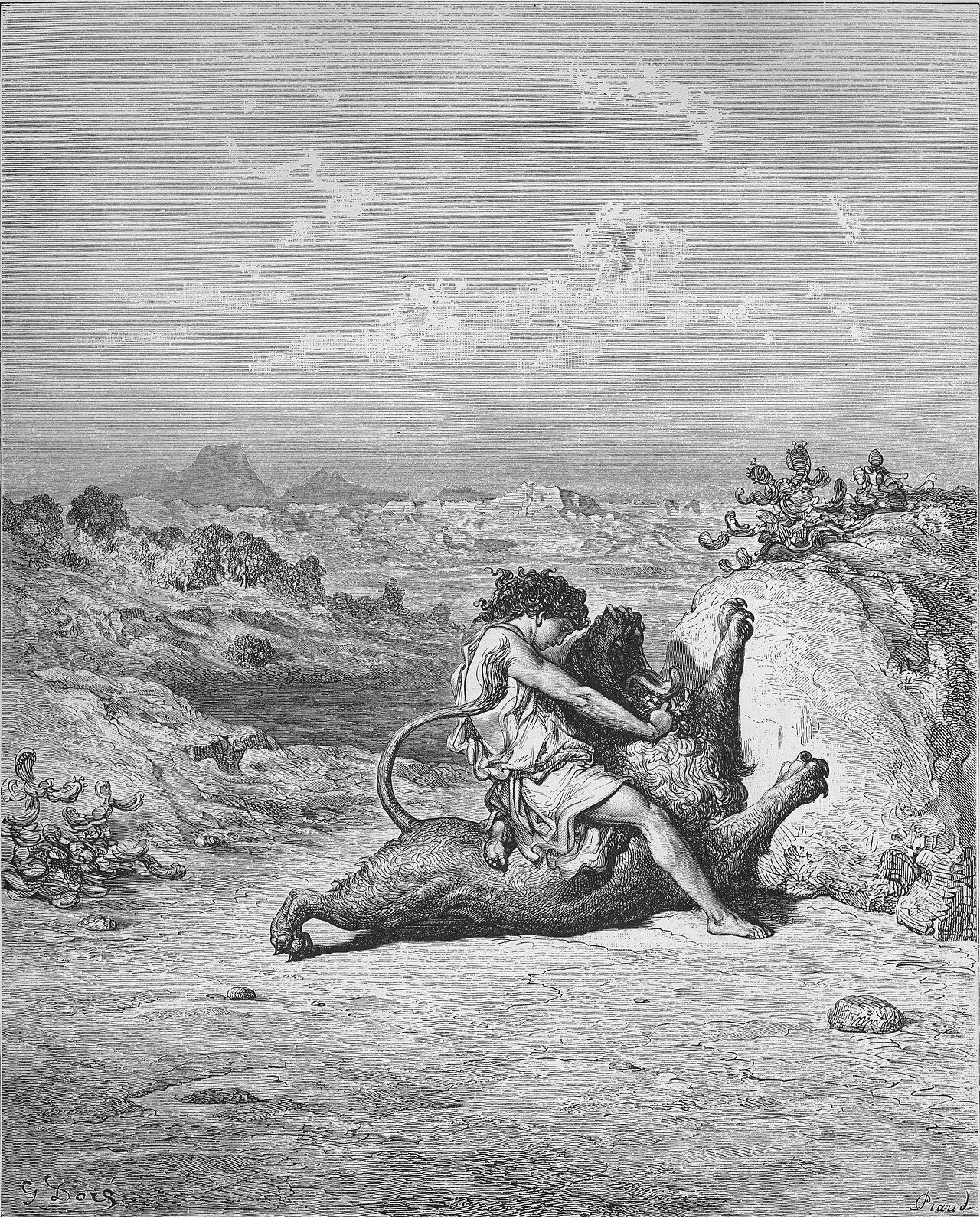
Judgeschapter 14
20 verses · Samuel, by tradition · 11th century BC · History
And Samson said unto them, I will now put forth a riddle unto you: if ye can certainly declare it me within the seven days of the feast, and find it out, then I will give you thirty sheets and thirty change of garments:
Introduction
Samuel, by tradition, History, Judges Overview.
This chapter was written for Israelites who knew the customs of a wedding and the price of good cloth, and tradition gives the book to Samuel. It follows the child promised in the last chapter into manhood and into the Philistine towns below his home. It asks how God works through a man who follows his own desires. Listen for the places where the terms of his vow are brought near: a vineyard, a dead animal, a drinking feast. Notice also the riddle and the pressure put on the one who knows its answer, since the same pressure returns two chapters later. The chapter ends in anger and in loss.
Context
- Who
- Israelites who knew what a seven day wedding feast was and what a wager of sixty garments was worth
- What
- An account of Samson's marriage to a Philistine woman of Timnah, the lion he killed, his riddle at the wedding feast, and its bitter end.
- Where
- Timnah in the Sorek valley under Philistine rule, the vineyards near it, and Ashkelon on the coast.
- When
- About 1080 BC on the traditional reckoning, within the forty years of Philistine rule.
- Why
- To show the LORD seeking an occasion against the Philistines through a marriage Samson's parents opposed.
Historical context
The chapter belongs to Samson, a Danite of Zorah, living under the vow laid on him at Judges 13:5, at the point where he takes a wife.
Show the rest of the historical context, 7 more paragraphs
It falls about 1080 BC on the traditional reckoning, inside the forty years of Philistine rule that Judges 13:1 opens.
Timnah stands in Judah's town list at Joshua 15:57 and is handed to Dan at Joshua 19:43, so the woman lives inside his own tribe's paper border and under Philistine government. Going down to it and coming back up fixes the hill country around Zorah above the plain where the town sits.
The occasion is a marriage his parents objected to and could not prevent.
A first hearer knew what the feast at verse 10 was. The word behind it is built on the verb to drink and is the ordinary word for a banquet, and a wedding feast ran seven days, which is why the riddle has seven days to run.
He knew what the wager was worth. Thirty linen garments and thirty changes of clothing on each side is a small fortune, since cloth was made by hand and a change of clothing was a substantial possession rather than an ordinary one.
He knew what a riddle was for. The Hebrew word is the one used of the hard questions the queen of Sheba brings to Solomon at 1 Kings 10:1, so this is a recognised contest of wit rather than a joke, and it is put at a wedding where such contests belonged.
And he knew the distance. Ashkelon is one of the five Philistine cities of Joshua 13:3 and lies about twenty four miles from Timnah, so the thirty men whose clothes paid the wager were not the thirty who won it.
Significance
The chapter set the man the last one had announced against the terms he had been born under. It walks him past a vineyard, past a carcass and into a drinking feast, and reports where he stood each time.
Show the rest of the significance, 2 more paragraphs
The threat at verse 15 would have been heard as real, and it was. The Philistines burn the woman and her father at Judges 15:6, so the fire she betrayed her husband to avoid reached her one chapter later.
The pattern at verse 17 is the one a first hearer would recognise again two chapters on. She wept the whole seven days and he told her on the last, and the same pressure takes the vow itself at Judges 16:16.
This chapter in Jewish lifeWhat this chapter is in Jewish life and reading.
How it is read
The commentators hold the marriage at Timnah and the LORD's purpose in it together. On the line that the father and mother did not know the matter was from the LORD, Rashi says it was "An accusation with which to provoke a confrontation against them", so that the marriage becomes the occasion of the fight with the Philistines (Rashi on Judges 14:4:1, the Metsudah Tanach series, Lakewood, N.J., CC-BY). The rest of his work on the chapter is the plain sense of a wedding. He says Samson spoke of the woman with her relatives rather than with the woman, following the Targum, and he glosses the companions at the feast as "Companions who formed the retinue of wedding attendants", and the man the bride was given to at the end as "one of the wedding attendants" (Rashi on Judges 14:7:1, 14:11:1 and 14:20:1, same edition). He counts the days of the riddle closely, holding that the seventh day named in the pressing of Samson's wife was the seventh day of the week and the fourth of the feast (Rashi on Judges 14:15:1 and 14:17:1, same edition). On the Spirit rushing upon Samson at Ashkelon he gives the Targum's rendering, "A spirit of power, Divinely inspired" (Rashi on Judges 14:19:1, same edition). Malbim, Radak and Metzudat David comment across the chapter and the corpus holds no English version of them here, so they stand as citations: Malbim on Judges 14:1:1, Malbim on Judges 14:3:1, Radak on Judges 14:4:1, Radak on Judges 14:6:1, Radak on Judges 14:12:1, Metzudat David on Judges 14:13:1, Metzudat David on Judges 14:14:1 and Metzudat David on Judges 14:16:1.
What the rabbis say
The corpus records forty rabbinic locators on this chapter, thirty-one of them Midrash and nine Talmud, each a locator without text. The going down to Timnah draws Bamidbar Rabbah 9:24, Bereshit Rabbah 85:6, Ein Yaakov, Sotah 1:27, Ein Yaakov, Sotah 1:34, Ein Yaakov (Glick Edition), Sotah 1:21 and Ein Yaakov (Glick Edition), Sotah 1:28. The demand for the Philistine woman draws Berakhot 12b:22, Horayot 10b:11, Bereshit Rabbah 67:12 and Ein Yaakov, Nazir 4:2. The line about the LORD's purpose draws Bereshit Rabbah 68:3, Jerusalem Talmud Sotah 1:8:4, Mekhilta DeRabbi Shimon Ben Yochai 21:13, Midrash Aggadah, Numbers 11:1:1 and Ein Yaakov, Moed Katan 3:18. The lion at the vineyards draws Sanhedrin 95a:2, Avot DeRabbi Natan 39:2, Bereshit Rabbah 70:15 and Ein Yaakov, Sanhedrin 11:28, and the honey taken from its carcass draws Zevachim 65b:1, Midrash Lekach Tov, Leviticus 11:3:1, Bereshit Rabbah 86:2, Eikhah Rabbah 1:41 and Yalkut Shimoni on Torah 145:14. The riddle and its answer draw Vayikra Rabbah 8:2, Eikhah Rabbah 1:11, Jerusalem Talmud Beitzah 2:8:3, Jerusalem Talmud Shabbat 5:4:8, Ein Yaakov, Sanhedrin 2:11 and Ein Yaakov (Glick Edition), Sanhedrin 2:9. The Spirit at Ashkelon draws Nazir 4b:19, Bamidbar Rabbah 14:9 and Ein Yaakov, Nazir 1:4. The rabbis teach in these places, and this site reports them as their teaching rather than as a rule of the text.
Sources: Rashi, Rashi on Judges 14:4:1, 14:7:1, 14:11:1, 14:15:1, 14:17:1, 14:19:1 and 14:20:1, the Metsudah Tanach series, Lakewood, N.J., CC-BY; Malbim, Malbim on Judges 14:1:1 and 14:3:1, cited only, no English version in the corpus; Radak, Radak on Judges 14:4:1, 14:6:1 and 14:12:1, cited only; Metzudat David, Metzudat David on Judges 14:13:1, 14:14:1 and 14:16:1, cited only.
The heads below are this chapter's scenes. The numbered points under each are its verses.
A lion torn apart, honey in the carcass
Judges 14:1-2
Timnah stands in Judah's town list at Joshua 15:57 and is given to Dan at Joshua 19:43, so the woman lives inside his tribe's allotment and under Philistine rule. He goes down to it from the hill country round Zorah and comes back up. His first recorded words are “Now get her for me as a wife”, and his ground is what his eyes had seen.
Judges 14:1
“And Samson went down to Timnath,.... A city which by lot fell to the tribe of Judah, but was afterwards given to the tribe of Dan, and now in the hands of the Philistines, Jos 15:57. Judah is said to go up to it, because the place where he lived lay below it, Gen 38:13, but Samson is said to go down to it, because he lived above it.”
1 more voice on this verseWhat preachers and commentators have said about this verse, in their own words.
Judges 14:1
“Went down to Timnath - A frontier town of the Philistines, at the beginning of the lands belonging to the tribe of Judah, Jos 15:57; but afterwards given up to Dan, Jos 19:43. David took this place from the Philistines, but they again got possession of it in the reign of Ahaz, 2Ch 28:18.”
Adam Clarke · Commentary on the Bible (1810-1826)evangelical
Albert Barnes explains the request: the father and mother of the bridegroom got the wife for their son and paid the dowry to her family. Matthew Henry notes that Samson asks his father and mother first. His wish still sets the terms.
Judges 14:2
“Get her for me - namely, by Paying the requisite dowry (see marginal references) and gifts to relations. Hence, the frequent mention of parents taking wives for their sons Exo 34:16; Neh 10:30, because the parents of the bridegroom conducted the negotiation, and paid the dower to the parents of the bride.”
Judges 14:3-4
The parents object to “the uncircumcised Philistines”, as Jonathan says at 1 Samuel 14:6 and David at 1 Samuel 17:26. In Hebrew, Samson says she is right in his eyes, the sentence the book closes on at 17:6 and 21:25. Matthew Henry takes the marriage rule as set aside to strike the oppressor, and Albert Barnes reads God as turning foreseen misconduct into “an occasion to move against the Philistines”.
Judges 14:3
“The uncircumcised Philistines - Compare 1Sa 14:6; 1Sa 17:26; 1Sa 31:4, for a similar use of the term as one of reproach. Also Act 11:3.”
The verse is the narrator's aside, and it tells the reader what Samson's parents could not see. Albert Barnes reads the occasion as God's secret purpose against the Philistines, with their rule over Israel as the reason given. Every clash that follows grows from this marriage.
Judges 14:4
“His father and mother very properly opposed Samson’s marriage with a Pagan woman, the daughter of the oppressors of his race. But they could not prevail, because it was the secret purpose of God by these means to “seek occasion” against the Philistines; i. e. to make the misconduct of the father of Samson’s wife, which He foresaw, the occasion of destruction to the Philistines. Compare the marginal references for similar statements.”
1 more voice on this verse
Judges 14:4
“It was not a thing evil in itself for him to marry a Philistine. It was forbidden because of the danger of receiving hurt by idolaters; where there was not only no danger of that kind, but an opportunity hoped for of doing that hurt to them which would be good service to Israel, the law might well be dispense with.”
Matthew Henry · Commentary on the Whole Bible (1707-1721)puritan
Judges 14:5-6
The lion meets him among “the vineyards of Timnah”, and Numbers 6:3-4 bars a Nazirite from everything the vine yields, though the text records nothing of what he ate there. This is the second of four comings of the Spirit on Samson, and “came powerfully upon him” is stronger than what is said of Othniel at 3:10 and Gideon at 6:34. He told neither parent.
Judges 14:5
“A young lion roared against him - Came fiercely out upon him, ready to tear him to pieces.”
Adam Clarke · Commentary on the Bible (1810-1826)evangelical
2 more voices on this verse
Judges 14:5
“He was exalted in his own strength. That which added much to the glory of Samson's triumph over the lion was that when he had done this great exploit he did not boast of it, did not so much as tell his father nor mother that which many a one would soon have published through the whole country.”
Matthew Henry · Commentary on the Whole Bible (1707-1721)puritan
Judges 14:5
“This request was granted; and Samson on his return to visit his promised bride, turned a little way out of the road, and straightway there met him a lion from the wood, fierce in its savage freedom. Samson had no companion, nor any weapon in his hand; but he felt ashamed to fly, and conscious power gave him courage.”
Ambrose of Milan · written before 397 · Letter 19.14patristic
Adam Clarke reads Samson's strength as the Spirit's, given by the will of the LORD and joined to his hair and his vow. Jamieson, Fausset and Brown describe the young lion as a lion in its prime. Samson told neither his father nor his mother.
Judges 14:6
“He rent him as he would have rent a kid - Now it is not intimated that he did this by his own natural strength, but by the Spirit of the Lord coming mightily upon him: so that his strength does not appear to be his own, nor to be at his command; his might was, by the will of God, attached to his hair and to his Nazarate.”
Adam Clarke · Commentary on the Bible (1810-1826)evangelical
Judges 14:7-9
Numbers 6:6 keeps a Nazirite from any dead body, yet Samson leaves the road to see “the lion’s carcass”, takes its honey and gives some to his parents without saying where it came from. That silence is the second in four verses, and the two silences make the riddle possible. Adam Clarke reads the interval of verse 8 as about a year, the usual space between betrothal and wedding.
Judges 14:7
“And talked with the woman - That is, concerning marriage; thus forming the espousals.”
Adam Clarke · Commentary on the Bible (1810-1826)evangelical
The Hebrew for later reads after days. John Wesley notes the phrase often means a year, and Charles Spurgeon observes that dry heat soon cleans a carcass in that country. By Samson's return the lion held bees and their honey.
Judges 14:8
“After a time - Probably about one year; as this was the time that generally elapsed between espousing and wedding. A swarm of bees and honey in the carcass - By length of time the flesh had been entirely consumed off the bones, and a swarm of bees had formed their combs within the region of the thorax, nor was it an improper place; nor was the thing unfrequent, if we may credit ancient writers; the carcasses of slain beasts becoming a receptacle for wild bees.”
Adam Clarke · Commentary on the Bible (1810-1826)evangelical
2 more voices on this verse
Judges 14:8
“After a time - Hebrew. after days; that is, either after some days: or, rather, after a year, as that word often signifies; when the flesh of the lion, (which by its strong smell is offensive to bees) was wholly consumed, and nothing was left but the bones.”
John Wesley · Explanatory Notes upon the Old Testament (1765)evangelical
Judges 14:8
“IT was a singular circumstance that a man unarmed should have slain a lion in the prime of its vigor and yet, more strange that a swarm of bees should have taken possession of the dried carcass and have filled it with their honey. In that country, what with beasts, birds, insects and the dry heat, a dead body is soon cleansed from all corruption and the bones are clean and white. Still, the killing of the lion and the finding of the honey make up a remarkable story.”
Matthew Henry notes that honey was one of the goods of a land said to flow with milk and honey. Charles Spurgeon preached this verse as Hands Full of Honey. Samson gave the honey to the father and mother who had opposed the marriage.
The riddle, the wedding week, and the plowed heifer
Judges 14:10-11
The word for feast is mishteh, built on the verb to drink, the word for the banquet at Genesis 21:8. Numbers 6:3 bars a Nazirite from wine and strong drink, and this verse puts him at a drinking feast without saying what he took. Albert Barnes takes the thirty companions as a mark of the family's standing, and Jamieson, Fausset and Brown as a watch on a stranger.
Judges 14:10
“Made a feast ... - This was the wedding-feast, protracted in this instance seven days, in that of Tobias (Tobit 8:19) fourteen days. It was an essential part of the marriage ceremony Gen 29:22; Est 2:18; Mat 22:2-4; Rev 19:7, Rev 19:9.”
Adam Clarke and Albert Barnes take the thirty men as the friends of the bridegroom named at Matthew 9:15 and John 3:29. One of the thirty men will take Samson's wife at verse 20.
Judges 14:11
“Thirty companions - These were “the children of the bride-chamber” (Mat 9:15; see Jdg 14:20). From the number of them it may be inferred that Samson’s family was of some wealth and importance.”
1 more voice on this verse
Judges 14:11
“Samson, in some place obtained for the occasion, as he was a stranger. A large number of paranymphs, or "friends of the bridegroom," furnished, no doubt, by the bride's family, attended his party, ostensibly to honor the nuptials, but really as spies on his proceedings.”
Jamieson, Fausset & Brown · Commentary Critical and Explanatory on the Whole Bible (1871)reformed
Judges 14:12-14
The word for riddle is chidah, used of the hard questions the queen of Sheba brings Solomon at 1 Kings 10:1. The stake is “thirty linen garments and thirty sets of clothes” on each side, a small fortune for a wedding game. Adam Clarke observes that no one who was not there could solve it, since the answer runs through a lion nobody saw and honey nobody was told about.
Judges 14:12
“I will now put forth a riddle--Riddles are a favorite Oriental amusement at festive entertainments of this nature, and rewards are offered to those who give the solution. Samson's riddle related to honey in the lion's carcass. The prize he offered was thirty sindinim, or shirts, and thirty changes of garments, probably woolen.”
Jamieson, Fausset & Brown · Commentary Critical and Explanatory on the Whole Bible (1871)reformed
1 more voice on this verse
Judges 14:12
“I will now put forth a riddle - Probably this was one part of the amusements at a marriage-feast; each in his turn proposing a riddle, to be solved by any of the rest on a particular forfeit; the proposer forfeiting, if solved, the same which the company must forfeit if they could not solve it. Thirty sheets - I have no doubt that the Arab hayk, or hake, is here meant; a dress in which the natives of the East wrap themselves, as a Scottish Highlander does in his plaid.”
Adam Clarke · Commentary on the Bible (1810-1826)evangelical
Jamieson, Fausset and Brown give the Hebrew for linen garments as sindinim, or shirts, and take the sets of clothes as woolen. John Gill reads the young men's reply as acceptance of the terms. The wager is now binding.
Judges 14:13
“But if ye cannot declare it unto me,.... Explain the riddle in the space of time allowed: then shall ye give me thirty sheets, and thirty change of garments; so many shirts and suits of apparel: and they said unto him, put forth thy riddle that we may hear it; not thereby to judge whether they would agree to his proposals, but hereby suggesting that they accepted his terms and conditions, either to give or receive the above premium, if they did or did not hit on the explanation of the riddle.”
Adam Clarke takes the riddle as two lines of verse, and he notes that the Syriac and Arabic read bitter where the Hebrew reads strong. Caesarius of Arles reads the lion as a figure of Christ. The answer lies in verse 8.
Judges 14:14
“And he said unto there - Thus he states or proposes his riddle: - Out of the eater came forth meat, And out of the strong came forth sweetness. Instead of strong, the Syriac and Arabic have bitter. I have no doubt that the riddle was in poetry; and perhaps the two hemistichs above preserve its order. This was scarcely a fair riddle; for unless the fact to which it refers were known, there is no rule of interpretation by which it could be found out. We learn from the Scholiast, on Aristophanes, Vesp. v.”
Adam Clarke · Commentary on the Bible (1810-1826)evangelical
1 more voice on this verse
Judges 14:14
“And perhaps this was not only a prodigy of valour, but also a mystery of wisdom, an utterance of prophecy. For it does not seem to have been without a purpose that, as he was going to his marriage, a roaring lion met him, which he tore asunder with his hands, in whose body, when about to enjoy the wished-for wedlock, he found a swarm of bees, and took honey from its mouth, which he gave to his father and mother to eat.”
Ambrose of Milan · written before 397 · On the Holy Spirit 2, Introduction, 6-9patristic
Judges 14:15-17
The threat to burn her “and your father’s household to death” is carried out at 15:6, so the fire she betrays her husband to escape reaches her one chapter later. He tells her on the seventh day “because she had pressed him so much”, the pressure Delilah repeats at 16:16. His answer at verse 16 sets his parents and his wife on one footing, since he had told neither.
Judges 14:15
“Seventh day - They had doubtless spoken to her before this time, but with some remissness, supposing that they should find it out; but now their time being nigh slipped, they put her under a necessity of searching it out. To take that we have - That is, to strip us of our garments.”
John Wesley · Explanatory Notes upon the Old Testament (1765)evangelical
She calls the Philistine guests her own people, and the phrase sets her with them. She turns the withheld answer into a test of love. Delilah makes the same charge at 16:15.
John Gill follows Kimchi in reading the seven days as the days left from the fourth onward, while others think her tears began on the first day of the feast. Adam Clarke reads her weeping as done to serve the Philistine men. She passes the answer to her people at once.
Judges 14:17
“And she wept before him the seven days, while the feast lasted,.... Those that remained of the seven days, from the fourth to this time, as Kimchi seems rightly to interpret it; though some think she began to beseech him with tears, on the first day of the feast, to impart the secret to her for her own satisfaction; and then, after the men had urged her on the fourth day to persuade her husband to it, she continued pressing him more earnestly with tears unto the seventh day.”
What is sweeter than honey?: They answer in the riddle's own two-line shape, naming the honey and the lion and leaving out the carcass, as far as the wife's information could carry them. The wager stood until “Before sunset on the seventh day”. Adam Clarke takes “plowed with my heifer” as a charge of infidelity, while Keil and Delitzsch read the narrower charge that they worked on his wife to reach him.
Judges 14:18
“If ye had not &c. - If you had not employed my wife to find it out, as men plough up the ground with an heifer, thereby discovering its hidden parts; he calls her heifer, because she was joined with him in the same yoke.”
John Wesley · Explanatory Notes upon the Old Testament (1765)evangelical
1 more voice on this verse
Judges 14:18
“If ye had not ploughed with my heifer - If my wife had not been unfaithful to my bed, she would not have been unfaithful to my secret; and, you being her paramours, your interest was more precious to her than that of her husband. She has betrayed me through her attachment to you. Calmet has properly remarked, in quoting the Septuagint, that to plough with one’s heifer, or to plough in another man’s ground, are delicate turns of expression used both by the Greeks and Latins, as well as the Hebrews, to point out a wife’s infidelities.”
Adam Clarke · Commentary on the Bible (1810-1826)evangelical
Judges 14:19-20
he went down to Ashkelon: Ashkelon lies about twenty-four miles from Timnah by Jamieson, Fausset and Brown, so the thirty men whose clothes pay the wager are not the thirty who won it. This third coming of the Spirit on Samson is followed by a killing. Meanwhile “his wife was given to one of the men who had accompanied him”.
Judges 14:19
“The Spirit of the Lord came upon him - “The spirit of fortitude from before the Lord.” - Targum. He was inspired with unusual courage, and he felt strength proportioned to his wishes. He - slew thirty men - and took their spoils - He took their hayks, their kumjas, and caftans, and gave them to the thirty persons who, by unfair means, had solved his riddle; thus they had what our version calls thirty sheets, and thirty changes of raiment. See the note on Jdg 14:12.”
Adam Clarke · Commentary on the Bible (1810-1826)evangelical
1 more voice on this verse
Judges 14:19
“HE SLAYS THIRTY PHILISTINES. 19, 20. went down to Ashkelon, and slew thirty men of them--This town was about twenty-four miles west by southwest from Timnah; and his selection of this place, which was dictated by the Divine Spirit, was probably owing to its bitter hostility to Israel. took their spoil--The custom of stripping a slain enemy was unknown in Hebrew warfare.”
Jamieson, Fausset & Brown · Commentary Critical and Explanatory on the Whole Bible (1871)reformed
Albert Barnes reads the wife given to one of the men who accompanied Samson as a sign of how lightly the Philistines held marriage. He draws from the chapter a lesson against ungodly marriages. Matthew Henry calls the Philistine match foolish from the start.
How this psalm is built
The form: Narrative prose built around a riddle, with a wager, a seven day feast and a betrayal inside it, as Clarke classes it.
The patterns in this chapter
| Device | What it does | Where to see it |
|---|---|---|
| The riddle and the answer in the same shape | Verse 14 puts the riddle in two lines, the eater yielding food and the strong yielding sweetness. Verse 18 answers in the same two line shape, naming honey and the lion and leaving the carcass out, which is as far as the wife's information could carry them. The Hebrew word for riddle is the word used of the hard questions the queen of Sheba brings to Solomon at 1 Kings 10:1 and of the dark saying Ezekiel is told to speak at Ezekiel 17:2.Adam Clarke, Commentary on the Bible, 1810 to 1826, on Judges 14:12 to 14. | Judges 14:14, Judges 14:18 |
| The two things he told nobody | Verse 6 ends on Samson keeping the lion from his father and mother. Verse 9 ends on him keeping the honey from them as well. The two silences frame the walk down to Timnah and they are what make the riddle unanswerable, since the road to the answer runs through a lion nobody saw and honey nobody was told about. At verse 16 he uses the first silence as his reason for keeping the second.Adam Clarke, Commentary on the Bible, 1810 to 1826, on Judges 14:12 to 14. | Judges 14:6, Judges 14:9, Judges 14:16 |
| The Spirit coming twice in one chapter | The Spirit of the LORD comes on Samson at verse 6 and again at verse 19. These are the second and third of his four comings, after Judges 13:25 and before Judges 15:14, and the Berean text carries seven such comings in the whole book, at 3:10, 6:34, 11:29, 13:25, 14:6, 14:19 and 15:14. What follows each of the two here is a killing. The count was made over the store's own Berean text for this lane and is printed in its report.Keil and Delitzsch, Biblical Commentary on the Old Testament: Joshua, Judges, Ruth, 1863, on Judges 14:6 and 14:19. | Judges 14:6, Judges 14:19, Judges 13:25, Judges 15:14 |
| What was right in his own eyes | At verse 3 Samson overrules his parents on the ground of what his eyes approved, and the Berean renders the clause as pleasing to my eyes. The Hebrew idiom behind it is the one the Berean renders at 17:6 and 21:25 as everyone did what was right in his own eyes, which is the book's closing verdict on the whole period. The chapter puts the deliverer under the sentence the book will pass on the nation.Matthew Henry, Commentary on the Whole Bible, 1708 to 1710, on Judges 14:1 to 4. | Judges 14:3, Judges 14:7, Judges 17:6, Judges 21:25 |
The structure
12 more paragraphs on the patterns
The chapter runs on things kept back. Samson withholds the lion, withholds the honey, and puts a riddle that cannot be solved from the outside. The Philistines get the answer by threatening a woman, and Samson pays the wager with clothes taken off thirty other Philistines in a city twenty miles away.
The pressure that opens him is named twice in the Samson account. His wife weeps the seven days and he tells her on the last because she had pressed him so much, and the same pattern runs again at Judges 16:16, where Delilah presses him daily until he is sick to death of it. The second time, the thing given away is the vow.
At verse 16 he sets his parents and his wife on the same footing, having told neither, which is accurate on the record of verses 6 and 9.
Across the canon
Timnah stands in Judah's town list at Joshua 15:57 and is handed to Dan at Joshua 19:43, so the woman Samson wants lives inside his own tribe's paper border and under Philistine rule. Going down to it and coming back up fixes the hill country around Zorah above the coastal plain.
The term the parents use at verse 3 for the Philistines is the term Jonathan uses at 1 Samuel 14:6 and David at 1 Samuel 17:26.
Ashkelon at verse 19 is one of the five Philistine cities named at Joshua 13:3. Jamieson, Fausset and Brown put it about twenty four miles from Timnah, so the thirty men whose clothes pay the wager are not the thirty who won it.
The threat of verse 15 is carried out at Judges 15:6, where the Philistines burn the woman and her father. The fire she betrayed her husband to escape reaches her one chapter later.
The historical setting
The Philistines of this chapter are the people whose arrival the site's Judges dossier records from the archaeology: the settlement horizons at Ashdod, Ashkelon and Ekron, which is Tel Miqne, from about 1175 BC, where locally made Aegean style pottery, new architecture, hearths and a changed diet appear suddenly at the start of the Iron Age, matching the records of the Sea Peoples that Ramesses III left at Medinet Habu. Ashkelon at verse 19 is one of those excavated cities. The dossier states what was excavated and the lane states no more than it does.
In the New Testament
No New Testament writer quotes this chapter. Hebrews 11:32 names Samson among the faithful and does not discuss his marriage or his riddle.
Keep studying
Sources for this chapter
The summary
Jamieson, Fausset & Brown, Commentary Critical and Explanatory; John Wesley, Notes on the Old Testament and Matthew Henry, Complete Commentary.
The form and classifications
Adam Clarke, Commentary on the Bible, 1810 to 1826, on Judges 14:12 to 14; Albert Barnes, Notes on the Old Testament, 1834 to 1885, on Judges 14:4 and Barry G. Webb, The Book of Judges, New International Commentary on the Old Testament, 2012.
The exposition
Adam Clarke, Commentary on the Bible; Albert Barnes; Caesarius of Arles, SERMON 119; Charles Spurgeon, The Metropolitan Tabernacle Pulpit, Sermon No. 1703: “Hands Full of Honey”; Jamieson, Fausset & Brown, Commentary Critical and Explanatory on the Whole Bible; John Gill, Exposition of the Old Testament; John Wesley, Explanatory Notes upon the Old Testament; Keil and Delitzsch, Biblical Commentary on the Old Testament: Joshua, Judges, Ruth and Matthew Henry, Commentary on the Whole Bible.