
Judges 14:8
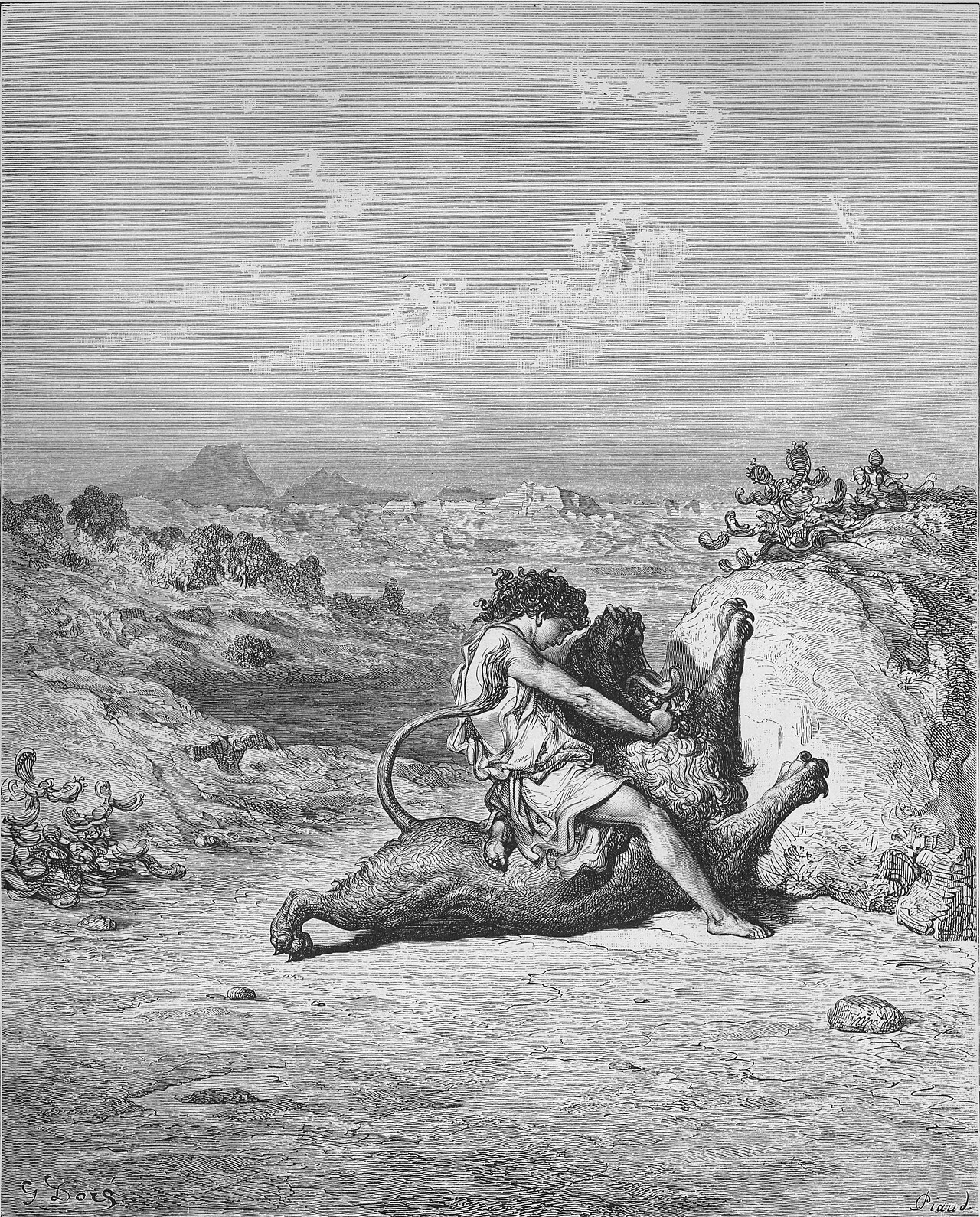
in Judges 14When Samson returned later to take her, he left the road to see the lion’s carcass, and in it was a swarm of bees, along with their honey.
BSB
The same verse in ASV and KJV ▾
ASV
And after a while he returned to take her; and he turned aside to see the carcass of the lion: and, behold, there was a swarm of bees in the body of the lion, and honey.
KJV
And after a time he returned to take her, and he turned aside to see the carcase of the lion: and, behold, there was a swarm of bees and honey in the carcase of the lion.
⋯
This verse in Judges 14
Commentary
12 notes on this verseAfter a time - Probably about one year; as this was the time that generally elapsed between espousing and wedding. A swarm of bees and honey in the carcass - By length of time the flesh had been entirely consumed off the bones, and a swarm of bees had formed their combs within the region of the thorax, nor was it an improper place; nor was the thing unfrequent, if we may credit ancient writers; the carcasses of slain beasts becoming a receptacle for wild bees.
This site's exposition
spoke to the woman
on Judges 14:7-9
Numbers 6:6 keeps a Nazirite from any dead body. Samson leaves the road to see “the lion’s carcass”, takes its honey and gives some to his parents without saying where it came from. Adam Clarke reads the interval as about a year, the usual space between betrothal and wedding.
This site's exposition
in it was a swarm of bees
The Hebrew for later reads after days. John Wesley notes the phrase often means a year, and Charles Spurgeon observes that dry heat soon cleans a carcass in that country. By Samson's return the lion held bees and their honey.
The record, by era
The Church Fathers2 voices
Many of the fathers have spoken a great deal about this lion, beloved brothers, and all of them have said what is fitting and in accord with the facts. Some have said that the lion prefigured Christ our Lord. Truly, this is very appropriate, for …
On his returning by the same road he found an honeycomb in the belly of the lion, and carried it off as a gift to the maiden and her parents; for such gifts befit a bride. And having first tasted the honey, he gave them the comb to eat, but was silent as to whence it came.
The Puritans and the Awakening3 voices
After a time - Hebrew. after days; that is, either after some days: or, rather, after a year, as that word often signifies; when the flesh of the lion, (which by its strong smell is offensive to bees) was wholly consumed, and nothing was left but the bones.
And after a time he returned to take her,.... Matters being agreed on, and settled on both sides, and the espousals made, he and his parents returned, and, at the proper usual time for the consummation of the marriage, he went again to Timnath for that purpose.
There he found the carcase of the lion; the birds or beasts of prey, it is likely, had eaten the flesh, and in the skeleton a swarm of bees had knit, and made a hive of it, and had not been idle, but had there laid up a good stock of honey, which was one of the staple commodities of Canaan; such plenty there was of it that the land is said to flow with milk and honey.
4 more voices on this verse
The Nineteenth Century4 voices
IT was a singular circumstance that a man unarmed should have slain a lion in the prime of its vigor and yet, more strange that a swarm of bees should have taken possession of the dried carcass and have filled it with their honey. In that country, what with beasts, birds, insects and the dry heat, a dead body is soon cleansed from all corruption and the bones are clean and white. Still, the killing of the lion and the finding of the honey make up a remarkable story.
A commentator
Jamieson, Fausset & Brown1802–1910
Commentary Critical and Explanatory on the Whole Bible (1871)
proposed
a young lion--Hebrew, a lion in the pride of his youthful prime. The wild mountain passes of Judah were the lairs of savage beasts; and most or all the "lions" of Scripture occur in that wild country.
quarantine:debris (2026-07-29) — starts-lowercase
IT was a singular circumstance that a man unarmed should have slain a lion in the prime of its vigor and yet, more strange that a swarm of bees should have taken possession of the dried carcass and have filled it with their honey. In that country, what with beasts, birds, insects and the dry heat, a dead body is soon cleansed from all corruption and the bones are clean and white. Still, the killing of the lion and the finding of the honey make up a remarkable story. These singular circumstances became, afterwards, the subject of a riddle—but with that riddle we have no concern at this time. Samson, himself, is a riddle! He was not only a riddle-maker, but he was, himself, an enigma very difficult to explain. With his personal character I have, at this time, little or nothing to do. We are not, today, resting at the house of "Gains, my host," where the pilgrims amused themselves with a dish of nuts after dinner, but we are on the march and must attend to the more important matter of refreshing and inspiriting those who are in our company. Neither are we going to discuss difficulties, but as Samson took the honey without being stung, so would we gain instruction without debate. We have, in these days, so much to do that we must make practical use of every incident that comes before us in the Word of God. My one design is to cheer the desponding and stir up all God's people to greater diligence in His service. I conceive that the text may legitimately be employed for this purpose. By the help of the Divine Spirit, even after this lapse of time, we may find honey in the lion! The particular part of the incident which is recorded in these two verses appears to have been passed over by those who have written upon Samson's life—I suppose it appeared to be too inconceivable.
A commentator
Albert Barnes1798–1870
Notes, Explanatory and Practical, on the Old and New Testaments (1832-1869)
proposed
The formal dowry and gifts having been given by Samson’s father, an interval, varying according to the Oriental custom, from a few days to a full year, elapsed between the betrothal and the wedding, during which the bride lived with her friends. Then came the essential part of the marriage ceremony, namely, the removal of the bride from her father’s house to that of the bridegroom or his father. The carcase of the lion - The lion, slain by him a year or some months before, had now become a mere skeleton, fit for bees to swarm into. It was a universal notion among the ancients that bees were generated from the carcass of an ox.
The words behind it
14 Hebrew wordsEvery Hebrew word of this verse in the order it stands, with what it means and the door to its own study. The last column counts the times a word stands in the whole Bible: the rarer the word, the more the places it appears belong together.
| Hebrew | Sound | Meaning | Word study | In the Bible |
|---|---|---|---|---|
| וַיָּ֤שָׁב | vaiyashov | and he returned | H7725 → | 1056 times |
| מִיָּמִים֙ | miyamim | from days | H3117 → | 2304 times |
| לְקַחְתָּ֔הּ | lekachtah | to take her | H3947 → | 966 times |
| וַיָּ֣סַר | vaiyasar | and he turned aside | H5493 → | 299 times |
| לִרְא֔וֹת | lirot | to see | H7200 → | 1300 times |
| אֵ֖ת | ʾet | <obj.> | H853 → | 10935 times |
| מַפֶּ֣לֶת | mapelet | [the] carcass of | H4658 → | |
| הָאַרְיֵ֑ה | haaryeh | the lion | H738 → | 80 times |
| וְהִנֵּ֨ה | vehineh | and there! | H2009 → | 843 times |
| עֲדַ֧ת | ʾadat | a swarm of | H5712 → | 149 times |
| דְּבוֹרִ֛ים | devorim | bees | H1682 → | |
| בִּגְוִיַּ֥ת | bigviyat | [was] in [the] carcass of | H1472 → | |
| הָאַרְיֵ֖ה | haaryeh | the lion | H738 → | 80 times |
| וּדְבָֽשׁ׃ | udevash | and honey | H1706 → | 54 times |
וַיָּ֤שָׁבand he returned
vaiyashovH7725 →1056 times
מִיָּמִים֙from days
miyamimH3117 →2304 times
לְקַחְתָּ֔הּto take her
lekachtahH3947 →966 times
וַיָּ֣סַרand he turned aside
vaiyasarH5493 →299 times
לִרְא֔וֹתto see
lirotH7200 →1300 times
אֵ֖ת<obj.>
ʾetH853 →10935 times
מַפֶּ֣לֶת[the] carcass of
mapeletH4658 →
הָאַרְיֵ֑הthe lion
haaryehH738 →80 times
וְהִנֵּ֨הand there!
vehinehH2009 →843 times
עֲדַ֧תa swarm of
ʾadatH5712 →149 times
דְּבוֹרִ֛יםbees
devorimH1682 →
בִּגְוִיַּ֥ת[was] in [the] carcass of
bigviyatH1472 →
הָאַרְיֵ֖הthe lion
haaryehH738 →80 times
וּדְבָֽשׁ׃and honey
udevashH1706 →54 times
A shaded row is a word that stands 400 times or fewer in the Bible.
The walk
8 stopsEach card is a verse this one points to, and under it the verses that one points to in turn. Where several paths arrive at the same place, that place is listed first: the text keeps returning to it.
Through
Matthew 1:20But after he had pondered these things, an angel of the Lord appeared to him in a dream and said, “Joseph, son of David, do not be afraid to embrace Mary as your wife,…
it leads to
- Matthew 1:18
This is how the birth of Jesus Christ came about: His mother Mary was pledged in marriage to Joseph, but before they came together, she was found to be with child through the Holy…
Reached by 2 separate paths from here.
- Proverbs 3:5–6
Trust in the LORD with all your heart, and lean not on your own understanding;
- Luke 1:19
“I am Gabriel,” replied the angel. “I stand in the presence of God, and I have been sent to speak to you and to bring you this good news.
- Luke 2:4
So Joseph also went up from Nazareth in Galilee to Judea, to the city of David called Bethlehem, since he was from the house and line of David.
- Matthew 2:19
After Herod died, an angel of the Lord appeared in a dream to Joseph in Egypt.
- Matthew 1:18
Through
Genesis 29:21Finally Jacob said to Laban, “Grant me my wife, for my time is complete, and I want to sleep with her.”
it leads to
- Judges 15:1
Later on, at the time of the wheat harvest, Samson took a young goat and went to visit his wife. “I want to go to my wife in her room,” he said. But her…
- Genesis 29:18
Since Jacob loved Rachel, he answered, “I will serve you seven years for your younger daughter Rachel.”
- Genesis 31:41
Thus for twenty years I have served in your household—fourteen years for your two daughters and six years for your flocks—and you have changed my wages ten times!
- Judges 15:1
Where this verse is studied
On this page
About Judges
Who and where
1 name in this verse with a page on the site.
This page draws on 11 works. Open the list of works
This page draws on Adam Clarke, Commentary on the Bible; Albert Barnes, Notes, Explanatory and Practical, on the Old and New Testaments (1832-1869); Ambrose of Milan, Letter 19.14; Caesarius of Arles, SERMON 119.1; Charles Spurgeon, The Metropolitan Tabernacle Pulpit, Sermon No. 1703: “Hands Full of Honey”; Charles Spurgeon, The Metropolitan Tabernacle Pulpit, Sermon No. 1703: “Hands Full of Honey” (lightly modernized text, CCEL edition); Jamieson, Fausset & Brown, Commentary Critical and Explanatory on the Whole Bible; John Gill, Exposition of the Old Testament; John Gill, Exposition of the Old Testament (1748-1763); John Wesley, Explanatory Notes upon the Old Testament and Matthew Henry, Commentary on the Whole Bible.