
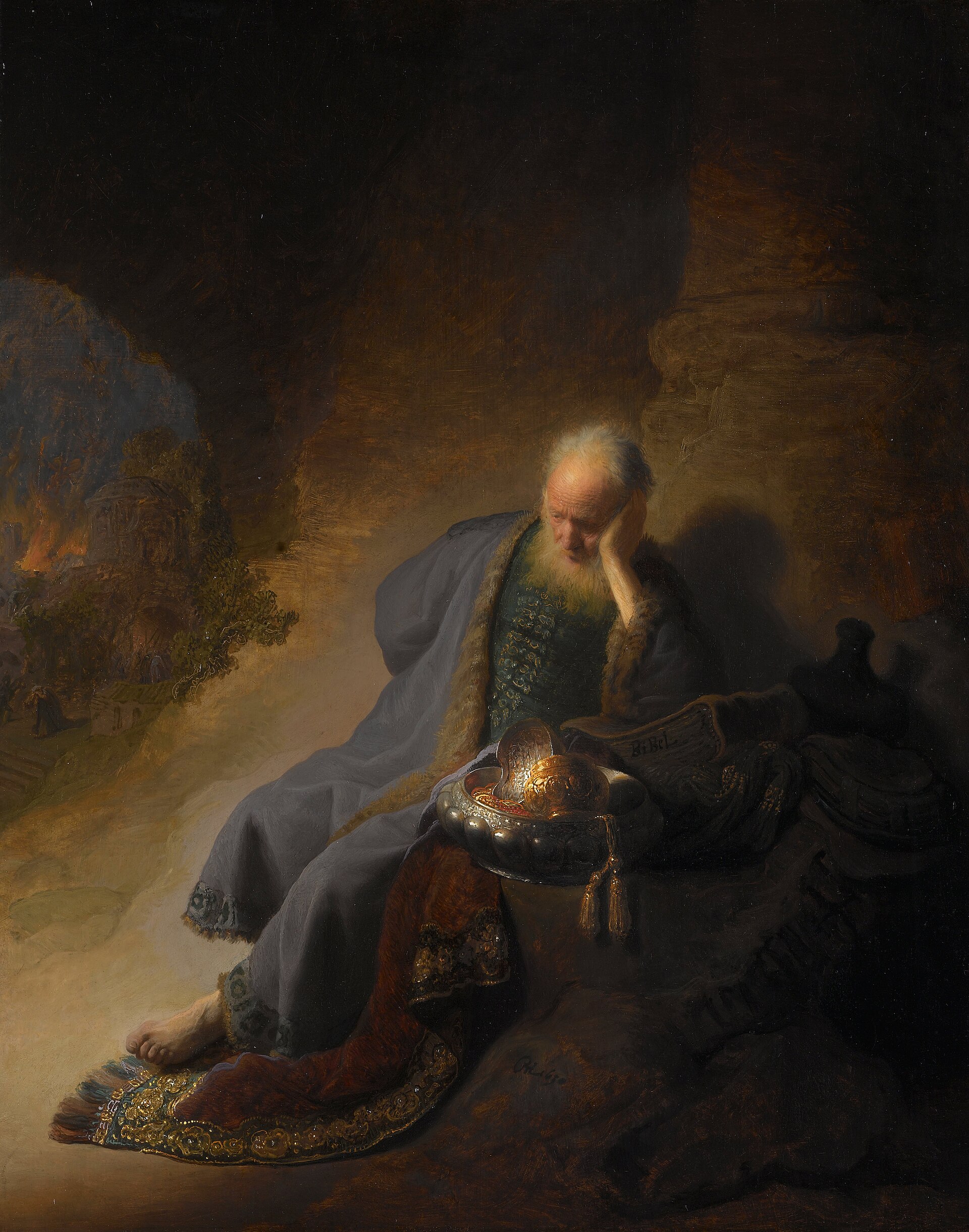
Jeremiahchapter 37
21 verses · Jeremiah, written by Baruch · 7th to 6th century BC · The Prophets
Yet King Zedekiah sent Jehucal son of Shelemiah and Zephaniah the priest, the son of Maaseiah, to Jeremiah the prophet with the message, “Please pray to the LORD our God for us!”
Introduction
Jeremiah, written by Baruch, The Prophets, Jeremiah Overview.
This chapter returns to the last siege of Jerusalem, in the weeks when an Egyptian army marched north and the Babylonians broke off to meet it. Its first hearers had watched the enemy leave and begun to believe the danger was over. The chapter follows Jeremiah from the city gate to a prison cell and into a private meeting with the king. Zedekiah is at the centre of it, a king who asks the prophet for the word of the LORD in secret. Listen for the one question the king asks and the short answer he receives. The chapter shows a ruler who could not act on what he believed.
Context
- Who
- A city that had just seen the besieging army pack up and march away
- What
- An account of Jeremiah's arrest at the Benjamin Gate during a pause in the siege, his imprisonment, and Zedekiah's secret request for a word from the LORD.
- Where
- Jerusalem: the Benjamin Gate, the house of Jonathan the secretary used as a prison, the palace, and the court of the guard.
- When
- About 588 BC, while Pharaoh's army had drawn the Babylonians away from the city for a time.
- Why
- To warn that the Egyptian relief would fail and to show how Judah's last king treated the word he asked for.
Historical context
The event driving this chapter is a real military manoeuvre. Pharaoh Hophra brought an army out of Egypt, and the Babylonians lifted the siege of Jerusalem to deal with it. Inside the walls it looked like deliverance. Jeremiah says the Egyptians will go home and the Babylonians will come back and burn the city, and adds that even if the whole attacking army were reduced to wounded men in their tents, they would rise and do it.
Show the rest of the historical context, 3 more paragraphs
In the lull he goes out through the Benjamin Gate to attend to property in his home territory. This is probably the Anathoth land business, which is why the chapter mentions it at all. At the gate a sentry officer named Irijah arrests him on a charge that made perfect sense in context: you are deserting to the Chaldeans. He had, after all, been publicly advising people to do exactly that.
He is beaten and imprisoned in the house of Jonathan the secretary, which had been converted into a prison, in the cells of a vaulted cellar. Private houses pressed into use as jails, with underground storage rooms as holding cells, are exactly what a besieged city improvises.
The king then sends for him secretly. Zedekiah's question, is there any word from the LORD, gets a one-line answer: there is, you shall be delivered into the hand of the king of Babylon. Jeremiah then negotiates his own transfer out of the cellar, and is given a loaf of bread a day from the bakers' street until all the bread in the city was gone.
Significance
That last clause was the whole siege in eight words for the first hearers. A daily loaf from the bakers' street, until there was no bread in the city.
Show the rest of the significance, 1 more paragraph
The chapter also shows a king who believed the prophet in private and could not act on it in public. He asks in secret, protects him a little, and keeps doing what his officials want. That was Judah's last government.
This chapter in Jewish lifeWhat this chapter is in Jewish life and reading.
What is done
The site's own table in src/lib/hebraic/readings.ts, probed for this lane, printed no weekly portion and no Haftarah from this chapter, and no festival reading for the book. That table carries the Haftarah of each of the fifty-four weekly portions and the books read whole at the feasts, and it carries nothing for the special Sabbaths or the fast days. This card therefore names no public reading of the chapter and leaves that question to a source that holds those readings.
How it is read
Rashi is the one commentator on this chapter whose English the corpus carries, quoted here from The Judaica Press complete Tanach with Rashi, translated by A. J. Rosenberg, which Sefaria reports as CC-BY. Every quotation of it is held to fifty words or fewer because the translation is modern, and his headwords, which carry the verse in that translation's wording, are never quoted.
Rashi reads the opening verse as a turn in the book. From here it tells how the retributions already prophesied "were fulfilled" (Rashi on Jeremiah 37:1:1). At the fourth verse he explains Jeremiah's freedom. Zedekiah freed him from Jehoiakim's prison, for "Zedekiah was a righteous man and the people of his generation were wicked" (Rashi on Jeremiah 37:4:1). Jehoiakim, Rashi says, was the reverse, a wicked king over a righteous generation.
The Egyptian army of the fifth verse had come out "to aid Judah" (Rashi on Jeremiah 37:5:1). Its return in the seventh verse he tells as a story. On the sea the soldiers saw shapes like human skins floating and took them for their fathers, drowned by the fathers of the people they were going to help. "They immediately returned to their land" (Rashi on Jeremiah 37:7:1).
Jeremiah's attempt to leave for the land of Benjamin Rashi reads through Targum Jonathan as a matter of inheritance (Rashi on Jeremiah 37:12:1). He adds that "as long as the Chaldeans were besieging it, he did not leave it, for he prayed that it should not be taken" (Rashi on Jeremiah 37:12:1). The captain at the gate was set there "so that no man should leave the city to make peace with the Chaldeans" (Rashi on Jeremiah 37:13:1).
The corpus carries sixteen further notes on this chapter without an English text. Each is marked linked because Sefaria holds no English version of the ref, so each is cited here and none is quoted. The notes of Radak are cited at Radak on Jeremiah 37:1:1, 37:4:1, 37:5:1, 37:14:1, 37:15:1 and 37:19:1. The notes of Malbim are cited at Malbim on Jeremiah 37:2:1, 37:3:1 and 37:10:1. The notes of Metzudat David are cited at Metzudat David on Jeremiah 37:7:1, 37:8:1, 37:9:1, 37:10:1, 37:11:1, 37:17:1 and 37:20:1.
What the rabbis say
The corpus carries fifteen rabbinic locators on this chapter and the text of none, so each is cited and linked here rather than quoted. On the first verse it holds Aggadat Bereshit 35:2, Esther Rabbah, Petichta 6 and Pesikta Rabbati 27:1. On the second verse it holds Pesikta Rabbati 26:1. On the fifth verse it holds Seder Olam Rabbah 26:1. On the seventh verse it holds Eikhah Rabbah 4:20. On the eleventh verse it holds Otzar Midrashim, Midrash on Yirmiyahu, Introduction 2.
On the twelfth verse it holds Pesikta DeRav Kahana 13:4. On the thirteenth verse it holds Ein Yaakov, Sotah 7:40, Sotah 42a:1 and Yalkut Shimoni on Nach 308:4. On the eighteenth verse it holds Sifrei Bamidbar 96:1, Sifrei Zuta 11:28:1 and Yalkut Shimoni on Torah 737:5. On the twenty-first verse it holds Shir HaShirim Rabbah 1:6:4. What each of them teaches is a saying of the rabbis, and is reported as theirs wherever this site quotes one. The quotations wait on a fetch that carries the text.
Sources: Rashi, Rashi on Jeremiah 37:1:1 to 37:13:1, The Judaica Press complete Tanach with Rashi, translated by A. J. Rosenberg, reported CC-BY; Radak, Radak on Jeremiah 37:1:1, 37:4:1, 37:5:1, 37:14:1, 37:15:1 and 37:19:1, cited by ref because the corpus carries no English text; Malbim, Malbim on Jeremiah 37:2:1, 37:3:1 and 37:10:1, cited by ref because the corpus carries no English text; Metzudat David, Metzudat David on Jeremiah 37:7:1, 37:8:1, 37:9:1, 37:10:1, 37:11:1, 37:17:1 and 37:20:1, cited by ref because the corpus carries no English text; The Sefaria corpus, scripts/data/sources/sefaria/jeremiah/37.json, the 15 Talmud and Midrash locators of this chapter; The site's own files, src/lib/hebraic/readings.ts, printing no portion and no Haftarah for this chapter and no festival reading for this book.
The heads below are this chapter's scenes. The numbered points under each are its verses.
Pharaoh's Army Departs, but the Chaldeans Will Return
Jeremiah 37:1-5
Nebuchadnezzar king of Babylon made Zedekiah son of Josiah the king of Judah: Verse 2 gives the verdict first: he and his people “refused to obey the words that the LORD had spoken through Jeremiah the prophet.” Yet the king sends to Jeremiah, “Please pray to the LORD our God for us!” Jeremiah is still free, and Pharaoh’s advance has lifted the siege.
Jeremiah 37:1
“And King Zedekiah the son of Josiah reigned,.... The brother of Jehoiakim, whose untimely death, and want of burial, are prophesied of in the preceding chapter.”
1 more voice on this verseWhat preachers and commentators have said about this verse, in their own words.
Jeremiah 37:1
“It is evident that Zedekiah was well affected toward Jeremiah. In Jer. 37–38, dealing with events during the siege of Jerusalem, we have an account of his relations with Jeremiah and of the prophet’s personal history up to the capture of the city.”
refused to obey the words that the LORD had spoken: Nebuchadnezzar made Zedekiah king in place of Coniah son of Jehoiakim, and Calvin reads this as 36:30 fulfilled, since Coniah reigned only three months. The new king was no better. Gill says king, court and people of the land were all corrupt.
Jeremiah 37:2
“But neither he, nor his servants, nor the people of the land,.... The king, his courtiers and subjects the royal family, nobility, and common people; they were all degenerate and corrupt.”
1 more voice on this verse
Jeremiah 37:2
“Then Jeconiah surrendered himself to them of his own accord. Now the Prophet had said, that there would be no legitimate successor to Jehoiakim; and this was fulfilled, though his son was set on the throne, for a three months' reign was so unimportant that it was deemed as nothing.”
John Calvin · Commentaries (1554)reformed
Barnes separates this embassy from the one in chapter 21, which came as Nebuchadnezzar first marched. This one came in the hope raised by Egypt's army, and Barnes thinks Zedekiah wanted Jeremiah to intercede as Isaiah had in Hezekiah's day. Adam Clarke says he wanted a word that suited him.
Jeremiah 37:3
“And Zedekiah the king sent Jehucal the son of Shelemiah, and Zephaniah the son of Maaseiah the priest,.... That is, Zephaniah the priest, as the accents shaw; though his father Maaseiah was doubtless a priest too; according to the Syriac version, both Jehucal, called Jucal, Jer 38:1; and Zephaniah, were priests; since it reads in the plural number, "priests": these the king sent as messengers to the Prophet Jeremiah, saying, pray now unto the Lord our God for us.”
2 more voices on this verse
Jeremiah 37:3
“But, as Pashur and Jehucal are both mentioned in Jer 38:1, 2, as hearing Jeremiah's reply, which is identical with that in Jer 21:9, it is probable the two messages followed one another at a short interval; that in this Jer 37:3, and the answer, Jer 37:7-10, being the earlier of the two.”
Jamieson, Fausset & Brown · Commentary Critical and Explanatory on the Whole Bible (1871)reformed
Jeremiah 37:3
“Note, When we are in distress we ought to desire the prayers of our ministers and Christian friends, for thereby we put an honour upon prayer, and an esteem upon our brethren.”
Matthew Henry · Commentary on the Whole Bible (1707-1721)puritan
Jeremiah was free to come and go among the people: The freedom was brief. Clarke ties it to the time when the Chaldeans withdrew from Jerusalem, before the prophet was put in the dungeon cell of verse 16. Jamieson, Fausset and Brown set it apart from his time in the courtyard of the guard in chapters 32 and 33.
Jeremiah 37:4
“Now Jeremiah came in and went out - After the siege was raised, he had a measure of liberty; he was not closely confined, as he afterwards was. See Jer 37:16.”
Adam Clarke · Commentary on the Bible (1810-1826)evangelical
Pharaoh’s army had left Egypt: Clarke and Barnes identify this Pharaoh as Hophra, called Apries, and Barnes cites Jeremiah 44:30. Zedekiah had sought his help against Babylon in breach of his oath, and the Chaldeans withdrew from Jerusalem at the report of his army. Henry says the pause hardened the city.
Jeremiah 37:6-10
Then the word of the LORD came to Jeremiah the prophet: Pharaoh’s army “will go back to its own land of Egypt,” and the Chaldeans will return, capture the city, and burn it. The LORD names the city’s hope as self-deception: “Do not deceive yourselves.” In verse 10, even “wounded men” left in their tents would rise and burn the city.
Jeremiah 37:6
“Then came the word of the Lord unto the Prophet Jeremiah,.... At the time when the messengers came to him from the king to pray for them; for Jer 37:4 are to be included in a parenthesis: saying; as follows: which is an answer to the messengers.”
will go back to its own land of Egypt: Sources differ on how Pharaoh's army returned to Egypt. Clarke says the Chaldeans defeated it and it went back at once. Barnes thinks Pharaoh withdrew without a battle, and he calls this word to Zedekiah darker than Jeremiah 21:4-7.
Jeremiah 37:7
“Jeremiah’s answer here is even more unfavorable than that which is given in Jer 21:4-7. So hopeless is resistance that the disabled men among the Chaldaeans would alone suffice to capture the city and burn it to the ground.”
Then the Chaldeans will return and fight against this city: The Chaldeans would return to the city they had left. Henry says the LORD directs the marches of armies, even of men who do not know him. Gill says the Chaldeans came back angry at the attempt to break their siege, and Jeremiah 39:8 records the city burned.
Jeremiah 37:8
“And the Chaldeans shall come again,.... To Jerusalem, after they have defeated or drove back the Egyptian army: and fight against this city; with fresh rigour and resolution; being exasperated by the methods taken to oblige them to raise the siege: and take it, and burn it with fire; as they did, Jer 39:8.”
Do not deceive yourselves: Matthew Henry comments that even Satan could make no headway with people who refused to deceive themselves. So those who hoped Babylon had gone for good were their own deceivers. The prophets of verse 19 had fed that hope.
Jeremiah 37:9
“Note, Satan himself, though he is the great deceiver, could not deceive us if we did not deceive ourselves; and thus sinners are their own destroyers by being their own deceivers, of which this is an aggravation that they are so frequently warned of it and cautioned not to deceive themselves, and they have the word of God, the great design of which is to undeceive them.”
Matthew Henry · Commentary on the Whole Bible (1707-1721)puritan
only wounded men remained in their tents: Even wounded men would get up and burn the city. Wesley says that once the LORD has resolved on a thing, the strength of the men he uses hardly matters. Henry reads the word the same way, and Clarke calls these strong words.
Jeremiah 37:10
“Note, Whatever instruments God has determined to make use of in any service for him, whether or mercy or judgment, they shall accomplish that for which they are designed, whatever incapacity or disability they may lie under or be reduced to.”
Matthew Henry · Commentary on the Whole Bible (1707-1721)puritan
Seized at the Gate of Benjamin; a Loaf of Bread Each Day
Jeremiah 37:11-15
When the Chaldean army withdrew from Jerusalem: While the Chaldeans are withdrawn, Jeremiah sets out for Benjamin “to claim his portion there among the people.” Irijah seizes him with the charge, “You are deserting to the Chaldeans!” Jeremiah answers, “That is a lie,” but he is beaten and jailed in the house of Jonathan the scribe.
Jeremiah 37:11
“Was broken up for fear of - Or, “had got them up from the face of.” It was simply a strategic movement.”
1 more voice on this verse
Jeremiah 37:11
“Whether he designed for Anathoth or no does not appear; his concerns might call him thither, but his neighbours there were such as (unless they had mended since ch. xi. 21 ) might discourage him from coming among them; or he might intend to hide himself somewhere where he was not known, and fulfil his own wish ( ch. ix.”
Matthew Henry · Commentary on the Whole Bible (1707-1721)puritan
to claim his portion there among the people: Readers differ on what Jeremiah went to Benjamin to do. Jamieson, Fausset and Brown read it as to slip away, while Barnes takes it as a portion of the produce of the priests' land. Clarke, following Blayney, takes it as Jeremiah's own portion of his family's land there.
Jeremiah 37:12
“Jeremiah went forth - At the time that Nebuchadnezzar had raised the siege, and gone to meet the Egyptian army. Go into the land of Benjamin - To Anathoth, his native city. To separate himself thence - “To receive a portion thereof among the people;” - Blayney: who supposes that Jeremiah went to receive a portion of the proceeds of his patrimony at Anathoth, which had, previously to the siege, been in the hands of the Chaldeans. The siege being now raised, he thought of looking thus after his own affairs.”
Adam Clarke · Commentary on the Bible (1810-1826)evangelical
1 more voice on this verse
Jeremiah 37:12
“Benjamin--to his own town, Anathoth. to separate himself--Margin translates, "to slip away," from a Hebrew root, "to be smooth," so, to slip away as a slippery thing that cannot be held.”
Jamieson, Fausset & Brown · Commentary Critical and Explanatory on the Whole Bible (1871)reformed
the captain of the guard, whose name was Irijah: Jamieson, Fausset and Brown identify Irijah's grandfather Hananiah with the false prophet whose death Jeremiah foretold in 28:16, and they see revenge in the arrest. Barnes calls the charge groundless, though Jeremiah's known counsel made him a natural suspect. The Benjamin Gate was the northern gate.
Jeremiah 37:13
“A captain of the ward - Captain of the watch, whose business was to examine all who went in and out. The gate of Benjamin - The northern gate, also called the gate of Ephraim. Thou fallest away ... - His well-known views made Jeremiah a suspected person, though the charge was groundless.”
Irijah would not listen to him: Jeremiah's denial went unheard. Barnes says these officials were a different company from those who spoke for the prophet in 26:16, men of the kind described in 24:8. They took the charge of deserting to the Chaldeans as proved.
Jeremiah 37:14
“The princes - Not the noblemen trained in the days of Josiah and Jeremiah’s friends Jer 26:16, but those described in Jer 24:8. They assumed that the accusation was true; they first scourged and then imprisoned Jeremiah.”
they beat him and placed him in jail: The officials beat Jeremiah without proof or any form of justice, as Clarke observes. The house of Jonathan the scribe was made into a jail. Barnes takes it as the house of a high officer of the king, and Clarke adds that such officers kept a room for the accused.
Jeremiah 37:15
“And smote him - Without any proof of the alleged treachery, without any form of justice. In prison to the house of Jonathan - In Asiatic countries there is an apartment in the houses of the officers of the law, to confine all the accused that are brought before them. Jonathan was a scribe or secretary, and had a prison of this kind in his house.”
Adam Clarke · Commentary on the Bible (1810-1826)evangelical
1 more voice on this verse
Jeremiah 37:15
“Thus there is the expression in Exodus: "From the firstborn of Pharaoh to the firstborn of the captive woman who was in the pit." But they even threw Jeremiah also into a pit. His brothers through jealousy confined Joseph in a pit without water. Each act, therefore, either draws us downward by oppressing us with sin or lifts us upward by raising us on wings toward God. Therefore, you have saved me, I who formerly lived a wicked life, and have separated me from those who go down to the dark and frigid region.”
Basil of Caesarea · written before 379 · Homilies on the Psalms 14:3 (Ps 29)patristic
Jeremiah 37:16-21
So Jeremiah went into a cell in the dungeon: Jeremiah stays in the dungeon “a long time” until Zedekiah sends for him. The answer is unchanged: “You will be delivered into the hand of the king of Babylon.” Jeremiah pleads not to be returned to Jonathan’s house, and the king moves him to “the courtyard of the guard.”
Jeremiah 37:16
“Entered into the dungeon, and into the cabins - The dungeon was probably a deep pit; and the cabins or cells, niches in the sides, where different malefactors were confined. See Blayney.”
Adam Clarke · Commentary on the Bible (1810-1826)evangelical
he asked him privately: Zedekiah sent for Jeremiah and asked him privately, and Jamieson, Fausset and Brown compare the secret believers of John 12:43 and 19:38. Clarke marks the courage of the reply to a king who held the prophet's life in his hand. The word from the LORD was unchanged.
Jeremiah 37:17
“Is there any word from the Lord? - Is there any farther revelation? There is: - thou shalt be delivered - What bold faithfulness! And to a king, in whose hands his life now lay.”
Adam Clarke · Commentary on the Bible (1810-1826)evangelical
Having given the hard word, Jeremiah turns to his own case. Matthew Henry sets out the logic: Jeremiah had no power to reverse God's sentence, yet the king had power to reverse the officials' sentence. The king consulted him as a prophet and held him as a criminal.
Jeremiah 37:18
“It was not in Jeremiah's power to reverse the sentence God had passed upon Zedekiah, but it was in Zedekiah's power to reverse the sentence which the princes had given against him; and therefore, since he thought him fit to be used as a prophet, he would not think him fit to be abused as the worst of malefactors.”
Matthew Henry · Commentary on the Whole Bible (1707-1721)puritan
Where are your prophets: Babylon had come, as the false prophets said it never would. Jamieson, Fausset and Brown reason that an army which came once in spite of them would surely return. Theodoret of Cyrus paraphrases the plea: punish those who lied and spare the one who warned the truth.
Do not send me back to the house of Jonathan the scribe: Jeremiah pleads for his life without softening the word he has just given the king. Jamieson, Fausset and Brown, following Calvin, say his fear of death makes his firmness the more remarkable. Clarke says the cell in the house of Jonathan was cold.
Jeremiah 37:20
“Cause me not to return to the house of Jonathan - He had been ill used in this man’s custody, so as to endanger his life, the place being cold, and probably unhealthy.”
Adam Clarke · Commentary on the Bible (1810-1826)evangelical
1 more voice on this verse
Jeremiah 37:20
“Zedekiah ought to have released him, to have made him a privy-counsellor, as Joseph was taken from prison to be the second man in the kingdom. But he had not courage to do that; it was well he did as he did, and it is an instance of the care God takes of his suffering servants that are faithful to him.”
Matthew Henry · Commentary on the Whole Bible (1707-1721)puritan
a loaf of bread daily from the street of the bakers: Jamieson, Fausset and Brown note that each trade in an Eastern city kept to its own street. Barnes explains the loaf as a round cake. The same commentators add that the supply lasted until Jeremiah was put into the dungeon of Malchiah in chapter 38, when the bread ran out.
Jeremiah 37:21
“The prison - the watch (marginal reference). Piece - literally, a circle, i. e., a round cake. The bakers’ street - It is usual in oriental towns for each trade to have a special place set apart for it. Compare Act 10:6.”
Keep studying
Studies1
Sources for this chapter
The summary
Jamieson, Fausset & Brown, Commentary Critical and Explanatory; John Calvin, Commentaries; John Wesley, Notes on the Old Testament and Matthew Henry, Complete Commentary.
The exposition
Adam Clarke, Commentary on the Bible; Albert Barnes; Carl Friedrich Keil, The Prophecies of Jeremiah; Jamieson, Fausset & Brown, Commentary Critical and Explanatory on the Whole Bible; John Calvin, Commentaries; John Gill; John Wesley, Explanatory Notes upon the Old Testament; Matthew Henry, Commentary on the Whole Bible and Theodoret of Cyrus, ON JEREMIAH 8:37.