
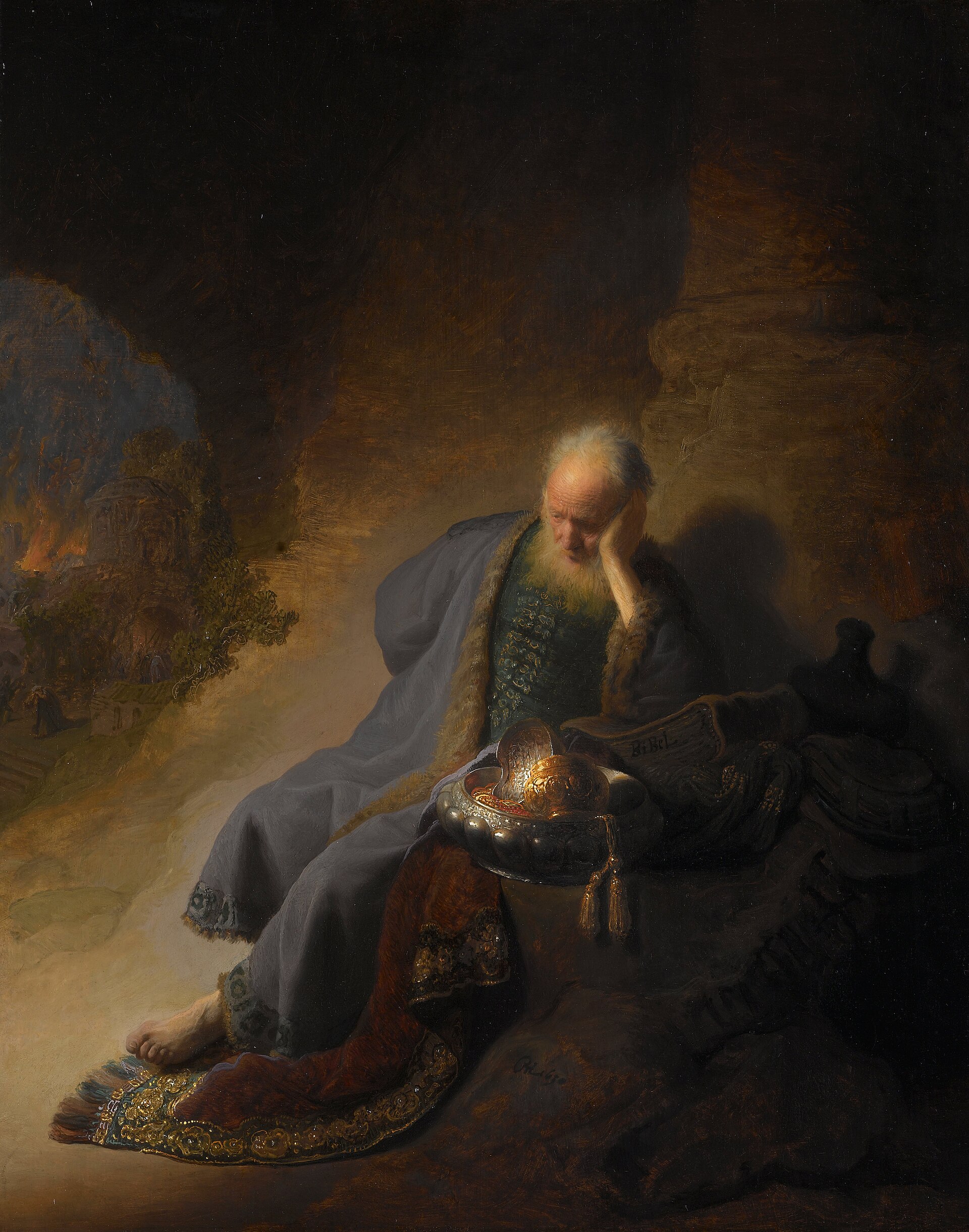
Jeremiahchapter 14
22 verses · Jeremiah, written by Baruch · 7th to 6th century BC · The Prophets
You are to speak this word to them: ‘My eyes overflow with tears; day and night they do not cease, for the virgin daughter of my people has been shattered by a crushing blow, a severely grievous wound.
Introduction
Jeremiah, written by Baruch, The Prophets, Jeremiah Overview.
Jeremiah spoke this chapter during a drought that struck Judah in its last decades. In that country the rain fell only in winter, and a failed season meant no bread the following year. The hearers had done what their faith prescribed in such a crisis, with fasting, weeping and prayer at the temple. The chapter is built as a conversation, with the people's prayer, God's reply and the prophet's own pleading. Listen for who speaks in each part and for the prophets who promised peace. The chapter asks what a prayer is worth when the heart behind it has not turned.
Context
- Who
- Farmers and townspeople in a real emergency, listening for a word that rain was coming
- What
- A lament over a drought, the people's prayer for rain, God's refusal to accept it, and a charge against the prophets who promised peace.
- Where
- Judah in drought, from the empty cisterns of Jerusalem to the cracked fields and bare hills.
- When
- The last decades of the kingdom of Judah, about 609 to 597 BC; the drought itself is undated.
- Why
- To show Judah that fasting and sacrifice without a return to God could not turn away the judgment.
Historical context
That country lives on a rain season. Showers come between roughly October and April and nothing falls in the summer at all, so every household depended on a cistern filled in winter and on springs that ran low by autumn. A failed rainy season did not mean discomfort; it meant no bread the following year.
Show the rest of the historical context, 3 more paragraphs
The chapter's details are exact. Nobles send their servants for water and the servants come back with empty jars, heads covered, the gesture of shame and grief. The ground is cracked because no rain has fallen. The plowmen cover their heads. A doe abandons her newborn fawn because there is no grass, which a deer will not normally do, and wild donkeys stand on the bare heights with their sides heaving, panting like jackals.
The people's response is the standard one: a public fast, with weeping, and prayers offered at the sanctuary. That was the correct procedure. God tells the prophet not to pray for them and says he will not accept the offerings.
The prophets get the blame in the middle of the chapter. They had been announcing assured peace, no sword, no famine, and are called out as men speaking a lying vision of their own minds. Their punishment is to die by the sword and famine they said would never come.
Significance
For a first audience in a drought, the shocking thing is not the description of the crisis. They were living it. The shock is being told that the emergency prayer service will not be answered.
Show the rest of the significance, 1 more paragraph
The chapter's honesty is worth noting. Jeremiah keeps praying anyway, and keeps arguing, pointing out that the people were misled by professional preachers. The prayer is refused, but the man refuses to stop praying it.
This chapter in Jewish lifeWhat this chapter is in Jewish life and reading.
What is done
No part of this chapter is read in the synagogue. Probed for this lane, the site's own table in src/lib/hebraic/readings.ts printed parashot 0 and haftarah uses 0 for Jeremiah 14, and no festival reading for the book. Across chapters 1 to 26 of Jeremiah the same probe found a Haftarah only in chapters 1, 2, 3, 4, 7, 8, 9, 16 and 17.
How it is read
Rashi is the one commentator on this chapter whose English the corpus carries, quoted here from The Judaica Press complete Tanach with Rashi, translated by A. J. Rosenberg, which Sefaria reports as CC-BY.
Rashi reads the chapter as a prophecy on the droughts. On the first verse he also reports Menahem, who reads the word as fortification (Rashi on Jeremiah 14:1:1). On the love of wandering he reads the exile as the place they loved: "they loved it there to go into exile to worship distant idols" (Rashi on Jeremiah 14:10:1).
On the prayer at the end of the chapter he reads the plea for the sake of God's name as the name by which He is "called merciful" (Rashi on Jeremiah 14:21:1). On the rain he sets out the rule of the double question in Hebrew, with examples from Numbers. He reads the verse as asking whether the idols of the nations can give rain (Rashi on Jeremiah 14:22:1).
The corpus carries seven further notes on this chapter without an English text, each marked linked because Sefaria holds no English version of the ref. They stand cited and unquoted at Radak on Jeremiah 14:1:1, 14:11:1, 14:12:1, 14:13:1, 14:15:1, 14:16:1 and 14:20:1.
What the rabbis say
The corpus carries 40 rabbinic locators on the verses of this chapter, 6 in the Talmud and 34 in the Midrash. It carries the text of none, so each is cited by ref here and never quoted or paraphrased. The verse numbers are the Hebrew ones the corpus prints.
On verse 1 it holds Ein Yaakov, Taanit 2:1, Jerusalem Talmud Taanit 2:3:1 and Taanit 15a:8. On verse 2 it holds Otzar Midrashim, Midrashim of Rabbi Akiba, The Small Letters and their Purposes 26, Ruth Rabbah (Lerner) 1:6:1 and Ruth Rabbah, Petichta 6. On verse 3 it holds Mekhilta DeRabbi Shimon Ben Yochai 15:22, Mekhilta DeRabbi Yishmael, Tractate Vayassa 1:9, Midrash Sekhel Tov, Shemot 15:26:12 and Midrash Tanchuma, Beshalach 19:1. On verse 7 it holds Bamidbar Rabbah 11:4, Ein Yaakov, Sotah 7:32 and Sotah 39b:13.
On verse 8 it holds Jerusalem Talmud Yoma 8:7:10, Midrash Tanchuma Buber, Behar 3:1, Midrash Tanchuma Buber, Lech Lecha 6:1 and Midrash Tanchuma, Behar 1:1. On verse 9 it holds Midrash Lekach Tov on Lamentations 2:3:1 and Midrash Tannaim on Deuteronomy 26:15:16. On verse 10 it holds Midrash Lekach Tov, Numbers 11:1:1. On verse 12 it holds Tractate Semachot 8:14. On verse 14 it holds Tractate Soferim 7:4. On verse 15 it holds Midrash Aggadah, Genesis 1:1:1 and Midrash Tannaim on Deuteronomy 32:25:2.
On verse 16 it holds Midrash Lekach Tov, Deuteronomy 32:24:1, Midrash Tannaim on Deuteronomy 32:24:1, Sifrei Devarim 321:4 and Yalkut Shimoni on Torah 945:20. On verse 17 it holds Pesikta Rabbati 29:1 and Pesikta Rabbati 29:3. On verse 18 it holds Midrash Sekhel Tov, Bereshit 34:10:2, Sifrei Devarim 321:9 and Yalkut Shimoni on Torah 945:24. On verse 19 it holds Eikhah Rabbah 5:20, Eikhah Rabbah, Petichta 24 and Midrash Tanchuma, Mishpatim 11:1.
On verse 21 it holds Midrash Lekach Tov, Deuteronomy 32:15:1, Sifrei Devarim 318:10 and Yalkut Shimoni on Torah 945:3. On verse 22 it holds Pirkei DeRabbi Eliezer 5:5.
Sources: Rashi, Rashi on Jeremiah 14:1:1 to 14:22:1, The Judaica Press complete Tanach with Rashi, translated by A. J. Rosenberg, reported CC-BY; Radak, Radak on Jeremiah 14:1:1, 14:11:1, 14:12:1, 14:13:1, 14:15:1, 14:16:1 and 14:20:1, cited by ref because the corpus carries no English text; The Sefaria corpus, scripts/data/sources/sefaria/jeremiah/14.json, the 40 Talmud and Midrash locators on the verses of this chapter; The site's own files, src/lib/hebraic/readings.ts, probed for Jeremiah 14: parashot 0, haftarah uses 0, and no festival reading for the book.
The heads below are this chapter's scenes. The numbered points under each are its verses.
The Drought: Nobles Send Their Little Ones for Water
Jeremiah 14:1-6
came to Jeremiah concerning the drought: The drought reaches every rank of creature, from nobles whose servants find the cisterns empty to farmers who “cover their heads” over cracked ground. Even “the doe in the field deserts her newborn fawn”. The spread from noble to farmer to beast shows a judgment on Judah as a whole.
Jeremiah 14:1
“The word of the Lord that came to Jeremiah concerning the dearth. Or, "concerning the words of straints" (x); that is, concerning the businesses of a drought, as the Targum; concerning the Lord's restraining rain from the earth, and forbidding the heavens dropping it down; the consequence of which is a drought, or dryness of the earth; and the effect of that a famine; when this was it is not anywhere said; it could not be the famine at the siege of Jerusalem by Nebuchadnezzar, because that only affected the city; this all Judea.”
1 more voice on this verseWhat preachers and commentators have said about this verse, in their own words.
Jeremiah 14:1
“The word - that came - concerning the dearth - This discourse is supposed to have been delivered, after the fourth year of Jehoiakim. Concerning the dearth. We have no historic record of any dearth that may fall in with the time of this prophecy, and perhaps it does not refer to any particular dearth: but this was a calamity to which Judea was very liable. They had ordinarily very dry summers, for scarcely any rain fell from April to the middle of October; and during much of this time, the rivers were generally either very low or entirely dry.”
Adam Clarke · Commentary on the Bible (1810-1826)evangelical
The gates were where a town met in public. Adam Clarke takes them as a name for the people, and Barnes pictures those people sitting on the ground in mourning. Matthew Henry hears two things in the cry from Jerusalem, the wail of their trouble and a prayer for rain.
Jeremiah 14:2
“The gates thereof languish - The gates being the places of public resort, they are put here for the people. They are black unto the ground - Covered from head to foot with a black garment, the emblem of sorrow and calamity.”
Adam Clarke · Commentary on the Bible (1810-1826)evangelical
1 more voice on this verse
Jeremiah 14:2
“They are black unto the ground - The people assembled at the gates, the usual places of concourse, are in deep mourning and sit humbly on the ground.”
The nobles send their servants for water: The cisterns were pits dug to catch rain in a land with few springs. Jamieson, Fausset and Brown read those sent as household servants, and Gill names the pools and the spring of Shiloah where the city drew water. The covered head is the sign of grief, as Barnes notes.
Jeremiah 14:3
“Little ones - mean ones, the common people. The word is unique to Jeremiah Jer 48:4. The pits - i. e., tanks for holding water. Covered their heads - The sign of grief.”
1 more voice on this verse
Jeremiah 14:3
“And their nobles have sent their little ones to the waters,.... To places where water used to be; to the pools, the upper and the lower, particularly to the fountain of Shiloah, which, Jerom says, was the only one the city of Jerusalem used.”
The ground is cracked because no rain: Adam Clarke reports that the cracks in such ground can run a cubit wide before rain falls on the land. Matthew Henry pictures the farmers idle, the ground too hard to plow. Like the nobles, they cover their heads in shame.
Jeremiah 14:4
“Because the ground is chapt,.... Through the violent heat of the sun, and want of rain; or, is broken (y); and crumbles into dust. The Targum is, "because of sins, the inhabitants of the earth are broken:'' for there was no rain in the earth; this was the reason of the dearth, and of the famine, and why there was no water in the pits, and the ground was parched.”
1 more voice on this verse
Jeremiah 14:4
“The ground is chapt - The cracks in the earth before the descent of the rains are in some places a cubit wide, and deep enough to receive the greater part of a human body.”
Adam Clarke · Commentary on the Bible (1810-1826)evangelical
Even the doe in the field deserts: Hunger drives even a mother deer to leave her newborn fawn. Matthew Henry hears the prophet laying the case of the animals before God as a plea for mercy. Judah had sinned, and the deer and the wild donkeys suffer with it.
Jeremiah 14:5
“Yea, the hind also calved in the field,.... Or brought forth her young in the field; of which see Job 39:1, and which they sometimes did through fear, particularly when frightened with thunder and lightning; and which are common in a time of heat and drought, which is the case here; see Psa 29:9 of these sort of creatures there were great plenty in Judea and the parts adjacent.”
1 more voice on this verse
Jeremiah 14:5
“Man's sin brings those judgments upon the earth which make even the inferior creatures groan: and the prophet takes notice of this as a plea with God for mercy. Judah and Jerusalem have sinned, but the hinds and the wild asses, what have they done?”
Matthew Henry · Commentary on the Whole Bible (1707-1721)puritan
Wild donkeys stand on barren heights: Gill pictures the wild donkeys climbing the heights to look for grass and a cooler wind. Barnes reads the animals they are likened to as jackals, and Adam Clarke took them for the hippopotamus coming up for air. Even their keen eyes fail.
Jeremiah 14:6
“Snuffed up the wind like dragons - תנים tannim here probably means the hippopotamus, who, after feeding under the water, is obliged to come to the surface in order to take in fresh draughts of air; or it may mean the wild asses.”
Adam Clarke · Commentary on the Bible (1810-1826)evangelical
Jeremiah 14:7-9
Although our iniquities testify against us: The people’s prayer names its own guilt, “our rebellions are many”, and asks the LORD to act “for the sake of Your name”. It calls him the Hope of Israel and its Savior. Verse 10 shows that this honest prayer still falls short of the turning the LORD requires.
Jeremiah 14:7
“Do thou it - Rather, “deal thou, act thou for Thy Name’s sake, i. e., not according to the strict measure of right and wrong, but as a God merciful and gracious.”
O Hope of Israel, its Savior: The prayer calls God by the names of the covenant. Jamieson, Fausset and Brown tie Hope of Israel to God's promise, the faith of the people having almost failed. The traveler who stays one night cares little for the land, and the people ask why God acts like that guest.
Jeremiah 14:8
“The reference is, not to the faith of Israel which had almost ceased, but to the promise and everlasting covenant of God. None but the true Israel make God their "hope." (Jer 17:13). turneth aside to tarry--The traveller cares little for the land he tarries but a night in; but Thou hast promised to dwell always in the midst of Thy people (2Ch 33:7, 8).”
Jamieson, Fausset & Brown · Commentary Critical and Explanatory on the Whole Bible (1871)reformed
Why are You like a man taken by surprise: Barnes explains the phrase as a man caught off guard who loses his presence of mind. Adam Clarke notes that the ark, the temple and its rites were still in the city, so the people could say God was among them. They plead the name they bear.
Jeremiah 14:9
“Yet thou, O Lord, art in the midst of us - Thy ark, temple, and sacred rites, are all here; and thou thyself, who art every where present, art here also: but alas! thou dost not reveal thyself as the Father of mercies, who forgivest iniquity, transgression, and sin. We are called by thy name; leave us not - Let us call thee our Father, and say thou to us, “Ye are my sons and daughters!” O leave us not!”
Adam Clarke · Commentary on the Bible (1810-1826)evangelical
2 more voices on this verse
Jeremiah 14:9
“Again, the Scriptures speak of God as asleep when the psalmist says, "Arise! Why do you sleep, O Lord?" He does not say this to make us suspect that God sleeps. This would be the utmost madness. By the word sleep the psalm shows God's patience and forbearance toward us. Another prophet has said, "You will not be like a person who sleeps, will you?" Do you not see that we need much help from our understanding and reason when we are searching into the treasure house of the divine Scriptures?”
John Chrysostom · written before 407 · Against the Anomoeans 8:5patristic
Jeremiah 14:9
Astonied - The word may possibly mean “one who is taken by surprise and loses his presence of mind.”
The Prophets Who Prophesy Lies in My Name
Jeremiah 14:10-12
The LORD answers the prayer by naming the pattern beneath it, “Truly they love to wander”. Jeremiah is told, “Do not pray for the well-being of this people”, and fasting and burnt offerings will not be accepted. The prophet is forbidden the very intercession his office exists to make.
Jeremiah 14:10
“The answer is addressed to the people. Jeremiah had prayed as their representative, but he must not intercede: for to the same degree that God was determined to punish them, to the same degree (thus) they love to continue their offence.” Compare Jer 15:6 note. Therefore the Lord ... - Translate: “And Yahweh hath no pleasure in them: Now will He remember their iniquity and visit their sins.” Interference in their behalf is out of the question.”
Then the LORD said to me: The LORD tells Jeremiah to stop praying for this people. Matthew Henry reads the command as a strong discouragement, and the prophet does pray again for the people in verses 19 to 22. Adam Clarke reads it as a sign that the people were ripe for destruction.
Although they may fast: Fasting and the offerings were the forms of Israel's worship, and God refuses them all. Jamieson, Fausset and Brown read the refusal as a verdict on prayers made while the heart still clung to idols. Sword, famine and plague come at once.
Jeremiah 14:12
You see, then, that fasting is certainly not considered by the Lord as a thing that is good in its own nature, because it becomes good and well-pleasing to God not by itself but by other works. Again, from the surrounding circumstances it may be regarded as not merely empty but hateful, as the Lord says: "When they fast, I will not hear their prayers."
John Cassian · written before 435 · CONFERENCE 3:21.14patristic
Jeremiah 14:13-16
the prophets are telling them: Jeremiah objects that the prophets promise “lasting peace in this place”, and the LORD answers, “The prophets are prophesying lies in My name”. The deceivers die, and the deceived are thrown into the streets with “no one to bury them”. The unburied dead are the covenant curse at its worst.
Jeremiah 14:13
“Jeremiah urges that much of the guilt of the people is due to the false prophets' influence. assured peace--solid and lasting peace. Literally, "peace of truth" (Isa 39:8).”
Jamieson, Fausset & Brown · Commentary Critical and Explanatory on the Whole Bible (1871)reformed
1 more voice on this verse
Jeremiah 14:13
“The false prophets in Jeremiah’s days were so numerous and influential an to counteract and almost nullify the influence of the true prophet. We find in Isaiah the first indications of the internal decay of the prophetic order; and Micah, his contemporary, denounces the false prophets in the strongest terms Mic 3:5, Mic 3:11. For the secret of their power see Jer 5:31.”
The LORD never sent them, yet they spoke in his name. Barnes explains divination as a kind of conjuring forbidden to Israel in Deuteronomy 18:10. Matthew Henry likens their false vision to a spider's web spun out of its own body.
Jeremiah 14:14
“The prophets prophesy lies - They say they have visions, but they have them by divination, and they are false. The people should know their character, and avoid them but they love to have it so, and will not be undeceived.”
Adam Clarke · Commentary on the Bible (1810-1826)evangelical
1 more voice on this verse
Jeremiah 14:14
“It is a false vision, and a thing of nought. Note, What is false and groundless in vain and worthless. The vision that is not true, be it ever so pleasing, is good for nothing; it is the deceit of their heart, a spider's web spun out of their own bowels, and in it they think to shelter themselves, but it will be swept away in a moment and prove a great cheat.”
Matthew Henry · Commentary on the Whole Bible (1707-1721)puritan
Therefore this is what the LORD says: Adam Clarke sets the scene under Jehoiakim. Jeremiah warned that revolt against Nebuchadnezzar would bring sword and famine, and the false prophets promised peace. The LORD sentences those prophets to die by the two things they said would never come.
Jeremiah 14:15
“By sword and famine shall those prophets be consumed - Jeremiah had told Jehoiakim that, if he rebelled against Nebuchadnezzar, he should be overthrown, and the land wasted by sword and famine: the false prophets said there shall be neither sword nor famine, but peace and prosperity. The king believed them, and withheld the tribute. Nebuchadnezzar, being incensed, invaded and destroyed the land; and the false prophets fell in these calamities. See 2Ki 25:3; Lam 2:11-19.”
Adam Clarke · Commentary on the Bible (1810-1826)evangelical
1 more voice on this verse
Jeremiah 14:15
“How should they secure others or foretel peace to them when they cannot secure themselves, nor have such a foresight of their own calamities as to get out of the way of them? Note, The sorest punishment await those who promise sinners impunity in their sinful ways.”
Matthew Henry · Commentary on the Whole Bible (1707-1721)puritan
And the people to whom they prophesy: The last clause names the cause of the ruin. Barnes reads it as their own wickedness brought home to them. Adam Clarke says the people fall for choosing the lying words over the truth the LORD gave through Jeremiah.
Jeremiah 14:16
“And the people - shall be cast out - They shall be destroyed, because they preferred their lying words to my truth, proclaimed by thee.”
Adam Clarke · Commentary on the Bible (1810-1826)evangelical
2 more voices on this verse
Jeremiah 14:16
“20 We acknowledge, O L ORD , our wickedness, and the iniquity of our fathers: for we have sinned against thee. 21 Do not abhor us, for thy name's sake, do not disgrace the throne of thy glory: remember, break not thy covenant with us.”
Matthew Henry · Commentary on the Whole Bible (1707-1721)puritan
Jeremiah 14:16
“I will pour ... - i. e., their wickedness shall be brought home to them.”
Let Mine Eyes Run Down with Tears Night and Day
Jeremiah 14:17-18
Jeremiah is commanded to speak his grief as part of the message, “My eyes overflow with tears”. The wound is named in tender terms, “the virgin daughter of my people”. Verse 18 closes every refuge, the slain by the sword in the country and the famished in the city.
Jeremiah 14:17
“A message from God to the effect that the calamity would be so overwhelming as to cause perpetual weeping; it is set before the people under the representation of Jeremiah’s own sorrow. The virgin daughter of my people - The epithet testifies to God’s previous care of Judah. She had been as jealously guarded from other nations as virgins are in an oriental household (compare Son 4:12).”
1 more voice on this verse
Jeremiah 14:17
“Jeremiah is desired to weep ceaselessly for the calamities coming on his nation (called a "virgin," as being heretofore never under foreign yoke), (Isa 23:4).”
Jamieson, Fausset & Brown · Commentary Critical and Explanatory on the Whole Bible (1871)reformed
If I go out to the country: Gill reads the country as the land held by the enemy camp during the siege, where people died by the sword. Jamieson, Fausset and Brown take the travel of prophet and priest as the exile to Babylon. Theodoret names Daniel and Ezekiel among those who went.
Jeremiah 14:18
“If I go forth into the field,.... Without the city, where was the camp of the enemy besieging it then behold the slain with the sword! the sword of the enemy; who by sallying out of the city upon them, or by endeavouring to make their escape into the country, fell into their hands, and were slain by them.”
Jeremiah 14:19-22
Have You rejected Judah completely?: The people’s second confession is fuller than the first, “We acknowledge our wickedness, O LORD”, and it appeals to the covenant itself. Verse 22 sets aside every rival power, asking whether “the worthless idols of the nations” can bring rain. The oracle leaves the plea standing.
Jeremiah 14:19
“Hast thou utterly rejected Judah?.... The prophet, though forbid, proceeds to prayers and expostulations on account of this people, the people of the two tribes of Judah and Benjamin: or, "in rejecting hast thou rejected Judah?" (t) from being a nation, from being under thy care and protection? hast thou cast them away, and wilt thou suffer them to go into captivity as the ten tribes? what! Judah, whom the Lord hath chosen, and where was his dwelling place? what! Judah, from whom the chief ruler, the Messiah, was to come? what!”
1 more voice on this verse
Jeremiah 14:19
“A second (compare Jer 14:7-9) earnest intercession, acknowledging the wickedness of the nation, but appealing to the covenant and to God’s Almighty power. Lothed - More exactly, “hath thrown away as worthless.” Jer 14:20 Our wickedness, and - Omit and. National sin is the sin of the fathers, perpetuated generation after generation by the children. Jer 14:21 This verse is in the original very emphatic, and consists of a series of broken ejaculations: “Abhor not for thy name’s sake! Disgrace - lightly esteem” in Deu 32:15 - “not the throne of thy glory! Remember!”
We acknowledge our wickedness, O LORD: They confess their sin and the guilt of their fathers. Jerome reads it as one folly shared by fathers and sons, the measure of the fathers filled up in their children. Adam Clarke has the prophet confessing alone for the people, and Gill hears the few faithful praying with him.
Jeremiah 14:20
“We acknowledge, O Lord, our wickedness, and the iniquity of our fathers,.... This is said by the prophet, in the name of the few faithful that were among this people, who were sensible of their own sins, the sins of their ancestors, and which they ingenuously confess; their fathers had sinned, and they had imitated them, and continued in the same, and therefore might justly expect the displeasure of the Lord, and his controversy with them: for we have sinned against thee; Jer 14:7.”
2 more voices on this verse
Jeremiah 14:20
“We acknowledge, O Lord, our wickedness - This the prophet did in behalf of the people; but, alas! they did not join him.”
Adam Clarke · Commentary on the Bible (1810-1826)evangelical
Jeremiah 14:20
He is saying, We and our ancestors have also neglected the precepts of God by the same insanity. The measure of our ancestors, therefore, is filled up in us, in such a way that whatever was coming due to them would be added to our measure. This is why it was said, concerning Judah: "May the Lord remember his fathers and may the sin of his mother not be forgotten! May they always be opposed to the Lord, and may their memory be eradicated from the earth!"
Jerome · written before 420 · Six Books on Jeremiah 3:39.1patristic
For the sake of Your name: The plea rests on the LORD's own name. Wesley reads the glorious throne as either the throne of David or the temple with the ark. Adam Clarke observes that the people had already broken the covenant and now ask God to remember his side of it.
Jeremiah 14:21
“Do not disgrace the throne of thy glory - The temple. Let not this sacred place be profaned by impious and sacrilegious hands. Break not thy covenant - See Exo 24:7, Exo 24:8; Exo 19:5. They had already broken the covenant, and they wish God to fulfill his part. They ceased to be his people, for they abandoned themselves to idolatry; and yet they wished Jehovah to be their Lord; to defend, support, and fill them with all good things!”
Adam Clarke · Commentary on the Bible (1810-1826)evangelical
2 more voices on this verse
Jeremiah 14:21
“We should not think that the glorious throne of God is only the throne of the temple, which was repeatedly destroyed, but that it is also every saint who is cast down and destroyed when he offends God by his multitude of sins, according to what is written: "You have cast his throne to the ground." Nevertheless, the one who perishes from his own guilt is sustained by the clemency of the Lord, whereby the severity of the sentence is altered, lest the Lord invalidate his covenant in which he promised to be our coming salvation.”
Jerome · written before 420 · Six Books on Jeremiah 3:40.1patristic
Jeremiah 14:21
“The throne - The words are either to be understood of the throne of the house of David, called the Lord's throne, 1 Chron. xxix, 23, or else the temple, and the ark in it, the more special symbol of God's presence.”
John Wesley · Explanatory Notes upon the Old Testament (1765)evangelical
Can the worthless idols of the nations: Jerome notes that the prayer returns at its close to the drought named in the title of the oracle. Jamieson, Fausset and Brown read the question this way: if the skies cannot give rain, the idols can do far less. Rain comes from the LORD alone.
Jeremiah 14:22
After many and various thoughts, he returns to the prophecy's title, in which it is written, "What the word of the Lord gave to Jeremiah concerning the drought." This is why he says, in effect: "Because the idols of demons are unable to make it rain, and the heavens are unable to give showers in and of themselves, therefore give us rain, O Lord our God, on whom we always wait and toward whom we have turned our hope and devotion. For everything is yours, and whatever is good cannot be given without you, to whom it belongs."
Jerome · written before 420 · Six Books on Jeremiah 3:41.1-3patristic
2 more voices on this verse
Jeremiah 14:22
“Are there any among the vanities of the Gentiles that can cause rain?.... The blessing wanted; none of the idols of the Gentiles, called vanities, because it was a vain thing to apply to them, or hope for anything from them, none of these could give a shower of rain; though the name of one of their idols was Jupiter Imbrius (u), or Pluvius, the god of rain, yet he could not make nor give a single drop; as Baal, in the times of Ahab, when there was a drought, could not.”
Jeremiah 14:22
THIS is an instance of amazing yet holy boldness. The Prophet had received from the Lord the explicit command, "Pray not for this people: for their good," and yet, after reasoning with God, his heart grew so warm with sacred fervor and his spirit became fired with such a passionate zeal that he could not help pleading for the sinful nation! He poured out his soul in the vehement prayer and said to the Lord, "We will wait upon You."
Charles Spurgeon · written before 1892 · The Metropolitan Tabernacle Pulpit, Sermon No. 2745: “Intercession and Supplication” (lightly modernized text, CCEL edition)Particular Baptist
Keep studying
Sources for this chapter
The summary
Jamieson, Fausset & Brown, Commentary Critical and Explanatory; John Calvin, Commentaries; John Wesley, Notes on the Old Testament and Matthew Henry, Complete Commentary.
The exposition
Adam Clarke, Commentary on the Bible; Albert Barnes; Carl Friedrich Keil, The Prophecies of Jeremiah; Jamieson, Fausset & Brown, Commentary Critical and Explanatory on the Whole Bible; Jerome, Commentary on Jeremiah; John Calvin, Commentary on Jeremiah and Lamentations; John Gill; John Wesley, Explanatory Notes upon the Old Testament; Matthew Henry, Commentary on the Whole Bible and Theodoret of Cyrus, ON JEREMIAH 4:14.