
Jeremiah 14:1
in Jeremiah 14This is the word of the LORD that came to Jeremiah concerning the drought:
BSB
The same verse in ASV and KJV ▾
ASV
The word of Jehovah that came to Jeremiah concerning the drought.
KJV
The word of the Lord that came to Jeremiah concerning the dearth.
⋯
This verse in Jeremiah 14
Commentary
6 notes on this verse(Chapter XIV—Verse 1) The word of the Lord came to Jeremiah concerning the words of drought. The anger of God is evident in everything. Therefore, the sun sets on sinners at noon, and the moon, stars, and other celestial bodies do not give their light (Amos VIII). It can be assumed that there was no rain during the time of the siege, so that the besieged would suffer from a lack of water. Truly, the city only has one source, the fountain of Siloam, and it does not have a continuous supply.
This site's exposition
The word of the Lord that came to Jeremiah concerning the dearth
on Jeremiah 14:1-6
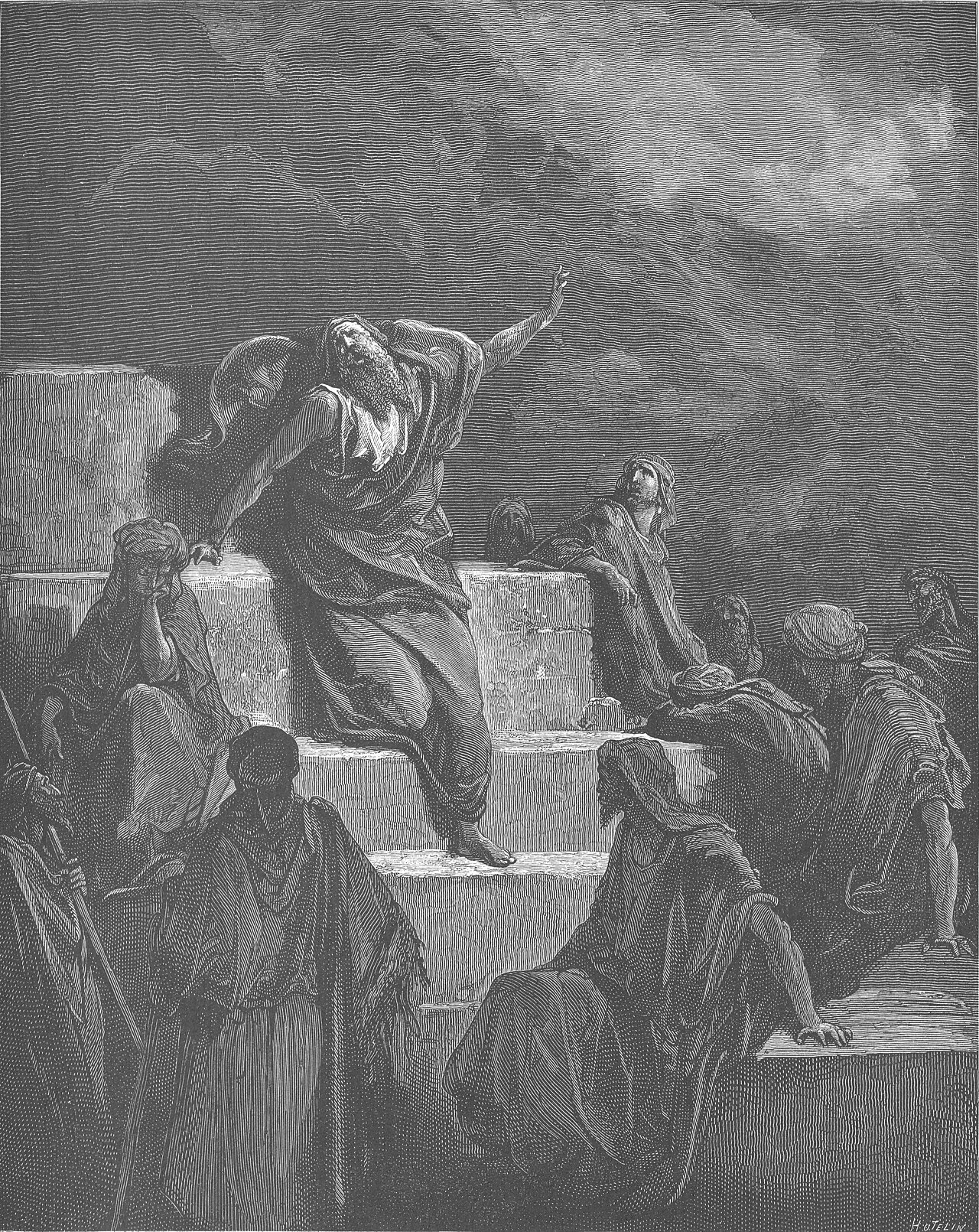
The oracle opens on a drought so complete that every rank of creature feels it: nobles sending servants to empty cisterns, plowmen covering their heads in shame at bare ground, the hind forsaking her newborn calf for want of grass, wild asses gasping like jackals on the high places. Henry reads the spread from noble to farmer to animal as the point, a judgment that respects no station because the sin behind it was Judah's as a whole. The drought is never explained here as ordinary weather; the chapter that follows makes plain it is the covenant's own curse for a broken covenant.
The record, by era
The Church Fathers1 voice
It will serve us to remember that what is called the Word came to certain persons, as "the word of the Lord which came to Hosea, the son of Beeri," and "the word which came to Isaiah, the son of Amoz, concerning Judah and concerning Jerusalem," and "the word that came to Jeremiah concerning the drought." We must inquire how this Word came to Hosea, and how it came also to Isaiah the son of Amoz, and again to Jeremiah concerning the drought. The comparison may enable us to find out how the Word was with God. We will generalize by simply looking at what the prophets said, as if that were the Word of the Lord or the Word that came to them. May it not be … that … the Son, the Word, of whom we are now theologizing, came to Hosea, sent to him by the Father, historically, that is to say, to the son of Beeri, the prophet Hosea.… Similarly the Word comes also to Isaiah, teaching the things that are coming on Judea and Jerusalem in the last days. So also it comes to Jeremiah lifted up by a divine elation.… Thus to find out what is meant by the phrase "the Word was with God," we have adduced the words used about the prophets, how he came to Hosea, to Isaiah, to Jeremiah.… We have to add that in his coming to the prophets he illuminates the prophets with the light of knowledge, causing them to see things that had been before them but that they had not understood until then.
The Puritans and the Awakening1 voice
The word of the Lord that came to Jeremiah concerning the dearth. Or, "concerning the words of straints" (x); that is, concerning the businesses of a drought, as the Targum; concerning the Lord's restraining rain from the earth, and forbidding the heavens dropping it down; the consequence of which is a drought, or dryness of the earth; and the effect of that a famine; when this was it is not anywhere said; it could not be the famine at the siege of Jerusalem by Nebuchadnezzar, because that only affected the city; this all Judea.
The Nineteenth Century2 voices
The word - that came - concerning the dearth - This discourse is supposed to have been delivered, after the fourth year of Jehoiakim. Concerning the dearth. We have no historic record of any dearth that may fall in with the time of this prophecy, and perhaps it does not refer to any particular dearth: but this was a calamity to which Judea was very liable. They had ordinarily very dry summers, for scarcely any rain fell from April to the middle of October; and during much of this time, the rivers were generally either very low or entirely dry.
A commentator
Jamieson, Fausset & Brown1802–1910
Commentary Critical and Explanatory on the Whole Bible (1871)
proposed
Literally, "That which was the word of Jehovah to Jeremiah concerning the dearth" drought--literally, the "withholdings," namely, of rain (De 11:17; This word should be used especially of the withholding of rain because rain is in those regions of all things the one chiefly needed (Jer 17:8, Margin).
quarantine:debris (2026-07-29) — unbalanced-parens
The words behind it
9 Hebrew wordsEvery Hebrew word of this verse in the order it stands, with what it means and the door to its own study. The last column counts the times a word stands in the whole Bible: the rarer the word, the more the places it appears belong together.
| Hebrew | Sound | Meaning | Word study | In the Bible |
|---|---|---|---|---|
| אֲשֶׁ֨ר | ʾasher | which | H834 → | 5497 times |
| הָיָ֤ה | hayah | it came | H1961 → | 3559 times |
| דְבַר־ | devar- | [the] word of | H1697 → | 1440 times |
| יְהוָה֙ | yahweh | Yahweh | H3068 → | 6520 times |
| אֶֽל־ | ʾel- | to | H413 → | 5510 times |
| יִרְמְיָ֔הוּ | yirmeyahu | Jeremiah | H3414 → | 147 times |
| עַל־ | ʾal- | on | H5921 → | 5755 times |
| דִּבְרֵ֖י | divrei | [the] matters of | H1697 → | 1440 times |
| הַבַּצָּרֽוֹת׃ | habatzarot | the droughts | H1226 → |
אֲשֶׁ֨רwhich
ʾasherH834 →5497 times
הָיָ֤הit came
hayahH1961 →3559 times
דְבַר־[the] word of
devar-H1697 →1440 times
יְהוָה֙Yahweh
yahwehH3068 →6520 times
אֶֽל־to
ʾel-H413 →5510 times
יִרְמְיָ֔הוּJeremiah
yirmeyahuH3414 →147 times
עַל־on
ʾal-H5921 →5755 times
דִּבְרֵ֖י[the] matters of
divreiH1697 →1440 times
הַבַּצָּרֽוֹת׃the droughts
habatzarotH1226 →
A shaded row is a word that stands 400 times or fewer in the Bible.
The walk
5 stopsEach card is a verse this one points to, and under it the verses that one points to in turn. Where several paths arrive at the same place, that place is listed first: the text keeps returning to it.
Through
Jeremiah 17:8He is like a tree planted by the waters that sends out its roots toward the stream. It does not fear when the heat comes, and its leaves are always green. It does not…
it leads to
- Psalms 1:3
He is like a tree planted by streams of water, yielding its fruit in season, whose leaf does not wither, and who prospers in all he does.
- Isaiah 58:11
The LORD will always guide you; He will satisfy you in a sun-scorched land and strengthen your frame. You will be like a well-watered garden, like a spring whose waters never fail.
- Ezekiel 47:12
Along both banks of the river, fruit trees of all kinds will grow. Their leaves will not wither, and their fruit will not fail. Each month they will bear fruit, because the water from…
- Ezekiel 31:4–10
The waters made it grow; the deep springs made it tall, directing their streams all around its base and sending their channels to all the trees of the field.
- Psalms 92:10–15
But You have exalted my horn like that of a wild ox; with fine oil I have been anointed.
- Psalms 1:3
Where this verse is studied
On this page
About Jeremiah
Who and where
1 name in this verse with a page on the site.
This page draws on Adam Clarke, Commentary on the Bible; Jamieson, Fausset & Brown, Commentary Critical and Explanatory on the Whole Bible; Jerome, Commentary on Jeremiah; John Gill, Exposition of the Old Testament; John Gill, Exposition of the Old Testament (1748-1763); Matthew Henry, Commentary on the Whole Bible and Origen of Alexandria, COMMENTARY ON THE GOSPEL OF JOHN 2:1.