
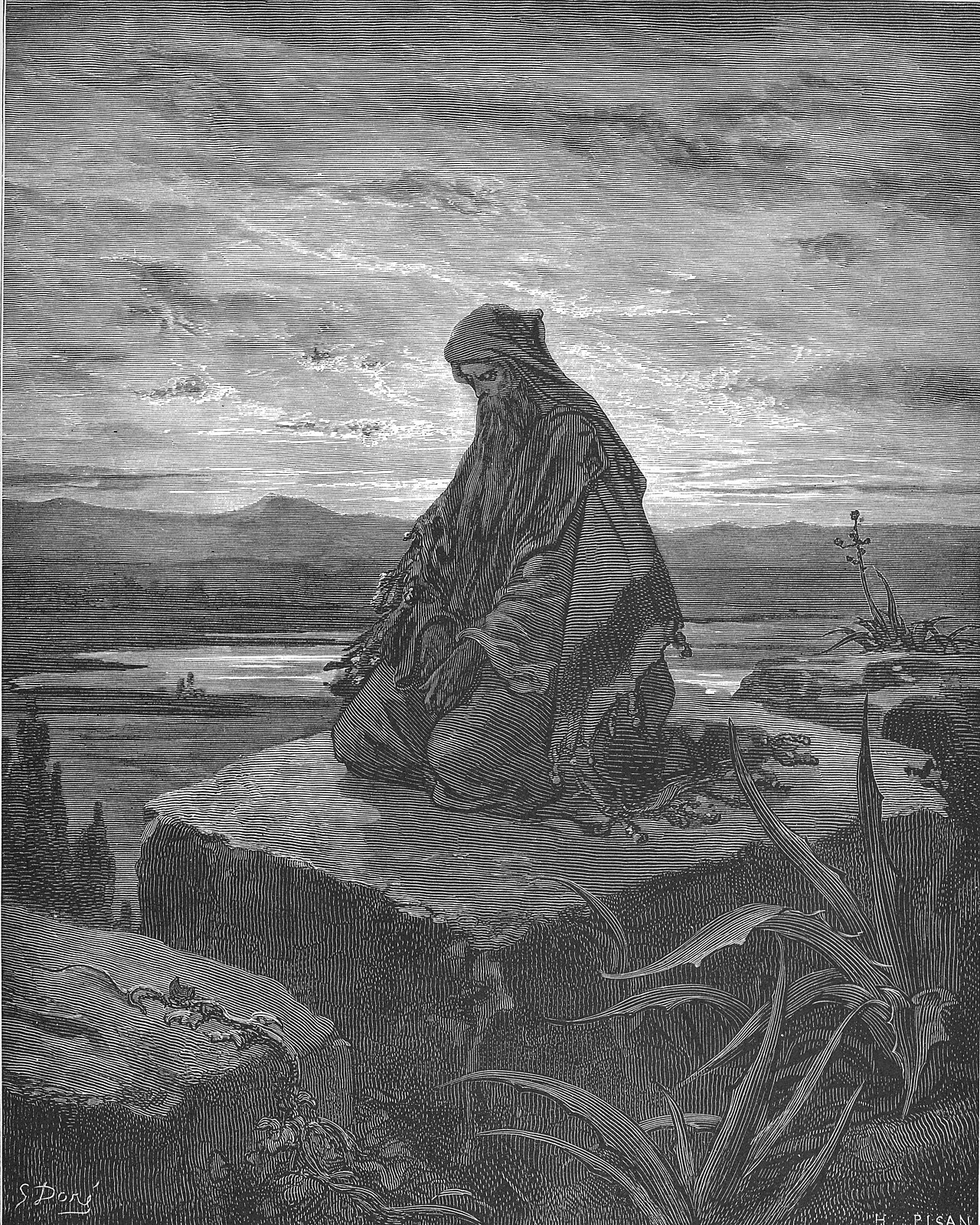
Isaiahchapter 34
17 verses · Isaiah · 8th century BC · The Prophets
The desert owl and screech owl will possess it, and the great owl and raven will dwell in it. The LORD will stretch out over Edom a measuring line of chaos and a plumb line of destruction.
Introduction
Isaiah, The Prophets, Isaiah Overview.
Isaiah turns in this chapter from Judah's crisis to the whole company of nations. Edom, the people descended from Esau, stands as the example of every power that turned on God's people. The chapter is written as a sentence of judgment, and it uses the language of sacrifice and of a land burned and left to wild creatures. It is one half of a pair, and chapter 35 is the other half. Listen for the surveyor's tools used to mark out ruin, and for the closing call to search the scroll of the LORD.
Context
- Who
- Judeans who knew Edom as the brother nation that betrayed them
- What
- A sentence of judgment on all nations, with Edom as the example, and a land left empty to wild creatures.
- Where
- The nations at large, and Edom in the red highlands south-east of the Dead Sea, with Bozrah its fortress.
- When
- Spoken most likely about 705 to 700 BC; the chapter gives no date and describes the day of the LORD's vengeance.
- Why
- To declare that God will judge the nations that set themselves against Zion, and that His word on them will stand.
Historical context
Edom sat in high, broken country of red rock south-east of the Dead Sea, hard to invade and easy to defend, with Bozrah as its main fortress. The Edomites descended from Esau, which made them Israel's cousins, and their long record of turning on Israel in her worst moments is why they become the standing example of the nations under judgment.
Show the rest of the historical context, 4 more paragraphs
The judgment is written as a sacrifice. The LORD has a sword filled with blood, a great slaughter in Edom, and the animals named, lambs, goats, rams, wild oxen, bulls, are the sacrificial list. Anyone who had stood in the temple court knew what a day of mass slaughter smelled and sounded like.
The burning imagery is drawn from the local geology, and travelers to the Dead Sea region reported it for centuries. Bitumen and asphalt seep out of the ground there, and it burns. Isaiah says the streams will be turned to pitch, the dust to brimstone, and the land will become burning pitch that is not quenched night or day, with smoke going up forever.
Then the ruin fills up with creatures, and the list is deliberately unclean: the pelican and the porcupine, the owl and the raven, jackals in the palaces and thorns in the fortresses, wild goats calling to each other and night creatures settling down. Over it God stretches the measuring line of confusion and the plumb line of emptiness, the surveyor's tools used, for once, to lay out a wasteland.
The chapter closes by pointing at a document: seek out of the book of the LORD and read. Whatever else the book is, the hearers are told the record exists and can be checked.
Significance
For a small nation being carved up by empires, this chapter said the nations do not have the last word about anything, including Israel's borders. The controversy of Zion is on God's docket.
Show the rest of the significance, 1 more paragraph
And Edom mattered personally. When Jerusalem finally fell, it was Edom that cheered. Isaiah puts the cousin nation on the list a century early.
This chapter in Jewish lifeWhat this chapter is in Jewish life and reading.
What is done
No part of this chapter is read aloud in the synagogue. The site's own table in src/lib/hebraic/readings.ts printed parashot 0 and haftarah uses 0 for Isaiah 34, and no festival reading for the book. The table records Isaiah only as a source of Haftarot, and none of the Haftarot it records reaches this chapter.
The chapter is met instead in the study of the weekly portions, and the corpus names the doors. Under the third verse it carries Midrash Tanchuma, Beshalach 13:2. Under the seventh verse it carries Midrash Tanchuma, Bo 4:7. Under the ninth verse it carries Midrash Tanchuma, Vaera 13:4. Under the tenth verse it carries Midrash Tanchuma Buber, Vaera 15:1 and Midrash Tanchuma, Terumah 11:8. Under the fourteenth verse it carries Midrash Tanchuma, Terumah 7:2. Each of those locators is named for the Torah portion whose study it belongs to.
How it is read
Rashi is quoted here from The Judaica Press complete Tanach with Rashi, translated by A. J. Rosenberg, which Sefaria reports as CC-BY, and Ibn Ezra from the Commentary of Ibn Ezra on Isaiah translated by M. Friedlander in 1873, which Sefaria reports as public domain. Ibn Ezra records at the second verse that the commentators part over the whole chapter. "All commentators refer this prophecy to the Messianic period, except R. Moses Hakkohen", who holds that Edom fell in the Assyrian invasion and that chapters 24 to 34 belong together (Ibn Ezra on Isaiah 34:2:1). The two readings stand side by side in his note, one of the end and one of history.
Rashi reads the chapter of the end. The host of heaven that melts is the heavenly princes of the nations, cast down first, since "no nation suffers until its prince suffers in heaven" (Rashi on Isaiah 34:4:1 and 34:5:1). The nation his sword falls on is named differently in the witnesses of his text: Ishmael in the printed editions, Edom in the manuscripts, and the Babylonians in the Warsaw edition (Rashi on Isaiah 34:5:1). Bozrah belongs to Moab, and it suffers with Edom because it gave Edom a king, as Genesis 36:33 records, a reading he takes from the Pesikta (Rashi on Isaiah 34:6:2).
At the tenth verse Rashi joins the chapter to Amalek. The war from generation to generation runs "From Moses' generation to Saul's generation, and from there to Mordecai's generation, and from there to the generation of the King Messiah" (Rashi on Isaiah 34:10:1). The Book of the Lord of the sixteenth verse he reads as Genesis. At the Flood every creature gathered to the Ark and none was missing, and so the beasts will gather over Edom (Rashi on Isaiah 34:16:1).
What the rabbis say
The corpus carries forty rabbinic locators on this chapter and the text of none, so each is cited by ref here and none is quoted or paraphrased. On the second verse it holds Eikhah Rabbah 2:3. On the third verse it holds Midrash Tanchuma, Beshalach 13:2. On the fourth verse it holds Avodah Zarah 17a:14, Ein Yaakov (Glick Edition), Avodah Zarah 1:19, Kohelet Rabbah 1:2:1, Mekhilta DeRabbi Shimon Ben Yochai 18:18 and Mekhilta DeRabbi Yishmael, Tractate Amalek 4:7. On the fifth verse it holds Aggadat Bereshit 56:1, Bereshit Rabbah 75:1, Mekhilta DeRabbi Shimon Ben Yochai 15:1, Mekhilta DeRabbi Yishmael, Tractate Shirah 2:23 and Midrash Sekhel Tov, Shemot 15:21:9. On the sixth verse it holds Bereshit Rabbah 65:11, Bereshit Rabbah 83:3, Midrash Aggadah, Genesis 27:1:4, Midrash Lekach Tov, Genesis 27:1:6 and Midrash Sekhel Tov, Bereshit 28:9:15.
On the seventh verse it holds Midrash Tanchuma, Bo 4:7. On the eighth verse it holds Midrash Lekach Tov, Deuteronomy 32:35:1 and Midrash Tehillim 7:19. On the ninth verse it holds Bereshit Rabbah 51:2, Midrash Tanchuma, Vaera 13:4 and Yalkut Shimoni on Torah 84:11. On the tenth verse it holds Aggadat Bereshit 20:1, Midrash Lekach Tov, Leviticus 8:36:3, Midrash Tanchuma Buber, Vaera 15:1 and Midrash Tanchuma, Terumah 11:8. On the eleventh verse it holds Chagigah 12a:7, Ein Yaakov (Glick Edition), Khagigah 2:5, Ein Yaakov, Khagigah 2:2 and Midrash Lekach Tov, Exodus 11:9:2.
On the thirteenth verse it holds Bava Kamma 16a:22. On the fourteenth verse it holds Midrash Tanchuma, Terumah 7:2, Midrash Tannaim on Deuteronomy 32:2:16 and Sifrei Devarim 306:26. On the fifteenth verse it holds Chullin 140b:9 and Yalkut Shimoni on Torah 930:13. On the sixteenth verse it holds Bereshit Rabbah 32:8, Introductions to Tanaitic Literature, Introduction to Halakhic Midrashim, Halakhic Midrash 19 and Midrash Sekhel Tov, Bereshit 42:27:5. What each of them teaches is a saying of the rabbis, and it is reported as theirs wherever this site quotes one. The quotations wait on a fetch that carries the text.
Sources: Rashi, Rashi on Isaiah 34:4:1 to 34:17:1, The Judaica Press complete Tanach with Rashi, translated by A. J. Rosenberg, reported CC-BY; Ibn Ezra, Ibn Ezra on Isaiah 34:1:1 to 34:3:2, Commentary of Ibn Ezra on Isaiah, translated by M. Friedlander, 1873, reported public domain; The Sefaria corpus, scripts/data/sources/sefaria/isaiah/34.json, the 40 Talmud and Midrash locators of this chapter; The site's own files, src/lib/hebraic/readings.ts, printing no portion, no Haftarah and no festival reading for this chapter, and src/data/bible/chapter-verse-counts.json for the verse count.
The heads below are this chapter's scenes. The numbered points under each are its verses.
The Host of Heaven Dissolved: a Day of Vengeance
Isaiah 34:1-4
Come near, O nations, to listen: The chapter opens beyond Edom with a summons to the whole world: Come near, O nations, to listen. The LORD is angry with all the nations, and the skies will be rolled up like a scroll. Revelation 6:14 uses the same image at the sixth seal.
Isaiah 34:1
“He addresses the Edomites who would haughtily despise these judgments, and therefore he calls heaven and earth to bear witness against them; for he dedares that the judgment will be so visible and striking, that not only all the nations but even the dumb creatures shall behold it.”
John Calvin · Commentaries (1554)reformed
The LORD is angry with all the nations: Calvin takes all the nations here as the peoples round Judah, who were as much her enemies as her neighbours. The LORD devotes them to destruction and gives them over to slaughter in verbs of the past tense. The slaughter is settled in his anger before it falls.
Isaiah 34:2
“For the indignation of the Lord - Yahweh is about to express his wrath against all the nations which are opposed to his people. He hath utterly destroyed them - In his purpose, or intention. The prophet represents this as so certain that it may be exhibited as already done.”
1 more voice on this verse
Isaiah 34:2
“For the indignation of Jehovah is on all the nations. He undoubtedly means "the nations" which were hostile to the Jews, and at the same time were contiguous to them; for, being surrounded on all sides by various nations, they had almost as many enemies as neighbors.”
John Calvin · Commentaries (1554)reformed
Their slain will be left unburied: Their slain lie unburied, the last disgrace in the ancient world, with the dead too many for anyone to bury. Matthew Henry sets the mountains flowing with blood beside the blood up to the horses' bridles at Revelation 14:20. Both overstatements make the reader feel the LORD's fury.
Isaiah 34:3
“Their slain also shall be cast out - They would lie unburied. The slaughter Would be so extensive, and the desolation would be so entire, that there would not remain enough to bury the dead (compare the notes at Isa 14:19). And the mountains shall be melted with their blood - The expression here is evidently hyperbolical, and means that as mountains and hills are wasted away by descending showers and impetuous torrents, so the hills would be washed away by the vast quantity of blood that would be shed by the anger of Yahweh.”
1 more voice on this verse
Isaiah 34:3
“These expressions are hyperbolical (as St. John's vision of blood to the horse-bridles, Rev. xiv. 20 ), and are made use of because they sound very dreadful to sense (it makes us even shiver to think of such abundance of human gore), and are therefore proper to express the terror of God's wrath, which is dreadful beyond conception and expression.”
Matthew Henry · Commentary on the Whole Bible (1707-1721)puritan
The skies will be rolled up: Wesley observes that the prophets describe great national calamities in the language that belongs to the day of judgment. The stars of heaven can also stand for kings and princes, as the heavenly host does at Isaiah 24:21. Edom's fall is told as the end of a world.
Isaiah 34:4
“And all the host of heaven - On the word ‘host’ (צבא tsâbâ'), see the note at Isa 1:9. The heavenly bodies often represent kings and princes (compare the note at Isa 24:21). Shall be dissolved - (ינמקוּ venâmaqqû. This figure Vitringa supposes to be taken from the common prejudice by which the stars appear to be crystals, or gems, set in the azure vault of heaven, which may melt and flow down by the application of heat.”
1 more voice on this verse
Isaiah 34:4
“It is usual for prophetic writers, both in the Old and New Testament, to represent great and general calamities, in such words and phrases, as properly agree to the day of judgment; as on the contrary, the glorious deliverances of God's people, in such expressions, as properly agree to the resurrection from the dead.”
John Wesley · Explanatory Notes upon the Old Testament (1765)evangelical
Isaiah 34:5-8
My sword has drunk its fill: The oracle narrows to Edom by name, upon the people I have devoted to destruction. The slaughter is described as a sacrifice in Bozrah, a year of recompense for the cause of Zion. Behind it stands Edom's old hostility toward Judah, the violence against your brother Jacob in Obadiah 1:10.
Isaiah 34:5
“Or else, knife for sacrifice for God does not here appear as a warrior with His sword, but as one about to sacrifice victims doomed to slaughter [VITRINGA]. (Eze 39:17). bathed--rather "intoxicated," namely, with anger (so De 32:42). "In heaven" implies the place where God's purpose of wrath is formed in antithesis to its "coming down" in the next clause.”
Jamieson, Fausset & Brown · Commentary Critical and Explanatory on the Whole Bible (1871)reformed
2 more voices on this verse
Isaiah 34:5
“For my sword shall be bathed in heaven,.... That is, the sword of the Lord, as it is called in the next verse Isa 34:6, and it is he that is speaking; it designs the vengeance of the Lord, the punishment he will inflict on the wicked, said to be "bathed in heaven", because determined and prepared there; the allusion may be to the bathing of swords in some sort of liquor, to harden or brighten them, and so fit them for use.”
Isaiah 34:5
“Heaven - Where God dwells; in which this is said to be done, because it was there decreed and appointed. Idumea - Upon the Edomites, who, tho' they were nearly related to the Israelites, yet were their implacable enemies. But these are named for all the enemies of God's church, of whom they were an eminent type.”
John Wesley · Explanatory Notes upon the Old Testament (1765)evangelical
For the LORD has a sacrifice in Bozrah: Blood and fat were the portions of every sacrifice reserved for God, and the slain of Edom are laid on his altar. Lambs, goats and rams stand for her people of every rank. Clarke notes that Ezekiel 39:17 takes up this same picture of the Lord's sacrifice.
Isaiah 34:6
“The sword - The metaphor is taken from a great glutton, who is almost insatiable. Rams - By lambs, and goats, and rams, he means people of all ranks and conditions, high and low, rich and poor. Bozrah - A chief city of Edom, and a type of those cities which should be most opposite to God's people.”
John Wesley · Explanatory Notes upon the Old Testament (1765)evangelical
2 more voices on this verse
Isaiah 34:6
“The image of a sacrifice is continued. blood . . . fat--the parts especially devoted to God in a sacrifice (2Sa 1:22). lambs . . . goats--sacrificial animals: the Idumeans, of all classes, doomed to slaughter, are meant (Zep 1:7).”
Jamieson, Fausset & Brown · Commentary Critical and Explanatory on the Whole Bible (1871)reformed
Isaiah 34:6
“The Lord hath a sacrifice “For Jehovah celebrateth a sacrifice” - Ezekiel, Eze 39:16, Eze 39:17, has manifestly imitated this place of Isaiah.”
Adam Clarke · Commentary on the Bible (1810-1826)evangelical
the wild oxen will fall with them: The wild ox, the re'em of the Hebrew, was a fierce beast of great strength, and the King James called it the unicorn. Gill follows the Targum, which reads the oxen and young bulls as the mighty men of Edom falling beside the common soldiers. Leaders and people fall together.
Isaiah 34:7
“And the unicorns shall come down with them,.... With the lambs, goats, and rams; that is, either the rhinoceros, as some, there being no such creature as the unicorn; or the buffaloes, as (m) others; these "shall fall", as the Septuagint, Syriac, and Arabic versions render it, they shall be slain, as well as the rest; meaning, that along with the common soldiers, and inferior officers, the general officers should fall; and so the Targum, "and the mighty shall be slain with them.'' R.”
1 more voice on this verse
Isaiah 34:7
“And the unicorns - Margin, ‘Rhinoceros’ (ראמים re'ēmı̂ym from ראם re'êm). This was evidently an animal well known in Palestine, since it is frequently mentioned in the Old Testament (Num 23:22; Deu 33:17; Job 39:9-10; Psa 22:21; Psa 29:6; Psa 92:10, in all which places it is translated unicorn, or unicorn). The derivation of the word is uncertain, and it has been regarded as doubtful what animal is intended. The corresponding Arabic word denotes the oryx, a large and fierce species of the antelope. Gesenius, Schultens, De Wette, and Rosenmuller suppose that the buffalo is intended by the word.”
a year of recompense: The word for cause is rib, the Hebrew term for a lawsuit, and Clarke reads the LORD as the defender of Zion's cause. The day of vengeance is the verdict in Zion's case against Edom. The LORD pays Edom back for Zion.
Isaiah 34:8
“The year of recompenses for the controversy of Zion “The year of recompense to the defender of the cause of Zion” - As from דון dun, דין din, a judge; so from רוב rub, ריב rib, an advocate, or defender; Judici Sionis: Syriac.”
Adam Clarke · Commentary on the Bible (1810-1826)evangelical
Edom's Streams of Pitch and the Book of the LORD
Isaiah 34:9-11
Edom’s streams will be turned to tar: Edom's ruin is described as unending, her soil to sulfur, and its smoke will ascend forever. Where a kingdom stood, only wild creatures remain. The LORD will stretch out over Edom a measuring line of chaos, the surveyor's tools that lay out a city here marking out its emptiness.
Its smoke will ascend forever: Aquinas reads the smoke that will ascend forever as the sign and memory of a fire whose effect remains. John uses the same words of fallen Babylon at Revelation 19:3. Later travellers' reports counted over thirty desolate towns in the land of Edom, deserted from generation to generation.
Isaiah 34:10
VOLNEY, the infidel, was forced to confirm the truth of this prophecy: "From the reports of the Arabs, southeast of the Dead Sea, within three days' journey are upwards of thirty ruined towns, absolutely deserted."
Jamieson, Fausset & Brown · Commentary Critical and Explanatory on the Whole Bible (1871)reformed
a measuring line of chaos: Chaos and destruction translate tohu and bohu, the formless and empty of Genesis 1:2. Edom returns to the earth's condition before God gave it order. Barnes notes that the owls and the raven repeat the picture of Babylon's ruin at Isaiah 13:20-22.
Isaiah 34:11
“Dwell - It shall be entirely possessed by those creatures which delight in deserts and waste places. Stretch - He shall use the line, or the stone or plummet joined to it, not to build them, but to mark them out to destruction, as workmen commonly use them to mark what they are to pull down.”
John Wesley · Explanatory Notes upon the Old Testament (1765)evangelical
1 more voice on this verse
Isaiah 34:11
“But the cormorant - This and the following verses contain a description of the desolations of Edom in language remarkably similar to that employed in the account of the destruction of Babylon Isa 13:20-22; Isa 14:23. The word here translated ‘cormorant’ (קאת qâ'ath), occurs in this place and in Zep 2:14, where it is rendered ‘cormorant,’ and in Lev 11:18; Deu 14:17; Psa 102:6, where it is rendered ‘pelican.’ Bochart supposes it is the ardea stellaris, or bitourn, which frequents watery places in deserts, and makes a horrible noise. The pelican is a sea-fowl, and cannot be intended here.”
Isaiah 34:12-15
No nobles will be left: The ruling class is gone: No nobles will be left to proclaim a king, and all her princes will come to nothing. Thorns overgrow her towers, and the land passes to desert creatures. Ostriches and owls, named in verses 13 and 15, stand among the birds Leviticus 11 calls detestable.
Isaiah 34:12
“Rather, "As to her nobles, there shall be none there who shall declare a kingdom," that is, a king [MAURER]; or else, "There shall be no one there whom they shall call to the kingdom" [ROSENMULLER] (Isa 3:6, &c.). Idumea was at first governed by dukes (Ge 36:15); out of them the king wan chosen when the constitution became a monarchy.”
Jamieson, Fausset & Brown · Commentary Critical and Explanatory on the Whole Bible (1871)reformed
She will become a haunt for jackals: Thorns and briers mark land left without a keeper, the same growth that overran the abandoned vineyard of Isaiah 5:6. Her strongholds now shelter jackals and ostriches. Barnes reads the word for abode as a dwelling, the settled home of the wild creatures that replace her people.
one wild goat will call to another: The night creature is lilith in Hebrew, from the word for night, and Clarke takes it as a night bird. The wild goat is the hairy one, the same word older versions rendered satyr. Only creatures of the dark and the waste remain.
Isaiah 34:14
“The weld beasts of the desert - ציים tsiyim, the mountain cats. - Bochart. Wild beasts of the island - איים aiyim, the jackals. The satyr - שעיר seir, the hairy one, probably the he-goat. The screech owl - לילית lilith, the night-bird, the night-raven, nyctycorax, from ליל layil, or לילה lailah, the night.”
Adam Clarke · Commentary on the Bible (1810-1826)evangelical
There the owl will make her nest: The creature rendered owl is the qippoz, found only here in the Bible. Barnes follows those who took it for the arrow-snake, which lays eggs, while older Jewish readers linked it with the bird of verse 11. Either way, the ruin becomes a nursery for wild things.
Isaiah 34:15
“There shall the great owl make her nest,.... Jarchi, Kimchi, and Ben Melech, say that "kippoz" here is the same with "kippod", rendered "bittern" in Isa 34:11 but Aben Ezra takes them to be two different birds; it is hard to say what is designed by it.”
1 more voice on this verse
Isaiah 34:15
“There shall the great owl - (קפוז qı̂pôz). Gesenius supposes that this is the arrow-snake, so called from its darting or springing, in the manner of the rattle-snake - from an obsolete root to draw oneself together, to contract. Bochart (Hieroz. ii. 3. 11. 408-419) has examined the meaning of the word at length, and comes to the conclusion that it means the serpent which the Greeks called acontias, and the Latins, jaculus - the arrow-snake. The serpent is oviparous, and nourishes its young.”
Isaiah 34:16-17
Search and read the scroll of the LORD: The oracle closes by pointing to its own written record: Search and read the scroll of the LORD. Not one of these will go missing, because He has ordered it. The wild creatures receive the land as an inheritance, the same surveying language as the measuring line of verse 11.
Isaiah 34:16
“Seek ye out of the book of the Lord, and read,.... Joseph Kimchi interprets this of the book of the law of Moses; which being consulted, it will appear that punishment was threatened to be inflicted on the enemies of God's people, particularly the Edomites. Jarchi thinks the book of Genesis is intended; in which we may read how every creature, with its mate, at the time of the flood, was gathered to Noah in the ark.”
2 more voices on this verse
Isaiah 34:16
“My mouth “For the mouth of Jehovah” - For הוא hu, five MSS., (three ancient), read יהוה Jehovah, and another is so corrected; so likewise the Septuagint. Two editions have צום tsivam; and so the Septuagint, Vulgate, and Arabic, with the edition of 1486, and a MS. has קבצם kebatsam, with the masculine pronoun instead of the feminine: and so in the next verses it is להם lahem, instead of להן lahen, in fourteen MSS., six of them ancient. - L. To see the importance of these various readings, the Hebrew Bible must be consulted.”
Adam Clarke · Commentary on the Bible (1810-1826)evangelical
Isaiah 34:16
“Seek - When this judgment is executed, if you pursue this prophecy, you will find, that all things exactly come to pass, as I have told you. His - My spirit, (such sudden changes of persons being frequent here) hath brought all these creatures together, as he formerly brought the creatures to Adam, and to Noah, by an instinct which he put into them.”
John Wesley · Explanatory Notes upon the Old Testament (1765)evangelical
He has allotted their portion: Barnes notes that conquered lands were commonly shared out by lot, as Canaan was divided among the tribes at Numbers 26:55. Here the lot and the line deed Edom to the wild creatures. They hold it by God's own grant.
Isaiah 34:17
“And he hath cast the lot for them - He hath assigned to them the land of Edom to be occupied by them as their portion. This language is taken from the fact that countries were commonly apportioned, particularly among conquerors, by the lot. In this way Judea was divided among the tribes of Israel Num 26:55-56. His hand hath divided it unto them by line - He has marked out, as a surveyor does, the land of Edom as the dwelling-place of the beasts of the forest.”
Keep studying
Sources for this chapter
The summary
Jamieson, Fausset & Brown, Commentary Critical and Explanatory; John Calvin, Commentaries; John Wesley, Notes on the Old Testament and Matthew Henry, Complete Commentary.
The exposition
Adam Clarke, Commentary on the Bible; Albert Barnes; Franz Delitzsch, Biblical Commentary on the Prophecies of Isaiah; Jamieson, Fausset & Brown, Commentary Critical and Explanatory on the Whole Bible; John Calvin, Commentaries; John Gill; John Wesley, Explanatory Notes upon the Old Testament; Matthew Henry, Commentary on the Whole Bible and Thomas Aquinas, Commentary on Isaiah.