
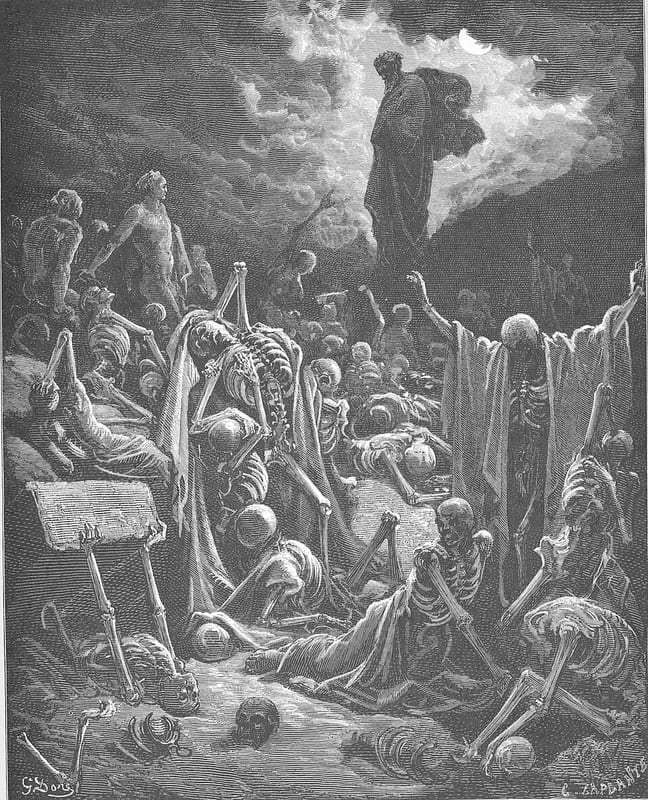
Ezekielchapter 12
28 verses · Ezekiel · 593 to 571 BC · The Prophets
Tell them that this is what the Lord GOD says: ‘This burden concerns the prince in Jerusalem and all the house of Israel who are there.’
Introduction
Ezekiel, The Prophets, Ezekiel Overview.
Ezekiel was once more told to act out his message, and his audience knew it better than anyone. They had packed a bundle and walked the road to Babylon themselves. The chapter opens a new stretch of the book, with signs and sayings aimed at the hope that Jerusalem would stand. Listen for what the prophet does in daylight and what he does at dusk. Notice the two proverbs the people were repeating, and the plain answer God gives to both.
Context
- Who
- Exiles who had themselves packed a bag and marched, and who knew exactly what they were watching
- What
- The prophet acts out a flight into exile and trembling at meals, and God answers the sayings that the visions would be delayed.
- Where
- The prophet's house at Tel Abib and the street outside it, in the sight of the exiles.
- When
- About 592 to 591 BC, some five years before the flight and capture of King Zedekiah in 586 BC.
- Why
- To show that a second deportation and the capture of Jerusalem's prince were coming and that God's word would no longer be delayed.
Historical context
An exile's baggage is a specific and pitiful thing: what a person can carry on their own back for months. Bedding, a cooking pot, a water skin, a change of clothes. Ezekiel brings his out in broad daylight so that everyone can see him pack, then leaves at dusk, which is when a man leaves who does not want to be seen.
Show the rest of the historical context, 3 more paragraphs
Digging through the wall is not clumsy tunnelling. Houses were built of sun-dried mud brick, sometimes on a low stone footing, and the walls could be broken through with hands and a tool, which is why the Law and the Gospels both speak of a thief digging through a house. Getting out through a hole in the wall rather than the door is the image of a man escaping his own city.
The prince who covers his face and does not see the land came true in awful detail five years later. When the Babylonians breached Jerusalem in 586 BC, Zedekiah slipped out at night through a gate between two walls, was overtaken on the plains of Jericho, and taken to Nebuchadnezzar at Riblah in Syria. There his sons were killed in front of him, and then his eyes were put out. He was carried to Babylon in chains and died there, a country he was taken to and never saw.
The chapter also quotes two street sayings the exiles were repeating: the days grow long and every vision comes to nothing, and the vision he sees is for many years from now. Delay had turned prophecy into background noise.
Significance
The audience were connoisseurs of exile. They had made this exact walk with these exact bundles. Watching their prophet do it again told them the first deportation had not been the end of it.
Show the rest of the significance, 1 more paragraph
Against the proverbs about postponement, God puts a flat sentence: none of my words will be delayed any longer. For hearers who had learned to treat prophecy as safely distant, the message was that the distance had run out.
This chapter in Jewish lifeWhat this chapter is in Jewish life and reading.
What is done
The site's table of synagogue readings ties no weekly portion and no Haftarah to this chapter. Probed for this lane, src/lib/hebraic/readings.ts printed parashot 0 and haftarah uses 0 for Ezekiel 12, and no festival reading for the book. The table holds the Haftarah of each weekly portion and the six books read whole on a feast or a fast. Across chapters 1 to 24 of Ezekiel the same probe found a Haftarah only in chapters 20 and 22.
How it is read
Rashi is the main commentator on this chapter in the corpus. He is quoted here from The Judaica Press complete Tanach with Rashi, translated by A. J. Rosenberg, which Sefaria reports as CC-BY. The translation is modern, so every quotation from it is fifty words or fewer.
The baggage for exile is a sign acted out. It held "A vessel from which to drink and a small earthen bowl in which to knead a cake" (Rashi on Ezekiel 12:3:1). The hole dug in the wall is "Symbolic of Zedekiah" (Rashi on Ezekiel 12:5:1). Zedekiah later went out by a tunnel because he was afraid of the Chaldeans. He covers his face "because of shame, that he is fleeing from the city at night" (Rashi on Ezekiel 12:12:1).
At the net of the thirteenth verse Rashi gives a tradition of the capture. A cave ran from the king's house to the plains of Jericho. God set a deer walking on the roof of the cave before the Chaldean army, and they chased it. "And when Zedekiah emerged from the cave in the plains of Jericho, they saw him emerging and caught him" (Rashi on Ezekiel 12:13:1).
The survivors will confess and say, "Because of our sins, we have suffered" (Rashi on Ezekiel 12:16:1). The proverb of the twenty-second verse said the vision would fail. Rashi answers from the twenty-fourth: "The false prophets will no longer be able to promise you peace with falsehood" (Rashi on Ezekiel 12:24:1).
The corpus carries 9 notes on this chapter without an English text, marked linked. Radak's notes stand at 12:1:1, 12:2:1, 12:8:1, 12:9:1, 12:11:1, 12:15:1, 12:17:1 and 12:18:1. Malbim's note stands at 12:21:1. Each stands cited and unquoted, because Sefaria holds no English version of the ref.
What the rabbis say
The corpus carries 12 rabbinic locators on the verses of this chapter, 3 filed under the Talmud and 9 under the Midrash. It carries the text of none, so each is cited by ref here and never quoted or paraphrased. The verse numbers are the Hebrew ones the corpus prints.
On verse 3 it holds Eikhah Rabbah 1:22, Ein Yaakov (Glick Edition), Nedarim 4:11, Ein Yaakov, Nedarim 4:12, Midrash Lekach Tov on Lamentations 3:16:1 and Nedarim 40b:3. On verse 22 it holds Bereshit Rabbah 64:5, Mishnat Rabbi Eliezer 10:45 and Yalkut Shimoni on Torah 111:10. On verse 25 it holds Eikhah Rabbah, Petichta 12 and Kohelet Rabbah 8:8:1. On verse 27 it holds Jerusalem Talmud Nazir 5:3:3 and Jerusalem Talmud Nedarim 9:2:3.
What each of them teaches is a saying of the rabbis, and is reported as theirs wherever this site quotes one. The quotations wait on a fetch that carries the text.
Sources: Rashi, Rashi on Ezekiel 12:3:1 to 12:24:1, The Judaica Press complete Tanach with Rashi, translated by A. J. Rosenberg, reported CC-BY; Radak, Radak on Ezekiel 12:1:1 to 12:18:1, cited by ref only: Sefaria holds no English version of the ref; Malbim, Malbim on Ezekiel 12:21:1, cited by ref only: Sefaria holds no English version of the ref; The Sefaria corpus, scripts/data/sources/sefaria/ezekiel/12.json, the 12 Talmud and Midrash locators on the verses of this chapter; The site's own files, src/lib/hebraic/readings.ts, probed for Ezekiel 12: parashot 0, haftarah uses 0, no festival reading for the book.
The heads below are this chapter's scenes. The numbered points under each are its verses.
Digging through the wall with a captive's baggage
Ezekiel 12:1-2
the word of the LORD came to me: The word of the Lord opens a new section. Ezekiel lives “in a rebellious house,” a people who “have eyes to see but do not see, and ears to hear but do not hear.” Words have failed this house, so the Lord next gives an acted sign.
Ezekiel 12:1
“The word of the Lord came unto me, saying. The word of prophecy, as the Targum; the vision of the cherubim being over, this, very likely, immediately followed upon the former; though the exact time of the prophecy cannot be fixed, because the date is not given; it must be between the sixth month of the sixth year of Jehoiachin's captivity, Eze 8:1; and the fifth month of the seventh year, Eze 20:1.”
They have eyes to see but do not see: The LORD calls the exiles a rebellious house with eyes that do not see and ears that do not hear. Adam Clarke places the fault in their will: they have eyes and refuse to use them. So the signs that follow are acted out before their eyes.
Ezekiel 12:2
“Which have eyes to see, and see not - It is not want of grace that brings them to destruction. They have eyes to see, but they will not use them. No man is lost because he had not sufficient grace to save him, but because he abused that grace.”
Adam Clarke · Commentary on the Bible (1810-1826)evangelical
1 more voice on this verse
Ezekiel 12:2
“When, therefore, unbelievers pretend that they have not been illuminated by the Lord, it may be conceded to them that they are blind and deaf: but we must often proceed beyond this, since their own obstinacy is the fountain of their blindness and deafness: and God blinds them, because they will not admit the light offered them, but stop their ears.”
John Calvin · Commentaries (1554)reformed
Ezekiel 12:3-7
pack your bags for exile: Ezekiel is told to “pack your bags for exile” with the hope, “Perhaps they will understand, though they are a rebellious house.” He digs “through the wall,” for “I have made you a sign to the house of Israel.” He performs it to the letter before any explanation.
Ezekiel 12:3
“Stuff - Raiment, vessels, and the like. The “removing” was to be of the kind that accompanied exile. The whole account of this transaction marks it as a real act. The prophet was to be “a sign” to his countrymen, and the “exiles” as well as those that remained in Judaea had need to be taught this lesson, for though themselves far away, they looked to Jerusalem as their home, and were scarcely less eager for its safety than the inhabitants themselves.”
Bring out your baggage for exile by day: Ezekiel is to act out an exile while the people watch, bringing out his baggage by day and leaving in the evening. Albert Barnes notes that each detail later came true when Zedekiah fled, as 2 Kings 25:4 records. At the time the king still seemed secure.
Ezekiel 12:4
“The particulars which Ezekiel here foretold actually occurred (compare 2Ki 25:4; Jer 39:4); but at this time Zedekiah seemed to be prosperous, and the Jews at Jerusalem expected, it is clear, a long continuance of his prosperity (see Eze 17:1 note). The prophetic character of the passage is undoubted (the prophet is declared to be “a sign,” Eze 12:6) - the genuineness of the book and of the position of the passage in the book, are beyond dispute; in the historical event we have an exact fulfillment. The only legitimate inference is that the prophet received his knowledge from above.”
dig through the wall: Ezekiel digs through the wall and carries his belongings out through the hole. Adam Clarke ties the act to the escape of Zedekiah by night through a breach in the wall of Jerusalem, told in Jeremiah 39:4. The sign shows a king fleeing in secret.
Ezekiel 12:5
“Dig thou through the wall in their sight,.... The wall of the house where he was, as an emblem of the city of Jerusalem closely besieged, from whence there was no escape but by digging through the wall this showed the manner in which Zedekiah made his escape, by the way of the gate, between the two walls which was by the king's garden, Jer 52:7; and carry out thereby; not his stuff, as before; but provisions for himself, necessary for his journey or flight; as no doubt Zedekiah and those with him did.”
1 more voice on this verse
Ezekiel 12:5
“Dig--as Zedekiah was to escape like one digging through a wall, furtively to effect an escape (Eze 12:12). carry out--namely, "thy stuff" (Eze 12:4). thereby--by the opening in the wall.”
Jamieson, Fausset & Brown · Commentary Critical and Explanatory on the Whole Bible (1871)reformed
cover your face so that you cannot see the land: Ezekiel carries his bags on his shoulder at dusk with his face covered, so he cannot see the land. Albert Barnes reads the covered face two ways: as mourning, as in 24:17, and as a sign of the blindness of Zedekiah. The prophet himself is the sign.
Ezekiel 12:6
“Thou shalt cover thy face, that thou see not the ground - Referring to the blinding of Zedekiah: even the covering of the face might be intended to signify that in this way Zedekiah should be carried to Babylon on men’s shoulders in some sort of palanquin, with a cloth tied over his eyes, because of the recent wounds made by extracting them. All the prophecies from this to the twentieth chapter are supposed to have been delivered in the sixth year of Zedekiah, five years before the taking of Jerusalem. How accurate the prediction! and how exactly fulfilled!”
Adam Clarke · Commentary on the Bible (1810-1826)evangelical
So I did as I was commanded: Ezekiel obeys every part of the command. He brings out his bags by day, digs through the wall by hand in the evening, and carries his belongings on his shoulder at dusk. Matthew Henry sees a prophet willing to take any trouble to convince people who refuse to see.
Ezekiel 12:7
“Christ himself learned obedience, and so we must all. (2.) To do all we can for the good of the souls of others, to put ourselves to any trouble or pains for the conviction of those that are unconvinced. We do all things (that is, we are willing to do any thing), dearly beloved, for your edifying.”
Matthew Henry · Commentary on the Whole Bible (1707-1721)puritan
Ezekiel 12:8-11
in the morning the word of the LORD came to me: The explanation comes the next morning. The Lord names the target: “This burden concerns the prince in Jerusalem and all the house of Israel who are there.” Ezekiel is to say, “I am a sign to you,” his own actions a small enactment of the exile to come.
Ezekiel 12:8
“And in the morning came the word of the Lord unto me, saying. That is, in the morning after he had done all the above things commanded him; explaining the meaning of them, and showing to whom they belonged.”
The acted sign works, and the rebellious house asks Ezekiel what he is doing. Matthew Henry notes that the strange act was chosen to draw such a question. Their asking opens the way for the answer of the LORD.
Ezekiel 12:9
“Though they are a rebellious house, yet they are inquisitive concerning the mind of God," as those ( Isa. lviii. 2 ) who sought God daily. Therefore the prophet must do such a strange uncouth thing, that they might enquire what it meant; and then, it may be hoped, people will take notice of what is told them, and profit by it, when it comes to them in answer to their enquiries.”
Matthew Henry · Commentary on the Whole Bible (1707-1721)puritan
The answer names who the sign is for: the prince in Jerusalem and all Israel still there. Albert Barnes explains that a burden is a word of coming woe laid on a person or people. The load on the shoulder of Ezekiel pictures that weight.
Ezekiel 12:10
“Say thou unto them, thus saith the Lord God,.... In answer to their sneering question; or notwithstanding their stupidity and indolence, and in order to awaken them out of it: this burden concerneth the prince in Jerusalem; the present reigning prince in Jerusalem, King Zedekiah.”
2 more voices on this verse
Ezekiel 12:10
“Burden - A word used to indicate a prediction of woe to be borne by some individual or people (Isa 13:1 note). Ezekiel, bearing his “stuff” on his shoulder was a sign of the weight of calamity coming upon king and people.”
Ezekiel 12:10
“JOSEPHUS [Antiquities, 10.7] reports that Ezekiel sent a copy of this prophecy to Zedekiah. As Jeremiah had sent a letter to the captives at the Chebar, which was the means of calling forth at first the agency of Ezekiel, so it was natural for Ezekiel to send a message to Jerusalem confirming the warnings of Jeremiah.”
Jamieson, Fausset & Brown · Commentary Critical and Explanatory on the Whole Bible (1871)reformed
Ezekiel tells the people he is a sign to them. What he did in their sight will be done to those in Jerusalem, who will go into exile as captives. Matthew Henry put it this way: the judgments of God can turn a prince into a porter.
Ezekiel 12:11
“I am your sign - My person is the emblem of yours, and my actions of that you shall do. And the like shall be done to you, O inhabitants of Jerusalem. We cannot say concerning our dwelling place, that it is our resting place.”
John Wesley · Explanatory Notes upon the Old Testament (1765)evangelical
1 more voice on this verse
Ezekiel 12:11
“The unsettled state and removals of ministers give warning to people what they must expect in this world, no continuance, but constant changes. When times of trouble are coming on Christ tells his disciples, They shall first lay their hands on you, Luke xxi.”
Matthew Henry · Commentary on the Whole Bible (1707-1721)puritan
Ezekiel 12:12-13
the prince among them: The Lord adds, “I will bring him to Babylon, the land of the Chaldeans; yet he will not see it, and there he will die.” The riddle is explained in 2 Kings 25:7, where Zedekiah’s sons are killed before his eyes and his eyes are put out.
Ezekiel 12:12
“Shall bear - Disguised, as a servant, in hope to conceal himself, chuses the twilight as the time that would best favour his design. They shall dig - This was fulfilled when they broke down the wall to fly, Jer. xxxix, 4.”
John Wesley · Explanatory Notes upon the Old Testament (1765)evangelical
he will not see it: The prince will be caught in the net of the LORD and brought to Babylon, yet he will never see it. Adam Clarke explains: Nebuchadnezzar had his eyes put out at Riblah, and he was carried blind to Babylon, where he died. The prophecy came true to the letter.
Ezekiel 12:13
“I will bring - him to Babylon - yet shall he not see it - Because Nebuchadnezzar caused him to have his eyes put out at Riblah. To Babylon he was carried in his blind state, and there he died. In saying, My net also will I spread upon him, there is probably a reference to an ancient manner of fighting.”
Adam Clarke · Commentary on the Bible (1810-1826)evangelical
1 more voice on this verse
Ezekiel 12:13
“It is God's net (Job 19:6). Babylon was God's instrument (Isa 10:5). Called "a net" (Hab 1:14-16). bring him to Babylon . . . ; yet shall he not see it--because he should be deprived of sight before he arrived there (Jer 52:11).”
Jamieson, Fausset & Brown · Commentary Critical and Explanatory on the Whole Bible (1871)reformed
Ezekiel 12:14-16
I will scatter to every wind: The judgment reaches past the prince. A few are spared from sword and famine and plague, “so that in the nations to which they go, they can recount all their abominations.” The recognition formula comes twice, over the scattering and over the remnant, so both serve one end.
Ezekiel 12:14
“And I will scatter to every wind all that are about him to help him,.... Either his bodyguards, the men of war that were with him when he fled, Jer 52:7; or his auxiliary troops, the Egyptians, whom he had taken into his pay for his assistance: and all his bands: or "wings" (w); the wings of his army.”
when I disperse them among the nations: The scattering of Israel among the nations will teach them that He is the LORD. John Gill notes that the proof lies in the fulfilment: God foretold these events and then brought them to pass. The dispersion itself becomes a witness.
Ezekiel 12:15
“And they shall know that I am the Lord,.... God omniscient, and can and do foresee and foretell future events, when the above things shall come to pass; and omnipotent, able to do what he purposed and declared he would; and true and faithful to his word, and holy and righteous in all his ways and works: when I shall scatter them among the nations, and disperse them in the countries; of Egypt, Babylon, Media, and other places.”
I will spare a few of them: A few will be spared from sword, famine and plague. Albert Barnes notes that the word means so few they could be easily counted. In the nations they reach, these survivors will recount their abominations, so that others learn why the judgment came.
Ezekiel 12:16
“Those that by their afflictions are brought to this are then made to know that God is the Lord and may help to bring others to the knowledge of him. See how God brings good out of evil. The dispersion of sinners, who had done God much dishonour and disservice in their own country, proves the dispersion of penitents, who shall do him much honour and service in others countries.”
Matthew Henry · Commentary on the Whole Bible (1707-1721)puritan
1 more voice on this verse
Ezekiel 12:16
“Few - literally, as in the margin; so few, that they can easily be counted Isa 10:19. The few who should escape destruction should make known to all among whom they should dwell how great had been the wickedness of the people, how just their punishment.”
Eating bread with trembling, drinking water with dread
Ezekiel 12:17-20
the word of the LORD came to me: A sign follows: “eat your bread with trembling, and drink your water with quivering and anxiety,” the prophet’s body acting out the fear. The land will be stripped “because of the violence of all who dwell in it.” Eating and drinking are ordinary acts, so the siege reaches every hour.
Ezekiel 12:17
“Moreover the word of the Lord came to me, saying. Here follows another sign of the desolation of the Jews, which the prophet was unto them; as the former signified their going into captivity, this their famine and distress at the siege of Jerusalem, and the dreadful calamities attending and following that.”
eat your bread with trembling: Ezekiel is to eat his bread with trembling and drink his water with anxiety. Albert Barnes explains that the sign acts out the terror of a city under siege. Every meal becomes a warning.
Ezekiel 12:18
“Son of man, eat thy bread with quaking,.... As one in surprise or fear, or that has got an ague upon him: and drink thy water with trembling and with carefulness; fearing want of it, or as apprehensive of danger of its being taken away; see Eze 4:16.”
1 more voice on this verse
Ezekiel 12:18
“Eat thy bread with quaking - Assume the manner of a person who is every moment afraid of his life, who has nothing but a morsel of bread to eat, and a little water to drink. Thus signifying the siege, and the straits to which they should be reduced. See this explained, Eze 12:19 (note).”
Adam Clarke · Commentary on the Bible (1810-1826)evangelical
their land will be stripped of everything in it: The sign is explained for those in Jerusalem and the land of Israel: they will eat and drink in dread. Violence fills the land, so it will be stripped bare. Albert Barnes takes this to mean the loss of both its people and its wealth.
Ezekiel 12:19
“The people - Thy fellow captives. And of the land - Those that dwell in the countries round about Jerusalem. Her land - Jerusalem's land, so called because it was the head city thereof.”
John Wesley · Explanatory Notes upon the Old Testament (1765)evangelical
1 more voice on this verse
Ezekiel 12:19
“The people of the land - Chaldaea. Of the inhabitants - In respect to “the inhabitants.” Desolate from, all that is therein - i. e., stripped of all its inhabitants and of all its wealth. At one and the same time, Jeremiah was prophesying in Jerusalem, and Ezekiel in Chaldaea; the prophecies of the former were sent to the exiles, and those of Ezekiel to the dwellers at Jerusalem, that the guiding hand of One God in different places might be made clear (Jerome).”
The inhabited cities will be laid waste: The ruin reaches past Jerusalem. John Gill notes that the other cities of Judea, then full of people, were also laid waste by the Chaldeans. Through the desolate land the people will know that He is the LORD.
Ezekiel 12:20
“And the cities that are inhabited shall be laid waste,.... Not only the city of Jerusalem, but the other cities of Judea; as they were by the Chaldeans, which were then full of inhabitants: and the land shall be desolate; the whole land of Judea be destitute of men and cattle, and lie uncultivated, and become barren and unfruitful: and ye shall know that I am the Lord; who were then captives in Babylon, as well as those who should be dispersed among the nations would; see Eze 12:15.”
No more delayed visions: the word will be done
Ezekiel 12:21-25
the word of the LORD came to me: A new oracle answers a proverb, “The days go by, and every vision fails,” a saying that made every delay a reason to ignore prophecy. Keil sets this saying beside the sour grapes proverb of chapter 18.
The people repeat a proverb that time passes and every vision fails. Jamieson, Fausset and Brown explain that the judgment had been delayed so long that scoffers said it would never come. Their repeated jest had hardened into a saying.
Ezekiel 12:22
“The days are prolonged, and every vision faileth? - These are the words of the infidels and scoffers, who, because vengeance was not speedily executed on an evil work, set their heart to do iniquity. “These predictions either will not come in our days, or will wholly fail; why then should we disquiet ourselves about them?” Strange, that the very means used by the most gracious God to bring sinners to repentance, should be made by them the very instruments of their own destruction! See 2Pe 3:4.”
Adam Clarke · Commentary on the Bible (1810-1826)evangelical
every vision will be fulfilled: The LORD ends the proverb with a new saying of His own. Now the days are near when every vision comes true. Adam Clarke notes that time was running out and the threatened ruin was at the door.
Ezekiel 12:23
“It is said, it is sworn, that delay shall be no longer ( Rev. x. 6 ); the year of God's patience has now just expired, and he will no longer defer the execution of the sentence.”
Matthew Henry · Commentary on the Whole Bible (1707-1721)puritan
no more false visions or flattering divinations: The false visions and flattering divinations in Israel will end. Jamieson, Fausset and Brown name them as the false prophets who promised peace and safety, citing Lamentations 2:14. What happens next would expose them.
Ezekiel 12:24
“The true prophets' visions and predictions stand, and are in full force, power, and virtue; they give law, and receive credit, when the vain visions, and the flattering divinations, are lost and forgotten, and shall be no more in the house of Israel; for great is the truth, and will prevail.”
Matthew Henry · Commentary on the Whole Bible (1707-1721)puritan
it will be fulfilled without delay: The LORD will speak His word and bring it to pass in the days of this rebellious house. Matthew Henry puts it in two words: said, and done. With God the saying and the doing come together.
Ezekiel 12:25
“That glorious name of his speaks him a God giving being to his word by the performance of it, and therefore to the patriarchs, who lived by faith in a promise not yet performed, he was not known by his name Jehovah, Exod. vi. But, as he is Jehovah in making good his promise, so he is in making good his threatenings.”
Matthew Henry · Commentary on the Whole Bible (1707-1721)puritan
Ezekiel 12:26-28
the word of the LORD came to me: A second proverb targets Ezekiel’s own words: “The vision that he sees is for many years from now; he prophesies about the distant future.” The people grant him a true prophet while pushing his warnings into a far future. The answer matches the first proverb’s.
Ezekiel 12:26
“Again, the word of the Lord came to me, saying. This is repeated to confirm what was before spoken, and that they might assure themselves that there would be a certain and speedy accomplishment of what the Lord had said by his prophet.”
1 more voice on this verse
Ezekiel 12:26
“In your days - will I say the word, and will perform it - Even these mockers shall live to see and feel this desolation. This is more particularly intimated in the following verses.”
Adam Clarke · Commentary on the Bible (1810-1826)evangelical
A second saying goes around the house of Israel: the vision is for many years from now. Jamieson, Fausset and Brown contrast it with verse 22. Those scoffers denied the judgment, and these people granted it and pushed it into the distant future.
Ezekiel 12:27
“Not a mere repetition of the scoff (Eze 12:22); there the scoffers asserted that the evil was so often threatened and postponed, it must have no reality; here formalists do not go so far as to deny that a day of evil is coming, but assert it is still far off (Am 6:3).”
Jamieson, Fausset & Brown · Commentary Critical and Explanatory on the Whole Bible (1871)reformed
1 more voice on this verse
Ezekiel 12:27
“But it was a great mistake, and they did but deceive themselves into their own ruin; and God is here much displeased at it; for, 1. It was a wretched abuse of the patience of God, who, because for a time he kept silence, was thought to be altogether such a one as themselves, Ps. l. That forbearance of God which should have led them to repentance hardened them in sin.”
Matthew Henry · Commentary on the Whole Bible (1707-1721)puritan
The answer of the LORD is short: none of His words will be delayed any longer. Adam Clarke notes that God had waited to be gracious, and the people abused His mercy. When the delay ended, the judgment came with full force.
Ezekiel 12:28
“Note, Those that will not have their eyes opened and their mistakes rectified, by the word of God, shall be undeceived by his judgments: for every mouth that speaks perverse things shall be stopped.”
Matthew Henry · Commentary on the Whole Bible (1707-1721)puritan
1 more voice on this verse
Ezekiel 12:28
“There shall none of my words be prolonged any more - He had waited to be gracious; they abused his mercy; and at last the protracted wrath rushed upon them with irresistible force.”
Adam Clarke · Commentary on the Bible (1810-1826)evangelical
Keep studying
Studies1
Sources for this chapter
The summary
Jamieson, Fausset & Brown, Commentary Critical and Explanatory; John Calvin, Commentaries; John Wesley, Notes on the Old Testament and Matthew Henry, Complete Commentary.
The exposition
Adam Clarke, Commentary on the Bible; Albert Barnes; Carl Friedrich Keil, Biblical Commentary on the Prophecies of Ezekiel; Jamieson, Fausset & Brown, Commentary Critical and Explanatory on the Whole Bible; John Gill; John Wesley, Explanatory Notes upon the Old Testament; Matthew Henry, Commentary on the Whole Bible and Patrick Fairbairn, An Exposition of Ezekiel.