
Estherchapter 1
22 verses · KJVEsther book hub →
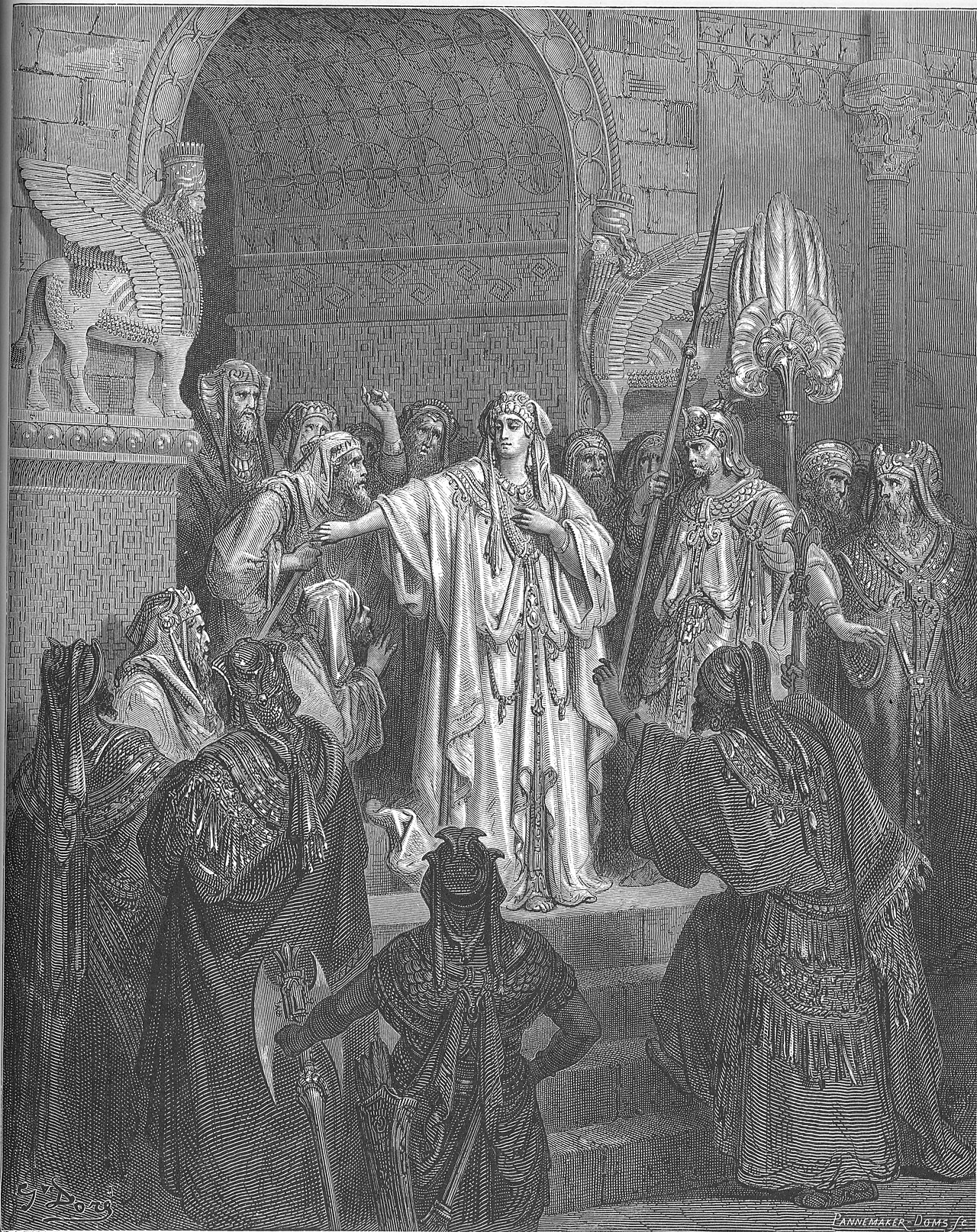
Queen Vashti Refuses to Obey Ahasuerus' Command, Gustave Doré, Doré's English Bible (1866), public domain
Key verse
Now it came to pass in the days of Ahasuerus, (this is Ahasuerus which reigned, from India even unto Ethiopia, over an hundred and seven and twenty provinces:)
It stands in scene A of the chapter, verses 1 to 9.
The chapter
Chapter summary
Ahasuerus reigns from India even unto Ethiopia over a hundred and twenty and seven provinces, and throws a hundred and eighty days of display for his princes, then seven days of feasting in the palace garden court for everyone in Shushan, white cloth and blue hangings, pillars of marble, couches of gold and silver, and drinking by decree that 'none did compel.' Queen Vashti feasts the women separately. On the seventh day the king, merry with wine, sends seven chamberlains to bring her wearing the royal crown to show her beauty; she refuses. Fearing the example will reach every wife in the empire, the princes have Vashti deposed by unalterable law, 'that every man should bear rule in his own house.'
Context
History · Mordecai · Esther overview
Where the chapter sits
Esther 1 falls in The queen and the plot (chapters 1–4). Vashti deposed; Esther chosen; Mordecai uncovers the assassination plot; Haman's rise and his genocidal edict; ‘for such a time as this.’
Vashti deposed. The queen refuses; the king's counselors panic; a new queen to be chosen.
After it: The reversal, chapters 5–7.
The whole shape of Esther→The world behind this chapter
Esther 1The history
Persia ruled the largest empire the world had yet seen, from India to the edge of Africa, cut into provinces under governors called satraps. The king kept four capitals and moved between them with the seasons. Susa was the winter residence, and the palace sat on a raised, walled citadel above the city. French excavators dug that palace out in the 1880s and found glazed brick panels of the royal guard and a great columned audience hall; the panels are in the Louvre today.
The rest of the history, and what it meant to them
A six-month display of wealth was not a party in our sense. It was statecraft. Herodotus records that Xerxes summoned the nobles and commanders of the empire to Susa in exactly these years to plan the invasion of Greece, and a war of that size had to be sold to the men who would pay for it and fight it. The 180 days of showing off the treasury, followed by a seven-day open feast for everyone in the citadel, is what a war council looked like from the outside.
The details of the feast are Persian to the bone. Guests reclined on gold and silver couches on a pavement of coloured stone, and no two drinking cups matched, a deliberate boast that the treasury never repeated itself. The one custom the text singles out is the rule that no one was forced to drink, which reverses the usual Persian practice; Herodotus says the Persians drank hard and made their biggest decisions drunk.
The seven officials who 'saw the king's face' were not invented for the story. Persian government really did reserve the right of direct access to the heads of seven noble houses, a privilege dating from the coup that put Darius on the throne. And the ruling that a royal decree, once sealed, could not be taken back is a feature of Persian law that shows up again in Daniel, a system built to make the king look unchangeable, which ends up trapping him.
What it meant to them
Jewish hearers knew this world from underneath. The chapter opens with the empire in full display, and then shows the whole machine seized up over a dinner-party insult, seven advisers writing an unchangeable law about husbands because one woman said no. The mightiest court on earth is run by men who cannot hold their wine or their tempers.
That is the ground the rest of the book stands on. If a Jew's life depends on this court's good judgment, a Jew is already dead. Something else must be at work, and the book never once names it, which is the point.
Sources cited
- Herodotus, The Histories
- Edwin M. Yamauchi, Persia and the Bible
- John H. Walton, Victor H. Matthews & Mark W. Chavalas, The IVP Bible Background Commentary: Old Testament
A. A hundred and eighty days of splendor in Shushan the palace
1. (vv. 1-4)
a.an hundred and seven and twenty provinces:): The book opens by measuring an empire before it measures a woman: an hundred and seven and twenty provinces from India to Ethiopia, and a display of royal wealth stretched across an hundred and fourscore days. Keil and the commentators who set the scene beside Herodotus read the third year’s gathering of nobles as the same council Xerxes held before his war on Greece, a synchronism the evidence supports without settling. The chapter’s first business is scale, and scale is the stage every later reversal will stand against.
Esther 1:1, 2 voicesWhat preachers and commentators have said about this verse, in their own words.
Esther 1:1
“Ahasuerus - . Xerxes, the son of Darius Hystaspis. His empire is rightly described as from India even unto Ethiopia. The satrapies of Darius Hystaspis reached 29 in number, and the nations under Xerxes were about 60. The 127 “provinces” include probably sub-satrapies and other smaller divisions of the great governments.”
Esther 1:1
“If such vast power be put into a bad hand, it is able to do so much the more mischief; but, if into a good hand, it is able to do so much the more good. Christ's kingdom is, or shall be, far larger than this, when the kingdoms of the world shall all become his; and it shall be everlasting.”
Matthew Henry· Commentary on the Whole Bible (1707-1721)puritan
Esther 1:2, 2 voices
Esther 1:2
“That in those days, when the King Ahasuerus sat on the throne of his kingdom,.... Not only was placed upon it, but settled in it; after Xerxes had subdued Egypt, in the second year of his reign (e), and enjoyed great peace and tranquillity: which was in Shushan the palace; that is, the throne of his kingdom was in Shushan, the royal city of the kings of Persia; of which see Gill on Neh 1:1, Dan 8:2. (e) Herodot. ib. (Thalia, sive, l. 3.) c. 7.”
Esther 1:2
“Sat on the throne of his kingdom - Having subdued all his enemies, and brought universal peace to his empire. See the commencement of the introduction. Shushan the palace - The ancient city of Susa, now called Shuster by the Persians. This, with Ecbatana and Babylon, was a residence of the Persian kings. The word הבירה habbirah, which we render the palace, should be rendered the city, εν Σουσοις τῃ πολει, as in the Septuagint.”
Adam Clarke· Commentary on the Bible (1810-1826)evangelical
Esther 1:3, 3 voices
Esther 1:3
“In the third year of his reign he made a feast unto all his princes, and his servants,.... The nobles and officers in his court; on what account this was cannot be said with certainty, whether the first day of it was his birthday, or the day of his coming to the throne, on which day Xerxes used to make a feast annually, as Herodotus relates (f): the power of Persia and Media; the mighty men therein, the potentates thereof; or the "army", the principal officers of it: the nobles and princes of the provinces being with him.”
Esther 1:3
“In the third year - In this year, 483 B.C., Xerxes assembled the governors of provinces at Susa, in connection with his contemplated expedition against Greece. The nobles - literally, “the first men.” The Hebrew word used is one adopted from the Persian.”
Esther 1:3
“The Chaldee paraphrast (who is very bold in his additions to the story of this book) says that there had been a rebellion among his subjects and that this feast was kept for joy of the quashing of it.”
Matthew Henry· Commentary on the Whole Bible (1707-1721)puritan
Esther 1:4, 1 voice
Esther 1:4
“The riches of his glorious kingdom - Luxury was the characteristic of the Eastern monarchs, and particularly of the Persians. In their feasts, which were superb and of long continuance, they made a general exhibition of their wealth, grandeur, etc., and received the highest encomiums from their poets and flatterers. Their ostentation on such occasions passed into a proverb: hence Horace: - Persicos odi, puer, apparatus: Displicent nexae philyra coronae; Mitte sectari, rosa quo locorum Sera moretur.”
Adam Clarke· Commentary on the Bible (1810-1826)evangelical
2. (vv. 5-8)
a.unto all the people that were present in Shushan the palace, both unto great and small: Seven more days follow for everyone in Shushan, small and great together, and the court of the garden is furnished in marble, gold and hangings the text lingers over color by color. The drinking was according to the law, none did compel, a Persian custom the king made into a statute so that even pleasure at his own table ran by decree. Every detail argues the same point before the story even begins: in this court, law reaches into rooms where no law is needed, and Vashti’s coming test is only the first of many.
Esther 1:5, 1 voice
Esther 1:5
“Feasts on this extensive scale were not unusual in the East. Cyrus is said on one occasion to have feasted “all the Persians.” Even ordinarily, the later Persian monarchs entertained 15,000 persons at their table.”
Esther 1:6, 2 voices
Esther 1:6
“Where were white, green, and blue hangings,.... Or curtains of fine linen, as the Targum, which were of these several colours; the first letter of the word for "white" is larger than usual, to denote the exceeding whiteness of them. The next word is "carpas", which Ben Melech observes is a dyed colour, said to be green.”
Esther 1:6
“White, green, and blue hangings - It was customary, on such occasions, not only to hang the place about with elegant curtains of the above colors, as Dr. Shaw and others have remarked, but also to have a canopy of rich stuffs suspended on cords from side to side of the place in which they feasted. And such courts were ordinarily paved with different coloured marbles, or with tiles painted, as above specified. And this was the origin of the Musive or Mosaic work, well known among the Asiatics, and borrowed from them by the Greeks and the Romans.”
Adam Clarke· Commentary on the Bible (1810-1826)evangelical
Esther 1:7, 1 voice
Esther 1:7
“They gave them drink in vessels of gold, the vessels being divers one from another,.... In the pattern and workmanship of them, though of the same metal, which diversity made the festival the more grand; earthen cups, with the Persians, were reckoned very mean; when a king would disgrace a man, he obliged him to use earthen cups (d).”
Esther 1:8, 2 voices
Esther 1:8
“None did compel: for so the king had appointed - Every person drank what he pleased; he was not obliged to take more than he had reason to think would do him good. Among the Greeks, each guest was obliged to keep the round, or leave the company: hence the proverb Η πιθι, η απιθι; Drink or begone. To this Horace refers, but gives more license: - Pasco libatis dapibus; prout cuique libido est. Siccat inaequales calices conviva, solutus Legibus insanis: seu quis capit acria fortis Pocula; seu modicis humescit aetius. Horat. Sat. lib. ii., s. vi., ver.”
Adam Clarke· Commentary on the Bible (1810-1826)evangelical
Esther 1:8
“This caution of a heathen prince, even when he would show his generosity, may shame many who are called Christians, who think they do not sufficiently show their good housekeeping, nor bid their friends welcome, unless they make them drunk, and, under pretence of sending the health round, send the sin round, and death with it.”
Matthew Henry· Commentary on the Whole Bible (1707-1721)puritan
3. (v. 9)
Esther 1:9-12
a.made a feast for the women in the royal house: Vashti hosts her own feast for the women, a mirror court inside the court, before the king, merry with wine on the seventh day, sends for her to be displayed before the princes wearing the crown royal. The readings on her refusal are named and neither is pressed as settled: many of the bench read a queen guarding her dignity against an indecent summons before drunken men, while others read plain disobedience to a lawful royal command. Either way the text records only the refusal and the king’s burning anger, and leaves the reason to the reader.
Esther 1:9, 3 voices
Esther 1:9
“Also Vashti the queen made a feast for the women.... For it was not customary with the Persians, nor other eastern nations, to admit of women to their festivals (m), but they feasted by themselves. Who Vashti was is not known with any certainty. Bishop Usher, who takes Ahasuerus to be Darius Hystaspis, thinks Vashti was Atossa, the daughter of Cyrus, whom he married. The Targumist says, she was the daughter of Evilmerodach, the son of Nebuchadnezzar.”
Esther 1:9
“Vashti - If Ahasuerus is Xerxes, Vashti would be Amestris, whom the Greeks regarded as the only legitimate wife of that monarch, and who was certainly married to him before he ascended the throne. The name may be explained either as a corruption of Amestris, or as a title, vahishta, (Sanskrit: vasishtha, the superlative of vasu, “sweet”); and it may be supposed that the disgrace recorded (Est 1:19-21, see the note) was only temporary; Amestris in the later part of Xerxes’ reign recovering her former dignity.”
Esther 1:9
“Also Vashti the queen made a feast for the women--The celebration was double; for, as according to the Oriental fashion, the sexes do not intermingle in society, the court ladies were entertained in a separate apartment by the queen.”
Jamieson, Fausset & Brown· Commentary Critical and Explanatory on the Whole Bible (1871)reformed
B. Vashti refuses to come at the king's command
1. (vv. 10-12)
Esther 1:10, 2 voices
Esther 1:10
“He commanded Mehuman - All these are doubtless Persian names; but so disguised by passing through a Hebrew medium, that some of them can scarcely be known. Mehuman signifies a stranger or guest. We shall find other names and words in this book, the Persian etymology of which may be easily traced.”
Adam Clarke· Commentary on the Bible (1810-1826)evangelical
Esther 1:10
“On the seventh day, when the heart of the king was merry with wine--As the feast days advanced, the drinking was more freely indulged in, so that the close was usually marked by great excesses of revelry. he commanded . . . the seven chamberlains--These were the eunuchs who had charge of the royal harem.”
Jamieson, Fausset & Brown· Commentary Critical and Explanatory on the Whole Bible (1871)reformed
Esther 1:11, 2 voices
Esther 1:11
“To bring Vashti the queen before the king,.... Not against her will, or by force; but they were sent to let her know it was the king's pleasure that she should come to him immediately: with the crown royal; that is, upon her head, to make her look the more grand and majestic: to show the people and the princes her beauty; for she was fair to look upon; which was not wisely done, neither was it comely nor safe.”
Esther 1:11
“To bring Vashti the queen - This command, though contrary to Persian customs, is not out of harmony with the character of Xerxes; and is evidently related as something strange and unusual. Otherwise, the queen would not have refused to come.”
Esther 1:12, 3 voices
Esther 1:12
“Vashti refused to come - And much should she be commended for it. What woman, possessing even a common share of prudence and modesty, could consent to expose herself to the view of such a group of drunken Bacchanalians? Her courage was equal to her modesty: she would resist the royal mandate, rather than violate the rules of chaste decorum. Her contempt of worldly grandeur, when brought in competition with what every modest woman holds dear and sacred, is worthy of observation.”
Adam Clarke· Commentary on the Bible (1810-1826)evangelical
Esther 1:12
“If he had not been put out of the possession of himself by drinking to excess, he would not have done such a thing, but would have been angry at any one that should have mentioned it. When the wine is in the wit is out, and men's reason departs from them. However, perhaps it was not her wisdom to deny him.”
Matthew Henry· Commentary on the Whole Bible (1707-1721)puritan
Esther 1:12
“Perhaps she refused in a haughty manner, and then it was certainly evil; she scorned to come at the king's commandment. What a mortification was this to him! While he was showing the glory of his kingdom he showed the reproach of his family, that he had a wife that would do as she pleased.”
Matthew Henry· Commentary on the Whole Bible (1707-1721)puritan
C. The wise men's counsel and a decree sent to every province
1. (vv. 13-15)
a.wise men, which knew the times: The king turns to legal machinery rather than his own anger: wise men who knew the times, seven princes of Persia and Media who saw the king’s face and sat first in the kingdom, the same formal apparatus that will later cast lots and seal decrees. Wesley notes the court’s habit of referring even a domestic offense to men learned in law and judgment, a habit that recurs when Esther’s own case comes before the throne. Memucan is named last among the seven, and the chapter is about to give him the floor.
Esther 1:13, 3 voices
Esther 1:13
“The advice which King Ahasuerus asks of his seven sages who were, according to royal custom always by his side, concerning the insolent Vashti—as well as the sentence he orders them to pass concerning her—undoubtedly signifies the sentence our Savior passes against the arrogance of …”
Rabanus Maurus· written before 856· EXPLANATION ON THE BOOK OF ESTHER 2patristic
Esther 1:13
“Then the king said to the wise men that knew the times,.... Astrologers, as Aben Ezra, that knew the fit time for doing anything; or that had knowledge of ancient times, historians, well read in history, and knew things that had happened similar to this: for so was the king's manner towards all that knew law and judgment; it was customary with him in any case of difficulty to have the opinion and advice of those that were expert in the law, and well understood right and wrong.”
Esther 1:13
Wise men ... - Not “astrologers,” who were unknown in Persia; but rather men of practical wisdom, who knew the facts and customs of former times. For so was the king’s manner - Some render it: “for so was the king’s business laid before all that knew law ...”
Esther 1:14, 1 voice
Esther 1:14
“Saw - Who had constant freedom of access to the king, and familiar converse with him: which is thus expressed, because the Persian kings were very seldom seen by their subjects.”
John Wesley· Explanatory Notes upon the Old Testament (1765)evangelical
2. (vv. 16-18)
a.hath not done wrong to the king only: Memucan’s answer inflates one refusal into an empire-wide grievance: Vashti has wronged not the king only but all the princes and all the people in all the provinces, because her deed will come abroad to every woman and teach wives everywhere to despise their husbands. Matthew Henry calls the argument out for what it is, statesmen frightened by their own wives dressing up a private slight as a public crisis. The logic that turns one woman’s no into a case for an empire is left to make its own point.
Esther 1:16, 1 voice
Esther 1:16
“Vashti - hath not done wrong to the king only - This reasoning or arguing was inconsequent and false. Vashti had not generally disobeyed the king, therefore she could be no precedent for the general conduct of the Persian women. She disobeyed only in one particular; and this, to serve a purpose, Memucan draws into a general consequence; and the rest came to the conclusion which he drew, being either too drunk to be able to discern right from wrong, or too intent on reducing the women to a state of vassalage, to neglect the present favorable opportunity.”
Adam Clarke· Commentary on the Bible (1810-1826)evangelical
3. (vv. 19-20)
a.let it be written among the laws of the Persians and the Medes, that it be not altered: The remedy is written into the laws of the Persians and the Medes that they be not altered, an irrevocability the chapter plants here that 8:8 will have to work around rather than repeal. Vashti is deposed, her royal estate given to another better than she, and Memucan’s household mandate rides along on the same decree, that all wives shall give their husbands honour. Keil observes that a code proud of never changing has just written a law it cannot unwrite, a problem the book will solve by decree answering decree rather than by repeal.
Esther 1:19, 1 voice
Esther 1:19
“That it be not altered - Compare the margin reference. This was the theory. Practically, the monarch, if he chose, could always dispense with the law. It was therefore quite within his power to restore Vashti to her queenly dignity notwithstanding the present decree, if he so pleased.”
4. (vv. 21-22)
a.the saying pleased the king and the princes: The plan pleases the king and the princes, and letters go out to every province in its own script and to every people in its own language, that every man should bear rule in his own house. An empire’s post system carries a message born from one queen’s private no, and the narrator states the mechanics without a word of comment on whether the remedy fit the offense. The silence is the chapter’s last word, the same silence that will govern the whole book where a name is never given for what stands behind these events.
Esther 1:22, 1 voice
Esther 1:22
“That every man should bear rule in his own house - Both God’s law and common sense taught this from the foundation of the world. And is it possible that this did not obtain in the Persian empire, previously to this edict? The twentieth verse has another clause, That all wives shall give to their husbands honor, both to great and small. This also was universally understood. This law did nothing. I suppose the parade of enactment was only made to deprive honest Vashti of her crown.”
Adam Clarke· Commentary on the Bible (1810-1826)evangelical
The text of this chapter
This page carries no textual note on Esther 1. Where this site has examined a place the manuscripts differ, the examination is in the manuscripts room. Every place this site examines →
This page draws on 10 works. Open for the list.
This page draws on Adam Clarke; Albert Barnes, Notes, Explanatory and Practical, on the Old and New Testaments (1832-1869); Jamieson Fausset and Brown, Commentary Critical and Explanatory on the Whole Bible; Jamieson, Fausset & Brown, Commentary Critical and Explanatory on the Whole Bible (1871); John Gill; John Wesley; Keil, The Books of Ezra, Nehemiah, and Esther; Matthew Henry; Rabanus Maurus, EXPLANATION ON THE BOOK OF ESTHER 2 and W. F. Adeney, Ezra, Nehemiah and Esther (Expositor's Bible).
Keep studying
On this page