
Esther 1:11
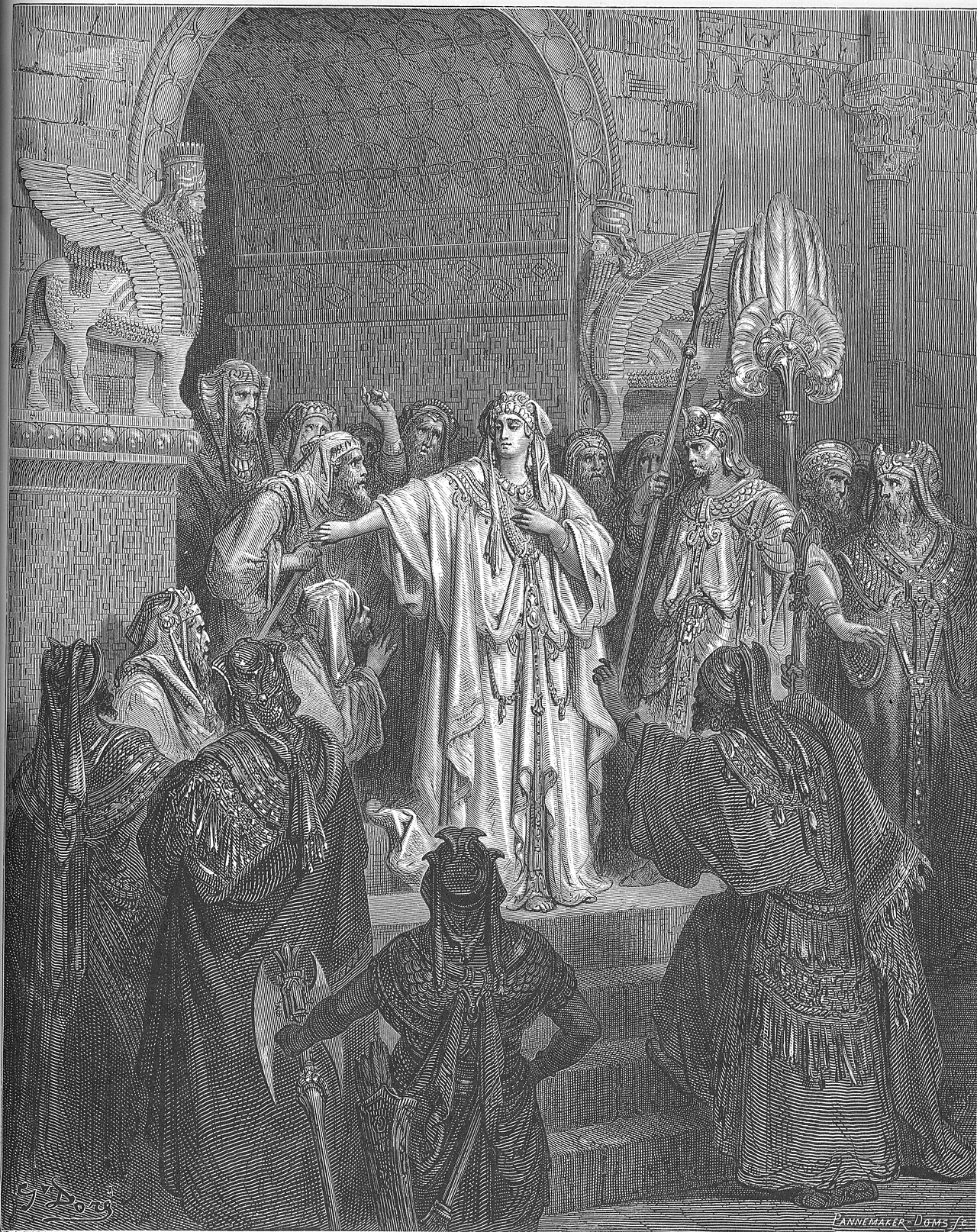
in Esther 1to bring Queen Vashti before him, wearing her royal crown, to display her beauty to the people and officials. For she was beautiful to behold.
BSB
The same verse in ASV and KJV ▾
ASV
to bring Vashti the queen before the king with the crown royal, to show the peoples and the princes her beauty; for she was fair to look on.
KJV
To bring Vashti the queen before the king with the crown royal, to shew the people and the princes her beauty: for she was fair to look on.
⋯
This verse in Esther 1
Commentary
8 notes on this verseTo bring Vashti the queen before the king,.... Not against her will, or by force; but they were sent to let her know it was the king's pleasure that she should come to him immediately: with the crown royal; that is, upon her head, to make her look the more grand and majestic: to show the people and the princes her beauty; for she was fair to look upon; which was not wisely done, neither was it comely nor safe.
This site's exposition
Queen Vashti also gave a banquet
on Esther 1:9-12
Vashti holds her own banquet for the women while the king feasts the men. On the seventh day, "when the king’s heart was merry with wine," he sends for her to be shown "wearing her royal crown". The text records only the refusal and that "his anger burned within him".
This site's exposition
to bring Queen Vashti before him
Barnes calls the summons of Queen Vashti contrary to the custom of Persia, and yet in keeping with the character of Xerxes. Gill judged it neither wise nor fitting nor safe to display the queen's beauty to the people and officials. Clarke reports that the Targum adds the word naked.
The record, by era
The Medieval Church1 voice
"So on the seventh day when the king was very festive, and after he had drunk too much and grown heated from the wine, he ordered Mehuman, and Biztha, and Harbona, and Bigtha, and Abigtha, and Zethar, and Carcas, the seven eunuchs who ministered in …
The Puritans and the Awakening1 voice
8 And the drinking was according to the law; none did compel: for so the king had appointed to all the officers of his house, that they should do according to every man's pleasure. 9 Also Vashti the queen made a feast for the women in the royal house which belonged to king Ahasuerus. Which of the kings of Persia this Ahasuerus was the learned are not agreed.
quarantine:scripture (2026-07-29) — scripture-overlap:88%@v8-10
The Nineteenth Century3 voices
A commentator
Albert Barnes1798–1870
Notes, Explanatory and Practical, on the Old and New Testaments (1832-1869)
To bring Vashti the queen - This command, though contrary to Persian customs, is not out of harmony with the character of Xerxes; and is evidently related as something strange and unusual. Otherwise, the queen would not have refused to come.
A commentator
Jamieson, Fausset & Brown1802–1910
Commentary Critical and Explanatory on the Whole Bible (1871)
On the seventh day, when the heart of the king was merry with wine--As the feast days advanced, the drinking was more freely indulged in, so that the close was usually marked by great excesses of revelry. he commanded . . . the seven chamberlains--These were the eunuchs who had charge of the royal harem.
To bring Vashti the queen - The Targum adds naked. For she was fair to look on - Hence she had her name Vashti, which signifies beautiful. See Est 1:9.
How the passage was read
What the Jewish commentators add
On the verses either side of this one
On the seventh day. Our Rabbis said. Maseches Megillah 12b. that it was on Shabbos. 23 Corresponding to “the seventh day” of the week.
2 more on this passage, in their own words ▾
Queen Vashti refused. Our Rabbis said because leprosy broke out on her, 24 Ibid. Vashti did not refuse out of modesty. She was as lewd as her husband and would have attended had she not broken out with leprosy.
On the seventh day, when the king and the hundred and twenty-seven crowned princes who were with him were merry with wine, a dispute arose among them about indecent things. The kings of the West said, Our women are the handsomest. The others said the same of their women.
This section is reception history: how the passage was read and kept in the Jewish tradition. Where a reading parts from an essential of the Christian faith, the section says so at that point.
Texts and citation data: Sefaria; each excerpt follows its version’s licence. 1 further source is cited on this chapter that carry no English text this site may quote or only restate the verse.
The words behind it
17 Hebrew wordsEvery Hebrew word of this verse in the order it stands, with what it means and the door to its own study. The last column counts the times a word stands in the whole Bible: the rarer the word, the more the places it appears belong together.
| Hebrew | Sound | Meaning | Word study | In the Bible |
|---|---|---|---|---|
| לְ֠הָבִיא | lehavi' | to bring | H935 → | 2568 times |
| אֶת־ | ʾet- | <obj.> | H853 → | 10935 times |
| וַשְׁתִּ֧י | vashti | Vashti | H2060 → | 10 times |
| הַמַּלְכָּ֛ה | hamalkah | the queen | H4436 → | 35 times |
| לִפְנֵ֥י | lifnei | <to> before | H6440 → | 2123 times |
| הַמֶּ֖לֶךְ | hamelekh | the king | H4428 → | 2525 times |
| בְּכֶ֣תֶר | bekheter | with a crown of | H3804 → | 3 times |
| מַלְכ֑וּת | malkhut | royalty | H4438 → | 91 times |
| לְהַרְא֨וֹת | leharot | to show | H7200 → | 1300 times |
| הָֽעַמִּ֤ים | haamim | the peoples | H5971 → | 1873 times |
| וְהַשָּׂרִים֙ | vehasarim | and the officials | H8269 → | 421 times |
| אֶת־ | ʾet- | <obj.> | H853 → | 10935 times |
| יָפְיָ֔הּ | yafeyah | beauty her | H3308 → | |
| כִּֽי־ | ki- | for | H3588 → | 4482 times |
| טוֹבַ֥ת | tovat | [was] good of | H2896 → | 538 times |
| מַרְאֶ֖ה | mareh | appearance | H4758 → | 103 times |
| הִֽיא׃ | hi' | she | H1931 → | 1879 times |
לְ֠הָבִיאto bring
lehavi'H935 →2568 times
אֶת־<obj.>
ʾet-H853 →10935 times
וַשְׁתִּ֧יVashti
vashtiH2060 →10 times
הַמַּלְכָּ֛הthe queen
hamalkahH4436 →35 times
לִפְנֵ֥י<to> before
lifneiH6440 →2123 times
הַמֶּ֖לֶךְthe king
hamelekhH4428 →2525 times
בְּכֶ֣תֶרwith a crown of
bekheterH3804 →3 times
מַלְכ֑וּתroyalty
malkhutH4438 →91 times
לְהַרְא֨וֹתto show
leharotH7200 →1300 times
הָֽעַמִּ֤יםthe peoples
haamimH5971 →1873 times
וְהַשָּׂרִים֙and the officials
vehasarimH8269 →421 times
אֶת־<obj.>
ʾet-H853 →10935 times
יָפְיָ֔הּbeauty her
yafeyahH3308 →
כִּֽי־for
ki-H3588 →4482 times
טוֹבַ֥ת[was] good of
tovatH2896 →538 times
מַרְאֶ֖הappearance
marehH4758 →103 times
הִֽיא׃she
hi'H1931 →1879 times
A shaded row is a word that stands 400 times or fewer in the Bible.
The walk
8 stopsEach card is a verse this one points to, and under it the verses that one points to in turn. Where several paths arrive at the same place, that place is listed first: the text keeps returning to it.
Through
Proverbs 16:9A man’s heart plans his course, but the LORD determines his steps.
it leads to
- Proverbs 19:21
Many plans are in a man’s heart, but the purpose of the LORD will prevail.
- Psalms 37:23
The steps of a man are ordered by the LORD who takes delight in his journey.
- Proverbs 16:1
The plans of the heart belong to man, but the reply of the tongue is from the LORD.
- Proverbs 20:24
A man’s steps are from the LORD, so how can anyone understand his own way?
- Jeremiah 10:23
I know, O LORD, that a man’s way is not his own; no one who walks directs his own steps.
- Proverbs 19:21
Through
Proverbs 31:30Charm is deceptive and beauty is fleeting, but a woman who fears the LORD is to be praised.
it leads to
- Proverbs 1:7
The fear of the LORD is the beginning of knowledge, but fools despise wisdom and discipline.
- 1 Peter 3:4–5
but from the inner disposition of your heart, the unfading beauty of a gentle and quiet spirit, which is precious in God’s sight.
- Proverbs 11:22
Like a gold ring in a pig’s snout is a beautiful woman who lacks discretion.
- Proverbs 1:7
Where this verse is studied
On this page
Studies5
On this verse
About Esther
This page draws on Adam Clarke, Commentary on the Bible; Albert Barnes, Notes, Explanatory and Practical, on the Old and New Testaments (1832-1869); Jamieson, Fausset & Brown, Commentary Critical and Explanatory on the Whole Bible; John Gill, Exposition of the Old Testament (1748-1763); John Gill, Exposition of the Old Testament; Matthew Henry, Commentary on the Whole Bible; Rabanus Maurus, Commentary on Esther and W. F. Adeney, Ezra, Nehemiah and Esther (Expositor's Bible).