
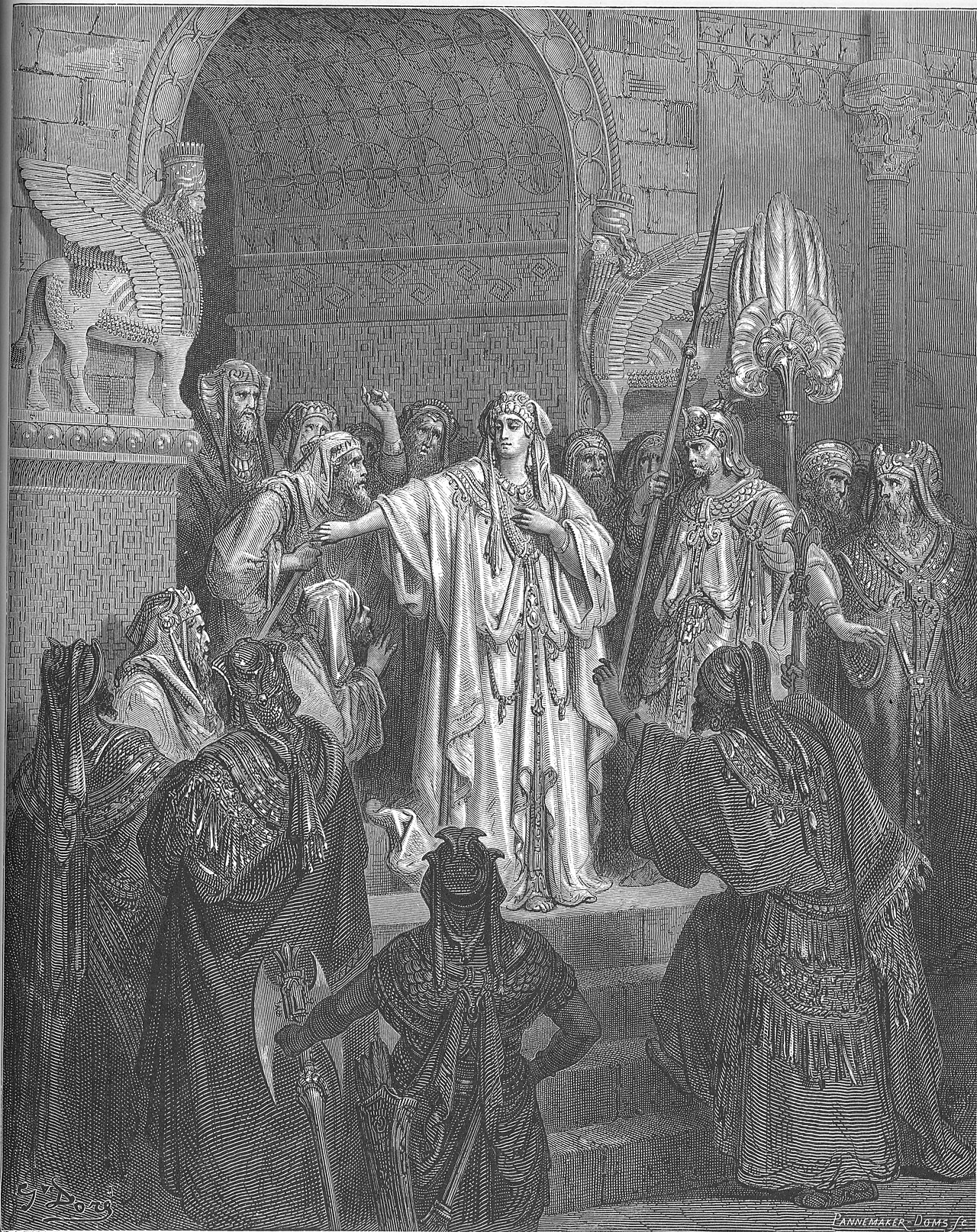
Estherchapter 1
22 verses · unknown · 5th century BC · History
This is what happened in the days of Xerxes, who reigned over 127 provinces from India to Cush.
Introduction
unknown, History, Esther Overview.
The book of Esther was written for Jews who stayed in the Persian empire after the return to Jerusalem, and its writer is not named. They lived far from the temple, under officials they would never meet. This opening chapter shows them the court that held power over their lives, at the height of its wealth and pride. It is a story told with an eye for irony, and the God of Israel is never mentioned in it. Listen for how often the king is advised and how rarely he decides alone. Notice the law that cannot be taken back, because the whole book will turn on it.
Context
- Who
- Jews scattered across the empire, who lived every day under decisions made in rooms like this one
- What
- A royal feast at the Persian court that ends with Queen Vashti removed from her place by a sealed decree.
- Where
- The citadel of Susa, the winter capital of Persia, in the garden court of the king's palace.
- When
- The third year of Ahasuerus, taken as Xerxes I, about 483 BC.
- Why
- To show the Jews of the dispersion the court that ruled their lives, and to open the vacancy the story will fill.
Historical context
Persia ruled the largest empire the world had yet seen, from India to the edge of Africa, cut into provinces under governors called satraps. The king kept four capitals and moved between them with the seasons. Susa was the winter residence, and the palace sat on a raised, walled citadel above the city. French excavators dug that palace out in the 1880s and found glazed brick panels of the royal guard and a great columned audience hall; the panels are in the Louvre today.
Show the rest of the historical context, 3 more paragraphs
A six-month display of wealth was not a party in our sense. It was statecraft. Herodotus records that Xerxes summoned the nobles and commanders of the empire to Susa in exactly these years to plan the invasion of Greece, and a war of that size had to be sold to the men who would pay for it and fight it. The 180 days of showing off the treasury, followed by a seven-day open feast for everyone in the citadel, is what a war council looked like from the outside.
The details of the feast are Persian to the bone. Guests reclined on gold and silver couches on a pavement of coloured stone, and no two drinking cups matched, a deliberate boast that the treasury never repeated itself. The one custom the text singles out is the rule that no one was forced to drink, which reverses the usual Persian practice; Herodotus says the Persians drank hard and made their biggest decisions drunk.
The seven officials who 'saw the king's face' were not invented for the story. Persian government really did reserve the right of direct access to the heads of seven noble houses, a privilege dating from the coup that put Darius on the throne. And the ruling that a royal decree, once sealed, could not be taken back is a feature of Persian law that shows up again in Daniel, a system built to make the king look unchangeable, which ends up trapping him.
Significance
Jewish hearers knew this world from underneath. The chapter opens with the empire in full display, and then shows the whole machine seized up over a dinner-party insult, seven advisers writing an unchangeable law about husbands because one woman said no. The mightiest court on earth is run by men who cannot hold their wine or their tempers.
Show the rest of the significance, 1 more paragraph
That is the ground the rest of the book stands on. If a Jew's life depends on this court's good judgment, a Jew is already dead. Something else must be at work, and the book never once names it, which is the point.
This chapter in Jewish lifeWhat this chapter is in Jewish life and reading.
What is done
This chapter opens the one public reading of the book in the Jewish year. The site's own table in src/lib/hebraic/readings.ts gives Esther no weekly portion and no Haftarah. It gives the whole book instead to Purim, where the scroll is read aloud twice, in the evening and again the next morning. It is read from a handwritten roll, and the congregation is expected to hear every word. The table cites Mishnah Megillah 2 and Babylonian Talmud Megillah 18a for that rule. A congregation therefore hears this chapter every year, always as the start of the whole story.
This site sets out the feast itself at /featured/purim, and the Greek additions to the book at /featured/additions-to-esther.
How it is read
Rashi carries most of the English the corpus holds on this chapter, quoted here from The Metsudah Five Megillot, Lakewood, N.J., 2001, which Sefaria reports as CC-BY. The edition prints its own numbered notes inside his words, and a note is named here as the edition's. Rashi fixes the king in time first. Achashveirosh was king of Persia and reigned in place of Koresh, "at the end of the seventy years of the Babylonian exile" (Rashi on Esther 1:1:1). His verdict on the man is one line. "He was equally wicked from beginning to end" (Rashi on Esther 1:1:2). The edition's note there names Maseches Megillah 11a, and adds that the king stopped the rebuilding of the Temple.
The feast is read through that same calendar. Rashi reports the reading of the Rabbis in Maseches Megillah. The king had feared the Jewish exile would end after seventy years, as Jeremiah had said. He counted the years, judged them past, and concluded the Jews would stay under his rule. So he feasted, using the vessels taken from the Temple (Rashi on Esther 1:2:1). In the same note Rashi gives the Targum's reading, that the king held Solomon's throne and had a copy of it built. A Christian reader meets here a tradition that reads a Persian banquet as a feast over Israel's hopes.
Two notes on the queen carry the Rabbis' judgment, and Rashi reports them as theirs. The seventh day of the feast, they said, was the Sabbath (Rashi on Esther 1:10:1). Vashti refused, they said, because leprosy broke out on her, and another opinion holds that the angel Gavriel caused her to grow a tail. The reason given is that she had forced Jewish girls to disrobe and work on the Sabbath (Rashi on Esther 1:12:1). The edition's note there calls the punishment measure for measure and names Maseches Megillah 12b.
The court scenes are glossed plainly. It was the king's custom to put every judgment before those versed in law (Rashi on Esther 1:13:1). The edition's note adds a Midrash, in which the Sages were asked to judge Vashti and declined because a capital case put them in danger. The fear of the ministers was that the queen's contempt would teach every wife contempt (Rashi on Esther 1:17:1). The last law of the chapter Rashi reads as a husband's right: "He can compel his wife to learn his language if her native tongue is different" (Rashi on Esther 1:22:1).
Malbim's method shows in the one note of his on this chapter whose English the corpus keeps, the Sefaria Community Translation, which Sefaria reports as CC0. He opens with questions on words he calls superfluous, asking why the verse repeats "in those days" when the verse before already named the king's days (Malbim on Esther 1:2:1). His answers are not in the kept text.
The corpus carries four further notes on this chapter without an English text, each marked linked because Sefaria holds no English version of the ref. They stand cited and unquoted at Ibn Ezra on Esther 1:9:1 and 1:20:1, and at Malbim on Esther 1:11:1 and 1:21:1.
What the rabbis say
The corpus carries forty rabbinic locators on this chapter and the text of none, so each is cited and linked here rather than quoted. Thirty-six are Midrash and four are Talmud. On the first verse it holds Bamidbar Rabbah 10:5 and Bereshit Rabbah 37:3. On the second, the king on his throne, it holds Ein Yaakov (Glick Edition), Megillah 1:18 and Esther Rabbah 1:10. On the third it holds Ein Yaakov, Megillah 1:23 and Esther Rabbah 1:15.
The banquet draws a long run from one work. Esther Rabbah 2:1 and 2:2 stand on the fourth verse, and 2:4 on the fifth with Ein Yaakov (Glick Edition), Megillah 1:19. Esther Rabbah 2:7 and 2:8 stand on the sixth. Esther Rabbah 2:10 stands on the seventh with Ein Yaakov (Glick Edition), Megillah 1:21. Esther Rabbah 2:13 and 2:14 stand on the eighth, and 3:1 and 3:10 on the ninth. On the tenth it holds Bereshit Rabbati, Parashat Noah 22 and Esther Rabbah 3:11.
Vashti's refusal and the council carry the rest. On the eleventh verse the corpus holds Esther Rabbah 3:13 and Midrash Lekach Tov on Esther 1:11:1. On the twelfth it holds Esther Rabbah 3:12 and 3:14, and on the thirteenth Esther Rabbah 4:1 with Jerusalem Talmud Avodah Zarah 3:1:5. Esther Rabbah 4:2 and 4:3 stand on the fourteenth, and 4:5 on the fifteenth with Jerusalem Talmud Pesachim 1:4:2. On the sixteenth it holds Esther Rabbah 4:6 and Megillah 12b:11, and on the seventeenth Esther Rabbah 4:7 with Midrash Lekach Tov on Esther 1:17:1. On the eighteenth it holds Esther Rabbah 4:8 and Midrash Aggadah, Genesis 4:8:1. Esther Rabbah 4:9, 4:10 and 4:11 stand on the nineteenth to the twenty-first, and Avot DeRabbi Natan 28:3 on the twenty-second. What each of them teaches is a saying of the rabbis, and is reported as theirs wherever this site quotes one.
Sources: Rashi, Rashi on Esther 1:1:1 to 1:22:1, The Metsudah Five Megillot, Lakewood, N.J., 2001, reported CC-BY; Malbim, Malbim on Esther 1:2:1, Sefaria Community Translation, reported CC0; Malbim on Esther 1:11:1 and 1:21:1, cited by ref because the corpus carries no English text; Ibn Ezra, Ibn Ezra on Esther 1:9:1 and 1:20:1, cited by ref because the corpus carries no English text; The Sefaria corpus, scripts/data/sources/sefaria/esther/1.json, the 40 Talmud and Midrash locators of this chapter; The site's own files, src/lib/hebraic/readings.ts, the FESTIVAL_READINGS entry for esther at Purim citing Mishnah Megillah 2, Babylonian Talmud Megillah 18a and the Rema's gloss to Shulchan Aruch, Orach Chayim 690:17, and no portion or Haftarah for this book.
The heads below are this chapter's scenes. The numbered points under each are its verses.
A hundred and eighty days of splendor in Shushan the palace
Esther 1:1-4
who reigned over 127 provinces: Xerxes reigned over "127 provinces from India to Cush," and his display of wealth ran "for a full 180 days". Keil set the gathering beside Herodotus, who records a council Xerxes held before his war on Greece, a match the evidence supports without settling.
Esther 1:1
“If such vast power be put into a bad hand, it is able to do so much the more mischief; but, if into a good hand, it is able to do so much the more good. Christ's kingdom is, or shall be, far larger than this, when the kingdoms of the world shall all become his; and it shall be everlasting.”
Matthew Henry · Commentary on the Whole Bible (1707-1721)puritan
In those days King Xerxes: Gill reads the king sitting on his royal throne as a king settled in it, after Xerxes had subdued Egypt in the second year. Clarke names Susa, with Ecbatana and Babylon, as a royal residence of the kings of Persia. He adds that the Septuagint calls the citadel the city.
Esther 1:2
“That in those days, when the King Ahasuerus sat on the throne of his kingdom,.... Not only was placed upon it, but settled in it; after Xerxes had subdued Egypt, in the second year of his reign (e), and enjoyed great peace and tranquillity: which was in Shushan the palace; that is, the throne of his kingdom was in Shushan, the royal city of the kings of Persia; of which see Gill on Neh 1:1, Dan 8:2. (e) Herodot. ib. (Thalia, sive, l. 3.) c. 7.”
1 more voice on this verse
Esther 1:2
“Sat on the throne of his kingdom - Having subdued all his enemies, and brought universal peace to his empire. See the commencement of the introduction. Shushan the palace - The ancient city of Susa, now called Shuster by the Persians. This, with Ecbatana and Babylon, was a residence of the Persian kings. The word הבירה habbirah, which we render the palace, should be rendered the city, εν Σουσοις τῃ πολει, as in the Septuagint.”
Adam Clarke · Commentary on the Bible (1810-1826)evangelical
In the third year: The occasion of the feast is left unstated. Gill weighed the king's birthday, and the Chaldee paraphrase, as Henry reports it, made the feast a celebration of a rebellion put down. Barnes notes the word for nobles means the first men and was taken from the language of Persia.
Esther 1:3
“In the third year of his reign he made a feast unto all his princes, and his servants,.... The nobles and officers in his court; on what account this was cannot be said with certainty, whether the first day of it was his birthday, or the day of his coming to the throne, on which day Xerxes used to make a feast annually, as Herodotus relates (f): the power of Persia and Media; the mighty men therein, the potentates thereof; or the "army", the principal officers of it: the nobles and princes of the provinces being with him.”
2 more voices on this verse
Esther 1:3
“In the third year - In this year, 483 B.C., Xerxes assembled the governors of provinces at Susa, in connection with his contemplated expedition against Greece. The nobles - literally, “the first men.” The Hebrew word used is one adopted from the Persian.”
Esther 1:3
“The Chaldee paraphrast (who is very bold in his additions to the story of this book) says that there had been a rebellion among his subjects and that this feast was kept for joy of the quashing of it.”
Matthew Henry · Commentary on the Whole Bible (1707-1721)puritan
And for a full 180: Henry calls the display of riches vain glory, since nobody questioned the king's riches or his splendor. Clarke notes that the display of wealth at the long feasts of Persia passed into a proverb, as a line of Horace shows. Rabanus Maurus saw Christ's spiritual riches in the feast.
Esther 1:4
“The riches of his glorious kingdom - Luxury was the characteristic of the Eastern monarchs, and particularly of the Persians. In their feasts, which were superb and of long continuance, they made a general exhibition of their wealth, grandeur, etc., and received the highest encomiums from their poets and flatterers. Their ostentation on such occasions passed into a proverb: hence Horace: - Persicos odi, puer, apparatus: Displicent nexae philyra coronae; Mitte sectari, rosa quo locorum Sera moretur.”
Adam Clarke · Commentary on the Bible (1810-1826)evangelical
Esther 1:5-8
At the end of this time: A second feast of seven days follows for all the people, "from the least to the greatest". Verse 8 puts even the drinking under a royal word: "By order of the king, no limit was placed on the drinking". An order reaches into matters no law needs to govern.
Esther 1:5
“Feasts on this extensive scale were not unusual in the East. Cyrus is said on one occasion to have feasted “all the Persians.” Even ordinarily, the later Persian monarchs entertained 15,000 persons at their table.”
Hangings of white and blue linen: Barnes notes white and blue were the royal colors of Persia, and the gold and silver couches were the sofas on which guests reclined. Clarke traces mosaic work, later borrowed by the Greeks and Romans, to pavements of colored stone. Barnes finds the four stones hard to identify.
Esther 1:6
“Where were white, green, and blue hangings,.... Or curtains of fine linen, as the Targum, which were of these several colours; the first letter of the word for "white" is larger than usual, to denote the exceeding whiteness of them. The next word is "carpas", which Ben Melech observes is a dyed colour, said to be green.”
1 more voice on this verse
Esther 1:6
“White, green, and blue hangings - It was customary, on such occasions, not only to hang the place about with elegant curtains of the above colors, as Dr. Shaw and others have remarked, but also to have a canopy of rich stuffs suspended on cords from side to side of the place in which they feasted. And such courts were ordinarily paved with different coloured marbles, or with tiles painted, as above specified. And this was the origin of the Musive or Mosaic work, well known among the Asiatics, and borrowed from them by the Greeks and the Romans.”
Adam Clarke · Commentary on the Bible (1810-1826)evangelical
Beverages were served in an array: Gill notes that in Persia earthen cups counted as mean, and a king disgraced a man by making him drink from one. Every goblet at this feast was gold. The Chaldee paraphrase, as Henry reports, claimed the vessels of the sanctuary were among the goblets.
Esther 1:7
“Vessels being diverse - They had different services of plate.”
Adam Clarke · Commentary on the Bible (1810-1826)evangelical
By order of the king: Barnes reads the order as an exception made for this feast to the usual practice of forced drinking. Clarke notes that each man drank whatever he desired, where a Greek guest had to keep the round or leave. Henry turned the order against Christians who make their guests drunk.
Esther 1:8
“None did compel: for so the king had appointed - Every person drank what he pleased; he was not obliged to take more than he had reason to think would do him good. Among the Greeks, each guest was obliged to keep the round, or leave the company: hence the proverb Η πιθι, η απιθι; Drink or begone. To this Horace refers, but gives more license: - Pasco libatis dapibus; prout cuique libido est. Siccat inaequales calices conviva, solutus Legibus insanis: seu quis capit acria fortis Pocula; seu modicis humescit aetius. Horat. Sat. lib. ii., s. vi., ver.”
Adam Clarke · Commentary on the Bible (1810-1826)evangelical
1 more voice on this verse
Esther 1:8
“This caution of a heathen prince, even when he would show his generosity, may shame many who are called Christians, who think they do not sufficiently show their good housekeeping, nor bid their friends welcome, unless they make them drunk, and, under pretence of sending the health round, send the sin round, and death with it.”
Matthew Henry · Commentary on the Whole Bible (1707-1721)puritan
Esther 1:9-12
Queen Vashti also gave a banquet: Vashti holds her own banquet for the women while the king feasts the men. On the seventh day, "when the king’s heart was merry with wine," he sends for her to be shown "wearing her royal crown". The text records only the refusal and that "his anger burned within him".
Esther 1:9
“Also Vashti the queen made a feast for the women.... For it was not customary with the Persians, nor other eastern nations, to admit of women to their festivals (m), but they feasted by themselves. Who Vashti was is not known with any certainty. Bishop Usher, who takes Ahasuerus to be Darius Hystaspis, thinks Vashti was Atossa, the daughter of Cyrus, whom he married. The Targumist says, she was the daughter of Evilmerodach, the son of Nebuchadnezzar.”
2 more voices on this verse
Esther 1:9
“Also Vashti the queen made a feast for the women--The celebration was double; for, as according to the Oriental fashion, the sexes do not intermingle in society, the court ladies were entertained in a separate apartment by the queen.”
Jamieson, Fausset & Brown · Commentary Critical and Explanatory on the Whole Bible (1871)reformed
Esther 1:9
“Vashti - If Ahasuerus is Xerxes, Vashti would be Amestris, whom the Greeks regarded as the only legitimate wife of that monarch, and who was certainly married to him before he ascended the throne. The name may be explained either as a corruption of Amestris, or as a title, vahishta, (Sanskrit: vasishtha, the superlative of vasu, “sweet”); and it may be supposed that the disgrace recorded (Est 1:19-21, see the note) was only temporary; Amestris in the later part of Xerxes’ reign recovering her former dignity.”
Vashti refuses to come at the king's command
On the seventh day, when the: Jamieson, Fausset and Brown note the drinking at a feast grew freer as the days went on, so the seventh day was usually the worst. The seven eunuchs who served the king, they add, kept the royal harem. Clarke reads the seven names as Persian names in Hebrew spelling.
Esther 1:10
“On the seventh day, when the heart of the king was merry with wine--As the feast days advanced, the drinking was more freely indulged in, so that the close was usually marked by great excesses of revelry. he commanded . . . the seven chamberlains--These were the eunuchs who had charge of the royal harem.”
Jamieson, Fausset & Brown · Commentary Critical and Explanatory on the Whole Bible (1871)reformed
1 more voice on this verse
Esther 1:10
“He commanded Mehuman - All these are doubtless Persian names; but so disguised by passing through a Hebrew medium, that some of them can scarcely be known. Mehuman signifies a stranger or guest. We shall find other names and words in this book, the Persian etymology of which may be easily traced.”
Adam Clarke · Commentary on the Bible (1810-1826)evangelical
to bring Queen Vashti before him: Barnes calls the summons of Queen Vashti contrary to the custom of Persia, and yet in keeping with the character of Xerxes. Gill judged it neither wise nor fitting nor safe to display the queen's beauty to the people and officials. Clarke reports that the Targum adds the word naked.
Esther 1:11
“To bring Vashti the queen before the king,.... Not against her will, or by force; but they were sent to let her know it was the king's pleasure that she should come to him immediately: with the crown royal; that is, upon her head, to make her look the more grand and majestic: to show the people and the princes her beauty; for she was fair to look upon; which was not wisely done, neither was it comely nor safe.”
1 more voice on this verse
Esther 1:11
“To bring Vashti the queen - This command, though contrary to Persian customs, is not out of harmony with the character of Xerxes; and is evidently related as something strange and unusual. Otherwise, the queen would not have refused to come.”
Queen Vashti, however, refused to come: Matthew Henry saw a king humbled at his own feast. He displayed the reproach of his own house, and Henry judged he would have done better to turn the affront off with a jest. Adam Clarke praised Vashti's courage as equal to her modesty.
Esther 1:12
“Vashti refused to come - And much should she be commended for it. What woman, possessing even a common share of prudence and modesty, could consent to expose herself to the view of such a group of drunken Bacchanalians? Her courage was equal to her modesty: she would resist the royal mandate, rather than violate the rules of chaste decorum. Her contempt of worldly grandeur, when brought in competition with what every modest woman holds dear and sacred, is worthy of observation.”
Adam Clarke · Commentary on the Bible (1810-1826)evangelical
1 more voice on this verse
Esther 1:12
“Perhaps she refused in a haughty manner, and then it was certainly evil; she scorned to come at the king's commandment. What a mortification was this to him! While he was showing the glory of his kingdom he showed the reproach of his family, that he had a wife that would do as she pleased.”
Matthew Henry · Commentary on the Whole Bible (1707-1721)puritan
The wise men's counsel and a decree sent to every province
Esther 1:13-15
the king consulted the wise men: The king takes his anger to his counsellors. He consults "the wise men who knew the times," and the seven princes who "ranked highest in the kingdom". Wesley notes that the court referred even an offense in the king's household to men learned in law.
Esther 1:13
“Then the king said to the wise men that knew the times,.... Astrologers, as Aben Ezra, that knew the fit time for doing anything; or that had knowledge of ancient times, historians, well read in history, and knew things that had happened similar to this: for so was the king's manner towards all that knew law and judgment; it was customary with him in any case of difficulty to have the opinion and advice of those that were expert in the law, and well understood right and wrong.”
His closest advisors were Carshena: Albert Barnes notes that seven families held the first rank in Persia, and the king could take his wives only from them. He suggests Marsena may be Mardonius and Admatha the king's uncle Artabanus. Persian kings, John Wesley adds, were seldom seen by their subjects.
Esther 1:14
“Saw - Who had constant freedom of access to the king, and familiar converse with him: which is thus expressed, because the Persian kings were very seldom seen by their subjects.”
John Wesley · Explanatory Notes upon the Old Testament (1765)evangelical
According to law,” he asked: Henry drew two points from the king's question. The law had to take its course even against the queen, and the king acted only on advice that the course was according to law. Jamieson, Fausset and Brown picture the astonishment in a court where the king's command was absolute.
Esther 1:16-18
Memucan widens one refusal into a wrong against the whole empire. He says Vashti has wronged "all the princes and the peoples in all the provinces," because her conduct "will become known to all women". The noble women, he warns, "will say the same thing to all the king’s officials".
Esther 1:16
“Vashti - hath not done wrong to the king only - This reasoning or arguing was inconsequent and false. Vashti had not generally disobeyed the king, therefore she could be no precedent for the general conduct of the Persian women. She disobeyed only in one particular; and this, to serve a purpose, Memucan draws into a general consequence; and the rest came to the conclusion which he drew, being either too drunk to be able to discern right from wrong, or too intent on reducing the women to a state of vassalage, to neglect the present favorable opportunity.”
Adam Clarke · Commentary on the Bible (1810-1826)evangelical
For the conduct of the queen: Memucan puts the king's own words into every wife's mouth. Clarke called the reasoning false, for Vashti had refused in one matter and could be no precedent for the women of Persia. In his reading the counsellors agreed out of drunkenness or a wish to reduce the women to vassalage.
This very day the noble women: Adam Clarke gives the Hebrew word for the noble women as saroth, the princesses. Albert Barnes renders the verse so that these princesses of Persia and Media speak this very day to the king's princes. The first houses at risk are the princes' own.
Esther 1:18
Translate it: “Likewise shall the princesses of Persia and Media, which have heard of the deed of the queen, say this day unto all the king’s princes.”
2 more voices on this verse
Esther 1:18
“Likewise shall the ladies of Persia and Media say this day unto the king's princes, which have heard of the deed of the queen,....”
Esther 1:18
“The ladies of Persia - שרות saroth, the princesses; but the meaning is very well expressed by our term ladies.”
Adam Clarke · Commentary on the Bible (1810-1826)evangelical
Esther 1:19-20
So if it pleases the king: Memucan's remedy is written into "the laws of Persia and Media so that it cannot be repealed". Vashti loses her place, and "her royal position shall be given to a woman better than she". Keil notes a law made unchangeable returns at 8:8, where a sealed decree cannot be revoked.
Esther 1:19
“That it be not altered - Compare the margin reference. This was the theory. Practically, the monarch, if he chose, could always dispense with the law. It was therefore quite within his power to restore Vashti to her queenly dignity notwithstanding the present decree, if he so pleased.”
The edict the king issues: Matthew Henry read the edict as sound policy. A kingdom, he wrote, has an interest in good order in private families. Clarke judged that the law did nothing, for every wife already owed that honour, and its parade served only to strip Vashti of her crown.
Esther 1:21-22
The king and his princes: Letters go to each province "in its own script" and to each people "in their own language". The empire's post carries a matter born of one queen's refusal, and the narrator reports it without comment. The book keeps that silence throughout and never names God behind its events.
Esther 1:21
“And the saying pleased the king and the princes,.... The king, and the other six princes and counsellors, approved of the proposal, and unanimously agreed to it: and the king did according to the word of Memucan; passed a law according to his advice, and signed and sealed it, and registered it among the laws of the kingdom, not to be revoked.”
He sent letters to all the: Barnes notes that the Achaemenian kings addressed their subject nations in their own speech, as their inscriptions in two and three languages show. He judges the decree a real protest against the influence women held at the Persian court. Atossa ruled Darius, and Amestris ruled Xerxes late in his reign.
Esther 1:22
“That every man should bear rule in his own house - Both God’s law and common sense taught this from the foundation of the world. And is it possible that this did not obtain in the Persian empire, previously to this edict? The twentieth verse has another clause, That all wives shall give to their husbands honor, both to great and small. This also was universally understood. This law did nothing. I suppose the parade of enactment was only made to deprive honest Vashti of her crown.”
Adam Clarke · Commentary on the Bible (1810-1826)evangelical
Keep studying
Studies6
Sources for this chapter
The summary
Jamieson, Fausset & Brown, Commentary Critical and Explanatory; John Wesley, Notes on the Old Testament and Matthew Henry, Complete Commentary.
The exposition
Adam Clarke, Commentary on the Bible; Albert Barnes, Notes, Explanatory and Practical, on the Old and New Testaments (1832-1869); Jamieson Fausset and Brown, Commentary Critical and Explanatory on the Whole Bible; Jamieson, Fausset & Brown, Commentary Critical and Explanatory on the Whole Bible; John Gill; John Wesley, Explanatory Notes upon the Old Testament; Keil, The Books of Ezra, Nehemiah, and Esther; Matthew Henry, Commentary on the Whole Bible; Rabanus Maurus and W. F. Adeney, Ezra, Nehemiah and Esther (Expositor's Bible).