
Ecclesiasteschapter 5
20 verses · Solomon, by tradition · 10th century BC · Wisdom and poetry
When you make a vow to God, do not delay in fulfilling it, because He takes no pleasure in fools. Fulfill your vow.
Introduction
Solomon, by tradition, Wisdom and poetry, Ecclesiastes Overview.
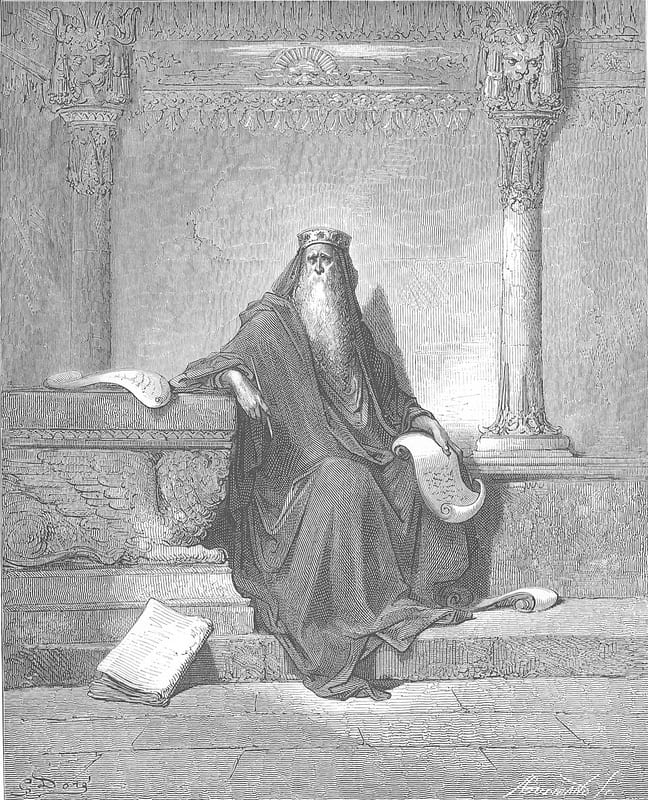
This chapter comes from the book of wisdom that tradition gives to Solomon, the king who built the temple in Jerusalem. It turns first to the house of God and then to the money that fills a king's treasury. It was heard by worshippers who made vows at the sanctuary and by taxpayers who lived under layers of officials. Listen for the counsel on speech before God and for the portrait of a person who can never have enough. The chapter closes on the one kind of wealth it counts as a gift.
Context
- Who
- Worshippers who made vows, and taxpayers under a growing bureaucracy
- What
- Counsel on reverent worship and the keeping of vows, followed by reflections on officials, greed and the gift of enjoyment.
- Where
- The courts of the temple in Jerusalem, and the provinces governed by the king's officials.
- When
- Late in the reign of Solomon, about 940 BC, on the traditional reading; many date the book's Hebrew to the Persian period, so the date is held with less certainty than the setting.
- Why
- To teach reverence and few words before God, and to expose the restlessness that the love of money brings.
Historical context
"Keep thy foot when thou goest to the house of God." Worshippers entered the temple courts barefoot or with washed feet, and the phrase means watch your step in the most literal way. "Be more ready to hear, than to give the sacrifice of fools" ranks listening above the offering, in a building whose entire daily business was offerings.
Show the rest of the historical context, 4 more paragraphs
The vow warning is legal. Under the Law a vow was binding once spoken; a man could dedicate an animal, a sum, or a period of service, and the sanctuary could hold him to it and set a redemption price. "Neither say thou before the angel, that it was an error" describes a man trying to talk his way out in front of the temple official who has come to collect.
"If thou seest the oppression of the poor… marvel not at the matter: for he that is higher than the highest regardeth." The picture is a chain of officials, each one watching and taxing the one below, which is exactly how ancient provincial administration worked, governors over districts, officers under them, each taking a cut.
"The profit of the earth is for all: the king himself is served by the field." No matter how many layers of officials there are, the food comes out of the ground. That is a farmer's sentence in a king's book.
"The sleep of a labouring man is sweet, whether he eat little or much: but the abundance of the rich will not suffer him to sleep." A man working in a field all day slept hard on a mat. A man with stored wealth in a house without locks or banks lay awake thinking about it.
Significance
"God is in heaven, and thou upon earth: therefore let thy words be few." First hearers surrounded by elaborate religious talk were being told that the correct posture in the temple was mostly silence.
Show the rest of the significance, 1 more paragraph
And the closing image, a man leaving the world exactly as naked as he came into it, carrying nothing of his labour in his hand, was aimed at a generation accumulating faster than any before it.
This chapter in Jewish lifeWhat this chapter is in Jewish life and reading.
What is done
This chapter is heard aloud once a year, when the whole book is read at Sukkot on the Sabbath that falls in the festival week. The site's own table in src/lib/hebraic/readings.ts records that reading and sources it to Tractate Soferim 14:3; it printed parashot total 0 and haftarah uses total 0 for this book.
The practice the chapter touches is the vow. Rashi reads the fool in whom God has no pleasure as "the wicked who vow and do not pay" (Rashi on Ecclesiastes 5:3:1). The mouth that must not bring guilt on the flesh is the mouth that utters a vow, and the guilt falls on the children (Rashi on Ecclesiastes 5:5:1 and 5:5:2). The corpus carries Chullin 2a:6 and Ein Yaakov, Khullin 1:1 on the fourth verse, and Midrash Lekach Tov, Deuteronomy 23:23:1 on the third. The corpus numbers this chapter by the Hebrew text, which runs it to a nineteenth verse, so a reader counting in an English Bible may land one verse away.
How it is read
Rashi is the one commentator on this chapter whose English the corpus carries, quoted here from The Metsudah Five Megillot, Lakewood, N.J., 2001, which Sefaria reports as CC-BY. Every quotation is held to fifty words or fewer because the translation is modern, and the edition's own notes are never quoted as his.
The chapter opens on speech before God, and Rashi reads it as a warning against complaint. To utter a word before God is "To speak critically toward [God] above" (Rashi on Ecclesiastes 5:1:1). God in heaven and man on earth he turns into an argument from the lesser to the greater. Even when the weak stands above and the strong below, the strong fears the weak, and how much more when the Strong One is above (Rashi on Ecclesiastes 5:1:2). A dream comes from the many thoughts of the day, and the fool's speech from many words, "for transgression is inevitable" (Rashi on Ecclesiastes 5:2:1).
The oppression of the poor in the province Rashi restates in plain words (Rashi on Ecclesiastes 5:7:1). The height of the earth's dwellers who provoke God is met by His messengers, "even through gnats, as He did to Titus" (Rashi on Ecclesiastes 5:8:1).
Rashi turns the verses on money toward the commandments. "Whoever loves [to perform God’s] commandments never has his fill of them" (Rashi on Ecclesiastes 5:9:1). The increase of goods is Israel improving its deeds (Rashi on Ecclesiastes 5:10:1). The labourer's sweet sleep he gives in its plain sense, the tiller of the soil who sleeps well "whether he eats little or a lot" (Rashi on Ecclesiastes 5:11:1). The riches kept to their owner's hurt are "Like the wealth of Korach, because of which he became haughty and descended into the grave" (Rashi on Ecclesiastes 5:12:1). The man who goes out with nothing in his hand has "Not even the merit of his ancestors" (Rashi on Ecclesiastes 5:13:1). At his death he takes no merit of charity with him (Rashi on Ecclesiastes 5:14:1).
The eating and drinking of the seventeenth verse Rashi reads as study. It means "To engage in Torah [study]", which he calls a good doctrine. A man should not heap up wealth, "rather he should rejoice with the portion given him, for that is his portion" (Rashi on Ecclesiastes 5:17:1).
The corpus carries four further notes on this chapter without an English text, each marked linked because Sefaria holds no English version of the ref. Three stand at Ibn Ezra on Ecclesiastes 5:2:1, 5:3:1 and 5:4:1, and one at Metzudat David on Ecclesiastes 5:4:1, cited by ref alone.
What the rabbis say
The corpus carries forty rabbinic locators on this chapter and the text of none, so each is cited and linked here rather than quoted. On the first verse, the word spoken before God, it holds Aggadat Bereshit 65:1, Berakhot 61a:2 and Kohelet Rabbah 4:17:1. On the second, the dream and the fool's voice, it holds Bereshit Rabbah 89:3, Kohelet Rabbah 5:2:1 and Midrash Lekach Tov on Ecclesiastes 5:2:1. On the third it holds Midrash Lekach Tov on Ecclesiastes 5:3:1 and Midrash Lekach Tov, Deuteronomy 23:23:1. On the fourth, the vow unpaid, it holds Chullin 2a:6 and Ein Yaakov, Khullin 1:1. On the fifth it holds Bamidbar Rabbah 10:2 and Chagigah 15a:5, and on the sixth Berakhot 10b:1 and Kohelet Rabbah 5:6:1.
The province and its rulers carry the next run. On the seventh verse the corpus holds Kohelet Rabbah 5:7:1 and Mekhilta DeRabbi Yishmael, Tractate Amalek 2:7. On the eighth it holds Avot DeRabbi Natan, Recension B 16:7 and Kohelet Rabbah 5:8:1. On the ninth, the lover of money, it holds Devarim Rabbah 2:26 and Ein Yaakov (Glick Edition), Makkot 2:3. On the tenth it holds Aggadat Bereshit 42:1 and Bereshit Rabbah 65:13. On the eleventh, the labourer's sleep, it holds Avot DeRabbi Natan, Recension B 41:4 and Ein Yaakov (Glick Edition), Menachot 13:3. On the twelfth, riches kept to their owner's hurt, it holds Bereshit Rabbah 50:11 and Bereshit Rabbati, Parashat Toldot 10.
The man who leaves as he came carries the rest. Kohelet Rabbah and Midrash Lekach Tov on Ecclesiastes stand together under the thirteenth, fourteenth, sixteenth, seventeenth and nineteenth verses, at 5:13:1, 5:14:1, 5:16:1, 5:17:1 and 5:19:1. On the fifteenth the corpus holds Bereshit Rabbah 42:2 and Kohelet Rabbah 1:3:1, and on the eighteenth Kohelet Rabbah 11:5:1 and 5:18:1. What each of them teaches is a saying of the rabbis, and is reported as theirs wherever this site quotes one. The quotations wait on a fetch that carries the text.
Sources: Rashi, Rashi on Ecclesiastes 5:1:1 to 5:19:1, The Metsudah Five Megillot, Lakewood, N.J., 2001, reported CC-BY; Ibn Ezra, Ibn Ezra on Ecclesiastes 5:2:1, 5:3:1 and 5:4:1, cited by ref because the corpus carries no English text; Metzudat David, Metzudat David on Ecclesiastes 5:4:1, cited by ref because the corpus carries no English text; The Sefaria corpus, scripts/data/sources/sefaria/ecclesiastes/5.json, the 40 Talmud and Midrash locators of this chapter; The site's own files, src/lib/hebraic/readings.ts, probed for this book and printing parashot total 0, haftarah uses total 0, and the festival reading at Sukkot on the Sabbath that falls in the festival week, sourced there to Tractate Soferim 14:3.
The heads below are this chapter's scenes. The numbered points under each are its verses.
Keep Thy Foot: Let Thy Words Be Few Before God
Ecclesiastes 5:1-3
Guard your steps when you go to the house of God: The Teacher turns from riches to reverence: Guard your steps when you go to the house of God. He would have the worshiper Draw near to listen. Verse 3 gives the parallel, As a dream comes through many cares, so the speech of a fool comes with many words.
Ecclesiastes 5:1
“WEISS needlessly reads, "Keep thy feast days" (Ex 23:14, 17; the three great feasts). hear--rather, "To be ready (to draw nigh with the desire) to hear (obey) is a better sacrifice than the offering of fools" [HOLDEN]. The warning is against mere ceremonial self-righteousness, as in Ec 7:12. Obedience is the spirit of the law's requirements (De 10:12).”
Jamieson, Fausset & Brown · Commentary Critical and Explanatory on the Whole Bible (1871)reformed
1 more voice on this verseWhat preachers and commentators have said about this verse, in their own words.
Ecclesiastes 5:1
“Keep thy foot - i. e., Give thy mind to what thou art going to do. The house of God - It has been said that here an ordinary devout Hebrew writer might have been expected to call it “the house of Yahweh;” but to those who accept this book as the work of Solomon after his fall into idolatry, it will appear a natural sign of the writer’s self-humiliation, an acknowledgment of his unworthiness of the privileges of a son of the covenant, that he avoids the name of the Lord of the covenant (see Ecc 1:13 note).”
Do not be quick to speak: Wesley and Henry read the hasty word as a rash prayer or vow spoken before God in His house. Heaven and earth mark the distance. Gregory of Nyssa takes that distance as the measure of how far God stands above reasoning, so few words keep the worshiper within his limits.
Ecclesiastes 5:2
"Be not rash with your mouth, and let not your heart be hasty to utter a word before God; for God is in heaven and you are on earth, so let your words be few. For a dream comes from much concern, and foolish talk from many words." Several men think that this teaches here that we should not promise something too quickly in the presence of God, and without due consideration of our strengths we vow things, which we cannot then fulfil.
Jerome · written before 420 · Commentary on Ecclesiastespatristic
1 more voice on this verse
Ecclesiastes 5:2
“This verse illustrates Ec 5:1, as to prayer in the house of God ("before God," Isa 1:12); so Ec 5:4-6 as to vows. The remedy to such vanities is stated (Ec 5:6). "Fear thou God." God is in heaven--Therefore He ought to be approached with carefully weighed words, by thee, a frail creature of earth.”
Jamieson, Fausset & Brown · Commentary Critical and Explanatory on the Whole Bible (1871)reformed
As a dream comes through: Clarke reads the comparison as cause and effect. A mind crowded with cares produces confused dreams, and Jamieson, Fausset and Brown add that words poured without weight in prayer betray a fool's speech. Wesley ties the many words to rash vows, the subject of verses 4 to 6.
Ecclesiastes 5:3
“As much "business," engrossing the mind, gives birth to incoherent "dreams," so many words, uttered inconsiderately in prayer, give birth to and betray "a fool's speech" (Ec 10:14), [HOLDEN and WEISS].”
Jamieson, Fausset & Brown · Commentary Critical and Explanatory on the Whole Bible (1871)reformed
Ecclesiastes 5:4-7
When you make a vow to God: A vow is words too: When you make a vow to God, do not delay in fulfilling it. Gill takes the messenger as likely the priest, and calling the vow a mistake leaves debt standing, so the counsel closes on Therefore, fear God.
Ecclesiastes 5:4
“When thou vowest a vow - When in distress and difficulty, men are apt to promise much to God if he will relieve them; but generally forget the vow when the distress or trouble is gone by.”
Adam Clarke · Commentary on the Bible (1810-1826)evangelical
1 more voice on this verse
Ecclesiastes 5:4
“This will be fulfilled in this way by each one of us. We pray when we renounce this world and promise that being dead to all worldly actions and the life of this world we will serve the Lord with full purpose of heart. We pray when we promise that despising secular honors and scorning earthly riches we will cling to the Lord in all sorrow of heart and humility of spirit.”
John Cassian · written before 435 · CONFERENCE 9:12patristic
It is better not to vow: Clarke holds that a man's life is owed to God, so a vow takes up a particular duty on top of it. The vow a man fails to fulfill is the greater evil. Cassian aims the warning at monks who vow holiness and then do God's work carelessly.
Ecclesiastes 5:5
Better is it that thou shouldest not vow, etc. - We are under constant obligations to live to God; no vow can make it more so. Yet, there may be cases in which we should bind ourselves to take up some particular cross, to perform some particular duty, to forego some particular attachment that does not tend to bring our souls nearer to God. Then, if fully determined, and strong in faith relative to the point, bind and hold fast; but if not fully, rationally, and conscientiously determined, “do not suffer thy mouth to cause thy soul to sin.”
Adam Clarke · Commentary on the Bible (1810-1826)evangelical
do not tell the messenger: Clarke and Wesley take the messenger as the priest who received vows and could release a man from them. Barnes reads a being from heaven who stands for God. Telling him the vow was a mistake adds a sin of the mouth, and Gill counts such excuses as lying.
Ecclesiastes 5:6
"Let not your mouth bring guilt on your flesh, and do not tell the messenger that it was an error. Why should God be angered by your speech and destroy the work of your hands? "What the Hebrew means is that if you are not able to do these things, do not promise to do them. For the words do not transgress to the spirit but are carried at once to the Lord by the angel present, who sticks to one man only as a companion.
Jerome · written before 420 · Commentary on Ecclesiastespatristic
2 more voices on this verse
Ecclesiastes 5:6
“We must take heed that we never vow anything that is sinful, or that may be an occasion of sin, for such a vow is ill-made and must be broken. Suffer not thy mouth, by such a vow, to cause thy flesh to sin, as Herod's rash promise caused him to cut off the head of John the Baptist.”
Matthew Henry · Commentary on the Whole Bible (1707-1721)puritan
Ecclesiastes 5:6
Neither say thou before the angel, that it was an error - Nor think of saying “before the cruel angel, who shall exercise authority over thee in the judgment of the great day, that thou didst it through ignorance.” - Chaldee. I believe by the angel nothing else is intended than the priest, whose business it was to take cognizance of vows and offerings. See Lev 5:4, Lev 5:5. In Mal 2:7, the priest is called the “angel of the Lord of hosts.”
Adam Clarke · Commentary on the Bible (1810-1826)evangelical
as many dreams bring futility: Wesley reads the many words as rash vows, and Jamieson, Fausset and Brown see worship itself turned futile by idle fancy and careless speech. Fear of God is the remedy both name. Clarke applies it to troubling dreams, holding that one who fears God need fear nothing else.
Ecclesiastes 5:7
“God's service, which ought to be our chief good, becomes by "dreams" (foolish fancies as of God's requirements of us in worship), and random "words," positive "vanity." The remedy is, whatever fools may do, "Fear thou God" (Ec 12:13).”
Jamieson, Fausset & Brown · Commentary Critical and Explanatory on the Whole Bible (1871)reformed
He That Loveth Silver Shall Not Be Satisfied With Silver
Ecclesiastes 5:8-9
If you see the oppression of the poor: The Teacher tells the reader who sees the oppression of the poor do not be astonished at the matter. Corruption has a chain of accountability: one official is watched by a superior, and others higher are over them. Verse 9 adds a fact, the king himself profits from the fields.
Ecclesiastes 5:8
“If thou seest the oppression of the poor - For this was a frequent case under all governments; and especially in the provinces or colonies which being far from the seat of government, were generally oppressed by the sovereign’s deputies. Marvel not at the matter - החפץ hachephets, the will, i.e., of God; which permits such evils to take place; for all things shall work together for good to them that love him. “Marvel not Ye righteous, if his dispensations here Unequal seem. What, though disorders reign? He still presides, and with unerring hand Directs the vast machine.”
Adam Clarke · Commentary on the Bible (1810-1826)evangelical
2 more voices on this verse
Ecclesiastes 5:8
“God is higher than the highest of creatures, than the highest of princes, than the king that is higher than Agag ( Num. xxiv. 7 ), than the highest angels, the thrones and dominions of the upper world. God is the Most High over all the earth, and his glory is above the heavens; before him princes are worms, the brightest but glow-worms.”
Matthew Henry · Commentary on the Whole Bible (1707-1721)puritan
Ecclesiastes 5:8
“If God is so exact in even punishing hasty words (Ec 5:1-6), why does He allow gross injustice? In the remote "provinces," the "poor" often had to put themselves for protection from the inroads of Philistines, &c., under chieftains, who oppressed them even in Solomon's reign (1Ki 12:4). the matter--literally, "the pleasure," or purpose (Isa 53:10).”
Jamieson, Fausset & Brown · Commentary Critical and Explanatory on the Whole Bible (1871)reformed
The produce of the earth: Barnes makes the king himself dependent on the field, so an official who crushes the poor with oppression cuts off his own produce. Clarke joins the worker and the king in one bond. Gill records a reading that sets God higher than every king and official of the earth.
Ecclesiastes 5:9
"The profit (produce) of the earth is (ordained) for (the common good of) all: even the king himself is served by (the fruits of) the field" (2Ch 26:10).
Jamieson, Fausset & Brown · Commentary Critical and Explanatory on the Whole Bible (1871)reformed
2 more voices on this verse
Ecclesiastes 5:9
“Moreover, the profit of the earth is for all,.... Or, "the excellency of the earth in" or "above all things is this" (y); that God most high rules over all the earth, and is higher than the kings of it, and all oppressors in it; or in all respects there is a preference, a superior excellency in the country as opposed to the city, especially in this, that there are not so many tumults, riots, and oppressions there; though this is mostly understood of the preference and superior excellency of agriculture, or tillage of the earth.”
Ecclesiastes 5:9
“The king himself is served by the field - Rather, the king is subject to the field, i. e., is dependent on its cultivation. The higher ranks, if they oppress the lower, lose thereby their own means of subsistence.”
Ecclesiastes 5:10-12
He who loves money is never satisfied by money: Three observations state wealth's diminishing returns. He who loves money is never satisfied by money, and When good things increase, so do those who consume them. The worker's sweet sleep stands against the rich man's sleeplessness, for the abundance of the rich man permits him no sleep.
Ecclesiastes 5:10
When they are intent on increasing money, let them hear what is written: "The covetous man is not filled with money, and he that loves riches shall not reap fruit thereof." For indeed he would reap fruit of them, were he minded, not loving them, to disperse them well. But whoever in his affection for them retains them shall surely leave them behind here without fruit. When they burn to be filled at once with all manner of wealth, let them hear what is written: "He that makes haste to be rich shall not be innocent."
Gregory the Dialogist · written before 604 · The Book of Pastoral Rule, Part 3, Chapter 20patristic
2 more voices on this verse
Ecclesiastes 5:10
He that loveth silver shall not be satisfied with silver - The more he gets, the more he would get; for the saying is true: - Crescit amor nummi, quantum ipsa pecunia crescit. “The love of money increases, in proportion as money itself increases.”
Adam Clarke · Commentary on the Bible (1810-1826)evangelical
Ecclesiastes 5:10
“Not only will God punish at last, but meanwhile the oppressive gainers of "silver" find no solid "satisfaction" in it. shall not be satisfied--so the oppressor "eateth his own flesh" (see on Ec 4:1 and Ec 4:5). with increase--is not satisfied with the gain that he makes.”
Jamieson, Fausset & Brown · Commentary Critical and Explanatory on the Whole Bible (1871)reformed
When good things increase: The owner's gain shrinks as his goods grow. Barnes names those who consume them as the laborers and household servants, and Clarke adds that more property brings more expense and more cares. Henry reckons that all beyond food and clothing is held for others, leaving only the sight of it.
Ecclesiastes 5:11
When goods increase - An increase of property always brings an increase of expense, by a multitude of servants; and the owner really possesses no more, and probably enjoys much less, than he did, when every day provided its own bread, and could lay up no store for the next. But if he have more enjoyment, his cares are multiplied; and he has no kind of profit. “This also is vanity.”
Adam Clarke · Commentary on the Bible (1810-1826)evangelical
1 more voice on this verse
Ecclesiastes 5:11
“What we have more than food and raiment we have for others; and then what good is there to the owners themselves, but the pleasure of beholding it with their eyes? And a poor pleasure it is.”
Matthew Henry · Commentary on the Whole Bible (1707-1721)puritan
The sleep of the worker: Barnes takes the worker as anyone who earns his bread, and Gill cites the Targum's reading of one who serves the LORD. Clarke credits the worker's rest to healthy toil and few possessions. Henry names the rich man's trouble as the abundance of his cares, which keeps his eyes open.
Ecclesiastes 5:12
“Ecclesiastes sees that riches are kept for ill by one who possesses them, for their loss causes a very great anxiety and disquiet. Indeed they are lost, for they are left here and can be of no advantage to one who is dead.”
Ambrose of Milan · written before 397 · Interrogation of Job and Davidpatristic
1 more voice on this verse
Ecclesiastes 5:12
“Proofs of God's judgments even in this world (Pr 11:31). The rich oppressor's wealth provokes enemies, robbers, &c. Then, after having kept it for an expected son, he loses it beforehand by misfortune ("by evil travail"), and the son is born to be heir of poverty.”
Jamieson, Fausset & Brown · Commentary Critical and Explanatory on the Whole Bible (1871)reformed
Ecclesiastes 5:13-15
There is a grievous evil I have seen under the sun: The Teacher files a grievous evil: wealth hoarded to the harm of its owner, then lost in a failed venture, so the son inherits nothing. Verse 15 echoes Job 1:21, As a man came from his mother’s womb, so he will depart again, naked as he arrived.
Ecclesiastes 5:13
“Riches kept for the owners thereof to their hurt - This may be the case through various causes: 1. He may make an improper use of them, and lose his health by them. 2. He may join in an unfortunate partnership and lose all. 3. His riches may excite the desire of the robber; and he may spoil him of his goods, and even take away his life. 4. Or, he may leave them to his son, who turns profligate; spends the whole, and ruins both his body and soul. I have seen this again and again.”
Adam Clarke · Commentary on the Bible (1810-1826)evangelical
wealth lost in a failed venture: Barnes reads the failed venture as an adverse accident or a business gone wrong. The lost wealth leaves the son nothing. Henry pictures a father who raised his son to expect an estate and left it so burdened by debt that nothing could pass to him.
Ecclesiastes 5:14
“He that thought he should have made his son a gentleman leaves him a beggar; he begets a son, and brings him up in the prospect of an estate, but, when he dies, leaves it under a charge of debt as much as it is worth, so that there is nothing in his hand. This is a common case; estates that made a great show do not prove what they seemed, but cheat the heir.”
Matthew Henry · Commentary on the Whole Bible (1707-1721)puritan
naked as he arrived: Wesley and Bonaventure place the return in the earth, the mother of every man. His labor stays behind with his wealth, and Clarke says a rich man's millions are dead to him forever. Henry warns of a soul departing as sinful as it came.
Ecclesiastes 5:15
“But sad is our case if the soul return as it came, for we were born in sin, and if we die in sin, unsanctified, we had better never have been born; and that seems to be the case of the worldling here spoken of, for he is said to return in all points as he came, as sinful, as miserable, and much more so.”
Matthew Henry · Commentary on the Whole Bible (1707-1721)puritan
Ecclesiastes 5:16-17
This too is a grievous evil: The case closes on a second evil, Exactly as a man is born, so he will depart, and the Teacher asks What does he gain. The loss runs through the whole life, for all his days he eats in darkness, with much sorrow, sickness, and anger.
Ecclesiastes 5:16
“And this also is a sore evil, that in all points as he came, so shall he go,.... This seems not to be an evil or vanity, distinct from the former; but the same repeated and confirmed, and expressed, if possible, in stronger terms, that a man is in all respects alike, when he goes out of the world, as when he came in.”
he eats in darkness: Gill reads eating as the man's whole manner of life. Wesley finds anxiety at every meal and anger in the sickness that cuts off his plans. Clarke notes several manuscripts that read walks in place of eats, a man walking in darkness with no light from God.
Ecclesiastes 5:17
“All his days also he eateth in darkness - Even his enjoyments are embittered by uncertainty. He fears for his goods; the possibility of being deprived of them fills his heart with anguish. But instead of יאכל yochel, “he shall eat,” ילך yelech, “he shall walk,” is the reading of several MSS. He walks in darkness - he has no evidence of salvation. There is no ray of light from God to penetrate the gloom; and all beyond life is darkness impenetrable!”
Adam Clarke · Commentary on the Bible (1810-1826)evangelical
To Eat, to Drink, to Enjoy the Labor: This Is the Gift of God
Ecclesiastes 5:18-20
Here is what I have seen to be good and fitting: The Teacher states the refrain again: to eat and drink, and to find satisfaction in all the labor one does under the sun is good. The chapter ends on a man who forgets his days because God keeps him occupied with the joy of his heart.
Ecclesiastes 5:18
“Returns to the sentiment (Ec 3:12, 13, 22); translate: "Behold the good which I have seen, and which is becoming" (in a man). which God giveth--namely, both the good of his labor and his life. his portion--legitimately. It is God's gift that makes it so when regarded as such.”
Jamieson, Fausset & Brown · Commentary Critical and Explanatory on the Whole Bible (1871)reformed
2 more voices on this verse
Ecclesiastes 5:18
“Good - Good or comfortable to a man's self, and comely or amiable in the eye of other men. His portion - Of worldly goods; he hath a better portion in heaven. This liberty is given him by God, and this is the best advantage, as to this life, which he can make of them.”
John Wesley · Explanatory Notes upon the Old Testament (1765)evangelical
Ecclesiastes 5:18
“Behold that which I have seen - This is the result of my observations and experience. God gives every man, in the course of his providence, the necessaries of life; and it is his will that he should thankfully use them. For it is his portion - What is requisite for him in the lower world; without them his life cannot subsist, and earthly blessings are as truly the portion of his body and animal life, as the salvation of God is the portion of his soul.”
Adam Clarke · Commentary on the Bible (1810-1826)evangelical
God has given riches and wealth: The gift is double: wealth, and the power to enjoy it. Bonaventure traces both to God, citing Sirach that good things and evil come from the Lord. Didymus notes that a man with abundant food can consume only part of it, so the gift lies in what he enjoys.
a man seldom considers the days: Gill finds contentment here: the man who can enjoy what God has given lets his days pass with little thought of their trouble. Barnes renders the verb as God answering his prayers through the joy of his heart. Henry calls a cheerful spirit a great blessing.
Ecclesiastes 5:20
“He will not remember much, looking back with disappointment, as the ungodly do (Ec 2:11), on the days of his life. answereth . . . in the joy--God answers his prayers in giving him "power" to enjoy his blessings.”
Jamieson, Fausset & Brown · Commentary Critical and Explanatory on the Whole Bible (1871)reformed
2 more voices on this verse
Ecclesiastes 5:20
“For he shall not much remember the days of his life,.... Be they more or fewer, as Jarchi: he will not think life long and tedious; nor dwell upon, and distress himself with, the troubles he has met with, or is likely to meet with; but, being content with the good things God has given him, and freely and cheerfully enjoying them, he passes away his time delightfully and pleasantly.”
Ecclesiastes 5:20
“If he does not answer all his desires and expectations, in the letter of them, yet he answers them with that which is more than equivalent, in the joy of his heart. A cheerful spirit is a great blessing; it makes the yoke of our employments easy and the burden of our afflictions light.”
Matthew Henry · Commentary on the Whole Bible (1707-1721)puritan
Keep studying
Studies6
Sources for this chapter
The summary
Jamieson, Fausset & Brown, Commentary Critical and Explanatory; John Wesley, Notes on the Old Testament and Matthew Henry, Complete Commentary.
The exposition
Adam Clarke, Commentary on the Bible; Albert Barnes, Notes, Explanatory and Practical, on the Old and New Testaments (1832-1869); Bonaventure, Commentary on Ecclesiastes, Chapter 5; Charles Bridges, An Exposition of the Book of Ecclesiastes; Didymus the Blind, COMMENTARY ON ECCLESIASTES 164:1; Gregory of Nyssa, ANSWER TO EUNOMIUS'S SECOND BOOK; Jamieson, Fausset & Brown, Commentary Critical and Explanatory on the Whole Bible; John Cassian, INSTITUTES 4:33; John Gill; John Wesley, Explanatory Notes upon the Old Testament and Matthew Henry, Commentary on the Whole Bible.