
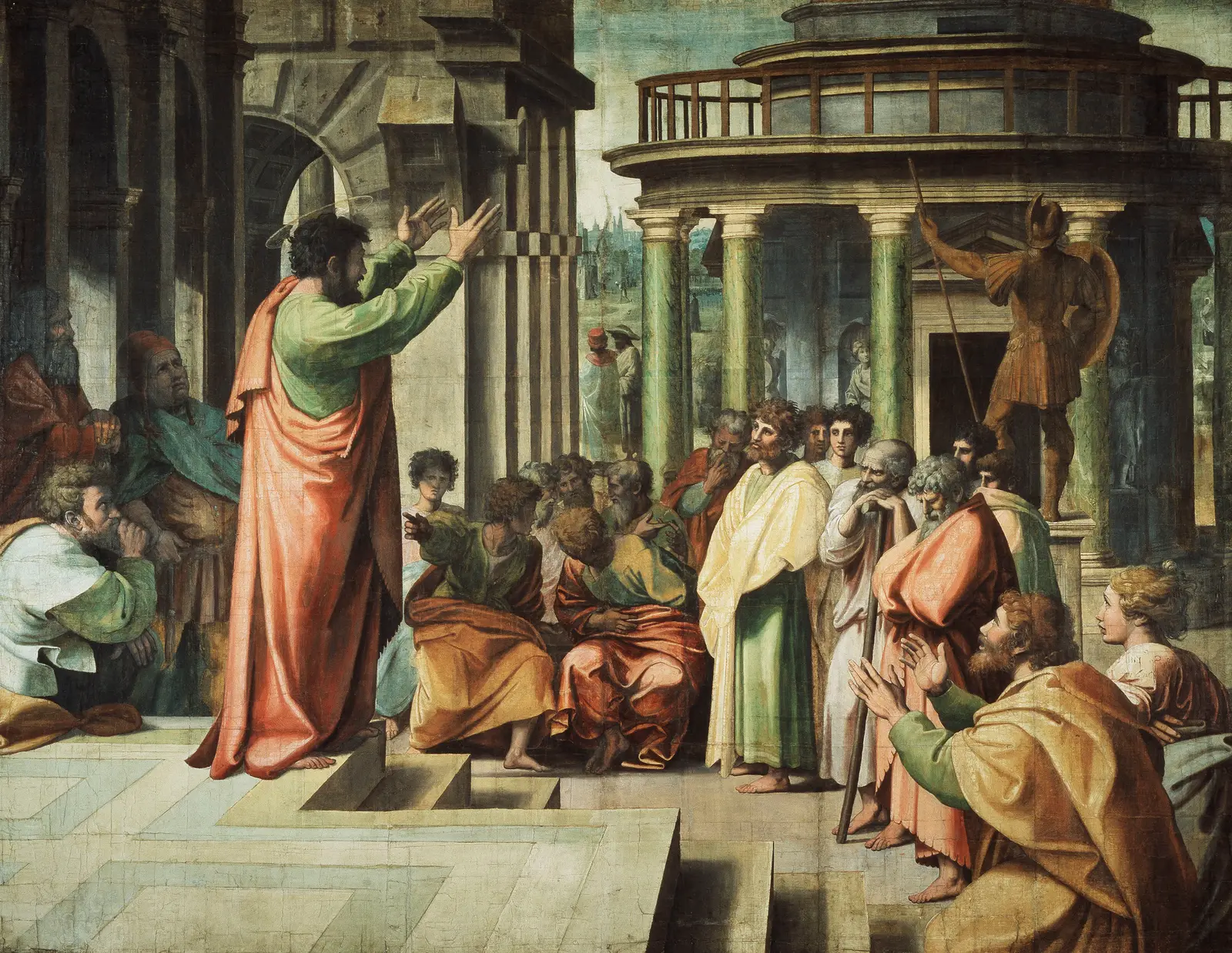
1 Thessalonianschapter 2
20 verses · Paul · AD 50 or 51 · Paul's letters
On the contrary, we were gentle among you, like a nursing mother caring for her children.
Introduction
Paul, Paul's letters, 1 Thessalonians Overview.
This chapter was written to people who were hearing their absent teacher called a fraud. Wandering speakers were common in Greek cities, and many of them preached for money or praise. Paul's answer is to call his hearers as witnesses of what they saw with their own eyes. Listen for how often he says you know. Listen too for the two family pictures he uses of himself, and for the sudden hard words about those who drove him out. The chapter ends with Paul trying, and failing, to get back to them.
Context
- Who
- Converts hearing their absent teacher accused of being one more traveling salesman of religion
- What
- Paul's account of how the missionaries preached and lived in Thessalonica, the church's reception of the word and its suffering, and his thwarted wish to return.
- Where
- Written from Corinth, recalling events in Philippi and Thessalonica in Macedonia.
- When
- About AD 50 to 51, recalling the founding visit of Acts 17:1 to 10 a few months earlier.
- Why
- To answer the suspicion that the missionaries were one more set of paid religious speakers, and to steady the church under persecution.
Historical context
Traveling speakers were a familiar sight in Greek cities. Some were street philosophers who begged, some were hired lecturers who charged well, and some were priests of foreign cults collecting for a shrine. All of them worked a crowd and all of them wanted money, so a stranger who preached was assumed to be after something.
Show the rest of the historical context, 3 more paragraphs
Paul's answer was his hands. He worked a leather and tent trade, the sort of job done in a rented front-room workshop that opened onto the street. Craftsmen started before dawn and talked while they worked, so the shop bench was itself a place to preach, and manual labor was exactly the thing respectable teachers refused to do.
The nurse picture in this chapter came from ordinary life. Wet-nurse contracts survive on Egyptian papyrus, spelling out how long a woman would feed and care for a child. A hired nurse fed someone else's baby; the point of the comparison is a nurse caring for her own.
The trouble in the city had been legal as well as social. The charge shouted before the politarchs was that these men proclaimed another king, which in a loyal free city was the most dangerous accusation that could be made.
Significance
The hearers were being asked, by neighbors and probably by relatives, why they had trusted a man who ran. Paul answers with things they could check themselves: they watched him work, they knew he took no fee, they knew whose door he ate at.
Show the rest of the significance, 1 more paragraph
Then he tells them their suffering is not a sign that they picked wrong. The churches in Judea had been through the same thing first. Being hurt by your own townsfolk put them in company, not out of it.
The heads below are this chapter's scenes. The numbered points under each are its verses.
No Flattery, No Greed: Gentle as a Nurse, Firm as a Father
1 Thessalonians 2:1-2
our visit to you was not in vain: The visit opened in suffering and shameful treatment in Philippi, the flogging and jail of Acts 16. Yet the missionaries were bold in our God to speak to you the gospel of God in the face of strong opposition.
1 Thessalonians 2:1
I beg you, in all this recall to your mind what I believe you must never forget: "All who would live godly in Christ suffer persecution." And with regard to this I confidently say that you would live less godly if you suffered less persecution. For let us hear what else the same teacher of the Gentiles says to his disciples. "You yourselves know, brothers, how we came to you; we did not come in vain, for we had already suffered and been shamefully treated."
Gregory the Dialogist · written before 604 · Register of Epistles, Book 7, Epistle 30patristic
1 more voice on this verseWhat preachers and commentators have said about this verse, in their own words.
1 Thessalonians 2:1
“The Greek for "was," expresses rather "hath been and is," implying the permanent and continuing character of his preaching.”
Jamieson, Fausset & Brown · Commentary Critical and Explanatory on the Whole Bible (1871)reformed
we were bold in our God: Strong opposition renders agon, the word for a contest in the games, and Jamieson, Fausset and Brown take it here as conflict with persecutors. The boldness had its ground in our God. Theophylact of Ohrid notes that Paul again credits the courage to God alone.
1 Thessalonians 2:2
“Shamefully entreated - at Philippi - There Paul and Silas had been beaten with many stripes, shut up in the inner prison, and their feet made fast in the stocks. See Act 16:23, etc.; and the notes there. With much contention - The words εν πολλῳ αγωνι not only signify, with intense labor and earnestness, but may here mean, exposed to the greatest danger; at the peril of our lives. The Greek phrase quoted by Rosenmuller is to the point, αγων προφασιν ουκ αναμενει, in danger we must not delay - activity and despatch are then indispensably necessary.”
Adam Clarke · Commentary on the Bible (1810-1826)evangelical
1 more voice on this verse
1 Thessalonians 2:2
“The gospel of Christ, at its first setting out in the world, met with much opposition; and those who preached it preached it with contention, with great agony, which denoted either the apostles' striving in their preaching or their striving against the opposition they met with. This was Paul's comfort; he was neither daunted in his work, nor driven from it.”
Matthew Henry · Commentary on the Whole Bible (1707-1721)puritan
1 Thessalonians 2:3-4
our appeal does not arise from deceit: The apostles clear themselves of three charges that pagan preachers on the make often earned: deceit or ulterior motives or trickery. Approval was itself a trust, approved by God to be entrusted with the gospel, so the aim runs opposite to a crowd pleaser's.
1 Thessalonians 2:3
“For our exhortation - That is, the exhortation to embrace the gospel. The word seems to be used here so as to include preaching in general. The sense is, that the means which they used to induce them to become Christians were not such as to delude them. Was not of deceit - Was not founded on sophistry. The apostle means to say, that the Thessalonians knew that his manner of preaching was not such as was adopted by the advocates of error. Nor of uncleanness - Not such as to lead to an impure life.”
2 more voices on this verse
1 Thessalonians 2:3
“It was the sincere and uncorrupted gospel that he preached and exhorted them to believe and obey. His design was not to set up a faction, to draw men over to a party, but to promote pure religion and undefiled before God and the Father. The gospel he preached was without deceit, it was true and faithful; it was not fallacious, nor a cunningly-devised fable.”
Matthew Henry · Commentary on the Whole Bible (1707-1721)puritan
1 Thessalonians 2:3
“So Simon Magus and Cerinthus taught [ESTIUS]. exhortation--The Greek means "consolation" as well as "exhortation." The same Gospel which exhorts comforts. Its first lesson to each is that of peace in believing amidst outward and inward sorrows.”
Jamieson, Fausset & Brown · Commentary Critical and Explanatory on the Whole Bible (1871)reformed
approved by God to be entrusted with the gospel: Approved and examines translate one Greek verb, dokimazo, and Jamieson, Fausset and Brown tie the two together. God tested the men before He trusted them with the gospel, and He still tests their hearts. Matthew Henry calls them stewards, who must be found faithful.
1 Thessalonians 2:4
“But as we were allowed of God - Καθως δεδοκιμασμεθα· As we were accounted worthy to be put in trust - as God put confidence in us, and sent us on his most especial message to mankind, even so we speak, keeping the dignity of our high calling continually in view; and, acting as in the sight of God, we speak not to please or flatter men, though our doctrine is the most consolatory that can be conceived, but to please that God who searcheth the heart, and before whom all our motives are constantly without a veil.”
Adam Clarke · Commentary on the Bible (1810-1826)evangelical
1 more voice on this verse
1 Thessalonians 2:4
“They were stewards, put in trust with the gospel: and it is required of a steward that he be faithful. The gospel which Paul preached was not his own, but the gospel of God.”
Matthew Henry · Commentary on the Whole Bible (1707-1721)puritan
1 Thessalonians 2:5-6
we never used words of flattery: Two more charges fall, words of flattery and any pretext for greed. Greed was the danger of a traveling teacher living off a young church's purse. Verse 6 adds a right to support they held as apostles of Christ and left unused.
1 Thessalonians 2:5
“It therefore follows, that every one of those who undertake to promote the good of their neighbours, ought to consider whether he has betaken himself to teaching rashly and out of rivalry to any; if his communication of the word is out of vainglory; if the only reward he reaps is the salvation of those who hear, and if he speaks not in order to win favour: if so, he who speaks by writings escapes the reproach of mercenary motives. "For neither at any time used we flattering words, as ye know," says the apostle, "nor a cloak of covetousness.”
Clement of Alexandria · written before 215 · The Stromata Book 1patristic
2 more voices on this verse
1 Thessalonians 2:5
“For neither at any time used we flattering words - see the Job 31:21-22 notes; and on 2Co 2:17 note. The word here rendered “flattering” - κολακείας kolakeias - occurs nowhere else in the New Testament. The meaning is, that the apostle did not deal in the language of adulation; he did not praise them for their beauty, wealth, talent, or accomplishments, and conceal from them the painful truths about their guilt and danger.”
1 Thessalonians 2:5
“He and his fellow-labourers preached Christ and him crucified, and did not aim to gain an interest in men's affections for themselves, by glorying, and fawning and wheedling them. No, he was far from this; nor did he flatter men in their sins; nor tell them, if they would be of his party, they might live as they listed.”
Matthew Henry · Commentary on the Whole Bible (1707-1721)puritan
as apostles of Christ we had authority: Authority to demand it can mean the right to be kept at the church's cost, which is how Adam Clarke reads it. Theophylact of Ohrid hears honor in it, since a king's envoys were received with honor. Either way, the right went unused.
1 Thessalonians 2:6
“Literally, "Nor of men (have we been found, 1Th 2:5) seeking glory." The "of" here represents a different Greek word from "of" in the clause "of you . . . of others." ALFORD makes the former (Greek, "ex") express the abstract ground of the glory; the latter (apo) the concrete object from which it was to come.”
Jamieson, Fausset & Brown · Commentary Critical and Explanatory on the Whole Bible (1871)reformed
1 more voice on this verse
1 Thessalonians 2:6
“Nor of men sought we glory - As we preached not for worldly gain, so we preached not for popular applause; we had what we sought for-the approbation of God, and the testimony of a good conscience. When we might have been burdensome - They had a right to their maintenance while they devoted themselves wholly to the work of the Gospel for the sake of the people’s souls.”
Adam Clarke · Commentary on the Bible (1810-1826)evangelical
1 Thessalonians 2:7-8
we were gentle among you: The register turns from courtroom to nursery: we were gentle among you, like a nursing mother caring for her children. The gift matches the feeling, the gospel of God and our own lives as well.
1 Thessalonians 2:7
“But we were gentle among you - Instead of using authority, we used only the most kind and gentle methods to win you and to promote your peace and order. The word here rendered “nurse,” may mean any one who nurses a child, whether a mother or another person. It seems here to refer to a mother (compare 1Th 2:11), and the idea is, that the apostle felt for them the affectionate solicitude which a mother does for the child at her breast.”
2 more voices on this verse
1 Thessalonians 2:7
Then it is right to notice, with respect to the appellation of infant (νήπιον), that it is not predicated of the silly: and νήπιος is νεήπιος (since he that is tender-hearted is called ἤπιος), as being one that has newly become gentle and meek in conduct. This the blessed Paul most clearly pointed out when he said, "When we might have been burdensome as the apostles of Christ, we were gentle (ἤπιοι) among you, as a nurse cherisheth her children."
Clement of Alexandria · written before 215 · The Instructor Book 1patristic
1 Thessalonians 2:7
“But we were gentle among you,.... Meek and humble, mild and moderate; not using severity, or carrying it in a haughty imperious manner; assuming power and dominion, lording it over God's heritage, and commanding persons to do homage and honour to them, and forcing themselves upon them, and obliging them to maintain them.”
We cared so deeply: renders a rare Greek word, homeiromenoi, which Theophylact of Ohrid explains as being joined to someone and caring for him. Our own lives means readiness to die for them. Thomas Aquinas sets the line beside John 10:11, where the good shepherd lays down his life.
1 Thessalonians 2:8
“Being affectionately desirous of you - We had such intense love for you that we were not only willing and forward to preach the unsearchable riches of Christ to you, but also to give our own lives for your sake, because ye were dear, διοτι αγαπητοι ἡμιν, because ye were beloved by us. The words used here by the apostle are expressive of the strongest affection and attachment.”
Adam Clarke · Commentary on the Bible (1810-1826)evangelical
1 more voice on this verse
1 Thessalonians 2:8
“The apostle had a most affectionate love to their persons, and sought them, not theirs; themselves, not their goods; and to gain them, not to be a gainer by them, or to make a merchandise of them: it was their spiritual and eternal welfare and salvation that he was earnestly desirous of.”
Matthew Henry · Commentary on the Whole Bible (1707-1721)puritan
1 Thessalonians 2:9-10
our labor and toil: The pair our labor and toil names work and its weariness, spelled out as tentmaking beside preaching night and day. The aim was that the church would carry no charge for the gospel of God it received.
1 Thessalonians 2:9
“I would translate, "weariness (so the Greek is translated, 2Co 11:27) and travail" (hard labor, toil). for--omitted in the oldest manuscripts. labouring--Greek, "working," namely, at tent-making (Ac 18:3). night and day--The Jews reckoned the day from sunset to sunset, so that "night" is put before "day" (compare Ac 20:31).”
Jamieson, Fausset & Brown · Commentary Critical and Explanatory on the Whole Bible (1871)reformed
1 more voice on this verse
1 Thessalonians 2:9
“Ye remember, brethren, our labour - Doubtless in the occupation of a tent-maker; Act 20:34 note; 1Co 4:12 note. And travail - see the notes on 2Co 11:27. The word means “wearisome labor.” For labouring night and day - That is, when he was not engaged in preaching the gospel. He appears to have labored through the week and to have preached on the Sabbath; or if engaged in preaching in the day time during the week, he made it up by night labor.”
You are witnesses, and so is God: Two witnesses are called because each sees a different part. The church saw the conduct, and God saw the motives behind it, as Jamieson, Fausset and Brown and Matthew Henry read the pair. Among you who believed may mean in the eyes of believers, who judged the missionaries most closely.
1 Thessalonians 2:10
“Ye are witnesses, and God also,.... Not so much to what goes before as to what follows after, relating to their holy walk and conversation among them, the more open part of which they were witness of; and for the more secret part God is appealed to, who is acquainted with the springs of actions, as well as with actions themselves: how holily, and justly, and unblamably we behaved ourselves among you that believe.”
2 more voices on this verse
1 Thessalonians 2:10
“Ye are witnesses, and God also, how holily - i.e., in reference to God; how justly in reference to men; and unblamably in reference to our spirit and conduct, as ministers of Christ, we behaved ourselves among you. What a consciousness of his own integrity must St. Paul have had to use the expressions that are here! No hypocrite, and none who did the work of the Lord carelessly, could make such an appeal both to God and man.”
Adam Clarke · Commentary on the Bible (1810-1826)evangelical
1 Thessalonians 2:10
“Ye are witnesses--as to our outward conduct. God--as to our inner motives. holily--towards God. justly--towards men. unblamably--in relation to ourselves. behaved ourselves--Greek, "were made to be," namely, by God. among you that believe--rather, "before (that is, in the eyes of) you that believe"; whatever we may have seemed in the eyes of the unbelieving.”
Jamieson, Fausset & Brown · Commentary Critical and Explanatory on the Whole Bible (1871)reformed
1 Thessalonians 2:11-12
as a father treats his own children—: The nursing mother of verse 7 is joined by a father: we treated each of you as a father treats his own children. Each of you makes the care personal, given one by one.
1 Thessalonians 2:11
The minister, if he would be useful, must not deal merely in generalities, but must individualize and particularize. as a father--with mild gravity. The Greek is, "his own children."
Jamieson, Fausset & Brown · Commentary Critical and Explanatory on the Whole Bible (1871)reformed
1 more voice on this verse
1 Thessalonians 2:11
“How we exhorted - That is, to a holy life. And comforted - In the times of affliction. And charged - Greek, “testified.” The word testify is used here in the sense of protesting, or making an earnest and solemn appeal.”
who calls you into His own kingdom and glory: Calls is present tense, the reading of some of the oldest manuscripts where others read called, as Jamieson, Fausset and Brown record. The call is still sounding while they walk. Matthew Henry reads kingdom and glory as grace now and glory hereafter, the way and its end.
1 Thessalonians 2:12
“That ye would walk worthy of God - That they should, in every respect, act up to their high calling, that it would not be a reproach to the God of holiness to acknowledge them as his sons and daughters. See the notes on Eph 4:1; Php 1:27 (note); and Col 1:10 (note). His Kingdom and glory - His Church here, for that is the kingdom of God among men; and his glory hereafter, for that is the state to which the dispensations of grace in his Church lead.”
Adam Clarke · Commentary on the Bible (1810-1826)evangelical
1 more voice on this verse
1 Thessalonians 2:12
“What is our great gospel privilege--that God has called us to his kingdom and glory. The gospel calls us into the kingdom and state of grace here and unto the kingdom and state of glory hereafter, to heaven and happiness as our end and to holiness as the way to that end.”
Matthew Henry · Commentary on the Whole Bible (1707-1721)puritan
You Took It as the Word of God, and It Cost You
when you received the word of God: The verse claims divine authorship for the apostolic preaching: you accepted it not as the word of men, but as the true word of God. The mark of true reception is the word which is now at work in you who believe.
1 Thessalonians 2:13
“For this cause also thank we God - In addition to the reasons for thankfulness already suggested, the apostle here refers to the fact that they received the truth, when it was preached, in such a way as to show that they fully believed it to be the word of God. Not as the word of men - Not of human origin, but as a divine revelation. You were not led to embrace it by human reasoning, or the mere arts of persuasion, or from personal respect for others, but by your conviction that it was a revelation from God.”
1 more voice on this verse
1 Thessalonians 2:13
“This converts their souls, and enlightens their minds, and rejoices their hearts ( Ps. xix. ); and such as have this inward testimony of the truth of the scriptures, the word of God, by the effectual operations thereof on their hearts, have the best evidence of their divine original to themselves, though this is not sufficient to convince others who are strangers thereto.”
Matthew Henry · Commentary on the Whole Bible (1707-1721)puritan
you, brothers, became imitators of the churches of God: This young Gentile church became imitators of the churches of God in Judea, and the parallel is suffering itself. The phrase your own countrymen narrows the coming charge to a particular persecuting party, a distinction verses 15 and 16 keep.
1 Thessalonians 2:14
“Note, The cross is the Christian's mark: if we are called to suffer we are called only to be followers of the churches of God; so persecuted they the prophets that were before you, Matt. v. 12 . It is a good effect of the gospel when we are enabled to suffer for its sake. The apostle mentions the sufferings of the churches of God, which in Judea were in Christ Jesus.”
Matthew Henry · Commentary on the Whole Bible (1707-1721)puritan
2 more voices on this verse
1 Thessalonians 2:14
“Ye - became followers of the Churches of God - There is not a word here of the Church of Rome being the model after which the other Churches were to be formed; it had no such pre-eminence: this honor belonged to the Churches of Judea; it was according to them, not the Church at Rome, that the Asiatic Churches were modelled. The purest of all the apostolic Churches was that of the Thessalonians, and this was formed after the Christian Churches in Judea.”
Adam Clarke · Commentary on the Bible (1810-1826)evangelical
1 Thessalonians 2:14
“Ye suffered the same things - The same fruit, the same afflictions, and the same experience, at all times, and in all places, are an excellent criterion of evangelical truth.”
John Wesley · Explanatory Notes upon the New Testament (1755)evangelical
who killed both the Lord Jesus: Paul writes as an Israelite of his own kinsmen, with the grief he states at Romans 9:1-5. The words who killed both the Lord Jesus and their own prophets name the Judean rulers behind the cross.
1 Thessalonians 2:15
“Who hath killed the Lord Jesus, etc. - What a finished but just character is this of the Jews! 1. They slew the Lord Jesus, through the most unprincipled and fell malice. 2. They killed their own prophets; there was no time in which the seed of the serpent did not hate and oppose spiritual things, they slew even their own prophets who declared to them the will of God. 3. They persecuted the apostles; showing the same spirit of enmity to the Gospel which they had shown to the law. 4.”
Adam Clarke · Commentary on the Bible (1810-1826)evangelical
4 more voices on this verse
1 Thessalonians 2:15
"Who both killed the Lord," he says-but, perhaps, they did not know Him,-assuredly they did know Him. What then? Did they not slay and stone their own prophets, whose books even they carry about with them? And they did not do this for the sake of truth. There is therefore not only a consolation under the temptations, but they are reminded not to think that (the Jews) did it for the truth's sake, and be troubled on that account. "And drave out us," he says. And we also, he says, have suffered numberless evils.
John Chrysostom · written before 407 · Homily on 1 Thessalonians 3patristic
1 Thessalonians 2:15
“They please not God - Nor are they even careful to please him, notwithstanding their fair professions. And are contrary to all men - Are common enemies of mankind; not only by their continual seditions and insurrections, and by their utter contempt of all other nations; but in particular, by their endeavouring to hinder their hearing or receiving the gospel.”
John Wesley · Explanatory Notes upon the New Testament (1755)evangelical
1 Thessalonians 2:15
“Who both killed the Lord Jesus - see the notes on Act 2:23. The meaning here is, that it was characteristic of the Jews to be engaged in the work of persecution, and that they should not regard it as strange that they who had put their own Messiah to death, and slain the prophets, should now be found persecuting the true children of God. And their own prophets - see the Mat 21:33-40; 23:29-37 notes; Act 7:52 note. And have persecuted us - As at Iconium Act 14:1, Derbe, and Lystra Act 14:6, and at Philippi, Thessalonica, and Berea.”
1 Thessalonians 2:15
“Even in brief works there is much pungency? The Jews had slain their prophets. I may ask, What has this to do with the apostle of the rival god, one so amiable withal, who could hardly be said to condemn even the failings of his own people; and who, moreover, has himself some hand in making away with the same prophets whom he is destroying? What injury did Israel commit against him in slaying those whom he too has reprobated, since he was the first to pass a hostile sentence on them? But Israel sinned against their own God.”
Tertullian · written before 220 · Against Marcion Book Vpatristic
hindering us from telling the Gentiles: The offense named is hindering us from telling the Gentiles how they may be saved. It was the synagogue opposition that followed Paul from Pisidian Antioch on. To heap up their sins to full capacity echoes the measure of iniquity of Genesis 15:16.
1 Thessalonians 2:16
“Forbidding--Greek, "Hindering us from speaking," &c. to fill up their sins alway--Tending thus "to the filling up (the full measure of, Ge 15:16; Mt 23:32) their sins at all times," that is, now as at all former times.”
Jamieson, Fausset & Brown · Commentary Critical and Explanatory on the Whole Bible (1871)reformed
1 more voice on this verse
1 Thessalonians 2:16
“Forbidding us to speak to the Gentiles - see Act 17:5, Act 17:13. No particular instance is mentioned in the life of Paul previous to this, when they had formally commanded him not to preach to the pagan, but no one can doubt that this was one of the leading points of difference between him and them.”
Torn Away: You Are Our Crown of Rejoicing
1 Thessalonians 2:17-18
we were torn away from you: The verb torn away speaks of being orphaned, the missionaries bereft of the church. The wish to return failed, and verse 18 names why: I, Paul, tried again and again, but Satan obstructed us.
1 Thessalonians 2:17
“Such was the rage of his persecutors. He was unwillingly sent away by night to Berea, Acts xvii. Though he was absent in body, yet he was present in heart.”
Matthew Henry · Commentary on the Whole Bible (1707-1721)puritan
2 more voices on this verse
1 Thessalonians 2:17
“He does not hereby, as many explain, anticipate a short separation from them, which would be a false anticipation; for he did not soon revisit them. The Greek past participle also forbids their view.”
Jamieson, Fausset & Brown · Commentary Critical and Explanatory on the Whole Bible (1871)reformed
1 Thessalonians 2:17
“But we, brethren, being taken from you - There is more implied in the Greek word here rendered, “being taken from you “ - ἀπορφανισθέντες aporphanisthentes - than appears from our translation. It properly has relation to the condition of an orphan (compare notes on Joh 14:18), or one who is bereaved of parents, or one who is bereaved of parents}.”
Satan obstructed us: Obstructed renders a military verb, which Jamieson, Fausset and Brown explain as cutting a trench across an advancing enemy's road. Adam Clarke takes the hinderer to be the devil or men acting for him. Theophylact of Ohrid sets the verse beside Acts 16:6, where the Spirit stops the team.
1 Thessalonians 2:18
“Wherefore we would have come unto you,.... They not only had a will, and purposed in themselves, and entered into some resolutions to come unto them, but endeavoured to put them into execution: even I Paul: as well as Silas and Timothy; the latter of which had been with them, and the others had as good a will, and especially Paul: and that once and again: or "once and twice" so the Jews used (h) to speak פעם ראשונה ושנייח, "one time and a second"; that is, several times: but Satan hindered us.”
2 more voices on this verse
1 Thessalonians 2:18
“Even I Paul - He had already sent Timothy and Silas to them; but he himself was anxious to see them, and had purposed this once and again, but Satan hindered; i.e., some adversary, as the word means, whether the devil himself, or some of his children. There was, however, such a storm of persecution raised up against him, that his friends did not think it prudent to permit him to go till the storm had been somewhat allayed.”
Adam Clarke · Commentary on the Bible (1810-1826)evangelical
1 Thessalonians 2:18
“The Greek for "hindered" is literally, "to cut a trench between one's self and an advancing foe, to prevent his progress"; so Satan opposing the progress of the missionaries.”
Jamieson, Fausset & Brown · Commentary Critical and Explanatory on the Whole Bible (1871)reformed
1 Thessalonians 2:19-20
who is our hope, our joy, our crown of boasting: The question who is our hope, our joy, our crown of boasting is answered by the church itself. The crown draws on the victor's wreath, and verse 20 states it in the present, our glory and our joy.
1 Thessalonians 2:19
“For what is our hope - That is, “I had a strong desire to see you; to assist you; to enjoy your friendship; for you are my hope and joy, and my absence does not arise from a want of affection.” The meaning, when he says that they were his “hope,” is, that their conversion and salvation was one of the grounds of his hope of future blessedness. It was an evidence that he was a faithful servant of God, and that he would be rewarded in heaven. Or joy - The source of joy here and in heaven.”
1 more voice on this verse
1 Thessalonians 2:19
“And further, when he shall come, all must appear in his presence, or before him. Ministers and people must all appear before him, and faithful people will be the glory and joy of faithful ministers in that great and glorious day.”
Matthew Henry · Commentary on the Whole Bible (1707-1721)puritan
our glory and our joy: The present tense answers verse 19. Adam Clarke calls the church the seal of Paul's apostleship, the proof that God had sent him. Jamieson, Fausset and Brown read the repetition as emphasis: the joy of that coming day is already theirs.
1 Thessalonians 2:20
“For ye are our glory and joy - Ye are the seal of our apostleship; your conversion and steadiness are a full proof that God hath sent us. Converts to Christ are our ornaments; persevering believers, our joy in the day of judgment. 1. In the preceding chapter we have the character and marks of a genuine pastor laid down in such a manner as not to be misunderstood. Every man who preaches the Gospel should carefully read this chapter and examine himself by it.”
Adam Clarke · Commentary on the Bible (1810-1826)evangelical
1 more voice on this verse
1 Thessalonians 2:20
“Emphatical repetition with increased force. Who but ye and our other converts are our hope, &c., hereafter, at Christ's coming? For it is ye who ARE now our glory and joy.”
Jamieson, Fausset & Brown · Commentary Critical and Explanatory on the Whole Bible (1871)reformed
How this psalm is built
The form: A defense of the missionaries' conduct, proved from what the hearers themselves saw, as 2 classes it.
The patterns in this chapter
| Device | What it does | Where to see it |
|---|---|---|
| You know, you recall, you are witnesses | Six times in eleven verses Paul appeals to what his hearers already know, at verses 1, 2, 5, 9, 10 and 11 in the Berean text. The site's published exposition of verses 9 and 10 marks the same appeal running through the chapter. The defense rests on their own memory.This site's published exposition of 1 Thessalonians 2:9 to 10, The exposition_notes row on 1 Thessalonians 2:9 to 10, citing Albert Barnes, Notes on the New Testament, and John Gill, Exposition of the New Testament. | 1 Thessalonians 2:1, 1 Thessalonians 2:5, 1 Thessalonians 2:9, 1 Thessalonians 2:10, 1 Thessalonians 2:11 |
| A nursing mother, then a father | Verse 7 compares the missionaries to a nursing mother caring for her own children, and verse 11 to a father with his children. Theophylact of Ohrid marks the move from the one picture to the other, the nurse's care first and then the father's exhortation.Theophylact of Ohrid, Commentary on 1 Thessalonians, on 1 Thessalonians 2:11 to 12. | 1 Thessalonians 2:7, 1 Thessalonians 2:11 |
| Imitators again | Verse 14 repeats the word of 1:6. There the church imitated the missionaries and the Lord, and here it imitates the churches of Judea by suffering at the hands of its own people. The site's published exposition of verse 14 reads the change as a whole line of suffering churches.This site's published exposition of 1 Thessalonians 2:14, The exposition_notes row on 1 Thessalonians 2:14, citing Jamieson, Fausset & Brown, Commentary Critical and Explanatory on the Whole Bible, and Albert Barnes, Notes on the New Testament. | 1 Thessalonians 2:14 |
Where the chapter stands in the letter
5 more paragraphs on the patterns
Chapter 1 ended on the report of the welcome the missionaries received, and chapter 2 opens on the same visit. Verses 1 to 12 recall how they preached and lived. Verses 13 to 16 turn to how the church received the word and what it suffered, and verses 17 to 20 begin the account of Paul's absence that fills chapter 3. The chapter closes on the coming of the Lord, the second time the letter ends a section there.
The debated reading: verses 14 to 16
These verses speak of Judeans who killed the Lord Jesus and the prophets and drove the missionaries out. Albert Barnes and John Calvin read the charge as aimed at the persecuting authorities who opposed the mission, and the site's published exposition of verse 15 follows them. John Gill and Adam Clarke read the wrath of verse 16 two ways, as the exposition of that verse records. It is either a sentence already under way or the judgment that fell on Jerusalem in AD 70. Paul writes as an Israelite himself, and Romans 9:1 to 5 shows his grief for his own people.
Where it reaches
The father of verse 11 stands again at 1 Corinthians 4:14 to 15, and the mother in labor at Galatians 4:19. Working with his hands so as to burden no one returns at 2 Thessalonians 3:7 to 9 and Acts 20:34. Theophylact of Ohrid sets Satan's hindrance of verse 18 beside Romans 1:13 and Acts 16:6, where Paul's plans are stopped in other ways.
Keep studying
Sources for this chapter
The summary
Jamieson, Fausset & Brown, Commentary Critical and Explanatory; John Calvin, Commentaries; John Wesley, Explanatory Notes Upon the New Testament and Matthew Henry, Complete Commentary.
The context
James Denney, The Epistles to the Thessalonians (Expositor's Bible) and Jamieson, Fausset and Brown, Commentary Critical and Explanatory on the Whole Bible.
The form and classifications
Theophylact of Ohrid, Commentary on 1 Thessalonians, on 1 Thessalonians 2:11 to 12 and This site's published exposition of 1 Thessalonians 2:1 to 2, The exposition_notes row on 1 Thessalonians 2:1 to 2, citing Matthew Henry, Commentary on the Whole Bible, and Albert Barnes, Notes on the New Testament.
The exposition
Adam Clarke, Commentary on the Bible; Albert Barnes, Notes on the New Testament; Jamieson, Fausset & Brown, Commentary Critical and Explanatory on the Whole Bible; John Calvin, Commentary on 1 Thessalonians; John Gill, Exposition of the New Testament; John Wesley, Explanatory Notes upon the New Testament; Matthew Henry, Commentary on the Whole Bible; Theophylact of Ohrid, Commentary on 1 Thessalonians and Thomas Aquinas, Commentary on 1 Thessalonians.