
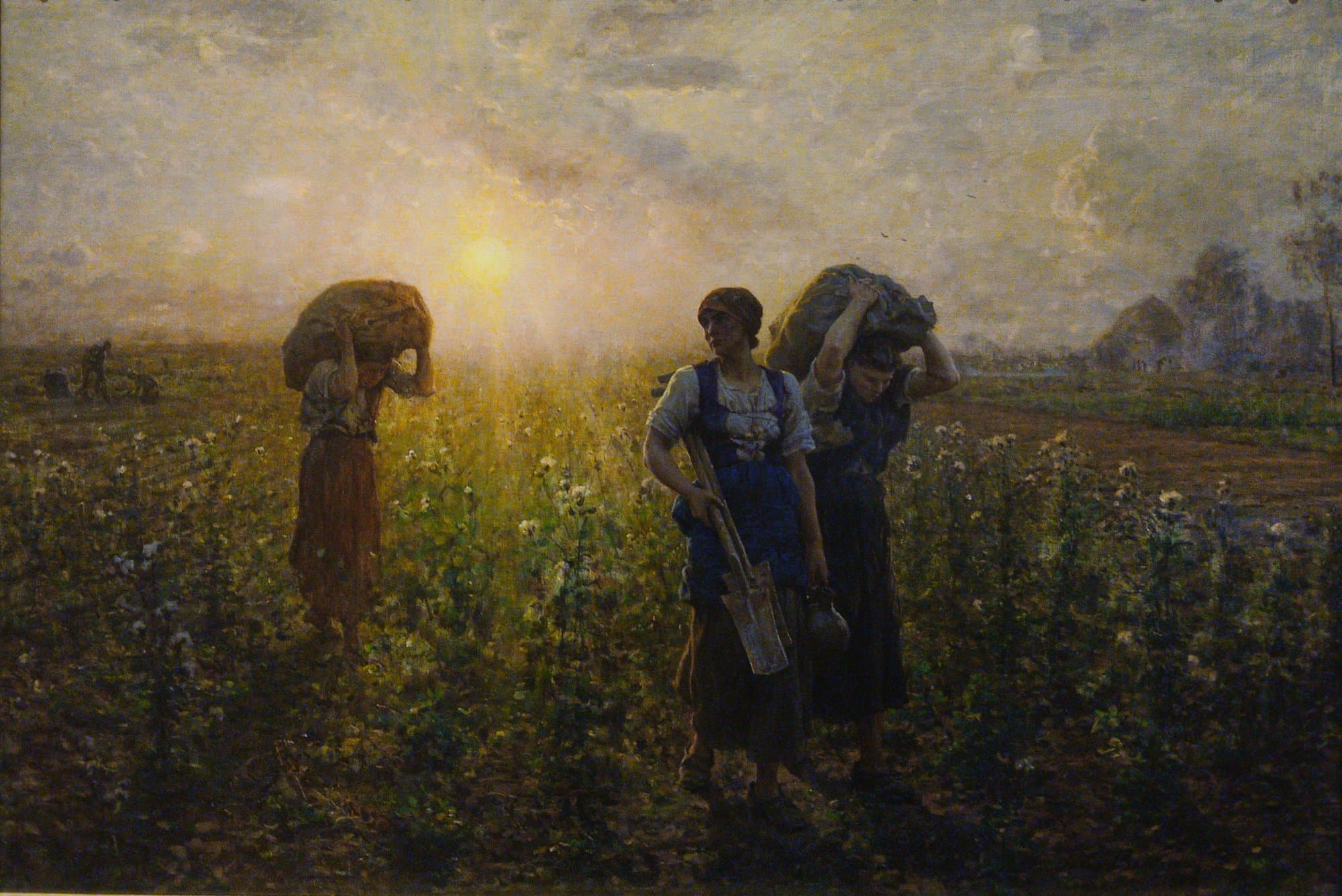
Ecclesiastes 2:18 to 26 · Passage · Work and Toil
What Does a Man Get for All His Toil?
Ecclesiastes 2:18 to 26 closes the Teacher's royal experiment with his verdict on the labor of a lifetime.
The Hebrew noun amal, toil, stands in six of the seven verses from Ecclesiastes 2:18 to 24.
Nothing is better for a man than to eat and drink and enjoy his work. I have also seen that this is from the hand of God.
- The passage
- Ecclesiastes 2:18 to 26
- Book
- Ecclesiastes
- Hold in memory
- Ecclesiastes 2:24
Summary
In Ecclesiastes 2:18 to 26 the Teacher looks at everything his labor has built and sees that he must hand it to a man who never worked for it and may be a fool. He hates his toil and despairs of it, and he finds that it fills his days with grief and keeps his mind awake at night. Then he turns to the plain goods of each working day and names God as their giver.
- The verdict this too is futile falls four times in the nine verses, the last at Ecclesiastes 2:26.
- Bonaventure, Matthew Henry and Augustine heard Ecclesiastes 2:24 in three ways: as a lesser evil, as joy received from God and as a pointer to the Lord's table.
- Albert Barnes read the Teacher as Solomon himself, and Franz Delitzsch argued from the book's Hebrew for a later writer speaking in Solomon's voice.
The Teacher's Reckoning
The hated labor, the sleepless night and the Giver in Ecclesiastes 2.
What Does a Man Get for All His Toil? studies Ecclesiastes 2:18 to 26 within the trial of work and toil. These verses speak to anyone who has built something over years and wondered who will keep it, or lain awake over work that would not leave the mind.
The question it answers is how the Teacher moves from hating his labor to calling its enjoyment a gift, and whether that turn is resignation or faith. It follows the passage verse by verse, sets the enjoyment refrains of the whole book side by side, and reads two Hebrew lines closely. It also gives the readings of the turn and of the Teacher's identity, each with its holders.
I hated all for which I had toiled under the sun, because I must leave it to the man who comes after me. And who knows whether that man will be wise or foolish? Yet he will take over all the labor at which I have worked skillfully under the sun. This too is futile. So my heart began to despair over all the labor that I had done under the sun. When there is a man who has labored with wisdom, knowledge, and skill, and he must give his portion to a man who has not worked for it, this too is futile and a great evil.These verses stand first because they give the cause of the Teacher's grief, which the rest of the passage answers.
Ecclesiastes 2:22 then asks what a man gets for all his toil and striving under the sun.
Indeed, all his days are filled with grief, and his task is sorrowful; even at night, his mind does not rest. This too is futile.The verse stands here because its sleepless worker belongs to the trial of stress and weariness as well as to the trial of work.
Psalm 127:2 answers that restless night with the sleep the LORD gives His beloved.
For apart from Him, who can eat and who can find enjoyment? To the man who is pleasing in His sight, He gives wisdom and knowledge and joy, but to the sinner He assigns the task of gathering and accumulating that which he will hand over to one who pleases God. This too is futile and a pursuit of the wind.The verses stand here because they answer the question of Ecclesiastes 2:22 with a Giver.
The verdict futile renders hebel (H1892), and the Teacher's phrase under the sun bounds his search to life as it is seen from the earth.
The Refrain of Joy
The refrains run from Ecclesiastes 3:12 to Ecclesiastes 9:9.
Every refrain ties its enjoyment to a man's labor or work.
| Verse | The words of the Berean text | What the verse adds |
|---|---|---|
| Ecclesiastes 3:12 to 13 | "every man should eat and drink and find satisfaction in all his labor" | "the gift of God" |
| Ecclesiastes 3:22 | "there is nothing better for a man than to enjoy his work" | "his lot" |
| Ecclesiastes 5:18 to 19 | "to eat and drink, and to find satisfaction in all the labor one does under the sun" | "his lot" and "a gift from God" |
| Ecclesiastes 8:15 | "So I commended the enjoyment of life" | joy that "will accompany him in his labor" |
| Ecclesiastes 9:7 to 9 | "Go, eat your bread with joy, and drink your wine with a cheerful heart" | "your portion in life and in your labor" |
The refrain grows as the book goes on. In Ecclesiastes 9:7 it becomes a command, and the reason given is that God has already approved the works of the one who eats.
Two Hebrew Lines
The opening of Ecclesiastes 2:24 and the close of Ecclesiastes 2:25 read differently in Hebrew and in English.
Ecclesiastes 2:24 opens in Hebrew with ein tov ba'adam, there is no good in a man, followed by that he should eat and drink. The line has no word for better, and the Berean text supplies the comparison in Nothing is better for a man.
The received Hebrew of Ecclesiastes 2:25 ends with chutz mimmeni, outside of me, where the Berean text reads apart from Him. Adam Clarke, in his Commentary on the Bible (1832), reported eight manuscripts of Kennicott and De Rossi, with the Septuagint, Syriac and Arabic, that read without Him. He wrote, “I believe this to be the true reading.”
Two Questions of the Passage
What the turn of Ecclesiastes 2:24 means and who the Teacher is, each reading with its holder and the objection to it.
A lesser evil than endless laborBonaventure
Bonaventure, in his Commentary on Ecclesiastes, chapter 2, set the eating and drinking beside endless labor and wrote, “it is better, that is, less evil”.
The objection: Ecclesiastes 2:24 says the enjoyment “is from the hand of God”, and Ecclesiastes 2:26 counts joy among God's gifts to the man who pleases Him.
Joy received from God's handMatthew Henry; Jamieson, Fausset and Brown
Matthew Henry, in his Commentary on the Whole Bible (1710), wrote that the good things of life are truly pleasant to us “when we take them from the hand of God as a Father”. Jamieson, Fausset and Brown, in their Commentary Critical and Explanatory (1871), judged that the King James rendering “gives a seemingly Epicurean sense, contrary to the general scope”.
The objection: the passage still closes with the verdict of futility at Ecclesiastes 2:26, so the gift does not lift the labor out from under the sun.
A pointer to the Lord's tableAugustine of Hippo
Augustine of Hippo, in The City of God, book 17, chapter 20, read the Teacher's eating and drinking as the Lord's Supper. In the Dods translation (1887) he called it the table “which the Mediator of the New Testament Himself, the Priest after the order of Melchizedek, furnishes with His own body and blood”.
The objection: Ecclesiastes 2:24 joins the eating to a man's own work, and Ecclesiastes 9:7 names bread and wine as the food of an ordinary day.
Solomon's own recordAlbert Barnes
Albert Barnes, in his Notes, Explanatory and Practical (1832 to 1869), wrote on Ecclesiastes 1:12 that “Solomon relates his personal experience” in the first two chapters.
The objection: the book never names Solomon, and Ecclesiastes 1:12 speaks of the Teacher's reign in the past tense, “I, the Teacher, was king over Israel in Jerusalem.”
A later writer's bookFranz Delitzsch; Martin Luther
Franz Delitzsch, in his commentary on Ecclesiastes in the Keil and Delitzsch Biblical Commentary on the Old Testament, argued from the book's vocabulary that it was written after the exile. He reported that Martin Luther, in his Table Talk, was the first to explain the book as one of the most recent of the Old Testament. Delitzsch's own verdict was, “If the Book of Koheleth were of old Solomonic origin, then there is no history of the Hebrew language.”
The objection: Ecclesiastes 1:1 presents the Teacher as “the son of David, king in Jerusalem”, a description that fits Solomon.
The Gift in the Toil
The book sets the labor of Ecclesiastes 2 under its last command.
The Teacher never finds a profit he can keep, and he never stops working. At the end of the book the labor he could not hold is placed under the fear of God.
When all has been heard, the conclusion of the matter is this: Fear God and keep His commandments, because this is the whole duty of man.The book's conclusion stands here because it names the duty that remains when the profit of labor cannot be kept.
Sources
Scripture is the Berean Standard Bible.
- STEP Bible, Translators Amalgamated Hebrew Old Testament (Tyndale House, Cambridge), CC BY 4.0.
- STEP Bible brief lexicon of Extended Strongs for Hebrew (Tyndale House, Cambridge), CC BY 4.0, with the definitions of James Strong, Strong's Exhaustive Concordance of the Bible (1890)
- Matthew Henry, Commentary on the Whole Bible (1710), Ecclesiastes 2:25.
- Robert Jamieson, A. R. Fausset and David Brown, Commentary Critical and Explanatory on the Whole Bible (1871), Ecclesiastes 2:24.
- Augustine of Hippo, The City of God, book 17, chapter 20, translated by M. Dods, Nicene and Post-Nicene Fathers, first series, volume 2 (Buffalo: Christian Literature Publishing, 1887)
- Bonaventure, Commentary on Ecclesiastes, chapter 2 (a modern English translation, cited under fifty words)
- Adam Clarke, Commentary on the Bible (1832), Ecclesiastes 2:25.
- Albert Barnes, Notes, Explanatory and Practical, on the Old and New Testaments (1832 to 1869), Ecclesiastes 1:12.
- Franz Delitzsch, Commentary on Ecclesiastes, introduction, in C. F. Keil and F. Delitzsch, Biblical Commentary on the Old Testament.
Keep Studying
Studies3
In this trial6
People and groups8
Values1
Subjects1
Trials of life1