
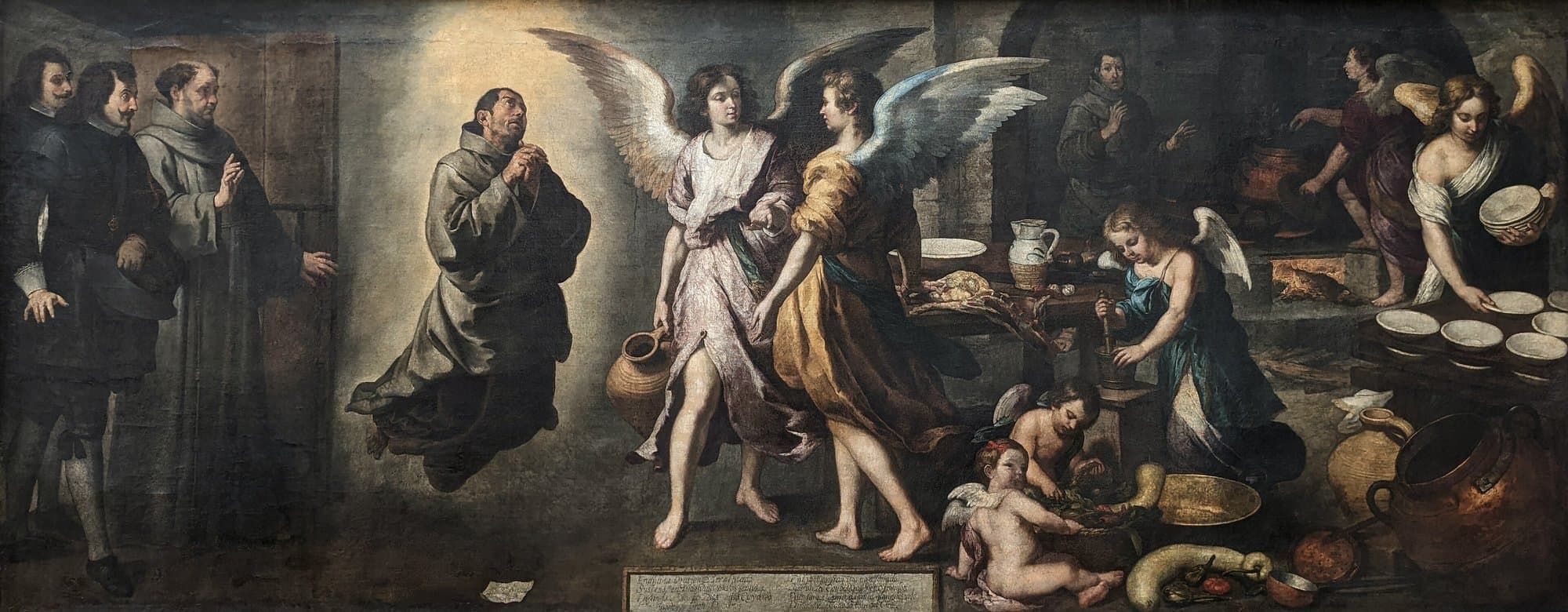
Paris, 1666 · Story · Work and Toil
Brother Lawrence in the Kitchen
Brother Lawrence, cook to a Carmelite house in Paris, taught that the busiest work could be done in the presence of God.
Before he entered the monastery he had been a footman who, by his own account, broke everything.
Whatever you do, work at it with your whole being, for the Lord and not for men,
- When
- 1666 to 1667, the four conversations Beaufort recorded, dated in Donald Attwater's translation
Summary
Nicolas Herman of Lorraine took the name Lawrence of the Resurrection when he entered a religious house as a lay brother, and he was set to cook for the community. The Abbé de Beaufort recorded four conversations with him in 1666 and 1667. Lawrence told him that he did everything in the kitchen for the love of God, and that his hours of work and his hours of prayer were one to him.
- He began each task with a prayer, kept up his converse with God as he worked, and examined himself when he had finished.
- He measured a task by the love put into it, so that the smallest work done for God's sake counted with Him.
- His conversations and letters were printed in two French books of 1693, two years after his death, and an English selection followed in 1724.
- Readers differ over whether Paul's command to pray without ceasing asks for an unbroken inward converse with God or for stated times of prayer kept faithfully.
A Lay Brother of the Carmelites
Nicolas Herman came to the Carmelites of Paris after years as a soldier.
Brother Lawrence in the Kitchen is a story from the church's history for the trial of work and toil. It asks how a lame lay brother who disliked his work in a monastery kitchen came to find it easy, and what he said about joining work to prayer.
The study tells who he was, dates his life and the books that carried his words, and gives his account of the kitchen and the wine errands in the words of the conversations. It sets his saying on the time of business beside Paul's charge to servants, and it weighs how readers have taken the command to pray without ceasing.
Donald Attwater, in the introduction to his translation of 1926, gives the outline of the life. Nicolas Herman of Herimesnil became a soldier at eighteen and was wounded in a raid by the Swedes on Rambervilliers. He entered the Discalced Carmelites of Paris and was set to work in their kitchen.
Lawrence dated his turning to God to a winter's day at eighteen. The Abbé de Beaufort, who recorded his conversations, wrote that in the winter Lawrence saw "a tree stripped of its leaves". From that sight he "received a high view of the Providence and Power of God".
From Lorraine to the English Editions
The dated record runs from his birth to the English translations of his words.
The conversations of 1666 and 1667 waited more than twenty-five years for the books of 1693.
- About 1611Lawrence is born in LorraineAttwater's introduction
- 3 August 1666Beaufort's first conversation with Brother LawrenceThe conversations
- 28 September 1666Beaufort's second conversation with LawrenceAttwater's translation
- 22 November 1666Beaufort's third conversation with LawrenceAttwater's translation
- 25 November 1667Beaufort's fourth conversation with LawrenceAttwater's translation
- 6 February 1691Lawrence writes his last letter from his deathbedAttwater's translation
- 12 February 1691Lawrence dies in Paris at about eightyAttwater's introduction
- 1693Maximes spirituelles is printed in ParisAttwater's introduction
- 1693Beaufort's Moeurs et Entretiens is printed at ChalonsAttwater's introduction
- 1724A selection of the conversations and letters is translated into EnglishAttwater's introduction
- 1926Donald Attwater's translation is first publishedAttwater's title page
A timeline of eleven dated events from Lawrence's birth to Donald Attwater's translation, each with its date and the account it comes from.
12 February 1691, 1693, 1693, 1724, 1926
The Kitchen and the Wine Errands
The second conversation records the work Lawrence was given and how he came to do it gladly.
The community sent him to Burgundy to buy its wine, a task he disliked because he "had no turn for business". He was lame, and he "could not go about the boat but by rolling himself over the casks". He told God that "It was His business he was about", and found it well done.
The kitchen was work "to which he had naturally a great aversion". Yet "having accustomed himself to do everything there for the love of God", he "had found everything easy, during the fifteen years that he had been employed there."
By the time of that conversation he had moved to other work, which Attwater's translation renders as "the cobbler's workshop". He was ready to leave that post too, since in any post he pleased himself by doing little tasks for God.
He kept the hours of prayer his Superior appointed, but said that "his greatest business did not divert him from God."
Beaufort and the Two Books
Lawrence's sayings, letters and maxims were gathered by others and printed after his death.
Attwater names Beaufort as vicar general of Cardinal de Noailles. The conversations are written in reported speech, so each saying comes through Beaufort's hand.
Attwater traces the works to two French books, Maximes spirituelles and Beaufort's Moeurs et Entretiens. He adds that in England some twenty editions of selections followed, most of them published under non-Catholic auspices.
One of those English editions is the Epworth Press's "Authentic Edition" of London, printed between 1932 and 1948 by the dates of its book steward, Edgar Barton. Its preface calls him "a lay brother among the Carmelites, for several years a soldier, in an irreligious age, amid a sceptical people".
The book met suspicion in France. Attwater notes a letter of 7 October 1697 in the correspondence of Bossuet that refers to the Moeurs et Entretiens as taken up by Madame Guyon and "in bad odour in consequence".
The Year of His Birth
Two years are given for Lawrence's birth, about 1611 and about 1605.
Attwater puts the birth "about the year 1611", while the catalogue line of the CCEL text names him "Nicholas Herman, c. 1605-1691". In the first conversation of 1666 Lawrence spoke of "above forty years" lived since his conversion at eighteen, which points to a birth before 1611.
In the seventh letter he wrote to his correspondent, "you are near sixty-four, and I am almost eighty." The letter bears no date in the CCEL text, so it cannot settle the year.
The Time of Business and the Time of Prayer
Beaufort recorded how Lawrence joined his cooking to prayer from the start of a task to its end.
Before his work he asked God, "since Thou art with me", to "grant me the grace to continue in Thy Presence".
"As he proceeded in his work, he continued his familiar conversation with his Maker", Beaufort wrote. When he had finished, he gave thanks if he had done well and asked pardon if he had not.
"The time of business," said he, "does not with me differ from the time of prayer". Of the noise of his kitchen he said, "I possess God in as great tranquillity as if I were upon my knees at the Blessed Sacrament".
He named the best way to God as "doing our common business without any view of pleasing men", and the edition's bracket at those words gives Galatians 1:10 and Ephesians 6:5 to 6.
And do this not only to please them while they are watching, but as servants of Christ, doing the will of God from your heart.Paul asked slaves to work as servants of Christ from the heart and not to please a watching master, the charge Lawrence's saying echoes.
What Scripture teaches of ordinary work as a calling from God belongs to the doctrine of work and vocation.
What Pray Without Ceasing Asks
Readers differ on whether Paul's command asks for an inward converse at every task or for stated times kept without a gap.
Pray without ceasing.Every reading of Lawrence's practice turns on what Paul meant by these three words.
An inward converse with God kept at every taskAugustine of Hippo, Adam Clarke and the Abbé de Beaufort
Augustine, in his Exposition on Psalm 38, wrote, "For it is thy heart's desire that is thy prayer; and if thy desire continues uninterrupted, thy prayer continueth also."
Adam Clarke, in his Commentary on the Bible (1832), told his readers to "feel that dependence at all times, and ye will always be in the spirit of prayer".
Beaufort said of the communion of heart Lawrence practised that "in it consists that ceaseless prayer which St Paul imposes on all Christians", in Attwater's translation.
Against this reading, Scripture also honours set times of prayer, as when Daniel knelt to pray three times a day (Daniel 6:10).
Stated times of prayer kept without a gapMatthew Henry, Albert Barnes and Jamieson, Fausset and Brown
Matthew Henry, in his Commentary on the Whole Bible (1710), wrote, "We should keep up stated times for prayer, and continue instant in prayer". He held that nothing else we do "should hinder prayer in its proper season".
Albert Barnes read the command as meaning that we are to be "regular and constant in the observance of the stated seasons of prayer". Jamieson, Fausset and Brown (1871) read it as "without allowing prayerless gaps to intervene between the times of prayer".
Against this reading, Paul sets the command beside "Rejoice at all times" (1 Thessalonians 5:16), which no stated hour can hold.
Little Things for the Love of God
Lawrence's smallest example of work done for God was the picking up of a straw.
He taught that God looks to "the love with which it is performed" more than to the size of a work. He told Beaufort that he was "pleased when he could take up a straw from the ground for the love of God".
So whether you eat or drink or whatever you do, do it all to the glory of God.Paul carries the glory of God into eating and drinking, the plain matter of a kitchen, and into whatever else a believer does.
Sources
Scripture is the Berean Standard Bible.
- Brother Lawrence, The Practice of the Presence of God: The Best Rule of Holy Life, being Conversations and Letters of Brother Lawrence, Authentic Edition (London: The Epworth Press, Edgar C. Barton, between 1932 and 1948)
- Donald Attwater, editor's introduction and translation, The Practice of the Presence of God, by Brother Lawrence of the Resurrection (London: Burns and Oates, first published 1926; printing of 1962), pages iii to viii, 7 to 8 and 65.
- Augustine of Hippo, Exposition on Psalm 38, section 13, translated by J. E. Tweed, Nicene and Post-Nicene Fathers, first series, volume 8 (Buffalo: Christian Literature Publishing Company, 1888)
- Adam Clarke, Commentary on the Bible (1832), on 1 Thessalonians 5:17.
- Matthew Henry, Commentary on the Whole Bible (1710), on 1 Thessalonians 5:17.
- Albert Barnes, Notes, Explanatory and Practical, on the Old and New Testaments (1832 to 1869), on 1 Thessalonians 5:17.
- Robert Jamieson, A. R. Fausset and David Brown, Commentary Critical and Explanatory on the Whole Bible (1871), on 1 Thessalonians 5:17.
Keep Studying
In this trial6
People and groups6
Subjects1
Values1