
The story
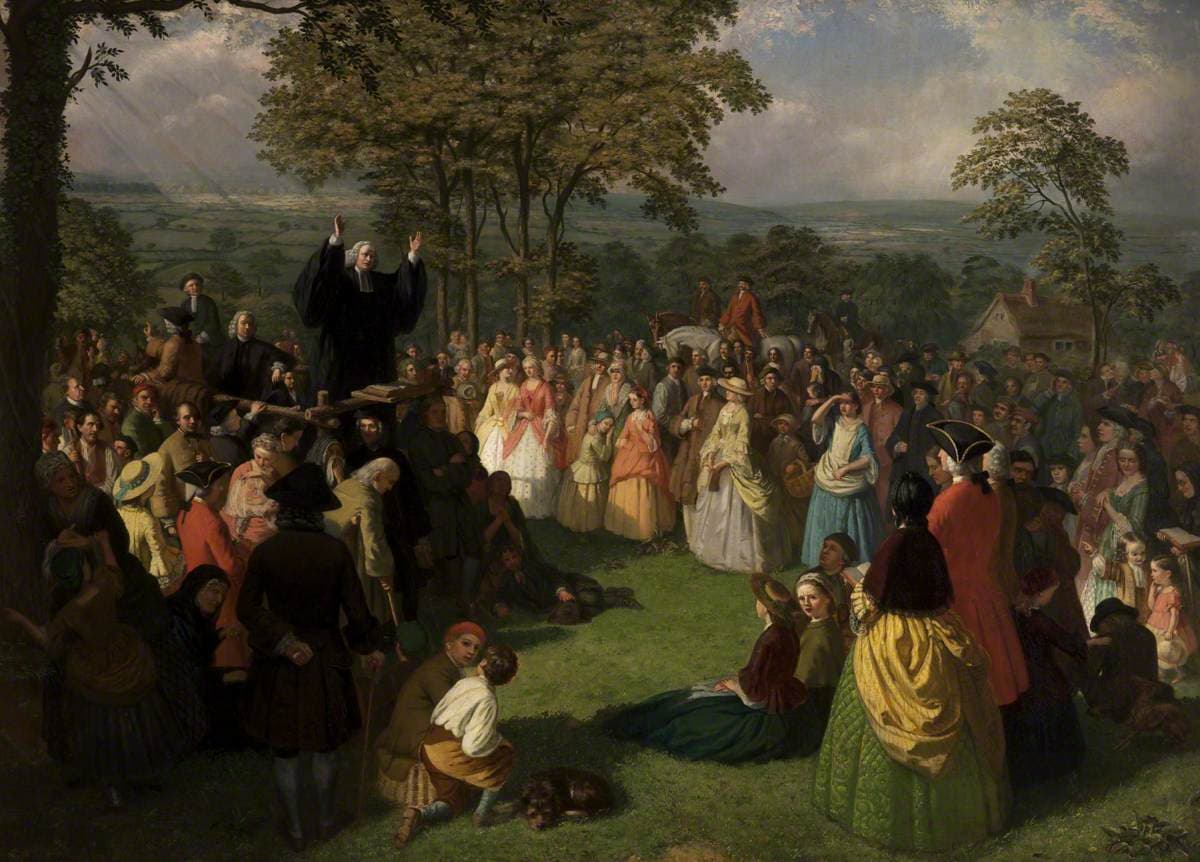
George Whitefield was a tavern-keeper's son from Gloucester who worked his way through Oxford as a servant to wealthier students. There he joined the Wesley brothers' Holy Club and was ordained at twenty-one. When English pulpits began closing to him, he did something respectable ministers considered scandalous: in February 1739 he stood on a mound outside Bristol and preached to the Kingswood coal miners in the open air. He wrote that he could see the white gutters made by tears running down their coal-blackened faces.
He landed at Lewes, Delaware, in October 1739 for the tour that made him famous. In Philadelphia, Benjamin Franklin, who printed him, liked him, and never believed a word of the theology, walked backward down Market Street to work out how far the voice carried, and calculated that thirty thousand people could have heard him. Franklin also went to a sermon determined to give nothing to the Georgia orphanage and admitted afterward that he emptied his pockets, gold and all. He is the best witness the awakening has, precisely because he was not converted by it.
Jesus replied, “Truly, truly, I tell you, no one can see the kingdom of God unless he is born again.”Ye must be born again was Whitefield's great text; the early biographies tell of him being asked why he preached it so often and answering, because ye must be born again.
The New England tour ran through September and October 1740. He landed at Newport on the fourteenth and reached Boston on the eighteenth, a town of roughly seventeen thousand people. On September 22 a crowd packing the New South Church panicked when a board broke and people thought the gallery was collapsing; some jumped from the windows and five died. Whitefield preached to the shaken crowd and then moved his meetings outdoors. His farewell sermon on Boston Common on October 12 drew a crowd contemporaries put at around twenty thousand, more people than lived in the town. Nobody counted; those are estimates written down by people standing in the middle of it, and what is not in doubt is that the crowds were larger than any building in America could hold.
From Boston he rode west to Northampton, where he preached in Jonathan Edwards's pulpit on October 17 through 19. Edwards wept through the sermons. He also, privately and then publicly, urged the young evangelist to be more careful about trusting sudden impressions, the older man had watched a revival rise and break five years earlier and knew what he was looking at.
The revival ledger's two lines: what marked the outpouring and what it left standing.
| The ledger | What the record holds |
|---|---|
| What marked it | Whitefield preached outdoors to crowds the churches could not hold, and Benjamin Franklin, no believer, measured the carrying power of his voice and defended his honesty. Preaching aimed straight at the conscience: you must be born again. In some meetings people cried out, wept, or fell down, and Edwards wrote a whole book sorting the real work of the Spirit from the froth around it. In Britain the same fire ran through the Wesleys’ societies and the Welsh fields under Harris and Rowland. |
| What was left standing | Church membership rose sharply across the colonies and new congregations were planted by the hundreds. It crossed the lines between denominations and colonies and gave scattered settlements a shared experience for the first time. It also produced hard opposition and lasting splits, and it seeded the Methodist movement, whose class meetings held converts long after the crowds went home. |
The awakening was never one man. William Tennent had built a log schoolhouse at Neshaminy, Pennsylvania, to train preachers when the colleges would not; critics sneered at it as the Log College, and it fed into what became Princeton. His son Gilbert preached a sermon at Nottingham in March 1740 called The Danger of an Unconverted Ministry, comparing ministers without a living faith to the Pharisees. It cut deep and it cut wrong ways too: the Presbyterian church split in 1741 into Old Side and New Side and did not reunite until 1758. Tennent himself came to regret how harshly he had put it.
The most famous sermon of the awakening was Edwards's Sinners in the Hands of an Angry God, preached at Enfield, Connecticut, on July 8, 1741, where witnesses said the crying grew so loud he had to stop and ask for quiet before he could finish. Meetings like that made the controversy as loud as the revival. Ministers called Old Lights, led by Boston's Charles Chauncy, argued in books like Seasonable Thoughts on the State of Religion in New England that the whole thing was disorder and enthusiasm; New Lights answered that God was visiting the colonies. Edwards refused to take either side whole: in The Distinguishing Marks, preached at the Yale commencement in September 1741 from 1 John 4:1, he listed things that prove nothing either way, crying out, bodily effects, great excitement, and then listed the marks that do count, chiefly a higher esteem for Jesus and a greater love of God and neighbor.
The 7 people and groups the revival ledger names, in its order.
| Who the ledger names |
|---|
| George Whitefield; Jonathan Edwards; Gilbert Tennent; John Wesley; Charles Wesley; Howell Harris; Daniel Rowland |
The critics had real material. James Davenport, a Long Island minister, denounced settled pastors by name, led followers through towns by torchlight singing, and in March 1743 at New London presided over a bonfire of books and fine clothes. A court had already sent him home in 1742 as not of sound mind. The honest end of the story is that in 1744 Davenport published a Confession and Retractations admitting he had been carried away by a false spirit, and spent the rest of his ministry quietly. The revival produced both the excess and the repentance.
The same fire was burning across the Atlantic in the same years. Howell Harris was converted at Talgarth in Wales in 1735 and began preaching house to house; Daniel Rowland drew thousands to Llangeitho; John and Charles Wesley organized their societies from 1739 and Charles wrote the hymns that carried the doctrine. These were separate fires that knew about each other by letter and by visiting preachers, and Whitefield moved between them.
How then can they call on the One in whom they have not believed? And how can they believe in the One of whom they have not heard? And how can they hear without someone to preach?How shall they hear without a preacher is the argument the field preachers used when the pulpits were closed to them and they went out to the fields and market squares instead.
What was left standing: hundreds of new congregations, sharply higher church membership across the colonies, and a shared experience that connected scattered settlements for the first time. The awakening's schools became Princeton, Brown, Rutgers, and Dartmouth. Methodist class meetings, small groups that met weekly to answer honest questions about one another's lives, held converts long after the crowds went home, and that plain structure may be the single most transferable thing the awakening produced.
One hard fact belongs on this page. Whitefield preached to enslaved men and women and insisted publicly that they had souls, at a time when many planters denied it; he also lobbied for legalizing slavery in Georgia, which happened in 1751, and held enslaved people to fund his Bethesda orphanage. Both things are true of the same man in the same years. A site that reports revivals honestly has to say so, and the awakening's own converts included Black preachers who would later use its gospel against the system Whitefield defended.
Beloved, do not believe every spirit, but test the spirits to see whether they are from God. For many false prophets have gone out into the world.Try the spirits was Edwards's text for The Distinguishing Marks in 1741, the sermon that taught a whole generation how to tell the real work of God from the froth around it.