
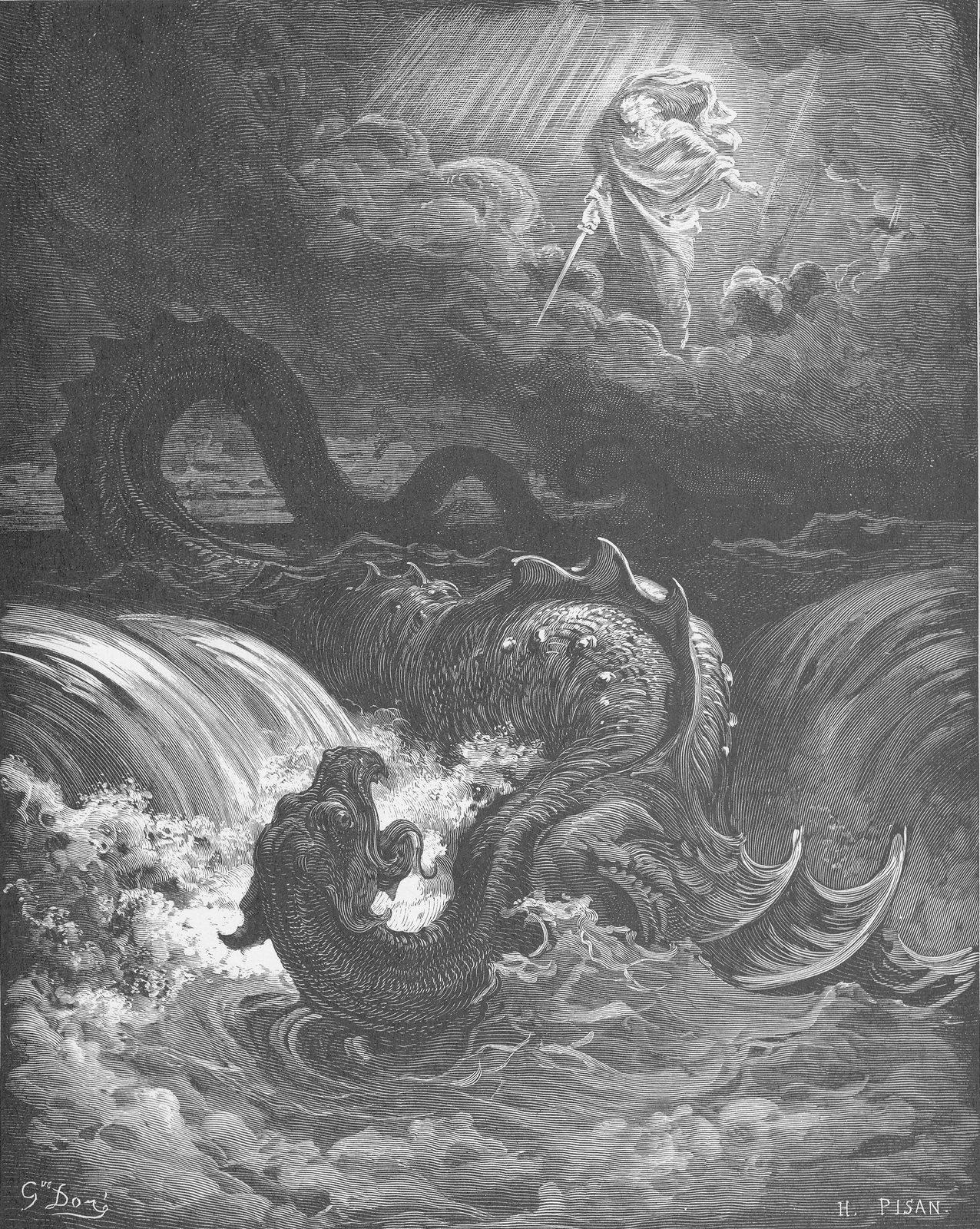
Gustave Doré, The Destruction of Leviathan, 1866. Public domain.
Isaiah 24 to 27 · Subject · Featured Study
The Isaiah Apocalypse (24 to 27)
Isaiah 24 to 27 is a section of four chapters of oracles and songs that commentators read as one prophecy.
The phrase in that day comes seven times in these four chapters.
He will swallow up death forever. The Lord GOD will wipe away the tears from every face and remove the disgrace of His people from the whole earth. For the LORD has spoken.
- Book
- Isaiah
- Hold in memory
- Isaiah 25:8
Summary
Isaiah 24 to 27 turns from single nations to the whole earth.
- The Pulpit Commentary reads the four chapters as one section.
- The Cambridge Bible says their apocalyptic ideas have struck nearly all commentators.
- It warns that this feature may have been exaggerated.
- Paul quotes Isaiah 25:8 at the resurrection of the dead.
Four Chapters on the Whole Earth
Chapter 24 opens on the earth itself after eleven chapters of oracles against nations.
Keil and Delitzsch call chapters 24 to 27 the finale to chapters 13 to 23, the oracles against the nations that open with the burden against Babylon (Isaiah 13:1).
Behold, the LORD lays waste the earth and leaves it in ruins. He will twist its surface and scatter its inhabitants—The Section in Order
Each unit is given with its verses and the words of the Berean text.
Judgment on the earth and songs of the LORD's people alternate through twelve units.
- Isaiah 24:1 to 13The earth mourns for its broken covenant, and the city of chaos is shattered.Isaiah 24:5
- Isaiah 24:14 to 16From the ends of the earth comes singing: “Glory to the Righteous One.”Isaiah 24:16
- Isaiah 24:16 to 20The prophet cries, “Woe is me,” and the earth staggers like a drunkard.Isaiah 24:20
- Isaiah 24:21 to 23The LORD punishes the host of heaven and the kings of the earth and reigns on Mount Zion.Isaiah 24:23
- Isaiah 25:1 to 5A song of praise for the city made a heap of rubble.Isaiah 25:2
- Isaiah 25:6 to 9The LORD prepares a banquet for all the peoples on this mountain.Isaiah 25:6
- Isaiah 25:10 to 12Moab is trampled, and the high-walled fortress is brought down.Isaiah 25:10
- Isaiah 26:1 to 6The song of the strong city in the land of Judah.Isaiah 26:1
- Isaiah 26:7 to 19A prayer that waits for the LORD and ends, “Your dead will live.”Isaiah 26:19
- Isaiah 26:20 to 27:1The people hide a little while, and the LORD brings judgment on Leviathan.Isaiah 27:1
- Isaiah 27:2 to 11The song of the fruitful vineyard, and the fortified city deserted.Isaiah 27:2
- Isaiah 27:12 to 13The LORD threshes from the Euphrates to the Wadi of Egypt, and a great ram's horn sounds.Isaiah 27:13
Twelve units of Isaiah 24 to 27 in order, each with its verses and what it holds in the Berean text.
Isaiah 25:10 to 12, Isaiah 26:1 to 6, Isaiah 26:7 to 19, Isaiah 26:20 to 27:1, Isaiah 27:2 to 11, Isaiah 27:12 to 13
How the Section Has Been Read
Readers take the section as judgments of Israel's history, as the end of the world-powers, or as the kingdom of the Messiah.
Judgments within Israel's historyAlbert Barnes
Barnes read the section of the calamities that the invasion of Nebuchadnezzar brought on the nation. He took the day of Isaiah 24:21 as the time of the captivity at Babylon.
The judgment of the world-powers at the endKeil and Delitzsch; Jamieson, Fausset and Brown
Keil and Delitzsch read the judgment on Assyria, Babylon and Egypt as the judgment on the world-powers everywhere.
Jamieson, Fausset and Brown, in their Commentary Critical and Explanatory (1871), called the LORD's reign in Isaiah 24:23 still future, and the triumphal entry of Jesus into Jerusalem its pledge.
The moon will be confounded and the sun will be ashamed; for the LORD of Hosts will reign on Mount Zion and in Jerusalem, and before His elders with great glory.The kingdom of the Messiah in the churchJohn Wesley
Wesley read the LORD who reigns in Isaiah 24:23 as the Messiah, who would set up His kingdom first in Jerusalem and then in all nations. He read the feast of Isaiah 25:6 as the ordinances, graces and comforts God gives in His church, for Jews and Gentiles both.
On this mountain the LORD of Hosts will prepare a banquet for all the peoples, a feast of aged wine, of choice meat, of finely aged wine.The City Without a Name
The section speaks of three cities and names none of them.
Five commentaries name Jerusalem, Babylon, Nineveh, Tyre or Gaza, an imperial city, the world itself or no one city, and none names one city at every verse.
| Commentary | The city of chaos | The city made rubble | The fortified city |
|---|---|---|---|
| Albert Barnes | Jerusalem | Babylon | Babylon |
| Keil and Delitzsch | The central city of the world estranged from God | The mighty imperial city | Jerusalem |
| The Cambridge Bible | Jerusalem | Turns on the date: Tyre or Gaza for Cheyne, Babylon on a date after the Exile | Jerusalem, desolate |
| Ellicott's Commentary | The world cast back into chaos | Nineveh or Babylon | The city of the strangers |
| The Pulpit Commentary | No special city | No particular city | Jerusalem, desolate for a time |
John Wesley read the city of Isaiah 24:10 as Jerusalem and the other cities of the land, the singular word taken as a collective.
When the Chapters Were Written
The commentators date the section from the Assyrian age of Isaiah to the reign of John Hyrcanus.
Keil and Delitzsch hold that the chapters are Isaiah's own, since nothing in their words passes beyond the Assyrian times. They record that most critics since Eichhorn and Koppe denied it.
Ellicott's Commentary reads the section as a prophecy of the overthrow of the world-powers, among which Assyria was then the most prominent.
Albert Barnes wrote that the time of the prophecy is wholly unknown.
The Cambridge Bible records that Duhm placed the chapters in the reign of John Hyrcanus, and that others placed them after the Exile under Darius Hystaspis. It prefers the view of Cheyne, who set them in the years before the end of the Persian Empire, about 350 to 330 BC.
The Unity and Date of Isaiah: the readings of the whole book
Your Dead Will Live
Isaiah 26 says of the oppressors that the dead will not live, and of the LORD's people that their dead will.
The dead will not live; the departed spirits will not rise. Therefore You have punished and destroyed them; You have wiped out all memory of them.Your dead will live; their bodies will rise. Awake and sing, you who dwell in the dust! For your dew is like the dew of the morning, and the earth will bring forth her dead.Thomas Aquinas, in his Commentary on Isaiah, allowed both senses of the promise, the bodily resurrection on the last day or the people's rising from the misery of captivity.
Irenaeus on the Resurrection
Irenaeus quoted Isaiah 26:19 in Against Heresies.
Irenaeus (died 202)
He read the verse as the joy of the just at their resurrection.
“Then, too, Isaiah himself has plainly declared that there shall be joy of this nature at the resurrection of the just, when he says: ‘The dead shall rise again; those, too, who are in the tombs shall arise, and those who are in the earth shall rejoice. For the dew from Thee is health to them.’”
Irenaeus · Against Heresies 5:34.1 · on Isaiah 26:19Patristic
Isaiah 26:19 Weighed
Two readings of the verse stand among the commentators, and each meets an objection.
Three commentaries read a resurrection of the body, and two read first the rising of a captive nation.
| Reading | Held by | Tradition | Representative work |
|---|---|---|---|
| The resurrection of the dead | Keil and Delitzsch, the Cambridge Bible and the Pulpit Commentary | Old Testament scholarship; Protestant commentary | Keil and Delitzsch on Isaiah 26:19 |
| The nation raised from captivity | Albert Barnes; Ellicott's Commentary | Protestant commentary | Barnes, Notes on Isaiah 26:19 |
Against the first reading1 paragraph
Ellicott's Commentary grants that the words imply a belief in a resurrection, but holds that they are used first of a national and spiritual one.
Against the second reading1 paragraph
The Cambridge Bible answers that the verse is a promise of life from the dead in the most literal sense. It reads the verse as the rising of members of the community whom death had seemed to rob of their hope.
Books to Read Next
Two older commentaries read the four chapters verse by verse.
Notes, Explanatory and Practical, on the Old and New Testaments
Albert Barnes · 1832 to 1869
Barnes gives an introduction to the four chapters.
Read it free at BibleHubExplanatory Notes upon the Old Testament
John Wesley · 1765
Wesley comments on each verse of the four chapters.
Read it free at BibleHubEvery Tear Wiped Away
Paul and John both take up the promise that God will swallow up death and wipe away tears.
When the perishable has been clothed with the imperishable and the mortal with immortality, then the saying that is written will come to pass: “Death has been swallowed up in victory.”‘He will wipe away every tear from their eyes,’ and there will be no more death or mourning or crying or pain, for the former things have passed away.”Sources
Scripture is the Berean Standard Bible.
- Carl Friedrich Keil and Franz Delitzsch, Biblical Commentary on the Old Testament (1857 to 1878), on Isaiah 24 to 27; public domain.
- The Cambridge Bible for Schools and Colleges, on Isaiah 24 to 27; public domain.
- The Pulpit Commentary, on Isaiah 24 to 27; public domain.
- Ellicott's Commentary for English Readers, on Isaiah 24 to 27; public domain.
- Albert Barnes, Notes, Explanatory and Practical, on Isaiah 24 to 27; public domain.
- Pull quotations on Isaiah 24 to 27.
- John Wesley, Explanatory Notes upon the Old Testament (1765), on Isaiah 24:10, 24:23 and 25:6.
- Jamieson, Fausset and Brown, Commentary Critical and Explanatory on the Whole Bible (1871), on Isaiah 24:23.
- Thomas Aquinas, Commentary on Isaiah, on Isaiah 26:19.
- Irenaeus, Against Heresies, book 5, chapter 34.
Keep Studying
Read it5
People and groups3