
1 Samuel 31:5
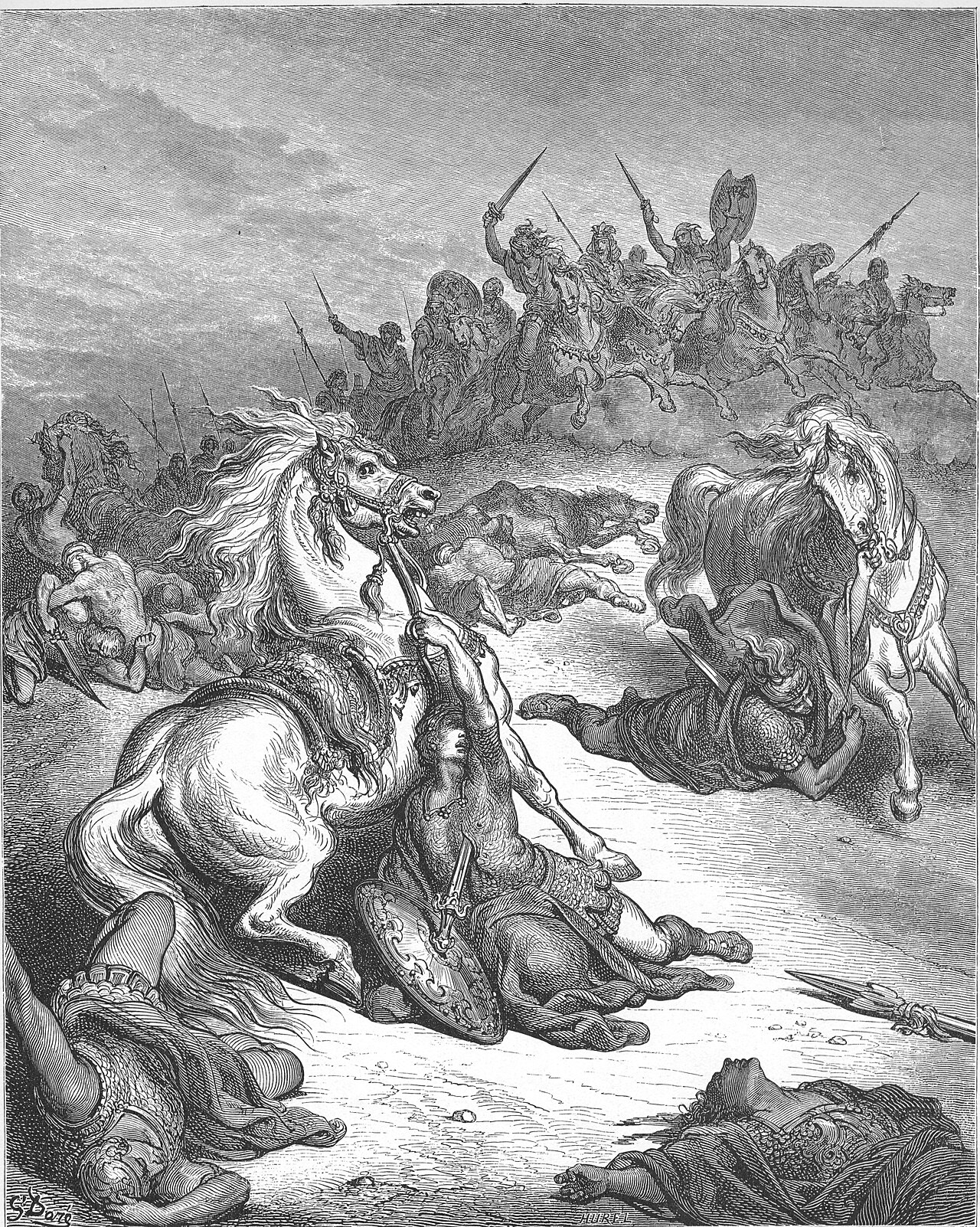
in 1 Samuel 31When his armor-bearer saw that Saul was dead, he too fell on his own sword and died with him.
BSB
The same verse in ASV and KJV ▾
ASV
And when his armorbearer saw that Saul was dead, he likewise fell upon his sword, and died with him.
KJV
And when his armourbearer saw that Saul was dead, he fell likewise upon his sword, and died with him.
⋯
This verse in 1 Samuel 31
Commentary
5 notes on this verseThis was an aggravating circumstance of the death of Saul, that, by the example of his wickedness in murdering himself, he drew in his servant to be guilty of the same wickedness, and perished not alone in his iniquity.
This site's exposition
sore wounded of the archers
on 1 Samuel 31:3-5
Saul's request that his armourbearer run him through, and the refusal born of fear, plays out the sentence Samuel had spoken to him from beyond the grave at Endor, that he and his sons would be with Samuel by the morrow, the word chapter 15 had already fixed when Saul spared Agag against the ban on Amalek. The armourbearer's fear answers Saul's own fear of Philistine abuse, and in the end neither man dies by an enemy's hand; both fall on their own swords. The text narrates the act without comment and passes no verdict beyond the one Samuel had already spoken.
This site's exposition
he too fell on his own sword
Matthew Henry counts this death against Saul. His example drew his servant into the same act, so the king did not die alone in his sin. The armor-bearer who was too terrified to run Saul through dies by his own sword that same day.
The record, by era
The Puritans and the Awakening1 voice
And when his armourbearer saw that Saul was dead,....
The Nineteenth Century1 voice
A commentator
Jamieson, Fausset & Brown1802–1910
Commentary Critical and Explanatory on the Whole Bible (1871)
proposed
the battle went sore against Saul, &c.--He seems to have bravely maintained his ground for some time longer; but exhausted with fatigue and loss of blood, and dreading that if he fell alive into the enemy's hands, they would insolently maltreat him (Jos 8:29;
quarantine:debris (2026-07-29) — starts-lowercase+unbalanced-parens
The words behind it
13 Hebrew wordsEvery Hebrew word of this verse in the order it stands, with what it means and the door to its own study. The last column counts the times a word stands in the whole Bible: the rarer the word, the more the places it appears belong together.
| Hebrew | Sound | Meaning | Word study | In the Bible |
|---|---|---|---|---|
| וַיַּ֥רְא | vaiyar' | and he saw | H7200 → | 1300 times |
| נֹשֵֽׂא־ | nose'- | [the] bearer of | H5375 → | 656 times |
| כֵלָ֖יו | khelav | armor his | H3627 → | 325 times |
| כִּ֣י | ki | that | H3588 → | 4482 times |
| מֵ֣ת | met | he had died | H4191 → | 839 times |
| שָׁא֑וּל | shaul | Saul | H7586 → | 402 times |
| וַיִּפֹּ֥ל | vaiyipol | and he fell | H5307 → | 435 times |
| גַּם־ | gam- | also | H1571 → | 769 times |
| ה֛וּא | hu' | he | H1931 → | 1879 times |
| עַל־ | ʾal- | on | H5921 → | 5755 times |
| חַרְבּ֖וֹ | charbo | sword his | H2719 → | 413 times |
| וַיָּ֥מָת | vaiyamot | and he died | H4191 → | 839 times |
| עִמּֽוֹ׃ | imo | with him | H5973 → | 1050 times |
וַיַּ֥רְאand he saw
vaiyar'H7200 →1300 times
נֹשֵֽׂא־[the] bearer of
nose'-H5375 →656 times
כֵלָ֖יוarmor his
khelavH3627 →325 times
כִּ֣יthat
kiH3588 →4482 times
מֵ֣תhe had died
metH4191 →839 times
שָׁא֑וּלSaul
shaulH7586 →402 times
וַיִּפֹּ֥לand he fell
vaiyipolH5307 →435 times
גַּם־also
gam-H1571 →769 times
ה֛וּאhe
hu'H1931 →1879 times
עַל־on
ʾal-H5921 →5755 times
חַרְבּ֖וֹsword his
charboH2719 →413 times
וַיָּ֥מָתand he died
vaiyamotH4191 →839 times
עִמּֽוֹ׃with him
imoH5973 →1050 times
A shaded row is a word that stands 400 times or fewer in the Bible.
About 1 Samuel
Who and where
1 name in this verse with a page on the site.
This page draws on Adam Clarke, Commentary on the Bible; Jamieson, Fausset & Brown, Commentary Critical and Explanatory on the Whole Bible; John Gill, Exposition of the Old Testament (1748-1763); Keil and Delitzsch, Biblical Commentary on the Books of Samuel and Matthew Henry, Commentary on the Whole Bible.