
2 John 1:4
in 2 John 1I was overjoyed to find some of your children walking in the truth, just as the Father has commanded us.
BSB
The same verse in ASV and KJV ▾
ASV
I rejoice greatly that I have found certain of thy children walking in truth, even as we received commandment from the Father.
KJV
I rejoiced greatly that I found of thy children walking in truth, as we have received a commandment from the Father.
⋯
This verse in 2 John 1
Commentary
8 notes on this verseTruly it is a most joyful thing to find a person walking without stumbling in the course of faith in Christ according to His commandment. And what is this commandment? The one about which Christ speaks in the Gospel: "He who loves Me will keep …
This site's exposition
walking in the truth
on 2 John 1:4-6
The elder rejoices over children walking in the truth. His request is one we have had from the beginning, echoing 1 John 2:7 and John 13:34. Love is to walk according to His commandments, and the commandment is to walk in love, each defining the other.
The record, by era
The Church Fathers2 voices
The saints are always overjoyed to see the results of truth at work.
I was very glad to find some of your children walking in truth, as we received a command from the Father. "I was very glad." For certainly, the greatest cause of joy is to find someone who walks without offense in the straight path of …
The Puritans and the Awakening1 voice
I rejoiced greatly that I found of thy children,....
The Nineteenth Century2 voices
That I found of thy children walking in truth - I have already supposed this Christian matron to be mother of a family, probably a widow, for no mention is made of her husband; and that she was also a deaconess in the church, and one in those house the traveling evangelists preached, and there they were entertained. The children mentioned here may either be her own children, or those members of the Church which were under her care, or some of both.
A commentator
Jamieson, Fausset & Brown1802–1910
Commentary Critical and Explanatory on the Whole Bible (1871)
See Introduction, at the end, and 2Jo 12; 3Jo 10, 14. of thy children--some. in truth--that is, in the Gospel truth. as--even as. "The Father's commandment" is the standard of "the truth."
1 more voice on this verse
The Nineteenth Century1 voice
A commentator
Albert Barnes1798–1870
Notes, Explanatory and Practical, on the Old and New Testaments (1832-1869)
proposed
I rejoiced greatly that I found ... - That I learned this fact respecting some of thy children. The apostle does not say how he had learned this. It may have been that he had become personally acquainted with them when they were away from their home, or that he had learned it from others. The word used εὕρηκα heurēka would apply to either method. Grotius supposed that some of the sons had come to Ephesus on business, and that John had become acquainted with them there. Of thy children walking in truth - That is, true Christians; living in accordance with the truth, for this constitutes the essence of religion. The expression used here, “of thy children,” (ἐκ τῶν τέκνων ek tōn teknōn,) means some of thy children; implying that he knew of a part of them who were true Christians. This is clear from the Greek construction, because: (a) If he had meant to say that he had found them all to be of this description, the sentiment would have been directly expressed, “thy children;” but as it is, some word is necessary to be understood to complete the sense; and, (b) The same thing is demanded by the fact that the participle used (“walking” - περιπατοῦντας peripatountas) is in the accusative case. If he had referred to them all, the participle would have been in the genitive, agreeing with the word “children,” (τῶν περιπατοῦντων tōn peripatountōn) - Lucke. Whether the apostle means to say that only a part of them had in fact embraced the gospel, or that he had only known that a part of them had done it, though the others might have done it without his knowledge, is not quite clear, though the former supposition appears to be the correct one, for if they had all become Christians it is to be presumed that he would have been informed of it. […]
The words behind it
17 Greek wordsEvery Greek word of this verse in the order it stands, with what it means and the door to its own study. The last column counts the times a word stands in the whole Bible: the rarer the word, the more the places it appears belong together.
| Greek | Sound | Meaning | Word study | In the Bible |
|---|---|---|---|---|
| Ἐχάρην | echaren | I rejoiced | G5463 → | 74 times |
| λίαν | lian | exceedingly | G3029 → | |
| ὅτι | hoti | that | G3754 → | |
| εὕρηκα | heureka | I have found | G2147 → | |
| ἐκ | ek | [some] of | G1537 → | |
| τῶν | ton | the | G3588 → | 19766 times |
| τέκνων | teknon | children | G5043 → | 99 times |
| σου | sou | of you | G4771 → | 2973 times |
| περιπατοῦντας | peripatountas | walking | G4043 → | 94 times |
| ἐν | en | in | G1722 → | 2738 times |
| ἀληθείᾳ | aletheia | truth | G225 → | 109 times |
| καθὼς | kathos | even as | G2531 → | |
| ἐντολὴν | entolen | commandment | G1785 → | 67 times |
| ἐλάβομεν | elabomen | we received | G2983 → | |
| παρὰ | para | from | G3844 → | 192 times |
| τοῦ | tou | the | G3588 → | 19766 times |
| πατρός. | patros | Father. | G3962 → | 410 times |
ἘχάρηνI rejoiced
echarenG5463 →74 times
λίανexceedingly
lianG3029 →
ὅτιthat
hotiG3754 →
εὕρηκαI have found
heurekaG2147 →
ἐκ[some] of
ekG1537 →
τῶνthe
tonG3588 →19766 times
τέκνωνchildren
teknonG5043 →99 times
σουof you
souG4771 →2973 times
περιπατοῦνταςwalking
peripatountasG4043 →94 times
ἐνin
enG1722 →2738 times
ἀληθείᾳtruth
aletheiaG225 →109 times
καθὼςeven as
kathosG2531 →
ἐντολὴνcommandment
entolenG1785 →67 times
ἐλάβομενwe received
elabomenG2983 →
παρὰfrom
paraG3844 →192 times
τοῦthe
touG3588 →19766 times
πατρός.Father.
patrosG3962 →410 times
A shaded row is a word that stands 400 times or fewer in the Bible.
The walk
8 stopsEach card is a verse this one points to, and under it the verses that one points to in turn. Where several paths arrive at the same place, that place is listed first: the text keeps returning to it.
Through
Ephesians 5:8For you were once darkness, but now you are light in the Lord. Walk as children of light,
it leads to
- John 8:12
Once again, Jesus spoke to the people and said, “I am the light of the world. Whoever follows Me will never walk in the darkness, but will have the light of life.”
- 1 John 1:7
But if we walk in the light as He is in the light, we have fellowship with one another, and the blood of Jesus His Son cleanses us from all sin.
- John 12:46
I have come into the world as a light, so that no one who believes in Me should remain in darkness.
- John 8:12
Through
1 John 2:6Whoever claims to abide in Him must walk as Jesus walked.
it leads to
- 1 Peter 2:21
For to this you were called, because Christ also suffered for you, leaving you an example, that you should follow in His footsteps:
- John 13:15
I have set you an example so that you should do as I have done for you.
- 1 Corinthians 11:1
You are to imitate me, just as I imitate Christ.
- John 15:4–6
Remain in Me, and I will remain in you. Just as no branch can bear fruit by itself unless it remains in the vine, neither can you bear fruit unless you remain in Me.
- 1 Peter 2:21
Through
Ephesians 5:2and walk in love, just as Christ loved us and gave Himself up for us as a fragrant sacrificial offering to God.
it leads to
- John 13:34
A new commandment I give you: Love one another. As I have loved you, so you also must love one another.
- John 13:34
Where this verse is studied
On this page
About 2 John
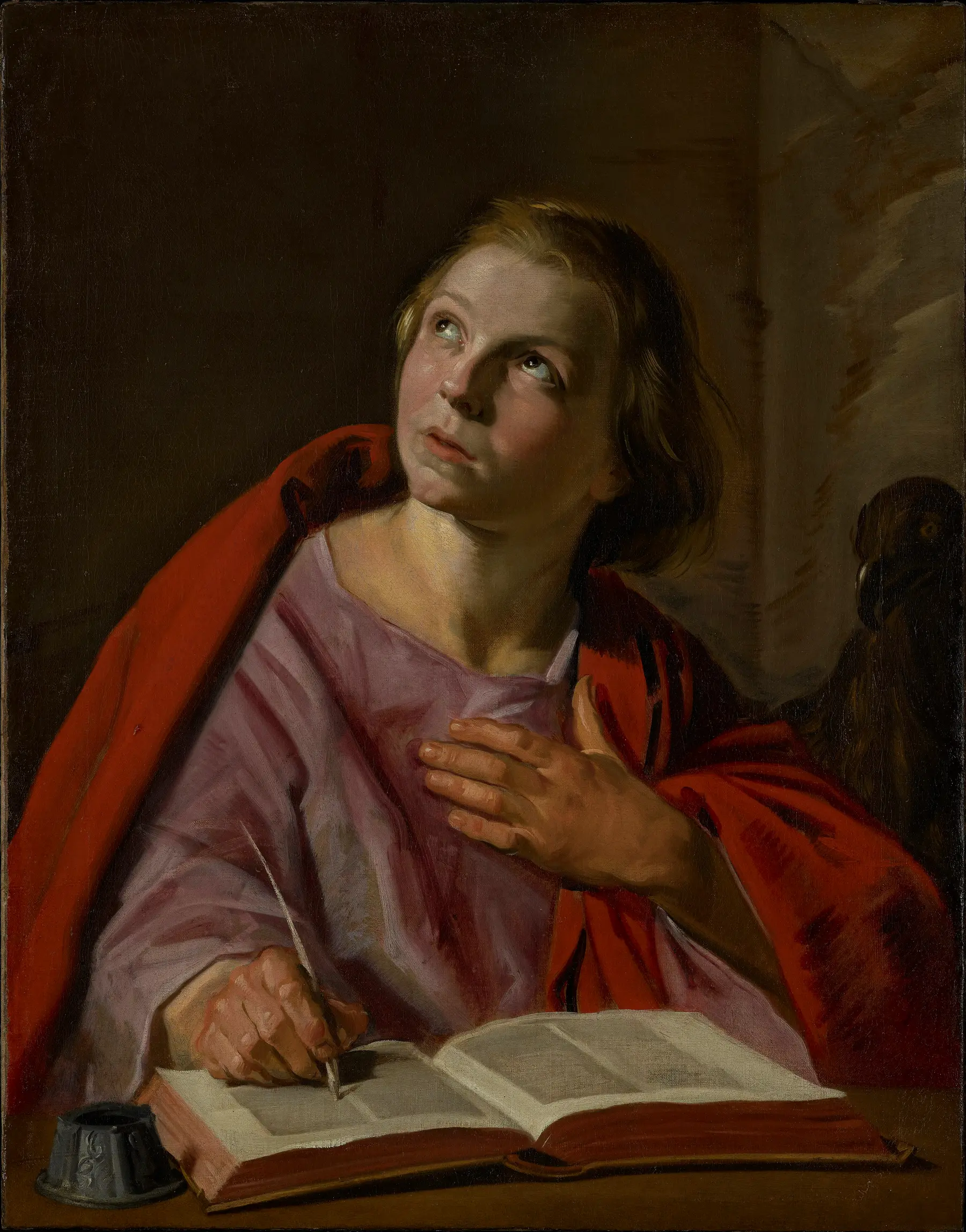
This page draws on 9 works. Open the list of works
This page draws on Adam Clarke, Commentary on the Bible; Albert Barnes, Notes, Explanatory and Practical, on the Old and New Testaments (1832-1869); Hilary of Arles, INTRODUCTORY COMMENTARY ON 2 JOHN; Jamieson, Fausset & Brown, Commentary Critical and Explanatory on the Whole Bible; John Gill, Exposition of the New Testament (1746-1748); John Wesley, Explanatory Notes upon the New Testament; Matthew Henry, Commentary on the Whole Bible; Oecumenius, Commentary on 2 John and Theophylact of Ohrid, Commentary on 2 John.