
1 Kings 10:12
in 1 Kings 10The king made the almug wood into steps for the house of the LORD and for the king’s palace, and into lyres and harps for the singers. Never before had such almug wood been brought in, nor has such been seen to this day.)
BSB
The same verse in ASV and KJV ▾
ASV
And the king made of the almug-trees pillars for the house of Jehovah, and for the king’s house, harps also and psalteries for the singers: there came no such almug-trees, nor were seen, unto this day.
KJV
And the king made of the almug trees pillars for the house of the Lord, and for the king’s house, harps also and psalteries for singers: there came no such almug trees, nor were seen unto this day.
⋯
This verse in 1 Kings 10
Commentary
5 notes on this verseA commentator
Albert Barnes1798–1870
Notes, Explanatory and Practical, on the Old and New Testaments (1832-1869)
Pillars - The Hebrew word signifies ordinarily a “prop” (margin). It is generally supposed to mean in this place a “railing,” or “balustrade,” a sense which connects and harmonises the present passage with the parallel passage in Chronicles (marginal reference), where Solomon is said to have made of the almug-wood “stairs” for the temple and for his own house. Harps - The Jewish harp כנור kı̂nnôr was of a triangular shape, and had ordinarily ten strings.
This site's exposition
great plenty of almug trees
on 1 Kings 10:11-13
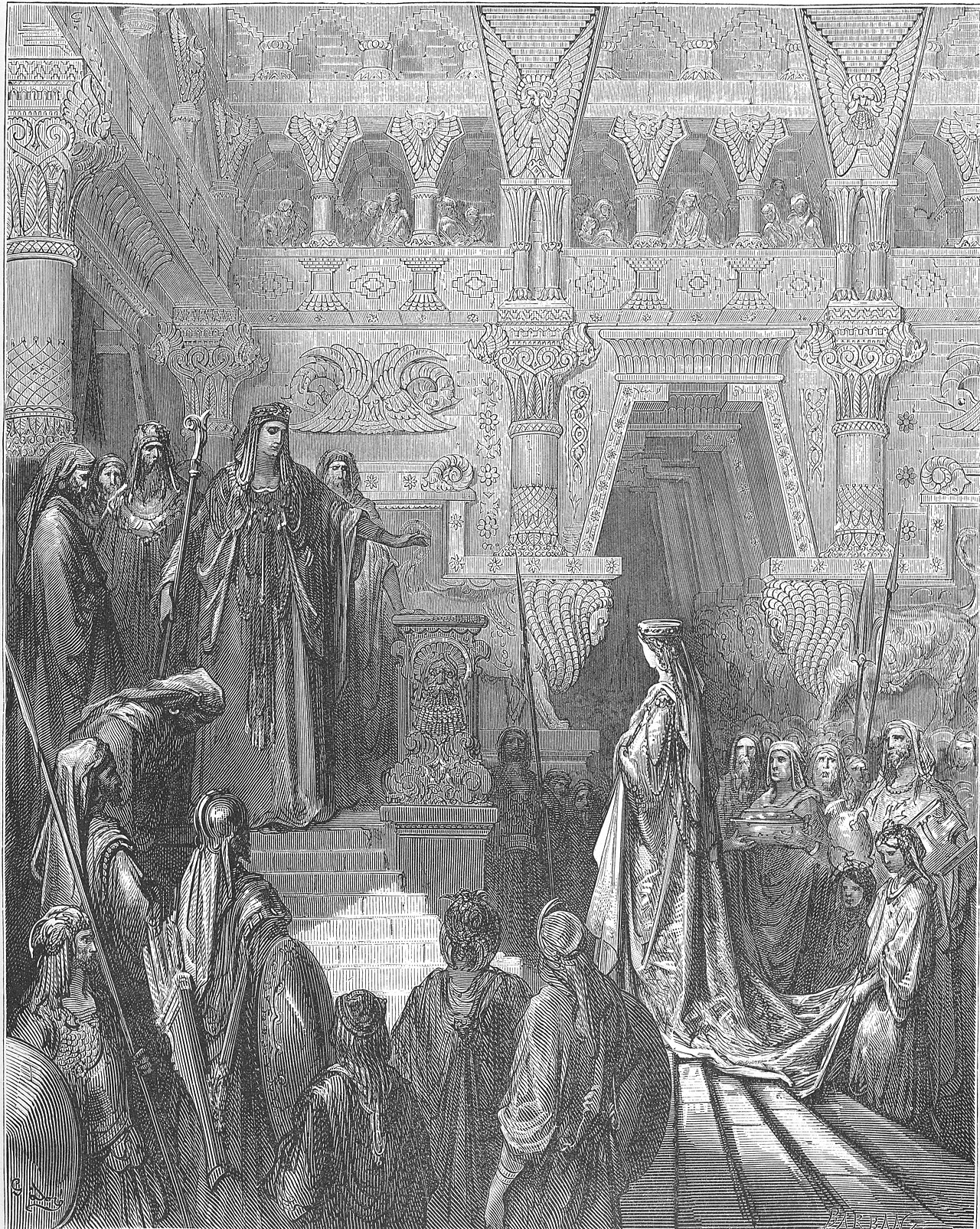
Hiram's navy, the same one that ferries gold from Ophir, also brings back almug wood, a timber rare enough that the narrator can say there came no such almug trees since. Solomon uses it for pillars in the house of the Lord and his own house, and for harps and psalteries, the same wood serving both worship and music. The chapter closes the queen's visit with Solomon's royal bounty added on top of her own requests, and she returns to her own country, an ending the Gospels never dwell on because their point in citing her is her rising in judgment, not her going home.
This site's exposition
made the almug wood into steps
The Hebrew word for steps ordinarily means a prop, and Albert Barnes takes it as a railing for the house of the LORD and the king's palace. The Berean renders it steps, as at 2 Chronicles 9:11. Barnes describes the lyre as a triangular harp with ten strings.
The record, by era
The Puritans and the Awakening2 voices
) as extraordinary, because perhaps much admired by the queen of Sheba. Solomon was not behind-hand with her: He gave her whatsoever, she asked, patterns, we may suppose, of those things that were curious, by which she might make the like; or perhaps he gave her his precepts of wisdom and piety in writing, besides that which he gave her of his royal bounty,
quarantine:debris (2026-07-29) — leading-punctuation+unbalanced-parens
And the king made of the almug trees pillars for the house of the Lord, and for the king's house,....
How the passage was read
What the Jewish commentators add
On the verses either side of this one
Gave to the queen of Sheva. This giving refers only to the teaching of wisdom.
This section is reception history: how the passage was read and kept in the Jewish tradition. Where a reading parts from an essential of the Christian faith, the section says so at that point.
Texts and citation data: Sefaria; each excerpt follows its version’s licence. 5 further sources are cited on this chapter that carry no English text this site may quote or only restate the verse.
The words behind it
23 Hebrew wordsEvery Hebrew word of this verse in the order it stands, with what it means and the door to its own study. The last column counts the times a word stands in the whole Bible: the rarer the word, the more the places it appears belong together.
| Hebrew | Sound | Meaning | Word study | In the Bible |
|---|---|---|---|---|
| וַיַּ֣עַשׂ | vaiyaas | and he made | H6213 → | 2628 times |
| הַ֠מֶּלֶךְ | hamelekh | the king | H4428 → | 2525 times |
| אֶת־ | ʾet- | <obj.> | H853 → | 10935 times |
| עֲצֵ֨י | ʾatzei | [the] wood<s> of | H6086 → | 328 times |
| הָאַלְמֻגִּ֜ים | haalmugim | the almug<s> | H484 → | 3 times |
| מִסְעָ֤ד | misad | support[s] | H4552 → | |
| לְבֵית־ | leveit- | for [the] house of | H1004 → | 2046 times |
| יְהוָה֙ | yahweh | Yahweh | H3068 → | 6520 times |
| וּלְבֵ֣ית | uleveit | and for [the] house of | H1004 → | 2046 times |
| הַמֶּ֔לֶךְ | hamelekh | the king | H4428 → | 2525 times |
| וְכִנֹּר֥וֹת | vekhinorot | and harps | H3658 → | |
| וּנְבָלִ֖ים | unevalim | and lyres | H5035 → | |
| לַשָּׁרִ֑ים | lasharim | for the singers | H7891 → | |
| לֹ֣א | lo' | not | H3808 → | 5168 times |
| בָֽא־ | va'- | it has come | H935 → | 2568 times |
| כֵ֞ן | khen | thus | H3651 → | 771 times |
| עֲצֵ֤י | ʾatzei | wood<s> of | H6086 → | 328 times |
| אַלְמֻגִּים֙ | ʾalmugim | almug<s> | H484 → | 3 times |
| וְלֹ֣א | velo' | and not | H3808 → | 5168 times |
| נִרְאָ֔ה | nirah | it has been seen | H7200 → | 1300 times |
| עַ֖ד | ʾad | until | H5704 → | 1261 times |
| הַיּ֥וֹם | haiyom | the day | H3117 → | 2304 times |
| הַזֶּֽה׃ | hazeh | <the> this | H2088 → | 1180 times |
וַיַּ֣עַשׂand he made
vaiyaasH6213 →2628 times
הַ֠מֶּלֶךְthe king
hamelekhH4428 →2525 times
אֶת־<obj.>
ʾet-H853 →10935 times
עֲצֵ֨י[the] wood<s> of
ʾatzeiH6086 →328 times
הָאַלְמֻגִּ֜יםthe almug<s>
haalmugimH484 →3 times
מִסְעָ֤דsupport[s]
misadH4552 →
לְבֵית־for [the] house of
leveit-H1004 →2046 times
יְהוָה֙Yahweh
yahwehH3068 →6520 times
וּלְבֵ֣יתand for [the] house of
uleveitH1004 →2046 times
הַמֶּ֔לֶךְthe king
hamelekhH4428 →2525 times
וְכִנֹּר֥וֹתand harps
vekhinorotH3658 →
וּנְבָלִ֖יםand lyres
unevalimH5035 →
לַשָּׁרִ֑יםfor the singers
lasharimH7891 →
לֹ֣אnot
lo'H3808 →5168 times
בָֽא־it has come
va'-H935 →2568 times
כֵ֞ןthus
khenH3651 →771 times
עֲצֵ֤יwood<s> of
ʾatzeiH6086 →328 times
אַלְמֻגִּים֙almug<s>
ʾalmugimH484 →3 times
וְלֹ֣אand not
velo'H3808 →5168 times
נִרְאָ֔הit has been seen
nirahH7200 →1300 times
עַ֖דuntil
ʾadH5704 →1261 times
הַיּ֥וֹםthe day
haiyomH3117 →2304 times
הַזֶּֽה׃<the> this
hazehH2088 →1180 times
A shaded row is a word that stands 400 times or fewer in the Bible.
The walk
5 stopsEach card is a verse this one points to, and under it the verses that one points to in turn. Where several paths arrive at the same place, that place is listed first: the text keeps returning to it.
Through
1 Chronicles 23:54,000 are to be gatekeepers, and 4,000 are to praise the LORD with the instruments I have made for giving praise.”
it leads to
- Amos 6:5
You improvise songs on the harp like David and invent your own musical instruments.
- Psalms 87:7
Singers and pipers will proclaim, “All my springs of joy are in You.”
- 2 Chronicles 8:14
In keeping with the ordinances of his father David, Solomon appointed the divisions of the priests over their service, and the Levites for their duties to offer praise and to minister before the priests…
- 2 Chronicles 29:25–26
Hezekiah stationed the Levites in the house of the LORD with cymbals, harps, and lyres according to the command of David, of Gad the king’s seer, and of Nathan the prophet. For the command…
- 2 Chronicles 35:15
The singers, the descendants of Asaph, were at their stations according to the command of David, Asaph, Heman, and Jeduthun the king’s seer. And the gatekeepers at each gate did not need to leave…
- Amos 6:5
Where this verse is studied
On this page
Studies1
About 1 Kings
This page draws on Albert Barnes, Notes, Explanatory and Practical, on the Old and New Testaments (1832-1869); Albert Barnes, Notes on the Old Testament; John Gill, Exposition of the Old Testament (1748-1763); Keil, The Books of the Kings and Matthew Henry, Commentary on the Whole Bible.