
Jonah 1:15
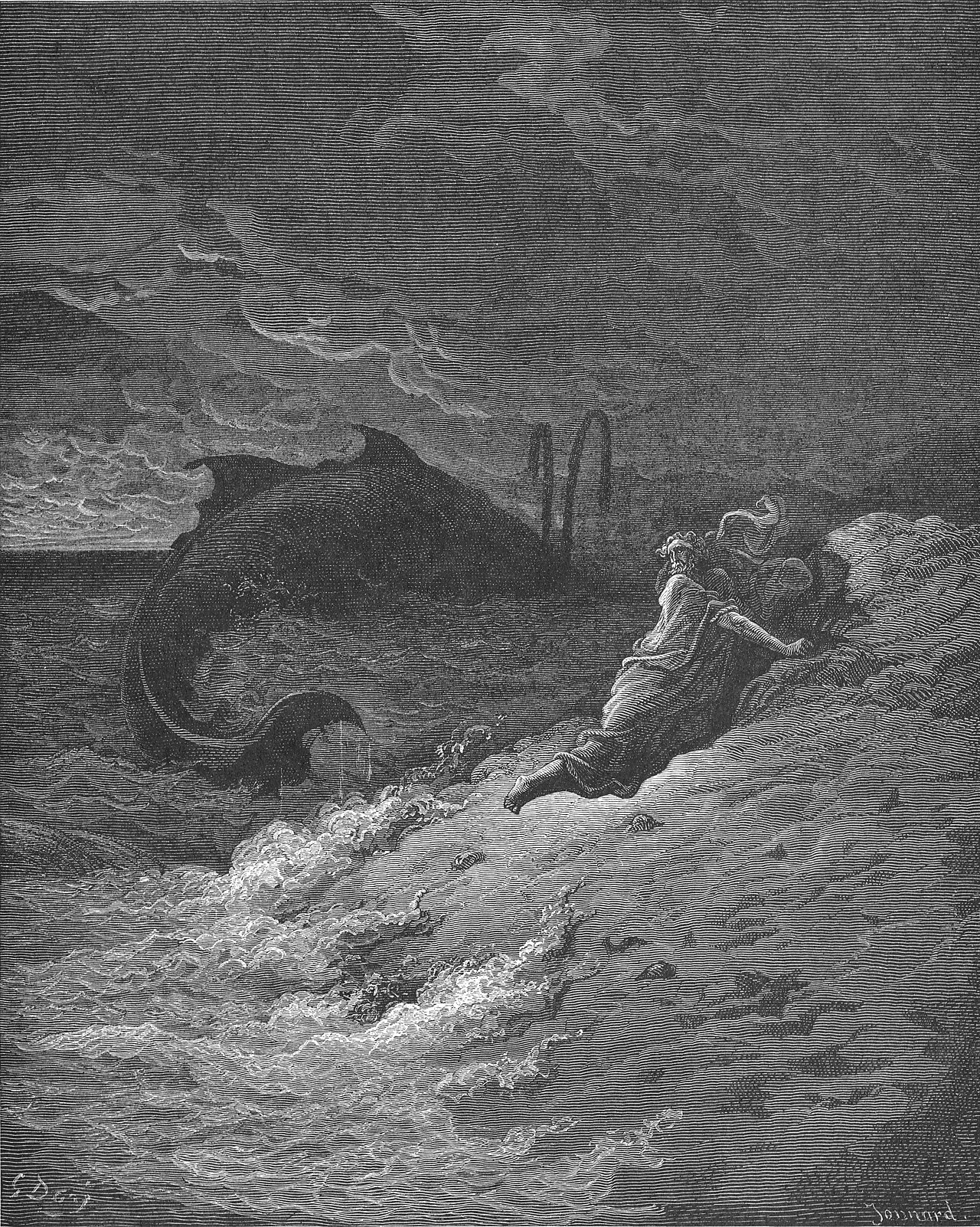
in Jonah 1At this, they picked up Jonah and cast him into the sea, and the raging sea grew calm.
BSB
The same verse in ASV and KJV ▾
ASV
So they took up Jonah, and cast him forth into the sea; and the sea ceased from its raging.
KJV
So they took up Jonah, and cast him forth into the sea: and the sea ceased from her raging.
⋯
This verse in Jonah 1
Commentary
7 notes on this verseThe text does not say they seized him or that they threw him in, but that they took him, carrying him as one [deserving] respect and honor. They discharged him into the sea not in repugnance; rather, he submitted himself of his own volition into their hands. And the sea ceased [its turmoil] because it found what it sought. When one continues as a fugitive and keeps running away as fast as one can, sooner or later he is caught and stops his running, and whatever was chasing him stands still.
This site's exposition
let us not perish for this man’s life
on Jonah 1:14-16
Let us not perish for this man's life is addressed to the Lord by name, pagan sailors now praying to Jonah's own God rather than each to his own god as at verse 5. Once they cast him into the sea and it ceases from her raging, the men feared the Lord exceedingly, and offered a sacrifice unto the Lord, and made vows, a turning recorded without a single word of Jonah's own preaching anywhere in the chapter. Calvin and Keil both point out that the sailors end this chapter doing what the reluctant prophet was sent to Nineveh to produce, fearing the Lord and worshipping him, before Jonah has preached to anyone at all.
The record, by era
The Church Fathers1 voice
"So they took up Jonah, and cast him forth into the sea: and the sea ceased from her raging." LXX: 'and they took Jonah and they threw him into the sea, and the sea became ceased from its agitation'. He did not say, they grabbed him and threw him but they raised him up as if they were carrying him with respect and honour, and they threw him into the sea without him struggling, but rather he went willingly. And the sea ceased because it had found the man it was searching for. Just as when you pursue a fugitive, and running, catch up with him, then stop to grab hold of him; so too the sea was wild without Jonah, and then when it had in its lap what it desired it rejoiced in having him and cherished him, and the calm returned by this joy. If we consider before the suffering of Christ, the confessions of the world, the contrary winds of different opinions, the ship and all human kind, that is all creation to be in danger, then, after the suffering of Christ there is the calm of faith, the peace of the world, universal safety, conversion to God, and we will see how after Jonah has been thrown overboard the sea ceases from its raging.
The Puritans and the Awakening2 voices
And if we thus by a thorough repentance and reformation cast our sins forth into the sea, never to recall them or return to them again, God will by pardoning mercy subdue our iniquities, and cast them into the depths of the sea too, Mic. vii.
So they took up, Jonah, and cast him forth into the sea,....
The Nineteenth Century2 voices
A commentator
Jamieson, Fausset & Brown1802–1910
Commentary Critical and Explanatory on the Whole Bible (1871)
proposed
sea ceased . . . raging--so at Jesus' word (Lu 8:24). God spares the prayerful penitent, a truth illustrated now in the case of the sailors, presently in that of Jonah, and thirdly, in that of Nineveh.
quarantine:debris (2026-07-29) — starts-lowercase
A commentator
Albert Barnes1798–1870
Notes, Explanatory and Practical, on the Old and New Testaments (1832-1869)
proposed
They took up Jonah - o “He does not say, ‘laid hold on him’, nor ‘came upon him’ but ‘lifted’ him; as it were, bearing him with respect and honor, they cast him into the sea, not resisting, but yielding himself to their will.” The sea ceased (literally “stood”) from his raging - Ordinarily, the waves still swell, when the wind has ceased. The sea, when it had received Jonah, was hushed at once, to show that God alone raised and quelled it. It “stood” still, like a servant, when it had accomplished its mission.
How the passage was read
What the Jewish commentators add
On the verses either side of this one
for the life of this man —I.e, for the sin of laying a hand upon his life.
This section is reception history: how the passage was read and kept in the Jewish tradition. Where a reading parts from an essential of the Christian faith, the section says so at that point.
Texts and citation data: Sefaria; each excerpt follows its version’s licence. 5 further sources are cited on this chapter that carry no English text this site may quote or only restate the verse.
The words behind it
9 Hebrew wordsEvery Hebrew word of this verse in the order it stands, with what it means and the door to its own study. The last column counts the times a word stands in the whole Bible: the rarer the word, the more the places it appears belong together.
| Hebrew | Sound | Meaning | Word study | In the Bible |
|---|---|---|---|---|
| וַיִּשְׂאוּ֙ | vaiyisu | and they picked up | H5375 → | |
| אֶת־ | ʾet- | <obj.> | H853 → | 10935 times |
| יוֹנָ֔ה | yonah | Jonah | H3124 → | 19 times |
| וַיְטִלֻ֖הוּ | vaytiluhu | and they threw him | H2904 → | 14 times |
| אֶל־ | ʾel- | into | H413 → | 5510 times |
| הַיָּ֑ם | haiyam | the sea | H3220 → | 396 times |
| וַיַּעֲמֹ֥ד | vaiyaamod | and it stopped | H5975 → | |
| הַיָּ֖ם | haiyam | the sea | H3220 → | 396 times |
| מִזַּעְפּֽוֹ׃ | miza'po | from storming its | H2197 → |
וַיִּשְׂאוּ֙and they picked up
vaiyisuH5375 →
אֶת־<obj.>
ʾet-H853 →10935 times
יוֹנָ֔הJonah
yonahH3124 →19 times
וַיְטִלֻ֖הוּand they threw him
vaytiluhuH2904 →14 times
אֶל־into
ʾel-H413 →5510 times
הַיָּ֑םthe sea
haiyamH3220 →396 times
וַיַּעֲמֹ֥דand it stopped
vaiyaamodH5975 →
הַיָּ֖םthe sea
haiyamH3220 →396 times
מִזַּעְפּֽוֹ׃from storming its
miza'poH2197 →
A shaded row is a word that stands 400 times or fewer in the Bible.
The walk
8 stopsEach card is a verse this one points to, and under it the verses that one points to in turn. Where several paths arrive at the same place, that place is listed first: the text keeps returning to it.
Through
Psalms 89:9You rule the raging sea; when its waves mount up, You still them.
it leads to
- Psalms 65:7
You stilled the roaring of the seas, the pounding of their waves, and the tumult of the nations.
Reached by 2 separate paths from here.
- Psalms 107:25–29
For He spoke and raised a tempest that lifted the waves of the sea.
Reached by 2 separate paths from here.
- Mark 4:41
Overwhelmed with fear, they asked one another, “Who is this, that even the wind and the sea obey Him?”
- Matthew 8:24–27
Suddenly a violent storm came up on the sea, so that the boat was engulfed by the waves; but Jesus was sleeping.
- Mark 4:39
Then Jesus got up and rebuked the wind and the sea. “Silence!” He commanded. “Be still!” And the wind died down, and it was perfectly calm.
- Psalms 65:7
Through
Psalms 107:29He calmed the storm to a whisper, and the waves of the sea were hushed.
it leads to
- Psalms 89:9
You rule the raging sea; when its waves mount up, You still them.
Reached by 2 separate paths from here.
- Matthew 8:26
“You of little faith,” Jesus replied, “why are you so afraid?” Then He got up and rebuked the winds and the sea, and it was perfectly calm.
- Luke 8:23–25
As they sailed, He fell asleep, and a windstorm came down on the lake, so that the boat was being swamped, and they were in great danger.
- Psalms 89:9
Where this verse is studied
On this page
Studies2
On this verse
On this chapter
About Jonah
Who and where
1 name in this verse with a page on the site.
This page draws on Albert Barnes, Notes, Explanatory and Practical, on the Old and New Testaments (1832-1869); Carl Friedrich Keil, The Twelve Minor Prophets; Jamieson, Fausset & Brown, Commentary Critical and Explanatory on the Whole Bible; Jerome, Commentary on Jonah, Chapter 1; John Calvin, Commentaries on the Twelve Minor Prophets; John Gill, Exposition of the Old Testament (1748-1763) and Matthew Henry, Commentary on the Whole Bible.