
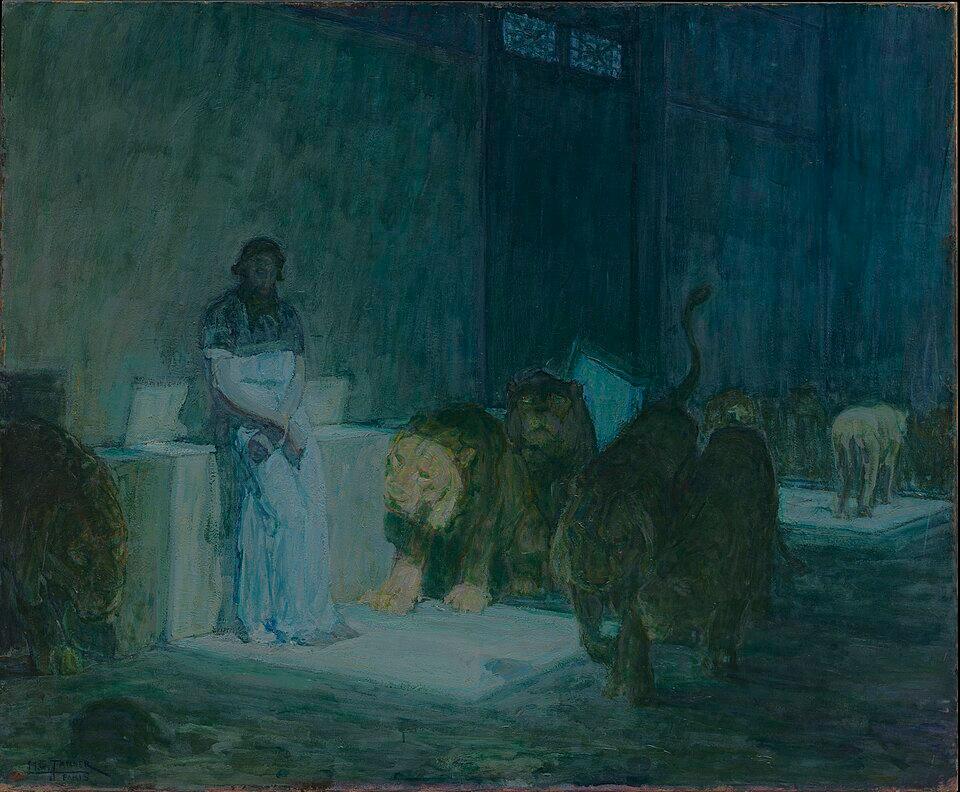
Henry Ossawa Tanner, Daniel in the Lions' Den, about 1907 to 1918. Public domain.
Matthew 22:15 to 22 · Debate · Featured Study
Church and State in Christian Thought
Christian teachers have drawn the line between the ruler's charge and God's in four ways.
“Caesar’s,” they answered. So Jesus told them, “Give to Caesar what is Caesar’s, and to God what is God’s.”
- The question
- What does the church owe the ruler, what does the ruler owe God, and where does obedience end?
- The texts
- Matthew 22:21, Romans 13:1, Acts 5:29
A synod of German Protestants met at Barmen from 29 to 31 May 1934 to answer the state's claim on the church.
Summary
The teachers of the church ask what a Christian owes the ruler. They ask what the ruler owes God, and where obedience ends. Their answers fall into four groups.
- Two answers come from the early church, one from Reformed and Methodist commentators, and one from the Anabaptists.
- Balthasar Hubmaier and Michael Sattler were both burned for their faith, in 1528 and 1527.
- Every answer grants that God is obeyed before men where the two conflict.
Two Debts
The Pharisees asked about the tax, and Jesus answered with the coin they brought Him.
The Pharisees sent the question to trap Him, and the denarius they brought bore Caesar's image.
Four Answers Side by Side
Each answer is set against the ruler's charge and the ruler's limit.
The four answers set the limit of the ruler's charge in four places.
| Held by | The ruler's charge | The ruler's limit | Representative work |
|---|---|---|---|
| Ambrose of Milan; William Allen, quoting him | The palace and the empire | The churches belong to the priest, and a bishop must speak freely to the emperor | Ambrose, Letters 40 and 57 |
| Augustine of Hippo; the Synod of Barmen | Justice and peace, by divine appointment | Temporal things only; the state may not become the whole order of human life | Augustine, The City of God 19.26; the Barmen Declaration (1934), thesis 5 |
| Matthew Henry; Adam Clarke | Civil power, which comes from God's governing power | The usurpation and abuse of power are not of God | Henry and Clarke on Romans 13 |
| Balthasar Hubmaier; Michael Sattler; Menno Simons | Kept apart from matters of faith | No sword and no law may be used to force the faith | Hubmaier, Concerning Heretics and Those Who Burn Them (1524) |
Where Obedience Ends
Peter before the council and Daniel in Babylon each refused an order that set a ruler's word against God's.
But Peter and the other apostles replied, “We must obey God rather than men.Peter's answer to the council is the limit each teacher on this subject has to place.
Now when Daniel learned that the document had been signed, he went into his house, where the windows of his upper room opened toward Jerusalem, and three times a day he got down on his knees, prayed, and gave thanks to his God, just as he had done before.The Old Testament gives Daniel's prayer under a king's ban as the same limit kept in Babylon.
John Gill, on Acts 5:29, held that civil and church rulers are to be obeyed in all that does not oppose the will of God. Where a command opposes it, God is obeyed. John Chrysostom, in his Homily 70 on Matthew, read the debt to Caesar as reaching only what does no harm to godliness.
Jonathan Mayhew, pastor of the West Church in Boston, argued in 1750 that Romans 13 itself sets a further limit.
“If it be our duty, for example, to obey our king merely for this reason, that he rules for the public welfare (which is the only argument the apostle makes use of), it follows, by a parity of reason, that when he turns tyrant, and makes his subjects his prey to devour and destroy, instead of his charge to defend and cherish, we are bound to throw off our allegiance to him, and to resist; and that according to the tenor of the apostle's argument in this passage.”
Jonathan Mayhew · A Discourse Concerning Unlimited Submission and Non-Resistance to the Higher Powers (1750), p. 79Congregational
Christians Under the Emperors
Two apologists described how Christians lived under Roman rule.
First of all, then, I urge that petitions, prayers, intercessions, and thanksgiving be offered for everyone— for kings and all those in authority—so that we may lead tranquil and quiet lives in all godliness and dignity.Paul's charge to pray for kings stands behind the prayers the apologists describe.
Justin Martyr told the emperor in his First Apology, chapter 17, that Christians paid every tax more readily than anyone. He gave the reason that Jesus had taught them to give Caesar his due. Tertullian, in his Apology 30, wrote that Christians prayed for the emperors with hands outstretched. They asked for long life, a secure empire and a quiet state.
The Holders in Their Own Words
Each answer stands with the works of the teachers who held it.
The palace for the emperor, the churches for the priestAmbrose of Milan, Letters 40 and 57; William Allen, A True, Sincere and Modest Defence of English Catholics (1584)
William Allen, defending English Catholics in 1584, gave Ambrose's rule for the two powers.
“The palaces pertain to the emperor, the churches to the priest.”
William Allen · A True, Sincere and Modest Defence of English Catholics (1584), quoting Ambrose of Milan to the emperor, volume 2Roman Catholic, cardinal
Ambrose held that a bishop must speak his mind to an emperor, and he set the emperor under the God who sees the heart.
“Though the imperial power be great, yet consider, O Emperor, how great God is. He sees the hearts of all, He questions the inmost conscience, He knows all things before they happen, He knows the inmost things of your breast. You do not suffer yourselves to be deceived, and do you desire to conceal anything from God?”
Ambrose of Milan · Letter 57 · on Acts 1:24Patristic
Two cities mingled, and the state's limited taskAugustine, The City of God 19.26 and his exposition of Romans 13; the Synod of Barmen, the Barmen Declaration (1934), thesis 5
Augustine, in The City of God 19.26, held that while the two cities are mingled the church may use the peace of Babylon. He set Paul's charge to pray for kings beside it. On Romans 13 he held that believers are subject in temporal things, which pass away, and not in the goods that remain forever.
The Confessional Synod of the German Evangelical Church gave the state its task and named the claim it rejected.
“We reject the false doctrine, as though the state, over and beyond its special commission, should and could become the single and totalitarian order of human life, thus fulfilling the church's vocation as well.”
The Synod of Barmen · The Barmen Declaration, thesis 5Barmen synod
The magistrate as God's ministerMatthew Henry, Commentary on the Whole Bible, on Romans 13:1 to 4; Adam Clarke, Commentary on the Bible, on Romans 13:6
Matthew Henry drew civil power from God's rule and set its abuse apart from it.
“By him kings reign, Prov. viii. The usurpation of power and the abuse of power are not of God, for he is not the author of sin; but the power itself is. As our natural powers, though often abused and made instruments of sin, are from God's creating power, so civil powers are from God's governing power.”
Matthew Henry · Commentary on the Whole Bible · on Romans 13:1 to 4Puritan
Adam Clarke, on Romans 13:6, called civil government an order of God. He held that a fair and moderate tax to pay its officers is reasonable.
The faith kept free of the swordBalthasar Hubmaier, Concerning Heretics and Those Who Burn Them (1524); Michael Sattler at his trial (1527), in the Martyrs Mirror; Menno Simons, A Humble and Christian Defense
Balthasar Hubmaier, an Anabaptist theologian, denied the ruler any power to punish belief.
“Now it is clear to every one, even the blind, that a law to burn heretics is an invention of the devil. Truth is immortal.”
Balthasar Hubmaier · Concerning Heretics and Those who Burn Them (1524), in Henry C. Vedder, Balthasar Hübmaier (New York, 1905), article 36, page 88Anabaptist
Michael Sattler told his judges in 1527 that he was sent to bear witness to the Word of God and not to judge it. Menno Simons answered the charge that his people refused to obey the magistracy and meant to take cities by force.
A Kingdom Not of This World
Jesus told Pilate where His kingdom comes from.
Jesus answered, “My kingdom is not of this world; if it were, My servants would fight to prevent My arrest by the Jews. But now My kingdom is not of this realm.”Jesus tells the governor who will judge Him why His servants do not fight, a word each answer must place.
Sources
Scripture is the Berean Standard Bible.
- William Allen, A True, Sincere and Modest Defence of English Catholics (1584), quoting Ambrose of Milan to the emperor.
- Ambrose of Milan, Letter 40, to Theodosius.
- Ambrose of Milan, Letter 57.
- Augustine of Hippo, The City of God 19.26.
- Augustine of Hippo, on Romans 13:5 (his exposition of Romans, 74)
- The Synod of Barmen, The Barmen Declaration (1934), thesis 5.
- Matthew Henry, Commentary on the Whole Bible, on Romans 13:1 to 4.
- Adam Clarke, Commentary on the Bible, on Romans 13:6.
- Balthasar Hubmaier, Concerning Heretics and Those Who Burn Them (1524), in Henry C. Vedder, Balthasar Hübmaier (New York, 1905), article 36.
- Michael Sattler, his answer at his trial (1527), in Thieleman J. van Braght, Martyrs Mirror, translated by Joseph F. Sohm (1886), page 418.
- Menno Simons, A Humble and Christian Defense, the preface.
- John Gill, Exposition of the New Testament, on Acts 5:29.
- John Chrysostom, Homily 70 on the Gospel of Matthew, on Matthew 22:21.
- Jonathan Mayhew, A Discourse Concerning Unlimited Submission and Non-Resistance to the Higher Powers (1750), page 79.
- Justin Martyr, The First Apology, chapter 17.
- Tertullian, Apology 30.
- The scholars table of the store: the records of Balthasar Hubmaier, Michael Sattler, William Allen, Jonathan Mayhew and the Synod of Barmen.
Keep Studying
Read it2
Studies5
People and groups8
Subjects1