
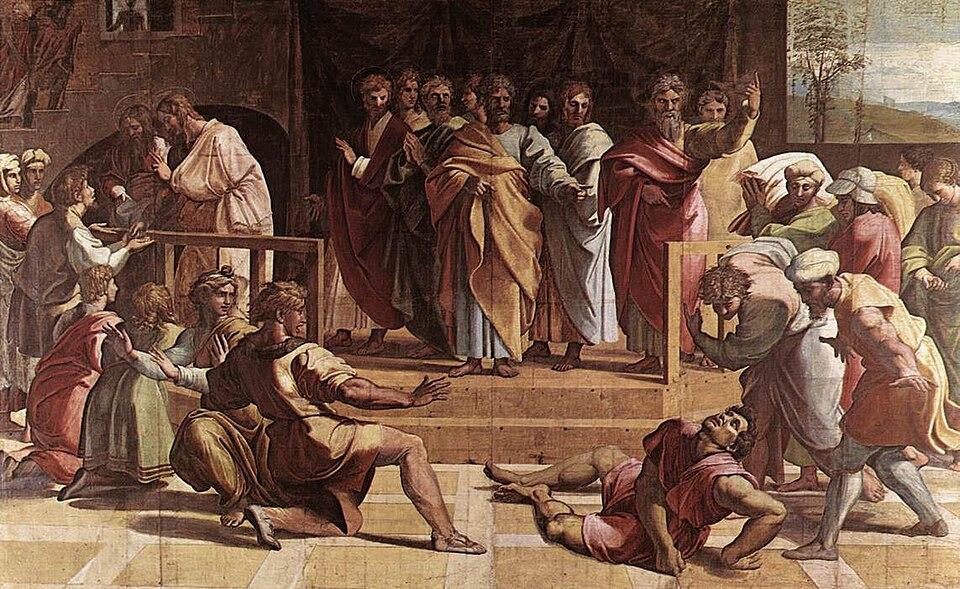
Raphael, The Death of Ananias, 1515. Public domain.
Matthew 16:18 to 19 · Debate · Featured Study
Peter, the Papacy and Apostolic Succession
Peter is named first in the lists of the apostles, and three traditions read three different offices in that place.
I will give you the keys of the kingdom of heaven. Whatever you bind on earth will be bound in heaven, and whatever you loose on earth will be loosed in heaven.”
- The question
- Did Peter hold a first place among the apostles, and does an office pass from him to the bishops after him?
- The texts
- Matthew 16:19, Matthew 18:18
Ignatius of Antioch wrote that wherever the bishop appears, there the people should be.
Summary
Simon stood up with the Eleven and preached on the day of Pentecost. He rose to speak at the council in Jerusalem.
- Roman Catholic teachers give the see of Rome the place Peter held.
- Cyprian and Jerome held that every bishop holds one and the same office.
- Methodist and Protestant commentators held that Peter's place died with him.
Simon's Charge in Luke and John
Luke and John record words Jesus spoke to Simon alone.
Simon, Simon, Satan has asked to sift each of you like wheat. But I have prayed for you, Simon, that your faith will not fail. And when you have turned back, strengthen your brothers.”Every answer on Peter's office cites this charge for the task he was given toward the other apostles.
When they had finished eating, Jesus asked Simon Peter, “Simon son of John, do you love Me more than these?” “Yes, Lord,” he answered, “You know I love You.” Jesus replied, “Feed My lambs.” Jesus asked a second time, “Simon son of John, do you love Me?” “Yes, Lord,” he answered, “You know I love You.” Jesus told him, “Shepherd My sheep.” Jesus asked a third time, “Simon son of John, do you love Me?” Peter was deeply hurt that Jesus had asked him a third time, “Do you love Me?” “Lord, You know all things,” he replied. “You know I love You.” Jesus said to him, “Feed My sheep.This is the second text each answer must explain, since the flock is given to Simon by name.
Every reading starts from these two scenes and from the keys of Matthew 16:19. The rock of that verse has its own study.
Three Answers Side by Side
Each answer is set against the same three questions.
Each answer gives Peter a first place and reads a different office in it.
| Held by | Peter's place among the Twelve | What passed after him | Where it passed |
|---|---|---|---|
| Rabanus Maurus; Thomas Aquinas; Bonaventure | Primacy of judgment | His office as vicar | The see of Rome |
| Cyprian of Carthage; Jerome | First in honour, for unity | The one office of bishop | Every faithful bishop |
| John Wesley; Albert Barnes; Jamieson, Fausset and Brown | First in order | No office of rule | No successor |
Peter Among the Apostles
Acts shows Peter sent by the other apostles and answering to the believers in Jerusalem.
When the apostles in Jerusalem heard that Samaria had received the word of God, they sent Peter and John to them.Readers weigh whether the apostles who send Peter stand over him or beside him.
Adam Clarke, on Acts 8:14, held that there was no single ruler among the apostles, since Peter is one of those sent, with the same commission as John. John Gill, on Acts 11:4, read Peter's account of Cornelius as a case submitted to the judgment of the brethren.
Gregory the Great read the same scene in Acts 11 the other way, in his Register of Epistles, book 11, letter 45. He called Peter the pastor of the church and the Prince of the Apostles. He held that Peter answered his critics with humility when he could have pleaded his authority.
Succession of Persons or of Teaching
Paul tells Timothy and Titus to hand on the teaching and to appoint elders.
And the things that you have heard me say among many witnesses, entrust these to faithful men who will be qualified to teach others as well.The answers that read a succession of teaching rest on this charge to Timothy.
The reason I left you in Crete was that you would set in order what was unfinished and appoint elders in every town, as I directed you.Every reading of succession must place the office Titus is told to fill.
Irenaeus set the first bishops of Rome as witnesses that the apostles' teaching was kept there.
“The blessed apostles, then, having founded and built up the Church, committed into the hands of Linus the office of the episcopate. Of this Linus, Paul makes mention in the Epistles to Timothy. To him succeeded Anacletus; and after him, in the third place from the apostles, Clement was allotted the bishopric. This man, as he had seen the blessed apostles, and had been conversant with them, might be said to have the preaching of the apostles still echoing [in his ears], and their traditions before his eyes.”
Irenaeus · Against Heresies Book 3 · on 2 Thessalonians 2:14Patristic
The Holders in Their Own Words
Each answer stands with the works of the teachers who held it.
Rabanus Maurus, Thomas Aquinas and BonaventureRabanus Maurus, in the Catena Aurea on Matthew 16:19; Thomas Aquinas, Commentary on Matthew; Bonaventure, Disputed Questions on Evangelical Perfection 4
Rabanus Maurus granted that the power to bind and loose was given to all the apostles and remains with the bishops and presbyters of every church. He held that Peter received the keys in a special manner, with a supremacy of judicial power. In his reading no one who leaves communion with Peter can be loosed from sin.
Thomas Aquinas, on Matthew 16:19, wrote that Christ founded the church on earth and established Peter as His vicar. Bonaventure called Peter the Vicar of the Rock, from whom the firmness of the whole church flows.
Cyprian of Carthage and JeromeCyprian, On the Unity of the Church 4; Jerome, Against Jovinianus 1.26 and Letter 146
Cyprian of Carthage held that after the resurrection Jesus gave an equal power to all the apostles. In his reading the other apostles had a like partnership of honour and power with Peter. The words to Peter set the beginning of unity in one man.
Jerome granted the point Peter's first place rests on and drew a limit from it.
“But you say the church was founded on Peter, although elsewhere the same is attributed to all the apostles, and they all receive the keys of the kingdom of heaven, and the strength of the church depends on them all alike, yet one among the twelve is chosen so that when a head has been appointed, there may be no occasion for schism.”
Jerome · Against Jovinianus 1.26 · on John 20:23Patristic
In his Letter 146 Jerome read Titus 1:5 as proof that a bishop and a presbyter were one office in the apostles' day. He held that one was later chosen to preside over the rest as a remedy for schism.
John Wesley, Albert Barnes and Jamieson, Fausset and BrownJohn Wesley, Explanatory Notes upon the New Testament; Albert Barnes, Notes on Matthew 18:18; Jamieson, Fausset and Brown on Matthew 16:19
John Wesley, on Luke 22:29, read Jesus as appointing a kingdom to every one of the apostles and a primacy to none. On Matthew 16:19 he held that the keys were given equally to all the apostles, and that Peter was the first to use them after the resurrection. On 1 Peter 5:1 he called Peter the first, though not the head, of the apostles. On Titus 1:5 he called the men Titus appointed the elders, or bishops, that Paul approved.
Albert Barnes, on Matthew 18:18, read the same words spoken to all the apostles as a sign that they all had the same power. He held that the promise reached the apostles alone, since every other minister may err.
Jamieson, Fausset and Brown granted Peter's firstness in the record and read it as a firstness in time.
“As first in confessing Christ, Peter got this commission before the rest; and with these ‘keys,’ on the day of Pentecost, he first ‘opened the door of faith’ to the Jews, and then, in the person of Cornelius, he was honored to do the same to the Gentiles. Hence, in the lists of the apostles, Peter is always first named.”
Jamieson, Fausset & Brown · Commentary Critical and Explanatory on the Whole Bible · on Matthew 16:19Reformed
A Fellow Elder
Peter's first letter names his own office among the elders he writes to.
As a fellow elder, a witness of Christ’s sufferings, and a partaker of the glory to be revealed, I appeal to the elders among you: Be shepherds of God’s flock that is among you, watching over them not out of compulsion, but because it is God’s will; not out of greed, but out of eagerness; not lording it over those entrusted to you, but being examples to the flock. And when the Chief Shepherd appears, you will receive the crown of glory that will never fade away.Each reading of Peter's office has to hold the title he gives himself here.
Sources
Scripture is the Berean Standard Bible.
- Rabanus Maurus, in the Catena Aurea of Thomas Aquinas, on Matthew 16:19.
- Thomas Aquinas, Commentary on the Gospel of Matthew, on Matthew 16:19.
- Bonaventure, Disputed Questions on Evangelical Perfection, question 4.
- Irenaeus, Against Heresies, book 3.
- Cyprian of Carthage, On the Unity of the Church 4.
- Jerome, Against Jovinianus 1.26.
- Jerome, Letter 146, to Evangelus.
- Ignatius of Antioch, The Epistle to the Smyrnaeans, chapter 8.
- Gregory the Great, Register of Epistles, book 11, epistle 45.
- John Wesley, Explanatory Notes upon the New Testament (1755), on Luke 22:29, Matthew 16:19, Titus 1:5 and 1 Peter 5:1.
- Adam Clarke, Commentary on the Bible, on Acts 8:14.
- John Gill, Exposition of the New Testament (1746 to 1748), on Acts 11:4.
- Albert Barnes, Notes, Explanatory and Practical, on Matthew 18:18.
- Jamieson, Fausset and Brown, Commentary Critical and Explanatory on the Whole Bible (1871), on Matthew 16:19.
Keep Studying
Read it2
Studies7
People and groups5
Subjects1