
Matthew 17:21
in Matthew 17BSB
The same verse in ASV and KJV ▾
ASV
KJV
Howbeit this kind goeth not out but by prayer and fasting.
⋯
This verse in Matthew 17
Commentary
22 notes on this verseThe manuscripts
Prayer and fasting, a verse that is missing from Matthew
Matthew's verse 21, "this kind goeth not out but by prayer and fasting" — is absent from the earliest manuscripts and looks like a copy of Mark 9:29 that a scribe wrote into the margin. What it changes: No doctrine. Fasting is commanded and assumed all through Scripture, Jesus teaches on it in Matthew 6:16-18, and the church in Acts 13:2-3 fasts before sending out Barnabas and Saul.
If then we shall ever be required to be employed in the healing of those who are suffering any thing of this sort, we shall not adjure them, nor ask them questions, nor even speak, as though the unclean spirit could hear us, but by our fasting and our prayers drive away the evil spirits.
This site's exposition
Why could not we cast him out
on Matthew 17:19-21
Privately the disciples ask why their own attempt failed, and Jesus names unbelief, then reaches for the smallest seed known in that region to picture the largest possible confidence, faith as a grain of mustard seed able to move a mountain, recalling the parable of 13:31-32 now applied to personal prayer rather than to the kingdom's growth. Verse 21, this kind goeth not out but by prayer and fasting, is absent from a number of early manuscripts and many modern critical texts bracket it, though the KJV floor carries it in full, and the exposition notes the variant honestly rather than silently. Either way, the passage as a whole ties effective faith to a life of dependence on God rather than to technique.
The record, by era
The Church Fathers4 voices
A commentator
Desert FathersThe Desert Fathers, Sayings of the Early Christian Monks · Written before 500.
proposed
John the Short said, 'If a king wants to take a city filled with his enemies, he first captures their food and water, and when they are starving he subdues them. So it is with gluttony. If a man is sincere about fasting and is …
Or, fasting is here understood generally as abstinence not from food only, but from all carnal allurements, and sinful passions. In like manner prayer is to be understood in general as consisting in pious and good acts, concerning which the Apostle speaks, Pray without ceasing. (1 Thess. 5:17.)
Thereafter He prescribed to fasts a law-that they are to be performed "without sadness: " for why should what is salutary be sad? He taught likewise that fasts are to be the weapons for battling with the more direful demons: for what wonder if the same operation is the instrument of the iniquitous spirit's egress as of the Holy Spirit's ingress? Finally, granting that upon the centurion Cornelius, even before baptism, the honourable gift of the Holy Spirit, together with the gift of prophecy besides, had hastened to descend, we see that his fasts had been heard, I think, moreover, that the apostle too, in the Second of Corinthians, among his labours, and perils, and hardships, after "hunger and thirst," enumerates "fasts" also "very many"
A commentator
John ChrysostomHomily on the Gospel of Matthew 57 · Written in the 5th century.
proposed
"Howbeit, this kind goeth not out, but by prayer and fasting;" meaning the whole kind of evil spirits, not that of lunatics only. Seest thou how He now proceeds to lay beforehand in them the foundation of His doctrine about fasting? Nay, argue not with me from rare cases, that some even without fasting have cast them out. For although one might say this, in one or two instances, of them that rebuke the evil spirits, yet for the patient it is a thing impossible, living luxuriously, to be delivered from such madness: this thing being especially necessary for him that is diseased in that way. "And yet, if faith be requisite," one may say, "what need of fasting?" Because, together with our faith, that also brings no small power. For it both implants much strictness, and of a man makes one an angel, and fights against the incorporeal powers: yet not by itself, but prayer too is needed, and prayer must come first. See, at any rate, how many blessings spring from them both. For he that is praying as he ought, and fasting, hath not many wants, and he that hath not many wants, cannot be covetous; he that is not covetous, will be also more disposed for almsgiving. He that fasts is light, and winged, and prays with wakefulness, and quenches his wicked lusts, and propitiates God, and humbles his soul when lifted up. Therefore even the apostles were almost always fasting. He that prays with fasting hath his wings double, and lighter than the very winds. For neither doth he gape, nor stretch himself, nor grow torpid in prayer, as is the case with most men, but is more vehement than fire, and rises above the earth. Wherefore also such a one is most especially a hater and an enemy to the evil spirits. For nothing is mightier than a man who prays sincerely. […]
The Medieval Church1 voice
But while He teaches the Apostles how the dæmon ought to be cast out, He instructs all in regulation of life; that we may all know that all the heavier inflictions, whether of unclean spirits, or temptations of men, may be removed by fasts and prayers; and that the wrath also of the Lord may be appeased by this remedy alone; whence he adds, Howbeit this kind is not cast out but by prayer and fasting.
14 more voices on this verse
The Medieval Church3 voices
(ord.) Or; This class of dæmons, that is the variety of carnal pleasures, is not overcome unless the spirit be strengthened by prayer, and the flesh enfeebled by fast.
But this kind of demons (the word this does not indicate only the kind of lunatic demon, but every kind of demon) is not cast out but by prayer and fasting. Chrysostom says that the more the soul is elevated, the more terrible it is …
Then came the disciples to Jesus apart, and said, Why could not we cast him out? And Jesus said unto them, Because of your unbelief: for verily I say unto you, If ye have faith as a grain of mustard seed, ye shall say unto …
The Puritans and the Awakening3 voices
This kind of devils - goeth not out but by prayer and fasting - What a testimony is here of the efficacy of fasting, when added to fervent prayer! Some kinds of devils the apostles had cast out before this, without fasting.
"This kind of faith (which removeth mountains) doth not proceed, is not obtained, from God, nor is it carried up to its full growth, nor drawn out into act and exercise, but by earnest prayer." [3.] Fasting and prayer are proper means for the bringing down of Satan's power against us, and the fetching in of divine power to our assistance.
Howbeit, this kind goeth not out,....
The Nineteenth Century8 voices
A commentator
Albert Barnes1798–1870
Notes, Explanatory and Practical, on the Old and New Testaments (1832-1869)
Howbeit, this kind ... - This kind means this kind of devils - this species of possession. Where they have had long possession where they produce such painful, fixed, and alarming effects, they can be expelled only in connection with prayer and fasting. Goeth not out but by prayer and fasting - That is, in order to work miracles of this kind to cast out devils in cases so obstinate and dreadful as this, faith of the highest kind is necessary.
We read in this passage another of our Lord’s great miracles. He heals a young man lunatic and possessed with a devil. The first thing we see in these verses is a lively emblem of the awful influence sometimes exercised by Satan over the young. We are told of a certain man’s son, who was “lunatic and sore vexed.” We are told of the evil spirit pressing him on to the destruction of body and soul: “Oftimes he falleth into the fire and oft into the water.”
A commentator
Charles Spurgeon1834–1892
The Metropolitan Tabernacle Pulpit, Sermon No. 2454: “The Secret of Failure” (lightly modernized text, CCEL edition) · Written before 1892.
I put these two texts together for this reason. Those of you who are acquainted with the Revised Version know that the 21st verse in the 17th chapter of Matthew is left out. There seems to be little doubt that it was inserted in certain copies by persons who thought that it ought to be there because it was in Mark's narrative. It is put in the margin of the Revised Version, but it is left out of the text.
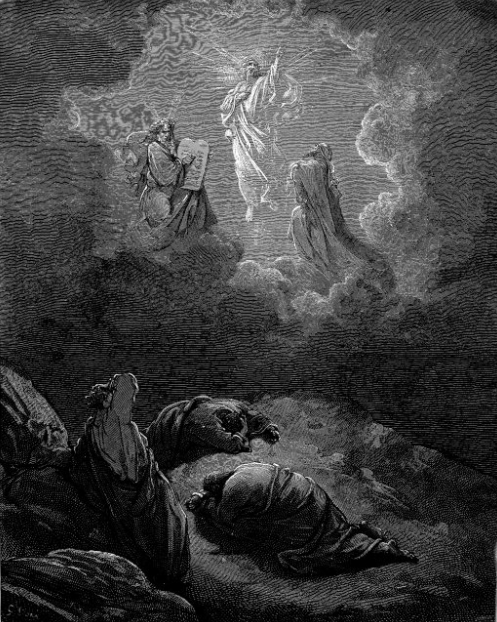
THE NARRATIVE, of which our text forms a part, describes a scene which took place immediately after the transfiguration of our Lord. Not to divorce it therefore from its connection, let us glance at the antecedents of the case, that nothing may be lost by negligence, or that peradventure we may gain something by meditation. How great the difference between Moses and Christ!
THE NARRATIVE, of which our text forms a part, describes a scene which took place immediately after the transfiguration of our Lord. Not to divorce it therefore from its connection, let us glance at the antecedents of the case, that nothing may be lost by negligence, or that peradventure we may gain something by meditation. How great the difference between Moses and Christ! When Moses had been forty days upon the mountaintop, he underwent a kind of transfiguration, so that his face shone with exceeding brightness when he came down among the people, and he was obliged to put a veil over his face; for they could not bear to look upon his glory. Not so our Saviour! He had been really transfigured with a greater glory than Moses could ever know, and yet, as he came down from the mount, whatever radiance shone upon his face, it is not written that the people could not look upon him, but rather they were amazed, and running to him, they saluted him. The glory of the law repelled; for the majesty of holiness and justice, drive the awed spirits away from God. But the greater glory of Jesus attracts; though he is holy, and just, and righteous too, yet blended with these there is so much of truth and grace that sinners run to Jesus, amazed at his goodness, attracted by the charming fascination of his love, and they salute him, become his disciples, and take him to be their Lord and Master. Some of you may be just now blinded by the dazzling brightness of the law of God. You feel its claims on your conscience, but you cannot keep it in your life. It is too high; you cannot attain to it. Not that you find fault with the law; on the contrary, it commands your profoundest esteem.
A commentator
Charles Spurgeon1834–1892
The Metropolitan Tabernacle Pulpit, Sermon No. 2454: “The Secret of Failure” (lightly modernized text, CCEL edition) · Written before 1892.
proposed
I put these two texts together for this reason. Those of you who are acquainted with the Revised Version know that the 21st verse in the 17th chapter of Matthew is left out. There seems to be little doubt that it was inserted in certain copies by persons who thought that it ought to be there because it was in Mark's narrative. It is put in the margin of the Revised Version, but it is left out of the text. It is, therefore, very satisfactory to find that the omission from Matthew's account makes no real difference because we have the words in the 29th verse of the 9th of Mark, "This kind can come forth by nothing but by prayer and fasting." Only there is this fact to be noticed—in the Revised Version this verse runs, according to Mark, "This kind can come out by nothing, save by prayer." Whether the fasting was originally there, or not, I cannot tell, but putting together the two accounts in Matthew and Mark, we believe we have a full and true report of what the Master did actually say on this occasion. I. Observe then, dear Friends, at the outset, without any further preface, that WE MAY BE THE SERVANTS OF GOD AND YET WE MAY OCCASIONALLY BE DEFEATED. Those nine disciples who remained at the foot of the mountain when the Savior took the other three to behold His Transfiguration, had, each of them, a true commission from the Lord Jesus Christ. They were nine of His chosen Apostles. He had elected them in His own good pleasure and there was no doubt about their being really called to the Apostleship. They were not only elected, but they were also qualified, for on former occasions they had healed the sick, they had cast out devils and they had preached the Word of Christ with great power.
We read in this passage another of our Lord’s great miracles. He heals a young man lunatic and possessed with a devil. The first thing we see in these verses is a lively emblem of the awful influence sometimes exercised by Satan over the young. We are told of a certain man’s son, who was “lunatic and sore vexed.” We are told of the evil spirit pressing him on to the destruction of body and soul: “Oftimes he falleth into the fire and oft into the water.” It was one of those cases of Satanic possession which, however common in our Lord’s times, in our own day is rarely seen; but we can easily imagine that, when they did occur, they must have been peculiarly distressing to the relations of the afflicted. It is painful enough to see the bodies of those we love wracked by disease: how much more painful must it have been to see body and mind completely under the influence of the devil! “Out of hell,” says Bishop Hall, “there could not be greater misery.” But we must not forget that there are many instances of Satan’s spiritual dominion over young people which are quite as painful, in their way, as the case described in this passage. There are thousands of young men who seem to have wholly given themselves up to Satan’s temptations, and to be led “captive at his will” (2 Timothy ). They cast off all fear of God, and all respect for his commandments; they serve divers lusts and pleasures; they run wildly into every excess of riot; they refuse to listen to the advice of parents, teachers or ministers; they fling aside all regard for health, character or worldly respectability. They do all that lies in their power to ruin themselves, body and soul, for time and eternity: they are willing bond-slaves of Satan. Who has not seen such young men? They are to be seen in town and in country; they are to be found among rich and among poor.
This kind goeth not out but by prayer, etc. - Τουτο το γενος, this kind, some apply to the faith which should be exercised on the occasion, which goeth not out, doth not exert itself, but by prayer and fasting; but this interpretation is, in my opinion, far from solid. However, there is great difficulty in the text. The whole verse is wanting in the famous Vatican MS., one of the most ancient and most authentic perhaps in the world; and in another one of Colbert’s, written in the 11th or 12th century. It is wanting also in the Coptic, Ethiopic, Syriac, Hieros., and in one copy of the Itala. But all the MSS. acknowledge it in the parallel place, Mar 9:29, only the Vatican MS. leaves out νηϚεια, fasting. I strongly suspect it to be an interpolation; but, if it be, it is very ancient, as Origen, Chrysostom, and others of the primitive fathers, acknowledged it. But while candour obliges me to acknowledge that I cannot account for the fact here alleged, that a certain class or genus of demons cannot be expelled but by prayer and fasting, while others may be ejected without them, I can give a sense to the passage which all my readers will easily understand: viz. that there are certain evil propensities, in some persons, which pampering the flesh tends to nourish and strengthen; and that self-denial and fasting, accompanied by prayer to God, are the most likely means, not only to mortify such propensities, but also to destroy them. For other remarkable circumstances relative to this case, see the notes on Mar 9:17, etc.
Where this verse is studied
About Matthew
This page draws on 18 works. Open the list of works
This page draws on Adam Clarke, Commentary on the Bible; Albert Barnes, Notes, Explanatory and Practical, on the Old and New Testaments (1832-1869); Charles Spurgeon, The Metropolitan Tabernacle Pulpit, Sermon No. 2454: “The Secret of Failure” (lightly modernized text, CCEL edition); Charles Spurgeon, The Metropolitan Tabernacle Pulpit, Sermon No. 549: “A Desperate Case—How to Meet It” (lightly modernized text, CCEL edition); Desert Fathers, The Desert Fathers, Sayings of the Early Christian Monks; Glossa Ordinaria, Catena Aurea by Aquinas; J.C. Ryle, Expository Thoughts on the Gospels: Matthew; John Chrysostom, Homily on the Gospel of Matthew 57; John Gill, Exposition of the New Testament; John Gill, Exposition of the New Testament (1746-1748); John Wesley, Explanatory Notes upon the New Testament; Matthew Henry, Commentary on the Whole Bible; Origen of Alexandria, Catena Aurea by Aquinas; Rabanus Maurus, Catena Aurea by Aquinas; Remigius of Rheims, Catena Aurea by Aquinas; Tertullian, On Fasting; Theophylact of Ohrid, Commentary on Matthew and Thomas Aquinas, Commentary on Matthew.