
Job 2:11
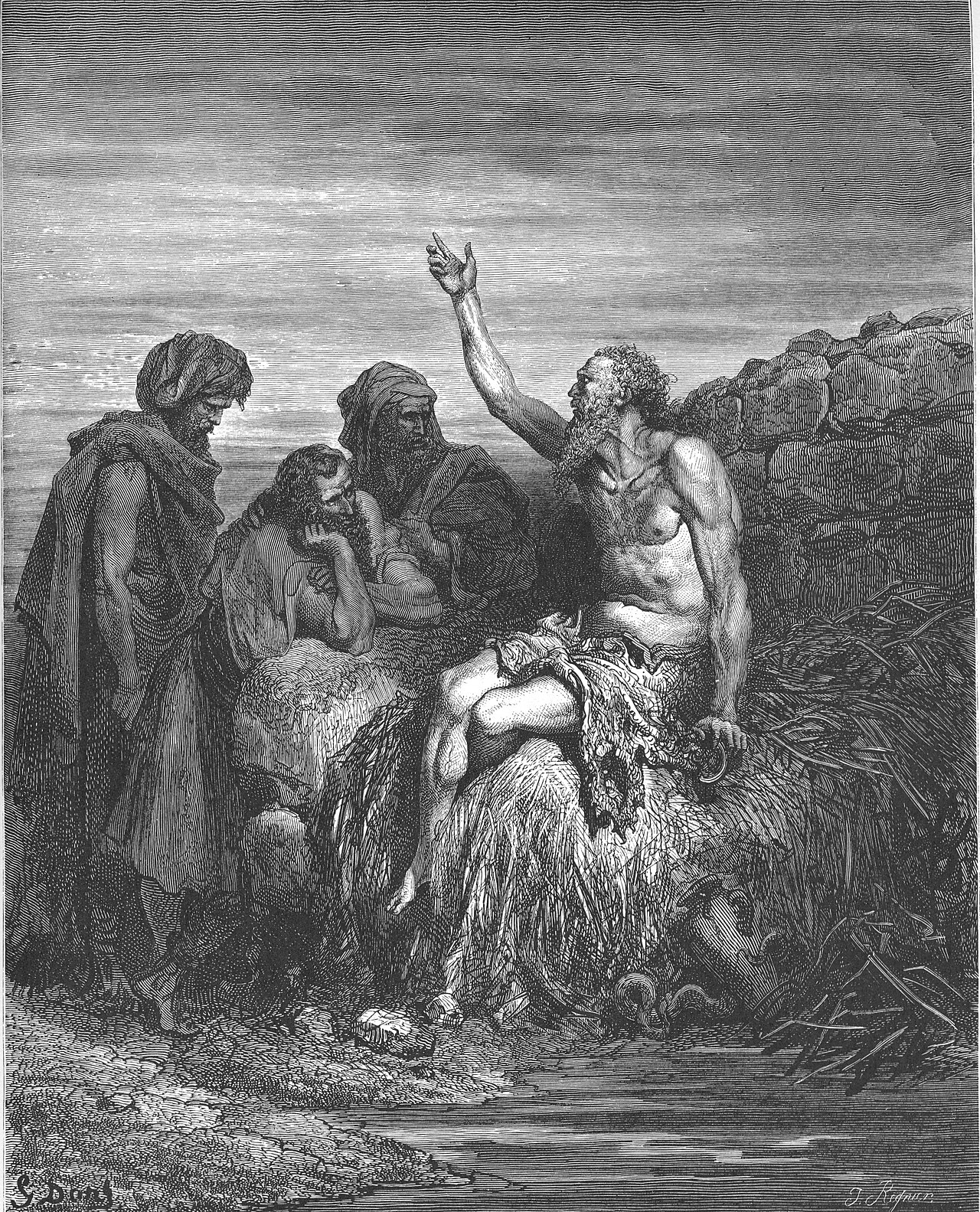
in Job 2Now when Job’s three friends—Eliphaz the Temanite, Bildad the Shuhite, and Zophar the Naamathite—heard about all this adversity that had come upon him, each of them came from his home, and they met together to go and sympathize with Job and comfort him.
BSB
The same verse in ASV and KJV ▾
ASV
Now when Job’s three friends heard of all this evil that was come upon him, they came every one from his own place: Eliphaz the Temanite, and Bildad the Shuhite, and Zophar the Naamathite; and they made an appointment together to come to bemoan him and to comfort him.
KJV
Now when Job’s three friends heard of all this evil that was come upon him, they came every one from his own place; Eliphaz the Temanite, and Bildad the Shuhite, and Zophar the Naamathite: for they had made an appointment together to come to mourn with him and to comfort him.
⋯
This verse in Job 2
Commentary
14 notes on this verseA commentator
Albert Barnes1798–1870
Notes, Explanatory and Practical, on the Old and New Testaments (1832-1869)
Now when Job’s three friends heard - It would seem from this that these men were his particular friends. They came every one from his own place - His residence. This was the result of agreement or appointment thus to meet together. Eliphaz the Temanite - This was the most prominent of his friends. In the ensuing discussion he regularly takes the lead, advances the most important and impressive considerations, and is followed and sustained by the others. The Septuagint renders this Ελιφὰζ ὁ Θαιμαινῶν βασιλεὺς Elifaz ho Thaimainōn basileus - Eliphaz, the king of the Themanites.
This site's exposition
heard about all this adversity
on Job 2:11-13
Eliphaz the Temanite, Bildad the Shuhite and Zophar the Naamathite arrive, and Eliphaz bears a town name from Edom, where the opening verse placed Job. They tear their robes and sit on the ground and "no one spoke a word to him because they saw how intense his suffering was".
The record, by era
The Church Fathers2 voices
In the meantime, while the friends investigated Job's case and made preparations for their journey, there is no doubt that many days passed. They were all lords and men of princely rank. Job's three friends signified the class of the high priests, the priests and …
Job's friends came to do both things, since he had suffered both. On the one hand, Job's possessions and his children were taken from him, and on the other hand his entire body was covered with leprosy. They arrived "together" at Job's place. Their simultaneous …
The Medieval Church3 voices
HISTORICAL INTERPRETATION. Now when Job's three friends heard of all this evil that was come upon him, they came everyone from his own place; Eliphaz the Temanite, and Bildad the Shuhite, and Zophar the Naamathite: for they had made an appointment together to come to mourn with him and to comfort him. We have it proved to us how great a love they entertained both for each other, and for the smitten man, in that they came by agreement to administer consolation to him when afflicted. Though even by this circumstance, viz. that Scripture bears witness they were the friends of so great a man, it is made appear that they were men of a good spirit and right intention; though this very intention of mind, when they break forth into words, upon indiscretion arising, becomes clouded in the sight of the strict Judge.
ALLEGORICAL INTERPRETATION. Now when Job's three friends heard of all this evil that was come upon him, they came everyone from his own place; Eliphaz the Temanite, and Bildad the Shuhite, and Zophar the Naamathite. In the Preface to this work we said that the friends of blessed Job, though they come together to him with a good purpose, yet do for this reason bear the likeness of heretics, in that they fall away into sin by speaking without discretion; and hence it is said to them by blessed Job, Surely I would speak to the Almighty, I desire to reason with God; but ye are forgers of lies, and followers of corrupt doctrines. Thus Holy Church, which is set in the midst of tribulation all this time of her pilgrimage, whilst she suffers wounds, and mourns over the downfall of her members, has other enemies of Christ besides to bear with, under Christ's name. For to the increasing of her grief, heretics also meet together in dispute and strife, and they pierce her with unreasonable words like as with a kind of dart. And it is well said, they came every one from his own place. For 'the place' of heretics is very pride itself. For except they first swelled with pride in their hearts, they would never enter the lists of false assertion. For the place of the wicked is pride, just as reversely humility is 'the place' of the good. Whereof Solomon saith, If the spirit of the ruler rise up against thee, leave not thy place. As though he said in plain words, 'If thou perceivest the spirit of the Tempter to prevail against thee in aught, quit not the lowliness of penitence;' and that it was the abasement of penitence that he called 'our place,' he shews by the words that follow, saying, for healing pacifieth great offences. For what else is the humility of mourning, save the remedy of sin. […]
MORAL INTERPRETATION. For they had made an appointment together to come to mourn with him and to comfort him. Yet it very often happens, that whilst we are striving to stay ourselves in this fight of temptation by exalted virtues, certain vices cloak themselves to our eyes under the garb of virtues, and come to us as it were with a smooth face, but how adverse to us they are we perceive upon examination.
7 more voices on this verse
The Medieval Church1 voice
The devil not only strove to exasperate the mind of blessed Job through his wife, but also through his friends, who although they came to console him, yet went so far as words of rebuke. About this, the text says, "Now when Job's three friends …
The Puritans and the Awakening4 voices
Zophar is thought by some to be the same with Zepho, a descendant from Esau, Gen. xxvi. The preserving of so much wisdom and piety among those that were strangers to the covenants of promise was a happy presage of God's grace to the Gentiles, when the partition-wall should in the latter days be taken down.
27 ), and, if done from a good principle, will be abundantly recompensed shortly, Matt. xxv. (1.) By visiting the sons and daughters of affliction we may contribute to the improvement, [1.] Of our own graces; for many a good lesson is to be learned from the troubles of others; we may look upon them and receive instruction, and be made wise and serious. [2.] Of their comforts.
quarantine:debris (2026-07-29) — leading-citation-number+unbalanced-parens
Now when Job's three friends heard of all this evil that was come upon him,....
One would have thought that he had enough of his former attempt upon Job, in which he was so shamefully baffled and disappointed; but malice is restless: the devil and his instruments are so.
The Nineteenth Century2 voices
A commentator
Jamieson, Fausset & Brown1802–1910
Commentary Critical and Explanatory on the Whole Bible (1871)
Teman means "at the right hand"; and then the south, namely, part of Idumea; capital of Edom (Am 1:12). Hebrew geographers faced the east, not the north as we do; hence with them "the right hand" was the south.
Job’s three friends - The first was Eliphaz the Temanite; or, as the Septuagint has it, Ελιφαζ ὁ Θαιμανων βασιλευς, Eliphaz the king on the Thaimanites. Eliphaz was one of the sons of Esau; and Teman, of Eliphaz, Gen 36:10, Gen 36:11. Teman was a city of Edom, Jer 49:7-20; Eze 25:13; Amo 1:11, Amo 1:12. Bildad the Shuhite - Or, as the Septuagint, Βαλδαδ ὁ Συχεων τυραννος, Baldad, tyrant of the Suchites. Shuah was the son of Abraham by Keturah: and his posterity is reckoned among the Easterns. It is supposed he should be placed with his brother Midian, and his brother’s sons Sheba and Dedan. See Gen 25:2, Gen 25:3. Dedan was a city of Edom, see Jer 49:8, and seems to have been situated in its southern boundary, as Teman was in its western. Eze 25:13. Zophar the Naamathite - Or, according to the Septuagint, Σωφαρ Μιναιων Βασιλευς, Sophar king of the Minaites. He most probably came from that Naamah, which was bordering upon the Edomites to the south and fell by lot to the tribe of Judah, Joshua 15:21-41. These circumstances, which have already been mentioned in the introduction, prove that Job must have dwelt in the land of Edom, and that all his friends dwelt in Arabia Petraea, or in the countries immediately adjacent. That some of those Eastern people were highly cultivated, we have at least indirect proof in the case of the Temanites, Jer 49:7: Concerning Edom thus saith the Lord of hosts, Is wisdom no more in Teman? Is counsel perished from the prudent? Is their wisdom vanished? They are celebrated also in Baruch 3:22, 23. Speaking of wisdom he says: It hath not been heard of in Chanaan; neither hath it been seen in Theman. The Agarenes that seek wisdom upon earth, the merchants of Meran and of Theman, the expounders of fables, and searchers out of understanding, none of these have known the way of wisdom. […]
How the passage was read
What the Jewish commentators add
On the verses either side of this one
also Is it not enough that He created us? Should we also accept the good, but not accept the evil? This is a wonder.
1 more on this passage, in their own words ▾
but they did not recognize him because his face had changed as a result of the agonies.
This section is reception history: how the passage was read and kept in the Jewish tradition. Where a reading parts from an essential of the Christian faith, the section says so at that point.
Texts and citation data: Sefaria; each excerpt follows its version’s licence. 5 further sources are cited on this chapter that carry no English text this site may quote or only restate the verse.
The words behind it
25 Hebrew wordsEvery Hebrew word of this verse in the order it stands, with what it means and the door to its own study. The last column counts the times a word stands in the whole Bible: the rarer the word, the more the places it appears belong together.
| Hebrew | Sound | Meaning | Word study | In the Bible |
|---|---|---|---|---|
| וַֽיִּשְׁמְע֞וּ | vaiyishmeu | and they heard | H8085 → | 1159 times |
| שְׁלֹ֣שֶׁת׀ | sheloshet | [the] three | H7969 → | 432 times |
| רֵעֵ֣י | reei | [the] friends of | H7453 → | 188 times |
| אִיּ֗וֹב | ʾiyov | Job | H347 → | 58 times |
| אֵ֣ת | ʾet | <obj.> | H853 → | 10935 times |
| כָּל־ | kol- | all | H3605 → | 5413 times |
| הָרָעָ֣ה | haraah | the evil | H7451 → | 662 times |
| הַזֹּאת֮ | hazot | <the> this | H2063 → | 603 times |
| הַבָּ֣אָה | habaah | that it had come | H935 → | 2568 times |
| עָלָיו֒ | ʾalav | on him | H5921 → | 5755 times |
| וַיָּבֹ֙אוּ֙ | vaiyavou | and they came | H935 → | 2568 times |
| אִ֣ישׁ | ʾish | each one | H376 → | 1663 times |
| מִמְּקֹמ֔וֹ | mimekomo | from own place his | H4725 → | 401 times |
| אֱלִיפַ֤ז | ʾelifaz | Eliphaz | H464 → | 15 times |
| הַתֵּימָנִי֙ | hateimani | the Temanite | H8489 → | 8 times |
| וּבִלְדַּ֣ד | uvildad | and Bildad | H1085 → | 5 times |
| הַשּׁוּחִ֔י | hashuchi | the Shuhite | H7747 → | 5 times |
| וְצוֹפַ֖ר | vetzofar | and Zophar | H6691 → | 4 times |
| הַנַּֽעֲמָתִ֑י | hanaamati | the Naamathite | H5284 → | 4 times |
| וַיִּוָּעֲד֣וּ | vaiyivaadu | and they met by appointment | H3259 → | |
| יַחְדָּ֔ו | yachdav | together | H3162 → | 141 times |
| לָב֥וֹא | lavo' | to come | H935 → | 2568 times |
| לָנֽוּד־ | lanud- | to show sympathy | H5110 → | |
| ל֖וֹ | lo | to him | ||
| וּֽלְנַחֲמֽוֹ׃ | ulenachamo | and to comfort him | H5162 → | 108 times |
וַֽיִּשְׁמְע֞וּand they heard
vaiyishmeuH8085 →1159 times
שְׁלֹ֣שֶׁת׀[the] three
sheloshetH7969 →432 times
רֵעֵ֣י[the] friends of
reeiH7453 →188 times
אִיּ֗וֹבJob
ʾiyovH347 →58 times
אֵ֣ת<obj.>
ʾetH853 →10935 times
כָּל־all
kol-H3605 →5413 times
הָרָעָ֣הthe evil
haraahH7451 →662 times
הַזֹּאת֮<the> this
hazotH2063 →603 times
הַבָּ֣אָהthat it had come
habaahH935 →2568 times
עָלָיו֒on him
ʾalavH5921 →5755 times
וַיָּבֹ֙אוּ֙and they came
vaiyavouH935 →2568 times
אִ֣ישׁeach one
ʾishH376 →1663 times
מִמְּקֹמ֔וֹfrom own place his
mimekomoH4725 →401 times
אֱלִיפַ֤זEliphaz
ʾelifazH464 →15 times
הַתֵּימָנִי֙the Temanite
hateimaniH8489 →8 times
וּבִלְדַּ֣דand Bildad
uvildadH1085 →5 times
הַשּׁוּחִ֔יthe Shuhite
hashuchiH7747 →5 times
וְצוֹפַ֖רand Zophar
vetzofarH6691 →4 times
הַנַּֽעֲמָתִ֑יthe Naamathite
hanaamatiH5284 →4 times
וַיִּוָּעֲד֣וּand they met by appointment
vaiyivaaduH3259 →
יַחְדָּ֔וtogether
yachdavH3162 →141 times
לָב֥וֹאto come
lavo'H935 →2568 times
לָנֽוּד־to show sympathy
lanud-H5110 →
ל֖וֹto him
lo
וּֽלְנַחֲמֽוֹ׃and to comfort him
ulenachamoH5162 →108 times
A shaded row is a word that stands 400 times or fewer in the Bible.
The walk
8 stopsEach card is a verse this one points to, and under it the verses that one points to in turn. Where several paths arrive at the same place, that place is listed first: the text keeps returning to it.
Through
Romans 12:15Rejoice with those who rejoice; weep with those who weep.
it leads to
- 1 Corinthians 12:26
If one part suffers, every part suffers with it; if one part is honored, every part rejoices with it.
Reached by 2 separate paths from here.
- Hebrews 13:3
Remember those in prison as if you were bound with them, and those who are mistreated as if you were suffering with them.
- Psalms 35:13–14
Yet when they were ill, I put on sackcloth; I humbled myself with fasting, but my prayers returned unanswered.
- John 11:33–36
When Jesus saw her weeping, and the Jews who had come with her also weeping, He was deeply moved in spirit and troubled.
- Job 30:25
Have I not wept for those in trouble? Has my soul not grieved for the needy?
- 1 Corinthians 12:26
Through
Proverbs 17:17A friend loves at all times, and a brother is born for adversity.
it leads to
- Proverbs 18:24
A man of many companions may come to ruin, but there is a friend who stays closer than a brother.
- John 15:13–14
Greater love has no one than this, that he lay down his life for his friends.
- Proverbs 18:24
Through
Job 42:11All his brothers and sisters and prior acquaintances came and dined with him in his house. They consoled him and comforted him over all the adversity that the LORD had brought upon him. And…
it leads to
- Romans 12:15
Rejoice with those who rejoice; weep with those who weep.
Reached by 2 separate paths from here.
- Romans 12:15
Where this verse is studied
On this page
Studies4
On this verse
On this chapter
About Job
Who and where
1 name in this verse with a page on the site.
This page draws on 9 works. Open the list of works
This page draws on Adam Clarke, Commentary on the Bible; Albert Barnes, Notes, Explanatory and Practical, on the Old and New Testaments (1832-1869); Didymus the Blind, Commentary (church-history corpus); Ephrem the Syrian, Commentary (church-history corpus); Gregory the Dialogist, Morals on the Book of Job, Book III; Jamieson, Fausset & Brown, Commentary Critical and Explanatory on the Whole Bible; John Gill, Exposition of the Old Testament (1748-1763); Matthew Henry, Commentary on the Whole Bible and Thomas Aquinas, Commentary on Job.