
Job 2:8
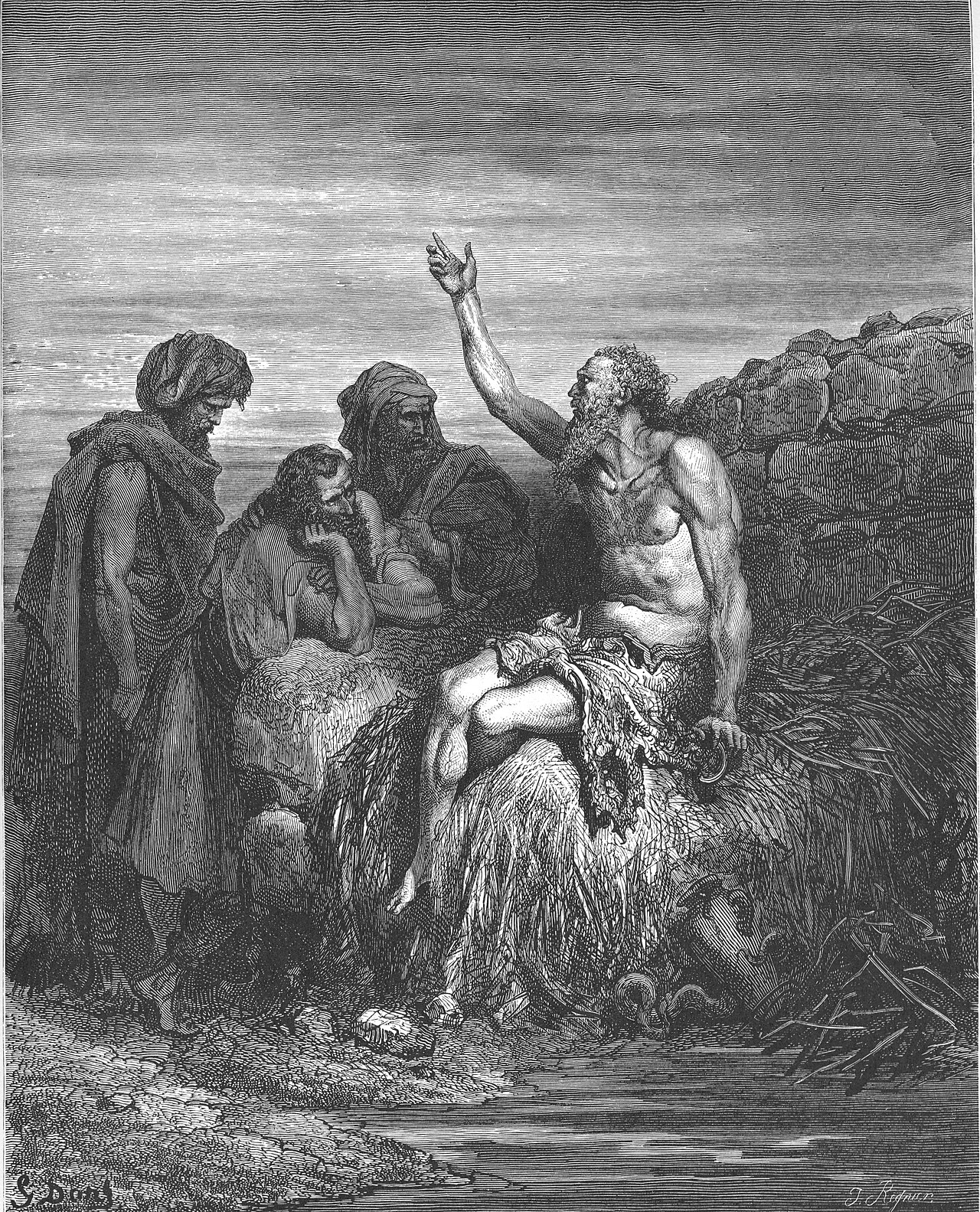
in Job 2And Job took a piece of broken pottery to scrape himself as he sat among the ashes.
BSB
The same verse in ASV and KJV ▾
ASV
And he took him a potsherd to scrape himself therewith; and he sat among the ashes.
KJV
And he took him a potsherd to scrape himself withal; and he sat down among the ashes.
⋯
This verse in Job 2
Commentary
12 notes on this verseALLEGORICAL INTERPRETATION. And he took him a potsherd to scrape the humour withal. For what is the potsherd in the hand of the Lord, but the flesh which He took of the clay of our nature? For the potsherd receives firmness by fire. And the Flesh of our Lord was rendered stronger by His Passion, in so far as dying by infirmity, He arose from death void of infirmity. And hence too it is rightly delivered by the Prophet, My strength is dried up like a potsherd.
This site's exposition
infected Job with terrible boils
on Job 2:7-8
The text gives "terrible boils from the soles of his feet to the crown of his head" and offers no diagnosis. Barnes calls any naming of the disease guesswork. Job scrapes himself as he sits "among the ashes," the posture of a mourner, as Delitzsch notes.
This site's exposition
a piece of broken pottery to scrape himself
Barnes identifies the broken pottery as a shard of a vessel, used to scrape the sores Satan struck on Job. Matthew Henry notes that the Greek version seats Job on a dunghill outside the city, while the Hebrew names only the ashes. Wesley adds that Job's hands were sore too.
The record, by era
The Medieval Church3 voices
HISTORICAL INTERPRETATION. And he took him a potsherd to scrape himself withal; and he sat down among the ashes. What is a potsherd made from, excepting mud? and what is the humour of the body, but mud? Accordingly he is said 'to scrape the humour with a potsherd,' as if it were plainly said, 'he wiped away mud with mud.' For the holy man reflected, whence that which he carried about him had been taken, and with the broken piece of a vessel of clay he scraped his broken vessel of clay. By which act we have it openly shewn us, in what manner he subdued under him that body of his when sound, which even when stricken he tended with such slight regard; how softly he dealt with his flesh in its sound state, who applied neither clothing, nor fingers, but only a potsherd to its very wounds. And thus he scraped the humour with a potsherd, that seeing himself in the very broken piece, he might even by the cleansing of the wound be taking a remedy for his soul. But because it often happens that the mind is swelled by the circumstances that surround the body, and by the way men behave toward us the frailty of the body is removed from before the eyes of the mind, (as there are some of those that are of the world, who while they are buoyed up with temporal honours, whilst they rule in elevated stations, whilst they see the obedience of multitudes yielded to them at will, neglect to consider their own frailty, and altogether forget, nor ever take heed, how speedily that vessel of clay which they bear, is liable to be shattered,) so blessed Job, that he might take thought of his own frailty from the things about him, and increase the intensity of his self-contempt in his own eyes, is described to have seated himself not any where on the earth, which at most in every place is found clean, but upon a dunghill. […]
MORAL INTERPRETATION. And he took him a potsherd to scrape the humour withal. For what do we understand by the 'potsherd,' saving forcibleness of severity, and what by the 'humour,' save laxity of unlawful imaginations? And thus we are smitten, and 'scrape off the humour with a potsherd,' when after the defilements of unlawful thoughts, we cleanse ourselves by a sharp judgment. By the potsherd too we may understand the frailness of mortality. And then to 'scrape the humour with a potsherd,' is to ponder on the course and frailty of our mortal state, and to wipe off the rottenness of a wretched self-gratification. For when a man bethinks himself how soon the flesh returns to dust, he readily gets the better of that which originating in the flesh foully assails him in the interior. So, when bad thoughts arising from temptation flow into the mind, it is as if humour kept running from a wound. But the humour is soon cleansed away, if the frailty of our nature be taken up in the thought, like a potsherd in the hand. For neither are these suggestions to be lightly esteemed, which though they may not draw us on so far as to the act, yet work in the mind in an unlawful way. It is hence that our Redeemer was come, as it were, 'to scrape the humour from our wounds,' when He said, Ye have heard that it was said by them of old time, Thou shalt not commit adultery. But I say unto you, that whosoever looketh on a woman to lust after her, hath committed adultery with her already in his heart. 'The humour,' therefore, 'is wiped off,' when sin is not only severed from the deed, but also from the thought. […]
The afflictions of the sick are customarily alleviated by cures applied externally which are pleasant. But Job was not alleviated in such a way, for the text continues, "Job scraped the bloody matter with a shard." In this the text shows that pleasant and soothing …
The Puritans and the Awakening2 voices
Nor with his own hands or fingers, which were also ulcerous, and so unfit for that use; but with potsherds, either because they were next at hand, and ready for his present use; or in token of his deep humiliation under God's hand, which made him decline all things that favoured of tenderness and delicacy. Hebrew. in dust or ashes, as mourners used to do.
If God lay him among the ashes, there he will contentedly sit down. A low spirit becomes low circumstances, and will help to reconcile us to them. The LXX. reads it, He sat down upon a dunghill without the city (which is commonly said, in mentioning this story); but the original says no more than that he sat in the midst of the ashes, which he might do in his own house.
4 more voices on this verse
The Puritans and the Awakening2 voices
And he took him a potsherd to scrape himself withal,....
The former attack was extremely violent, but Job kept his ground, bravely made good the pass and carried the day. Yet he is still but girding on the harness; there is worse behind.
The Nineteenth Century2 voices
A commentator
Albert Barnes1798–1870
Notes, Explanatory and Practical, on the Old and New Testaments (1832-1869)
And he took him a potsherd - The word used here חרשׁ chârâsh means a fragment of a broken vessel; see the notes at Isa 45:9. The Septuagint renders it ὄστρακον ostrakon - “a shell.” One object of taking this was to remove from his body the filth accumulated by the universal ulcer, compare Job 7:4-5; and another design probably was, to “indicate” the greatness of his calamity and sorrow.
A commentator
Jamieson, Fausset & Brown1802–1910
Commentary Critical and Explanatory on the Whole Bible (1871)
proposed
a potsherd--not a piece of a broken earthen vessel, but an instrument made for scratching (the root of the Hebrew word is "scratch"); the sore was too disgusting to touch.
quarantine:debris (2026-07-29) — starts-lowercase
The words behind it
9 Hebrew wordsEvery Hebrew word of this verse in the order it stands, with what it means and the door to its own study. The last column counts the times a word stands in the whole Bible: the rarer the word, the more the places it appears belong together.
| Hebrew | Sound | Meaning | Word study | In the Bible |
|---|---|---|---|---|
| וַיִּֽקַּֽח־ | vaiyikach- | and he took | H3947 → | 966 times |
| ל֣וֹ | lo | for himself | ||
| חֶ֔רֶשׂ | cheres | a potsherd | H2789 → | |
| לְהִתְגָּרֵ֖ד | lehitgared | to scrape himself | H1623 → | |
| בּ֑וֹ | bo | with it | ||
| וְה֖וּא | vehu' | and he | H1931 → | 1879 times |
| יֹשֵׁ֥ב | yoshev | [was] sitting | H3427 → | 1079 times |
| בְּתוֹךְ־ | betokh- | in [the] midst | H8432 → | 418 times |
| הָאֵֽפֶר׃ | haefer | the ash[es] | H665 → | 22 times |
וַיִּֽקַּֽח־and he took
vaiyikach-H3947 →966 times
ל֣וֹfor himself
lo
חֶ֔רֶשׂa potsherd
cheresH2789 →
לְהִתְגָּרֵ֖דto scrape himself
lehitgaredH1623 →
בּ֑וֹwith it
bo
וְה֖וּאand he
vehu'H1931 →1879 times
יֹשֵׁ֥ב[was] sitting
yoshevH3427 →1079 times
בְּתוֹךְ־in [the] midst
betokh-H8432 →418 times
הָאֵֽפֶר׃the ash[es]
haeferH665 →22 times
A shaded row is a word that stands 400 times or fewer in the Bible.
The walk
8 stopsEach card is a verse this one points to, and under it the verses that one points to in turn. Where several paths arrive at the same place, that place is listed first: the text keeps returning to it.
Through
Job 42:6Therefore I retract my words, and I repent in dust and ashes.”
it leads to
- Daniel 9:3
So I turned my attention to the Lord God to seek Him by prayer and petition, with fasting, sackcloth, and ashes.
Reached by 2 separate paths from here.
- Ezra 9:6
and said: “O my God, I am ashamed and embarrassed to lift up my face to You, my God, because our iniquities are higher than our heads, and our guilt has reached the heavens.
- 1 Timothy 1:13–16
I was formerly a blasphemer, a persecutor, and a violent man; yet because I had acted in ignorance and unbelief, I was shown mercy.
- James 4:7–10
Submit yourselves, then, to God. Resist the devil, and he will flee from you.
- Job 40:3–4
Then Job answered the LORD:
- Daniel 9:3
Through
Jonah 3:6When word reached the king of Nineveh, he got up from his throne, took off his royal robe, covered himself with sackcloth, and sat in ashes.
it leads to
- Esther 4:1–4
When Mordecai learned of all that had happened, he tore his clothes, put on sackcloth and ashes, and went out into the middle of the city, wailing loudly and bitterly.
- James 4:6–10
But He gives us more grace. This is why it says: “God opposes the proud, but gives grace to the humble.”
- Esther 4:1–4
Through
Matthew 11:21“Woe to you, Chorazin! Woe to you, Bethsaida! For if the miracles that were performed in you had been performed in Tyre and Sidon, they would have repented long ago in sackcloth and ashes.
it leads to
- Ezekiel 3:6–7
not to the many peoples of unfamiliar speech and difficult language whose words you cannot understand. Surely if I had sent you to them, they would have listened to you.
- Ezekiel 3:6–7
Where this verse is studied
On this page
About Job
Who and where
1 name in this verse with a page on the site.
This page draws on 10 works. Open the list of works
This page draws on Albert Barnes, Notes on the Book of Job; Albert Barnes, Notes, Explanatory and Practical, on the Old and New Testaments; Albert Barnes, Notes, Explanatory and Practical, on the Old and New Testaments (1832-1869); Franz Delitzsch, Biblical Commentary on the Book of Job; Gregory the Dialogist, Morals on the Book of Job, Book III; Jamieson, Fausset & Brown, Commentary Critical and Explanatory on the Whole Bible; John Gill, Exposition of the Old Testament (1748-1763); John Wesley, Explanatory Notes upon the Old Testament; Matthew Henry, Commentary on the Whole Bible and Thomas Aquinas, Commentary on Job.