
On this page, 6 sections
The one drawing
Across the canon
10 passages
Where Scripture speaks
The passages this subject stands on, in canon order.
And the LORD said to Samuel, “Listen to the voice of the people in all that they say to you. For it is not you they have rejected, but they have rejected Me as their king.But the LORD said to Samuel, “Do not consider his appearance or height, for I have rejected him; the LORD does not see as man does. For man sees the outward appearance, but the LORD sees the heart.”Therefore give Your servant an understanding heart to judge Your people and to discern between good and evil. For who is able to govern this great people of Yours?”For when Solomon grew old, his wives turned his heart after other gods, and he was not wholeheartedly devoted to the LORD his God, as his father David had been.When all Israel saw that the king had refused to listen to them, they answered the king: “What portion do we have in David, and what inheritance in the son of Jesse? To your tents, O Israel! Look now to your own house, O David!” So the Israelites went home,And he did what was right in the eyes of the LORD and walked in all the ways of his father David; he did not turn aside to the right or to the left.“I have installed My King on Zion, upon My holy mountain.”He changes the times and seasons; He removes kings and establishes them. He gives wisdom to the wise and knowledge to the discerning.“Then You are a king!” Pilate said. “You say that I am a king,” Jesus answered. “For this reason I was born and have come into the world, to testify to the truth. Everyone who belongs to the truth listens to My voice.”And He has a name written on His robe and on His thigh: KING OF KINGS AND LORD OF LORDS.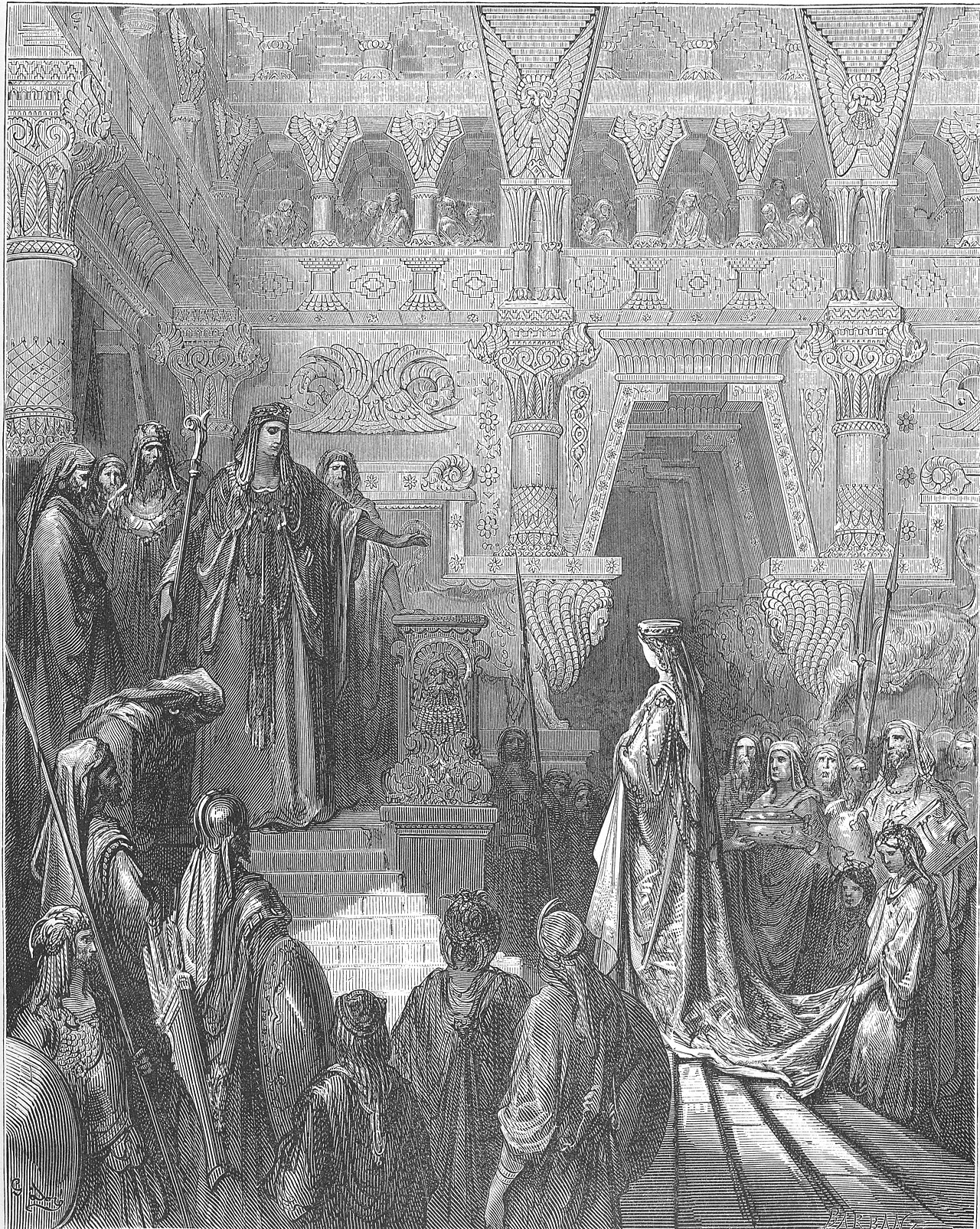
The kings in Scripture, in full
Israel began without a king. For centuries the tribes were ruled directly by God, through judges he raised up in times of trouble. Then the people asked for a king like the nations around them had. Samuel warned them what a king would cost, but the deeper wound was named plainly: the LORD told Samuel that the people had not rejected Samuel, they had rejected God himself as their king (1 Samuel 8:7).
God gave Israel Saul first: tall, capable, and hollow. Saul disobeyed and lost the throne to a shepherd boy anointed in secret. When Samuel looked over Jesse's sons, he wanted to choose by height and appearance. God corrected him on the spot: man looks on the outward appearance, but the LORD looks on the heart (1 Samuel 16:7).
David became the measure every king after him was compared to. Not because he was perfect (he was a murderer and an adulterer) but because his heart kept turning back to God. God made David a promise no other king received: his throne would be established forever (2 Samuel 7:16). That promise outlived David's failures, outlived his son's compromises, and outlived the whole kingdom's eventual collapse.
Solomon inherited the throne and asked for one thing: wisdom to judge God's people rightly (1 Kings 3:9). For a while he had it. Then his heart turned. Foreign wives, foreign gods, and a kingdom's weight of gold could not keep him faithful. After Solomon died, the kingdom split in two, and ten tribes tore themselves away from the house of David (1 Kings 12:16).
From there the story runs down two tracks. The northern kings, without exception, did evil. The southern kings were mixed: some faithful, most not. Josiah stands out as one who did right in the sight of the LORD and walked in the ways of his father David (2 Kings 22:2). But even a good king could not undo what centuries of bad ones had done. Both kingdoms eventually fell, and the throne of David sat empty.
The promise did not die with the kingdom, though. The prophets kept pointing forward, to a king who would not fail, whose government would never end (compare Isaiah 9:6-7). The book of Daniel pictures every human throne as temporary, raised up and torn down at God's word, while one everlasting kingdom is still to come (Daniel 2:21).
That king arrived, and he did not look like one. He was born in a stable, worked with his hands, and was crowned with thorns before he was ever crowned with glory. Standing before Pilate, with nothing left but his own testimony and a cross ahead of him, he did not deny the title Pilate put to him (John 18:37).
Every king in Israel's history (good, bad, and everything between), was a shadow pointing at him. David's throne was never really about David. It was a promise waiting for the one it belonged to all along, the one John later saw wearing a name no earthly crown could hold: King of kings, and Lord of lords (Revelation 19:16).
That is the story of kingship in Scripture. It starts with a people who wanted a king instead of God, and ends with the discovery that the only king who could ever be trusted with that much power was God himself.
5 voices
What teachers have said
Thy reign, of which the scepter is the ensign, is full of justice and equity.
John Wesley · Explanatory Notes upon the New Testament, 1755
Mercy and truth preserve the king: and his throne is upholden by mercy. The virtues of a good king. Those are mercy and truth, especially mercy, for that is mentioned twice here.
Matthew Henry · Commentary on the Whole Bible, 1710
The crown could not have been given to one who was worthy of it, unless grace had been given to him when still unworthy.
Augustine of Hippo · Proceedings of Pelagius 35
Written before 430.
The crown of the Lord is the church gathered from the various nations, about which Paul in the person of the believers says, "My joy and my crown."
Jerome · Brief Commentary on Psalm 21
Written before 420.
David was a type of Christ; and concerning him the prophecy is literally true.
Adam Clarke · Commentary on the Bible
Written before 1832.
The words underneath
Each card is one Hebrew or Greek word behind the kings. It gives the sense, the count across the canon, and the number in Strong's 1890 concordance.
melek: king
Hebrew · H4428Strong's entry: a king
the ordinary Hebrew word for Israel's and the nations' rulers
2,525 times in the Old Testament · melek, in full →
kisse: throne
Hebrew · H3678Strong's entry: properly, covered, i.e. a throne (as canopied)
the seat of royal judgment and authority
135 times in the Old Testament · kisse, in full →
basileia: kingdom
Greek · G932Strong's entry: properly, royalty, i.e. (abstractly) rule, or (concretely) a realm (literally or figuratively)
the NT word for royal rule, human and divine
162 times in the New Testament · basileia, in full →
malak: to reign
Hebrew · H4427Strong's entry: to reign; inceptively, to ascend the throne; causatively, to induct into royalty; hence (by implication) to take counsel
the verb behind every king's ascension to the throne
348 times in the Old Testament · malak, in full →
Who it is about
The subjects beside it
On this page
Subjects11