
Psalm 65
13 verses · Harvest hymn
You stilled the roaring of the seas, the pounding of their waves, and the tumult of the nations.
Introduction
David, the Harvest Hymn, Book 2: The Elohistic Psalter, Poetry, Psalms Overview.
This psalm was sung at harvest by a people who farmed without a river and lived on rain they could not command. David wrote it for the temple courts, where vows made in a hard season were paid in a good one. It praises God in three widening rings, at the altar where sin is forgiven, across the seas and the nations, and out in the fields at the turn of the year. Listen for forgiveness named before the rain, and for the farm work God is said to do with His own hands.
Context
- Who
- Farmers whose whole year depended on rain they could not command
- What
- A harvest hymn praising God for forgiving sin, ruling the world and sending rain on the land.
- Where
- The temple courts at the turn of the agricultural year, with the grain in and the flocks fat
- When
- The monarchy, sung at the harvest festivals. Date unstated; attributed to David, c. 1000 BC
- Why
- To give thanks at harvest and to teach that the rain and the crops come from the God who forgives.
Historical context
The heading gives the psalm to David and calls it a song, and its subject places it at the gathering of a harvest. Israel farmed without a river, since Egypt had the Nile flood and Mesopotamia had canal irrigation, while Canaan drank rain out of the sky. The early rain in autumn softened ground baked hard so that a plough could enter it, the latter rain in spring filled out the grain, and missing either one cost the year. Heavy rain knocked the ridges a wooden plough threw up back down into the furrows, so the psalm watches God do the second half of the farmer's work. The vows it says will be paid were paid at the spring feasts of firstfruits and of Weeks, and its God stills the seas with no fight at all, where Israel's neighbours told of a storm god who had to fight the sea for his throne.
Significance
Everyone in the region held that harvest came from keeping a fertility god satisfied, and this song says the rain comes from the God who forgives sins, naming the forgiveness first. So the paths overflowing with plenty are evidence of a character rather than proof that a ritual worked.
This chapter in Jewish lifeWhat this chapter is in Jewish life and reading.
How it is read
Rashi opens the psalm on its first word and finds a rule of praise in it. "Silence is praise to You. Because there is no end to Your praise, the more one praises, the more one detracts" (Rashi on Psalms 65:2:1). He offers a second reading of the same line, that God's silence over what His enemies did in Zion is itself praiseworthy. He could take revenge and is slow to anger (Rashi on Psalms 65:2:2). The iniquities of verse 4 are more than a congregation can set out one by one, so the prayer is made in general and asks for atonement (Rashi on Psalms 65:4:1). From verse 7 the psalm turns to rain, and Rashi reads the mountains, the stream and the furrows as the ordinary machinery of a fed year (Rashi on Psalms 65:7:1 and 65:10:2). At verse 9 he ties the singing of the morning and the evening to the blessings said at those hours. They are "Blessed is He Who formed the luminaries" and "Blessed is He Who brings about evening" (Rashi on Psalms 65:9:1). Radak reads verses 8 and 9 of Israel rather than of the world at large. The God who quieted the raging waters at the sea, he writes, "will quiet the multitude of nations" and bring Israel up from among them at the ingathering of the exiles (Radak on Psalms 65:9:3). Rashi is quoted here from the Judaica Press complete Tanach with Rashi, translated by A. J. Rosenberg, under CC-BY. Radak is quoted from the Sefaria Community Translation under CC0.
What the rabbis say
The corpus records forty places where the Midrash and the Talmud draw on this psalm, cited here by reference. Midrash Tehillim treats it at 65:1 and 65:4. Verse 2, on the silence that is praise, is carried into the Babylonian Talmud at Eruvin 19a:3 and into the Jerusalem Talmud at Berakhot 9:1:6. Verse 5, on the man God chooses and draws near, is read at Bamidbar Rabbah 3:2, 10:1 and 14:10. Verse 7, on the mountains set fast by God's strength, stands in the Babylonian Talmud at Chagigah 12a:14. Verses 10 and 11, on the watering of the earth, are drawn into Bereshit Rabbah 4:4, 20:7, 41:9 and 69:5, and into the Jerusalem Talmud at Peah 1:1:19 and 1:1:52.
Sources: Rashi, Rashi on Psalms 65:2 to 65:14, the Judaica Press complete Tanach with Rashi, translated by A. J. Rosenberg, CC-BY, 1040 to 1105; Radak, Radak on Psalms 65:9:3, Sefaria Community Translation, CC0, 1160 to 1236; Midrash Tehillim, 65:1 and 65:4, cited by reference; Babylonian Talmud, Eruvin 19a:3 and Chagigah 12a:14, cited by reference; Bereshit Rabbah, 4:4, 20:7, 41:9 and 69:5, cited by reference; The Sefaria corpus, scripts/data/sources/sefaria/psalms/65.json, fetched 2026-09-19, 2026.
Psalms 65:1-2
Praise awaits You, O God: Praise waits for God in Zion, and the vows made there will be paid. Verse 2 widens the address from Zion to all people, who will come to the God who listens to prayer. Praise here is a debt, kept by a vow.
Psalms 65:1
“Praise waiteth for thee--literally, "To Thee silence praise," or (compare Ps 62:1), To Thee silence is praise--that is, Praise is waiting as a servant; it is due to Thee. So the last clause expresses the duty of paying vows. These two parts of acceptable worship, mentioned in Ps 50:14, are rendered in Zion, where God chiefly displays His mercy and receives homage.”
Jamieson, Fausset & Brown · Commentary Critical and Explanatory on the Whole Bible (1871)reformed
2 more voices on this verseWhat preachers and commentators have said about this verse, in their own words.
Psalms 65:1
“By sincere faithfulness: Unto thee shall the vow be performed, that is, the sacrifice shall be offered up which was vowed. We shall not be accepted in our thanksgivings to God for the mercies we have received unless we make conscience of paying the vows which we made when we were in pursuit of the mercy; for better it is not to vow than to vow and not to pay.”
Matthew Henry · Commentary on the Whole Bible (1707-1721)puritan
Psalms 65:1
“Praise waiteth for thee, O God, in Sion. Though Babylon adores Antichrist, Zion remains faithful to her King; to him, and to him only, she brings her perpetual oblation of worship. Those who have seen in Zion the blood of sprinkling, and know themselves to belong to the church of the firstborn, can never think of her without presenting humble praise to Zion's God; his mercies are too numerous and precious to be forgotten. The praises of the saints wait for a signal from the divine Lord, and when he shows his face they burst forth at once.”
Charles Spurgeon · The Treasury of David, Vol. 3 (1872)Particular Baptist
O You who listen to prayer: Charles Spurgeon takes the one who listens to prayer as God's own name and nature. He listens now and always. That encourages all people to come to Him, he adds.
Psalms 65:2
“O thou that hearest prayer. This is thy name, thy nature, thy glory. God not only has heard, but is now hearing prayer, and always must hear prayer, since he is an immutable being and never changes in his attributes. What a delightful title for the God and Father of our Lord Jesus Christ! Every right and sincere prayer is as surely heard as it is offered.”
Charles Spurgeon · The Treasury of David, Vol. 3 (1872)Particular Baptist
Psalms 65:3-4
iniquities prevail against me: , and the same verse says God atones for them, which means He covers the sin and puts it away. Verse 4 calls blessed the man God chooses and brings near to dwell in His courts. Nearness is God's own choice.
Psalms 65:3
“Iniquities prevail against me. Others accuse and slander me, and in addition to my own sins rise up and would beset me to my confusion, were it not for the remembrance of the atonement which covers every one of my iniquities. Our sins would, but for grace, prevail against us in the court of divine justice, in the court of conscience, and in the battle of life. Unhappy is the man who despises these enemies, and worse still is he who counts them his friends!”
Charles Spurgeon · The Treasury of David, Vol. 3 (1872)Particular Baptist
1 more voice on this verse
Psalms 65:3
God's mercy alone delivers us from the burden of iniquities, by purging or expiating by an atonement the transgressions with which we are charged, and which are denoted by-- Iniquities--or, literally, "Words of iniquities."
Jamieson, Fausset & Brown · Commentary Critical and Explanatory on the Whole Bible (1871)reformed
filled with the goodness of Your house: The blessing moves from one man to a whole people. Jamieson, Fausset and Brown take that change as widening the goodness of God's house to all His people in His courts.
Psalms 65:4
“Approach - To draw near to God in his house and ordinance, by prayer and praise, and other acts of communion with him. Satisfied - With the blessings there conferred upon thy people, the favour and fellowship of God, remission of sins, renovation of heart and life, joy and peace, and well-grounded assurance of eternal life.”
John Wesley · Explanatory Notes upon the Old Testament (1765)evangelical
1 more voice on this verse
Psalms 65:4
“Blessed is the man whom thou choosest, and causest to approach unto thee. After cleansing comes benediction, and truly this is a very rich one. It comprehends both election, effectual calling, access, acceptance, and sonship. First, we are chosen of God, according to the good pleasure of his will, and this alone is blessedness. Then, since we cannot and will not come to God of ourselves, he works graciously in us, and attracts us powerfully; he subdues our unwillingness, and removes our inability by the almighty workings of his transforming grace. This also is no slight blessedness.”
Charles Spurgeon · The Treasury of David, Vol. 3 (1872)Particular Baptist
Psalms 65:5-8
awesome deeds of righteousness: are how God answers, and He is the hope of the farthest seas. Verse 7 sets the roaring seas and the tumult of the nations in one line, all stilled by the same hand that formed the mountains. The dawn and sunset shout for joy.
Psalms 65:5
“By terrible things in righteousness wilt thou answer us, O God of our salvation. God's memorial is that he hears prayer, and his glory is that he answers it in a manner fitted to inspire awe in the hearts of his people. The saints, in the commencement of the Psalm, offered praise in reverential silence; and now, in the like awe stricken spirit, they receive answers to their prayers.”
Charles Spurgeon · The Treasury of David, Vol. 3 (1872)Particular Baptist
1 more voice on this verse
Psalms 65:5
“Righteousness - By virtue of thy faithfulness, and goodness. Wilt thou - Thou wilt graciously answer our prayers. The confidence - Thou art the stay and support of all mankind, by thy powerful and gracious providence.”
John Wesley · Explanatory Notes upon the Old Testament (1765)evangelical
formed the mountains by Your power: Matthew Henry notes that the mountains God formed by His power are called everlasting in Habakkuk 3. Isaiah 54 sets His covenant with His people firmer still.
Psalms 65:6
“Which by his strength setteth fast the mountains. He, as it were, fixed them in their sockets, and preserved them from falling by earthquake or storm. The firmest owe their stability to him. Philosophers of the forget God school are too much engrossed with their laws of upheaval to think of the Upheaver. Their theories of volcanic action and glacier action, etc., etc., are frequently used as bolts and bars to shut the Lord out of his own world.”
Charles Spurgeon · The Treasury of David, Vol. 3 (1872)Particular Baptist
the tumult of the nations: Charles Spurgeon explains why the tumult of the nations stands beside the roaring seas and their pounding waves. Nations are as restless and hard to rule as the sea.
Psalms 65:7
“Which stilleth the noise of the seas, the noise of their waves,.... By a word speaking; as our Lord did when here on earth, and which was a proof and evidence of his eternal power and Godhead.”
1 more voice on this verse
Psalms 65:7
“Which stilleth the noise of the seas. His soft breath smooths the sea into a glass, and the mountainous waves into ripples. God does this. Calms are of the God of peace; it needs not that we look for a hurricane when it is said that he cometh. He walked of old in the garden in the cool of the day; he is resting even now, for his great seventh day is not yet over, and he is always "the Lord and giver of peace." Let mariners magnify the God who rules the waves. The noise of their waves.”
Charles Spurgeon · The Treasury of David, Vol. 3 (1872)Particular Baptist
the dawn and sunset shout for joy: John Wesley divides the verse in two. Those who live far away fear the wonders that bring terror, and the dawn and sunset shout for joy at the ordinary works that delight.
Psalms 65:8
“They also that dwell in the uttermost parts are afraid at thy tokens,.... The tokens of his wrath and displeasure at wicked men, seen in the punishments inflicted on them, which cause them to fear and tremble. Some interpret them of the sun, moon, and stars, which are set for "signs", as the word (m) used signifies; and which declare the glory of God to the uttermost parts of the earth, and strike men with awe and reverence of him; and others of thunder and lightning, which are sometimes very dreadful and terrible.”
3 more voices on this verse
Psalms 65:8
“They also that dwell in the uttermost parts are afraid of thy tokens. Signs of God's presence are not few, nor confined to any one region. Zembla sees them as well as Zion, and Terra del Fuego as surely as the Terra Sacra. These tokens are sometimes terrible phenomena in nature—such as earthquakes, pestilence, tornado, or storm; and when these are seen, even the most barbarous people tremble before God. At other times they are dread works of providence—such as the overthrow of Sodom, and the destruction of Pharaoh.”
Charles Spurgeon · The Treasury of David, Vol. 3 (1872)Particular Baptist
Psalms 65:8
“Morning - The successive courses of the morning and evening; or of the sun and moon which go forth at those times. Thus the whole verse speaks of the natural works of God, the former clause, of such as are extraordinary and terrible, the latter of such as are ordinary and delightful.”
John Wesley · Explanatory Notes upon the Old Testament (1765)evangelical
Psalms 65:8
“So does the hireling earnestly desire the shadow. Some understand it of the morning and evening sacrifice, which good people greatly rejoiced in and in which God was constantly honoured. Thou makest them to sing (so the word is); for every morning and every evening songs of praise were sung by the Levites; it was that which the duty of every day required.”
Matthew Henry · Commentary on the Whole Bible (1707-1721)puritan
Psalms 65:9-10
You attend to the earth: The psalm turns from the nations to the soil. Every verb in verses 9 and 10 has God as its subject: He waters, enriches, soaks the furrows, levels the ridges and softens the ground. The field work is His.
Psalms 65:9
“Thou visitest the earth, and waterest it. God's visits leave a blessing behind; this is more than can be said of every visitor. When the Lord goes on visitations of mercy, he has abundance of necessary things for all his needy creatures. He is represented here as going round the earth, as a gardener surveys his garden, and as giving water to every plant that requires it, and that not in small quantities, but until the earth is drenched and soaked with a rich supply of refreshment.”
Charles Spurgeon · The Treasury of David, Vol. 3 (1872)Particular Baptist
1 more voice on this verse
Psalms 65:9
“It is a visit in mercy, which the inhabitants of the earth ought to return in praises. (2.) God, that made it dry land, hereby waters it, in order to its fruitfulness. Though the productions of the earth flourished before God had caused it to rain, yet even then there was a mist which answered the intention, and watered the whole face of the ground, Gen. ii.”
Matthew Henry · Commentary on the Whole Bible (1707-1721)puritan
You soak its furrows: Charles Spurgeon pictures clods turned to iron by drought before the showers soften them. Then ridge and furrow are drenched and the growth is blessed.
Psalms 65:10
“Thou waterest the ridges thereof abundantly: thou settlest the furrows thereof. Ridge and furrow are drenched. The ridges beaten down and settled, and the furrows made to stand like gutters flooded to the full. Thou makest it soft with showers. The drought turned the clods into iron, but the plenteous showers dissolve and loosen the soil. Thou blessest the springing thereof. Vegetation enlivened by the moisture leaps into vigour, the seed germinates and sends forth its green shoot, and the smell is that as of a field which the Lord has blessed.”
Charles Spurgeon · The Treasury of David, Vol. 3 (1872)Particular Baptist
Psalms 65:11-13
crown the year with Your bounty: The year wears a crown of bounty. God's paths overflow, the hills are robed with joy, and flocks and grain cover the pastures and the valleys. The land itself shouts and sings the praise that waited in Zion at verse 1.
Psalms 65:11
“Thou crownest the year with thy goodness. The harvest is the plainest display of the divine bounty, and the crown of the year. The Lord himself conducts the coronation, and sets the golden coronal upon the brow of the year. Or we may understand the expression to mean that God's love encircles the year as with a crown; each month has its gems, each day its pearl. Unceasing kindness girdles all time with a belt of love. The providence of God in its visitations makes a complete circuit, and surrounds the year. And thy paths drop fatness.”
Charles Spurgeon · The Treasury of David, Vol. 3 (1872)Particular Baptist
the hills are robed with joy: Charles Spurgeon notes that the rain falls on the pastures of the wilderness, where only wild animals live. After drought, the hills are robed with joy again.
Psalms 65:12
“They drop upon the pastures of the wilderness. Not alone where man is found do the showers descend, but away in the lone places, where only wild animals have their haunt, there the bountiful Lord makes the refreshing rain to drop. Ten thousand oases smile while the Lord of mercy passes by. The birds of the air, the wild goats, and the fleet stags rejoice as they drink from the pools, new filled from heaven. The most lonely and solitary souls God will visit in love. And the little hills rejoice on every side.”
Charles Spurgeon · The Treasury of David, Vol. 3 (1872)Particular Baptist
1 more voice on this verse
Psalms 65:12
“So extensive are the gifts of God's bounty that in them the hills, the little hills, rejoice on every side, even the north side, that lies most from the sun. Hills are not above the need of God's providence; little hills are not below the cognizance of it.”
Matthew Henry · Commentary on the Whole Bible (1707-1721)puritan
the valleys are decked with grain: Charles Spurgeon notes that the pastures clothed with flocks will in turn clothe men. Flocks and grain are both God's gifts, he adds. The valleys shout and sing for both.
Psalms 65:13
“The pastures are clothed with flocks. The clothing of man first clothes the fields. Pastures appear to be quite covered with numerous flocks when the grass is abundant. The valleys also are covered over with corn. The arable as well as the pasture land is rendered fruitful. God's clouds, like ravens, bring us both bread and flesh. Grazing flocks and waving crops are equally the gifts of the Preserver of men, and for both praise should be rendered. Sheep shearing and harvest should both be holiness unto the Lord. They shout for joy.”
Charles Spurgeon · The Treasury of David, Vol. 3 (1872)Particular Baptist
How this psalm is built
The form: A hymn of praise for what God does at the altar, on the sea and in the fields, as Gunkel classes it.
The patterns in this chapter
| Device | What it does | Where to see it |
|---|---|---|
| Praise that waits, and a vow that is paid | The two halves of verse 1 set a waiting praise beside a vow to be fulfilled. Jamieson, Fausset and Brown read the Hebrew as to Thee silence is praise, with praise waiting as a servant waits, and take the pair as the two parts of acceptable worship named in Psalm 50:14.Jamieson, Fausset and Brown, Commentary Critical and Explanatory on the Whole Bible, 1871, on Psalm 65:1. | Psalm 65:1 |
| The three rings of the psalm, altar, earth and field | The psalm names its subjects in widening order rather than in one word. The courts of God stand at verses 1 to 4, the mountains and seas and nations at verses 5 to 8, the fields at verses 9 to 13. Each ring is larger than the one before it and each is worked by the same hand.Charles Spurgeon, The Treasury of David, Vol. 3, 1872, on Psalm 65:9. | Psalm 65:4, Psalm 65:7, Psalm 65:13 |
| The verbs that all take God as their subject | In verses 9 and 10 God attends, waters, enriches, prepares, soaks, levels, softens and blesses. Spurgeon reads the visiting of verse 9 as a gardener going round his garden and giving water to every plant that needs it, until the earth is drenched.Charles Spurgeon, The Treasury of David, Vol. 3, 1872, on Psalm 65:9. | Psalm 65:9, Psalm 65:10, Psalm 65:11 |
| The shout at the end and the silence at the start | Praise waits in silence at verse 1 and the fields shout and sing at verse 13. The land finishes what Zion began, and the same psalm holds both. Spurgeon reads the harvest as the crown of the year, with the Lord Himself conducting the coronation.Charles Spurgeon, The Treasury of David, Vol. 3, 1872, on Psalm 65:11. | Psalm 65:1, Psalm 65:11, Psalm 65:13 |
In the New Testament
5 more paragraphs on the patterns
Psalm 65 is not quoted in the New Testament. Verse 5 calls God the hope of all the ends of the earth and of the farthest seas. That line runs with Psalm 66 and Psalm 67 toward the same end, and the three stand together in Book II.
Inside the psalm
The pattern is a single hand at three scales. The hand that atones at verse 3 is the hand that stills the sea at verse 7 and soaks the furrows at verse 10. Gill notes on verse 7 that the stilling is done by a word, and points to the Lord doing the same on the lake. The psalm makes no argument for the connection and moves from one scale to the next.
Where it stands in the Psalter
Its close reverses its opening. The psalm begins with praise that waits in silence and ends with pastures and valleys that shout in triumph. Psalm 67 ends on a harvest as well, and the two are the Psalter's pair of harvest songs in Book II.
Keep studying
Places1
Words7
Subjects1
Sources for this chapter
The summary
Jamieson, Fausset & Brown, Commentary Critical and Explanatory; John Calvin, Commentaries; John Wesley, Notes on the Old Testament and Matthew Henry, Complete Commentary.
The form and classifications
Charles Spurgeon, The Metropolitan Tabernacle Pulpit, Sermon No. 1023, "Praises and Vows Accepted in Zion", 1871, on Psalm 65:1 and 65:2; Hermann Gunkel, Einleitung in die Psalmen, 1933, as set out for students in C. Hassell Bullock, Encountering the Book of Psalms, 2001; the type this site publishes for Psalm 65 and Jamieson, Fausset and Brown, Commentary Critical and Explanatory on the Whole Bible, 1871, on Psalm 65:1.
The exposition
Albert Barnes, Notes on the Book of Psalms; Charles Spurgeon; Franz Delitzsch, Biblical Commentary on the Psalms; Jamieson, Fausset & Brown, Commentary Critical and Explanatory on the Whole Bible; John Gill, Exposition of the Old Testament; John Wesley, Explanatory Notes upon the Old Testament and Matthew Henry, Commentary on the Whole Bible.
The painting
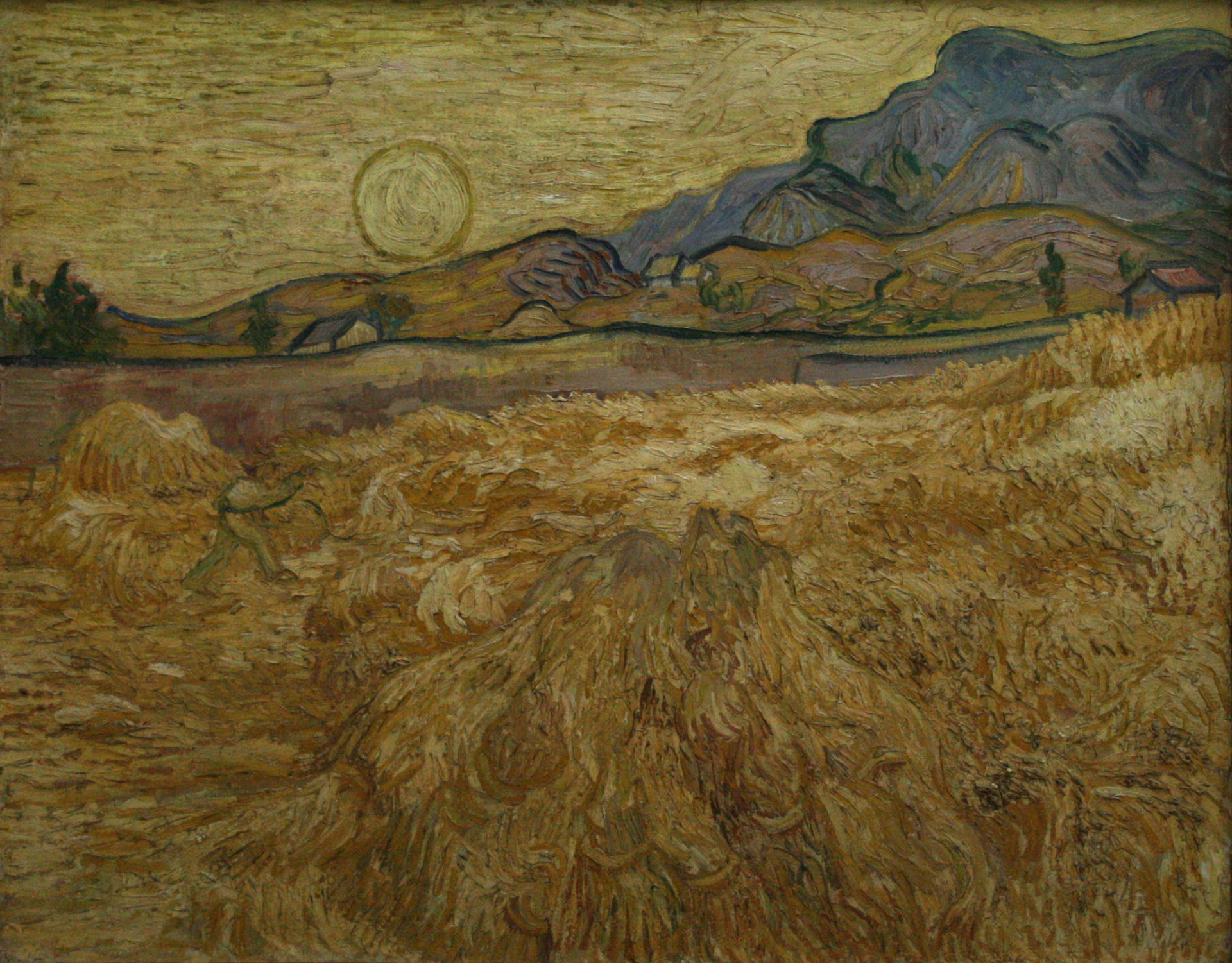
Wheat Field with Reaper and Sun. Vincent van Gogh, Late June - early September 1889. own photo in the Kröller-Müller museum. Public domain.