
Psalm 40
17 verses · Thanksgiving and lament
Sacrifice and offering You did not desire, but my ears You have opened. Burnt offerings and sin offerings You did not require.
Introduction
David, the Pit and the Rock, Book 1: The book of David, Poetry, Psalms Overview.
David wrote this psalm after a rescue he had waited a long time to see, while another trouble still pressed on him. It was written for Israelites who had waited long and owed a public thanksgiving when the answer came. Its first half gives thanks for a deliverance already finished, and its second half prays out of a danger still present. Only the change of tense marks the join. Listen for the man paying his vow before the congregation, and for what he sets in the place of the offerings.
Context
- Who
- Israelites who had waited a long time and who owed a thanksgiving when the answer came
- What
- A thanksgiving for a finished rescue joined to a plea out of a trouble still present.
- Where
- The great assembly at the sanctuary, where a deliverance was reported publicly
- When
- The reign of David, about 1010 to 970 BC by the superscription, which names no event.
- Why
- To give a worshipper a pattern that matches real life, and to set obedience ahead of offering.
Historical context
The psalm is David's by its title. Its first half reports a rescue already finished and its second half prays out of a trouble still present, and nothing in the Hebrew marks the join except the change of tense. The pit of verse 2 is a cistern, the bottle-shaped hole cut in rock to hold rainwater, with mud in the bottom and walls a man could not climb. Being set on a rock is the exact opposite of standing in that mud. Verses 9 and 10 describe a public thanksgiving in the great assembly. When a vow was paid in Israel the worshipper told the congregation what God had done. Verse 6 names the four classes of offering, sacrifice, offering, burnt offering and sin offering, and sets an opened ear in their place. The ear was the organ of obedience.
Significance
For the first hearers the psalm settled the order between obedience and offering. It said what the sacrifices were for, and 1 Samuel 15:22 had already said the same to Saul. It also gave a worshipper a model that matched real life: thanksgiving for what was finished and a plea for what was not, in one psalm.
This chapter in Jewish lifeWhat this chapter is in Jewish life and reading.
How it is read
Rashi reads this psalm as the song of Israel brought up out of Egypt, and he sets the whole of it there from the second line:
I have greatly hoped for the Lord in Egypt, and this psalm is meant for all Israel. (Rashi on Psalms 40:2:1)
The pit is the imprisonment in Egypt, the mire is the sea, and the new song is the song at the sea, at Rashi on Psalms 40:3:1, Rashi on Psalms 40:3:2 and Rashi on Psalms 40:4:1. He then reads the lines about sacrifice and the written scroll as the giving of the Torah at Sinai rather than as the words of any one man, at Rashi on Psalms 40:7:1, and he puts the answer of the people into the eighth line:
Then at the time of the giving of the Torah, behold I came to You to be bound in Your covenant. (Exod. 24:7): “We will do and hear,” and this matter is written as testimony concerning me in the scroll of the book, i.e., in the Law of Moses. (Rashi on Psalms 40:8:1)
He holds the poor man of the last line to be the people again:
poor Every expression of poor and needy in Psalms refers only to Israel. (Rashi on Psalms 40:18:1)
This is the sharpest parting in the range. The letter to the Hebrews puts the same lines of this psalm into the mouth of Christ on his entry into the world, at Hebrews 10:5 to 10, and this site sets the Greek and the Hebrew wording of the clause side by side on its page for that book. Rashi reads the lines of Sinai and of Israel, and the two readings cannot both be the whole sense of the passage. Ibn Ezra stands on this chapter at Ibn Ezra on Psalms 40:4:1, 40:11:1, 40:14:1 and 40:17:1, Radak at Radak on Psalms 40:1:1 and Malbim at Malbim on Psalms 40:1:1, and Sefaria holds no English version of those references, so this card cites them without quotation.
What the rabbis say
The corpus records 40 places where the rabbinic literature takes up a line of this psalm, 33 of them in the Midrash. The Midrash on the Psalms treats it at Midrash Tehillim 40:1, 40:3, 116:3, 119:16 and 70:2, Bereshit Rabbah at Bereshit Rabbah 41:1, 89:3, 65:8 and 92:2 and Midrash Tanchuma Buber at Midrash Tanchuma Buber, Beshalach 12:1, Bereshit 33:1, Re'eh 10:1 and Re'eh 12:2. The Talmud takes up lines of the psalm at Jerusalem Talmud Berakhot 9:5:21, Jerusalem Talmud Sanhedrin 10:3:3, Eruvin 19a:17, Jerusalem Talmud Rosh Hashanah 1:3:5, Gittin 60a:14, Avot DeRabbi Natan, Recension B 18:9 and Eruvin 63a:22. Each is a locator in this corpus, so the saying stands at its reference and is read there.
Sources: Rashi, Rashi on Psalms, in The Judaica Press complete Tanach with Rashi, translated by A. J. Rosenberg, under a CC-BY licence; Ibn Ezra, Ibn Ezra on Psalms, cited at Ibn Ezra on Psalms 40:4:1, 40:11:1, 40:14:1 and 40:17:1; Radak, Radak on Psalms, cited at Radak on Psalms 40:1:1; Malbim, Malbim on Psalms, cited at Malbim on Psalms 40:1:1; Midrash Tehillim, the Midrash on the Psalms, cited at Midrash Tehillim 40:1, 40:3, 116:3, 119:16 and 70:2; The Talmud, cited at Jerusalem Talmud Berakhot 9:5:21, Jerusalem Talmud Sanhedrin 10:3:3, Eruvin 19a:17, Jerusalem Talmud Rosh Hashanah 1:3:5, Gittin 60a:14, Avot DeRabbi Natan, Recension B 18:9 and Eruvin 63a:22; MannaFest, the letter to the Hebrews, at /book/hebrews, 2026; MannaFest, the Sefaria corpus at scripts/data/sources/sefaria/psalms/40.json, fetched 2026-09-19, 2026.
Psalms 40:1-3
waited patiently for the LORD: The rescue is finished when the psalm opens. The pit of despair and the miry clay give no foothold, and God sets the feet on a rock and makes the footsteps firm. The new song is put in his mouth, and many will see and fear and trust the LORD.
Psalms 40:1
“I waited patiently for the Lord. Patient waiting upon God was a special characteristic of our Lord Jesus. Impatience never lingered in his heart, much less escaped his lips. All through his agony in the garden, his trial of cruel mockings before Herod and Pilate, and his passion on the tree, he waited in omnipotence of patience. No glance of wrath, no word of murmuring, no deed of vengeance came from God's patient Lamb; he waited and waited on; was patient, and patient to perfection, far excelling all others who have according to their measure glorified God in the fires.”
Charles Spurgeon · The Treasury of David, Vol. 2 (1870)Particular Baptist
1 more voice on this verseWhat preachers and commentators have said about this verse, in their own words.
Psalms 40:1
“He tells us, not merely that he had waited, but by the repetition of the same expression, he shows that he had been a long time in anxious suspense. In proportion then as his trial was prolonged, the evidence and proof of his faith in enduring the delay with calmness and equanimity of mind was so much the more apparent.”
John Calvin · Commentaries (1554)reformed
He lifted me up from the pit of despair: The Hebrew behind despair means noise or uproar, and John Calvin heard a roaring pit of rushing waters. Albert Barnes noted its other sense, desolation, fit for the grave. Matthew Henry noted these verses name no sickness or enemy, and so read the pit as inward distress of spirit.
Psalms 40:2
“Christ has heard the prayer of his own servants and has brought us out from the pit of misery and from the mire of dregs. We were drowning there; our whole flesh was clinging to the mire, trapped in the whirlpool of our sins. Our soul was powerless to save itself; fallen and ruined as it was by the multiplicity and dreadfulness of our offenses. Thanks be to the Lord Jesus, God's only Son, who came down from heaven to forgive us our sins.”
Ambrose of Milan · written before 397 · Commentaries on the Twelve Davidic Psalmspatristic
2 more voices on this verse
Psalms 40:2
“And he drew me out of the roaring pit. Some translate, from the pit of desolation, because the verb s'h, shaah, from which the noun s'vm, shaon, is derived, signifies to destroy or to waste, as well as to resound or echo. But it is more appropriate to consider that there is here an allusion to the deep gulfs, where the waters gush with a tumultuous force.”
John Calvin · Commentaries (1554)reformed
Psalms 40:2
“He brought me up also out of an horrible pit. When our Lord bore in his own person the terrible curse which was due to sin, he was so cast down as to be like a prisoner in a deep, dark, fearful dungeon, amid whose horrible glooms the captive heard a noise as of rushing torrents, while overhead resounded the tramp of furious foes. Our Lord in his anguish was like a captive in the oubliettes, forgotten of all mankind, immured amid horror, darkness, and desolation.”
Charles Spurgeon · The Treasury of David, Vol. 2 (1870)Particular Baptist
He put a new song in my mouth: The song is put in his mouth, and Thomas Aquinas drew from that verb that even worthy praise is God's gift. Albert Barnes took new to mean a fresh occasion, a rescue too great for the old words of thanks. Adam Clarke read the fear as a fear of sinning.
Psalms 40:3
“And he hath put a new song in my mouth, even praise unto our God. At the passover, before his passion, our Lord sang one of the grand old Psalms of praise; but what is the music of his heart now, in the midst of his redeemed! What a song is that in which his glad heart for ever leads the chorus of the elect! Not Miriam's tabor nor Moses' triumphant hymn over Miriam's chivalry can for a moment rival that ever new and exulting song.”
Charles Spurgeon · The Treasury of David, Vol. 2 (1870)Particular Baptist
Psalms 40:4-5
Blessed is the man: The blessing goes to the man who makes the LORD his trust, the man who turns away from the proud and from falsehood. The wonders God has done and the plans He has for His people are past counting. The attempt at a list breaks off unfinished.
Psalms 40:4
“Turn - From God, in whom alone they ought to trust. To lies - To lying vanities, such as worldly power and wisdom, and riches, and all other earthly things, or persons, in which men are prone to trust: which are called lies, because they promise more than they perform.”
John Wesley · Explanatory Notes upon the Old Testament (1765)evangelical
the plans You have for us—: John Wesley saw this verse as a dividing wall between David speaking for himself and David speaking as the Messiah in the verses that follow. The plans are for us, and Jamieson, Fausset and Brown took the plural as Christ joined with His people.
Psalms 40:5
“Many, O Lord my God, are thy wonderful works which thou hast done. Creation, providence, and redemption, teem with wonders as the sea with life. Our special attention is called by this passage to the marvels which cluster around the cross and flash from it. The accomplished redemption achieves many ends, and compasses a variety of designs; the outgoings of the atonement are not to be reckoned up, the influences of the cross reach further than the beams of the sun.”
Charles Spurgeon · The Treasury of David, Vol. 2 (1870)Particular Baptist
2 more voices on this verse
Psalms 40:5
“Many - This verse seems to be interposed as a wall of partition, between that which David speaks in his own person, and that which he speaks in the person of the Messiah, in the following verses.”
John Wesley · Explanatory Notes upon the Old Testament (1765)evangelical
Psalms 40:5
“This is but one instance of many. The use of the plural accords with the union of Christ and His people. In suffering and triumph, they are one with Him.”
Jamieson, Fausset & Brown · Commentary Critical and Explanatory on the Whole Bible (1871)reformed
Psalms 40:6-8
my ears You have opened: is the mark of a servant. What follows is obedience above offerings, delight in God's will and a law inside the heart. Hebrews 10:5 to 7 puts all three verses in Christ's mouth, following the Greek, where a prepared body replaces the opened ears.
Psalms 40:6
“Here we enter upon one of the most wonderful passages in the whole of the Old Testament, a passage in which the incarnate Son of God is seen not through a glass darkly, but as it were face to face. Sacrifice and offering thou didst not desire. In themselves considered, and for their own sakes, the Lord saw nothing satisfactory in the various offerings of the ceremonial law.”
Charles Spurgeon · The Treasury of David, Vol. 2 (1870)Particular Baptist
1 more voice on this verse
Psalms 40:6
“Sacrifice - These and the following words, may in an improper sense belong to the time of David; when God might be said, not to desire or require legal sacrifices comparatively.”
John Wesley · Explanatory Notes upon the Old Testament (1765)evangelical
Cross references
Psalms 40:6
- Quoted inHebrews 10:5“Therefore, when Christ came into the world, He said: “Sacrifice and offering You did not desire, but a body You prepared for Me.”
'Sacrifice and offering thou wouldest not, but a body hast thou prepared me'
ConnectionsHebrews 10:5
it is written about me in the scroll: Albert Barnes read then as since this is the case, the answer to offerings that could not do the work. The scroll is the roll of the book, and Jamieson, Fausset and Brown took it as the Law of Moses. Didymus the Blind widened it to all inspired Scripture.
Psalms 40:7
“He calls the "roll of the book" every divinely inspired Scripture, both the legal and the prophetic. In these Scriptures things are written concerning the memory of the Savior among us. The psalmist calls it a roll because everything is summed up into one.”
Didymus the Blind · written before 398 · Fragments on the Psalms 40:8patristic
2 more voices on this verse
Psalms 40:7
“Them - These words literally and truly belong to Christ, and the sense is this; seeing thou requirest a better sacrifice than those of the law, lo, I offer myself to come, and I will in due time come, into the world, as this phrase is explained in divers places of scripture, and particularly Heb. x, 5, where this place is expressly applied to Christ.”
John Wesley · Explanatory Notes upon the Old Testament (1765)evangelical
Psalms 40:7
“In either case, the Pentateuch, or law of Moses, is meant, and while it contains much respecting Christ directly, as Ge 3:15; De 18:15, and, indirectly, in the Levitical ritual, there is nowhere any allusion to David. I have preached--literally, "announced good tidings." Christ's prophetical office is taught.”
Jamieson, Fausset & Brown · Commentary Critical and Explanatory on the Whole Bible (1871)reformed
Within my heart is literally in the midst of my bowels, and Albert Barnes took it as obedience that rose from inside. Augustine linked the verse to the opening of the Psalter, whose blessed man has his delight in the Law of the LORD.
Psalms 40:8
“I delight to do thy will, O my God. Our blessed Lord alone could completely do the will of God. The law is too broad for such poor creatures as we are to hope to fulfil it to the uttermost: but Jesus not only did the Father's will, but found a delight therein; from old eternity he had desired the work set before him; in his human life he was straitened till he reached the baptism of agony in which he magnified the law, and even in Gethsemane itself he chose the Father's will, and set aside his own.”
Charles Spurgeon · The Treasury of David, Vol. 2 (1870)Particular Baptist
2 more voices on this verse
Psalms 40:8
“I delight - This is eminently true, of Christ, and is here observed as an act of heroic obedience, that he not only resolved to do, but delighted in doing the will of God, or what God had commanded him, which was to die, and that a most shameful, and painful, and cursed death.”
John Wesley · Explanatory Notes upon the Old Testament (1765)evangelical
Psalms 40:8
“Because there is one will, there is one substance, there is inseparable majesty and the power of the Trinity. But there is another voice, that of the flesh; and yet, it too consents to God's will.… Christ accepted death and crucifixion so as to crucify the flesh. For my sake he took on himself the combat, so that he might conquer me. Though Christ's flesh was strong and not liable to sin, he nevertheless took on my sins.”
Ambrose of Milan · written before 397 · Commentaries on the Twelve Davidic Psalmspatristic
Psalms 40:9-10
righteousness in the great assembly: The deliverance is told out loud in the great assembly. Four words pile up for what was received, righteousness, faithfulness, salvation and loving devotion. None of it is kept back from the assembly.
Psalms 40:9
“I have preached righteousness in the great congregation. The purest morality and the highest holiness were preached by Jesus. Righteousness divine was his theme. Our Lord's whole life was a sermon, eloquent beyond compare, and it is heard each day by myriads. Moreover, he never shunned in his ministry to declare the whole counsel of God; God's great plan of righteousness he plainly set forth. He taught openly in the temple, and was not ashamed to be a faithful and a true witness.”
Charles Spurgeon · The Treasury of David, Vol. 2 (1870)Particular Baptist
1 more voice on this verse
Psalms 40:9
“Righteousness - Thy faithfulness. Great congregation - In the most public and solemn assemblies: not only to the Jews, but also to all nations; to whom Christ preached by his apostles, as is observed Eph. ii, 17.”
John Wesley · Explanatory Notes upon the Old Testament (1765)evangelical
I have not covered up Your righteousness in my heart: Augustine took this as open confession of faith. He pictured a Christian questioned by a persecutor who says aloud what he believes. Albert Barnes read righteousness in David's mouth as what God requires, and in the Messiah's as God's way of making men righteous.
Psalms 40:10
“I have not hid thy righteousness within my heart. On the contrary, "Never man spake like this man." God's divine plan of making men righteous was well known to him, and he plainly taught it. What was in our great Master's heart he poured forth in holy eloquence from his lips. The doctrine of righteousness by faith he spake with great simplicity of speech. Law and gospel equally found in him a clear expositor. I have declared thy faithfulness and thy salvation.”
Charles Spurgeon · The Treasury of David, Vol. 2 (1870)Particular Baptist
1 more voice on this verse
Psalms 40:10
“A person can speak of his own justice without arrogance, … if he has faith in God and believes that on account of his faith he will be reckoned as just. … It was for this reason that Christ came, to establish faith and to grant us forgiveness of sin.”
Ambrose of Milan · written before 397 · Commentaries on the Twelve Davidic Psalmspatristic
Psalms 40:11-13
do not withhold Your mercy: The psalm turns back to present need and asks that the mercy not be withheld. Evils and sins are counted together, more than the hairs of his head, and the heart fails. Psalm 70:1 opens with nearly these same words.
Psalms 40:11
“Withhold not thou thy tender mercies from me, O Lord,.... this is a petition of Christ to his Father, when in the midst of his sorrows and sufferings, before related; and particularly when he hid his face from him, and withheld the discoveries of his tender and affectionate love; let thy lovingkindness and thy truth continually preserve me; as he had promised; of which promise some notice is given, Isa 49:8, in the fulfilment of which the lovingkindness, truth, and faithfulness of God, would appear.”
2 more voices on this verse
Psalms 40:11
“Withhold not thou thy tender mercies from me, O Lord. Alas! these were to be for awhile withheld from our Lord while on the accursed tree, but meanwhile in his great agony he seeks for gentle dealing; and the coming of the angel to strengthen him was a clear answer to his prayer. He had been blessed aforetime in the desert, and now at the entrance of the valley of the shadow of death, like a true, trustful, and experienced man, he utters a holy, plaintive desire for the tenderness of heaven.”
Charles Spurgeon · The Treasury of David, Vol. 2 (1870)Particular Baptist
Psalms 40:11
“With-hold not - David, having been transported by the spirit of God to the commemoration of the great mystery of the Messiah, he now seems to be led back by the same spirit, to the consideration of his own case.”
John Wesley · Explanatory Notes upon the Old Testament (1765)evangelical
my sins have overtaken me: My sins is hard for readers who hear Christ speaking in verses 6 to 8. Charles Spurgeon answered that sins were laid on Him and He took them as His own. Jamieson, Fausset and Brown took the Hebrew word as sufferings.
Psalms 40:12
“For innumerable evils have compassed me about. On every side he was beset with evils; countless woes environed the great Substitute for our sins. Our sins were innumerable, and so were his griefs. There was no escape for us from our iniquities, and there was no escape for him from the woes which we deserved. From every quarter evils accumulated about the blessed One, although in his heart evil found no place. Mine iniquities have taken hold upon me, so that I am not able to look up.”
Charles Spurgeon · The Treasury of David, Vol. 2 (1870)Particular Baptist
2 more voices on this verse
Psalms 40:12
“This was it that made the discovery he was now favoured with of a Redeemer very welcome to him. He saw his iniquities to be evils, the worst of evils; he saw that they compassed him about; in all the reviews of his life, and his reflections upon each step of it, still he discovered something amiss. The threatening consequences of his sin surrounded him.”
Matthew Henry · Commentary on the Whole Bible (1707-1721)puritan
Psalms 40:12
“Taken hold - Mens sins are figuratively said to take hold of them, as an officer takes hold of a man whom he arrests. To look - Unto God or men, with any comfort: I am ashamed and confounded.”
John Wesley · Explanatory Notes upon the Old Testament (1765)evangelical
Be pleased, O LORD, to deliver me: Be pleased asks for God's good will, and Augustine heard in it the leper's appeal to Jesus in Matthew 8:2. Charles Spurgeon placed the prayer in Gethsemane. Spurgeon read it as a plea to be upheld while drinking the cup and set free at the first fitting moment.
Psalms 40:13
“Be pleased, O Lord, to deliver me,.... From the innumerable evils which compassed him about; from sinful men, and from devils, signified by the sword, dog, and lion, Psa 22:20; and from the power and dominion of death and the grave; all which was done when he was raised from the dead, and as the fruit and effect of God's well pleasedness in him, and with what he did and suffered; see Psa 22:8; O Lord, make haste to help me; See Gill on Psa 22:19.”
2 more voices on this verse
Psalms 40:13
“Be pleased, O Lord, to deliver me: O Lord, make haste to help me. How touching! How humble! How plaintive! The words thrill us as we think that after this sort our Lord and Master prayed. His petition is not so much that the cup should pass away undrained, but that he should be sustained while drinking it, and set free from its power at the first fitting moment. He seeks deliverance and help; and he entreats that the help may not be slow in coming; this is after the manner of our pleadings. Is it not?”
Charles Spurgeon · The Treasury of David, Vol. 2 (1870)Particular Baptist
Psalms 40:13
“The language is not necessarily imprecatory, but rather a confident expectation (Ps 5:11), though the former sense is not inconsistent with Christ's prayer for the forgiveness of His murderers, inasmuch as their confusion and shame might be the very means to prepare them for humbly seeking forgiveness (compare Ac 2:37).”
Jamieson, Fausset & Brown · Commentary Critical and Explanatory on the Whole Bible (1871)reformed
Psalms 40:14-15
who seek my life: The prayer asks shame and confusion on those who seek his life and wish him harm. The mockers who say Aha, aha are to be appalled at their own shame. The man lifted out of the pit asks it.
Psalms 40:14
“Let them be ashamed and confounded together that seek after my soul to destroy it. Whether we read this as a prayer or a prophecy it matters not, for the powers of sin, and death, and hell, may well be ashamed as they see the result of their malice for ever turned against themselves.”
Charles Spurgeon · The Treasury of David, Vol. 2 (1870)Particular Baptist
be appalled at their own shame: The same cry, Aha, aha, is raised against the psalmist in Psalm 35:21, as Adam Clarke noted. Augustine's text read the cry as well done, well done, and he applied it to flatterers who praise a Christian's virtues and scorn his faith. John Gill heard the mockers at the cross.
Psalms 40:15
“Let them be desolate, or amazed; even as Jesus was desolate in his agony, so let his enemies be in their despair when he defeats them. The desolation caused in the hearts of evil spirits and evil men by envy, malice, chagrin, disappointment, and despair, shall be a fit recompense for their cruelty to the Lord when he was in their hands. For a reward of their shame that say unto me, Aha, aha. Did the foul fiend insult over our Lord? Behold how shame is now his reward!”
Charles Spurgeon · The Treasury of David, Vol. 2 (1870)Particular Baptist
1 more voice on this verse
Psalms 40:15
“Both the conversion of a sinner and the glorification of a saint are great disappointments to Satan, who does his utmost, with all his power and subtlety, to hinder both. Now, our Lord Jesus having undertaken to bring about the salvation of all his chosen, we may in faith pray that, in both these ways, that great adversary may be confounded.”
Matthew Henry · Commentary on the Whole Bible (1707-1721)puritan
Psalms 40:16-17
rejoice and be glad in You: Those who seek God are to rejoice and be glad in Him, and those who love His salvation say the LORD be magnified. The last verse leaves the speaker poor and needy, with God as his helper and deliverer. The closing word asks God not to delay.
Psalms 40:16
“Let all those that seek thee, rejoice and be glad in thee. We have done with Ebal and turn to Gerizim. Here our Lord pronounces benedictions on his people. Note who the blessed objects of his petition are: not all men, but some men, "I pray for them, I pray not for the world." He pleads for seekers: the lowest in the kingdom, the babes of the family; those who have true desires, longing prayers, and consistent endeavours after God. Let seeking souls pluck up heart when they hear of this.”
Charles Spurgeon · The Treasury of David, Vol. 2 (1870)Particular Baptist
But I am poor and needy: Adam Clarke gave needy as a beggar, one utterly destitute, and read think of me as God turning the matter over in His mind. What fills God's heart, he reasoned, will soon move His hand. John Cassian took the beggar of the Lord as the pattern of dependence on God.
Psalms 40:17
“But I am poor and needy. The man of sorrows closes with another appeal, based upon his affliction and poverty. Yet the Lord thinketh upon me. Sweet was this solace to the holy heart of the great sufferer. The Lord's thoughts of us are a cheering subject of meditation, for they are ever kind and never cease. His disciples forsook him, and his friends forgat him, but Jesus knew that Jehovah never turned away his heart from him, and this upheld him in the hour of need. Thou art my help and my deliverer.”
Charles Spurgeon · The Treasury of David, Vol. 2 (1870)Particular Baptist
3 more voices on this verse
Psalms 40:17
Truly, what higher or holier poverty can there be than this, that a person knowing he is defenseless of his own, asks help for daily life from another's generosity and realizes his life and being to depend every moment on God's help. Such a one truly confesses himself "the beggar of the Lord," like the psalmist, who said, "I am a beggar and a poor man, and God helps me."
John Cassian · written before 435 · CONFERENCES 10:11patristic
Psalms 40:17
“David himself was one of these: I am poor and needy (a king, perhaps now on the throne, and yet, being troubled in spirit, he calls himself poor and needy, in want and distress, lost and undone without a Saviour), yet the Lord thinketh upon me in and through the Mediator, by whom we are made accepted.”
Matthew Henry · Commentary on the Whole Bible (1707-1721)puritan
Psalms 40:17
“A summary of his condition and hopes. thinketh upon--or provides for me. "He was heard," "when he had offered up prayers and supplications with strong crying and tears, unto Him that was able to save him from death" [Heb 5:7].”
Jamieson, Fausset & Brown · Commentary Critical and Explanatory on the Whole Bible (1871)reformed
How this psalm is built
The form: A thanksgiving for deliverance that turns into a prayer for deliverance, joined in one psalm, as Delitzsch classes it.
The patterns in this chapter
| Device | What it does | Where to see it |
|---|---|---|
| The pit and the rock | Verses 2 and 3 move a man through four positions in two verses: out of the pit of despair, out of the miry clay, onto a rock, with his footsteps made firm. The clay gives no foothold and the rock gives nothing else, so the pair is the psalm's picture of the whole rescue.Charles Spurgeon, The Treasury of David, Vol. 2, 1870, on Psalm 40:2. | Psalm 40:2, Psalm 40:3 |
| The list that breaks off because it cannot be finished | Verse 5 starts to count the wonders God has done and the plans He has for His people, and gives up in the same verse: they are more than can be told. The psalm's method is to attempt the count and report the failure rather than to use a large adjective.Matthew Henry, Commentary on the Whole Bible, 1710, on Psalm 40:5. | Psalm 40:5 |
| The opened ear against the four offerings | Verse 6 names sacrifice, offering, burnt offering and sin offering and says God did not require them, and puts in their place an opened ear. The ear is the organ of obedience, and verse 8 finishes the thought with the law inside the heart. The psalm replaces a ritual with a faculty.Franz Delitzsch, Biblical Commentary on the Psalms, on Psalm 40:6. | Psalm 40:6, Psalm 40:7, Psalm 40:8 |
| Not kept back, said four times over | Verses 9 and 10 pile up what was told in the great assembly: righteousness, faithfulness, salvation and loving devotion, with the repeated insistence that none of it was concealed and none held back. The psalm's thanksgiving is public by design.John Gill, Exposition of the Old Testament, 1748 to 1763, on Psalm 40:10. | Psalm 40:9, Psalm 40:10 |
| More than the hairs of my head, set against more than can be told | Verse 5 counts God's wonders and finds them past telling. Verse 12 counts his own sins and finds them more than the hairs of his head. The same failure of arithmetic serves praise in the first half and confession in the second, and the two verses hold the psalm's halves together.Matthew Henry, Commentary on the Whole Bible, 1710, on Psalm 40:11 to 17. | Psalm 40:5, Psalm 40:12 |
The New Testament's use
8 more paragraphs on the patterns
Hebrews 10:5 to 7 quotes verses 6 to 8 and puts them in the mouth of Christ coming into the world. The quotation follows the Greek of the Septuagint, where a prepared body stands in place of the opened ears of the Hebrew, and the writer of Hebrews builds his argument that the second covenant replaces the first on that passage. It is one of the most important Old Testament quotations in the New.
Verses 13 to 17 stand again as Psalm 70:1 to 5, with only small differences. The same prayer appears twice in the Psalter, once as the close of a thanksgiving and once on its own.
The psalm's internal pairing is its counting. God's wonders cannot be told at verse 5, the speaker's sins cannot be numbered at verse 12, and both failures are stated in the same construction. The psalm uses arithmetic to measure two things that are past measuring.
The new song of verse 3 is put in his mouth by God rather than composed by the man, which is how the psalm describes its own existence.
The debated concept
Verse 6 says in the Hebrew that God has opened, or dug, the writer's ears, and the Greek of the Septuagint that Hebrews 10:5 quotes reads a body You prepared for Me. The difference is the psalm's best known textual question. Albert Barnes treats the Greek as an interpretive rendering that keeps the sense, the whole person made ready to obey standing for the ear made ready to hear. Others hold that the Greek translators read a different Hebrew text. John Gill takes the opened ear as the mark of the bondservant at Exodus 21:6 whose ear was pierced at the doorpost. What both readings agree on is the psalm's point, that obedience is what the offerings were for, and the writer of Hebrews builds on that sense rather than on the wording alone.
The divine connection
Hebrews 10:5 to 7 puts verses 6 to 8 in the mouth of Christ coming into the world, so the New Testament's own use is the ground of the messianic reading and no inference is needed. The claim should be stated at that tier: the apostolic writer reads the psalm of Christ, and the argument that the second covenant sets aside the first rests on it.
Keep studying
Sources for this chapter
The summary
Jamieson, Fausset & Brown, Commentary Critical and Explanatory; John Calvin, Commentaries; John Wesley, Notes on the Old Testament and Matthew Henry, Complete Commentary.
The form and classifications
Albert Barnes, Notes on the Book of Psalms, 1832 to 1869, on Psalm 40:13; Charles Spurgeon, The Treasury of David, Vol. 2, 1870, on Psalm 40:6; Franz Delitzsch, Biblical Commentary on the Psalms, on Psalm 40 and Matthew Henry, Commentary on the Whole Bible, 1710, on Psalm 40.
The exposition
Adam Clarke, Commentary on the Bible; Albert Barnes; Augustine of Hippo, Exposition on Psalm 40; Charles Spurgeon, The Treasury of David; Didymus the Blind, FRAGMENTS ON THE PSALMS; Franz Delitzsch, Biblical Commentary on the Psalms; Jamieson, Fausset & Brown, Commentary Critical and Explanatory on the Whole Bible; Jerome, HOMILY ON PSALM 108[109]; John Calvin; John Cassian, CONFERENCES; John Gill, Exposition of the Old Testament; John Wesley, Explanatory Notes upon the Old Testament; Matthew Henry, Commentary on the Whole Bible and Thomas Aquinas, Exposition on the Psalms of David.
The painting
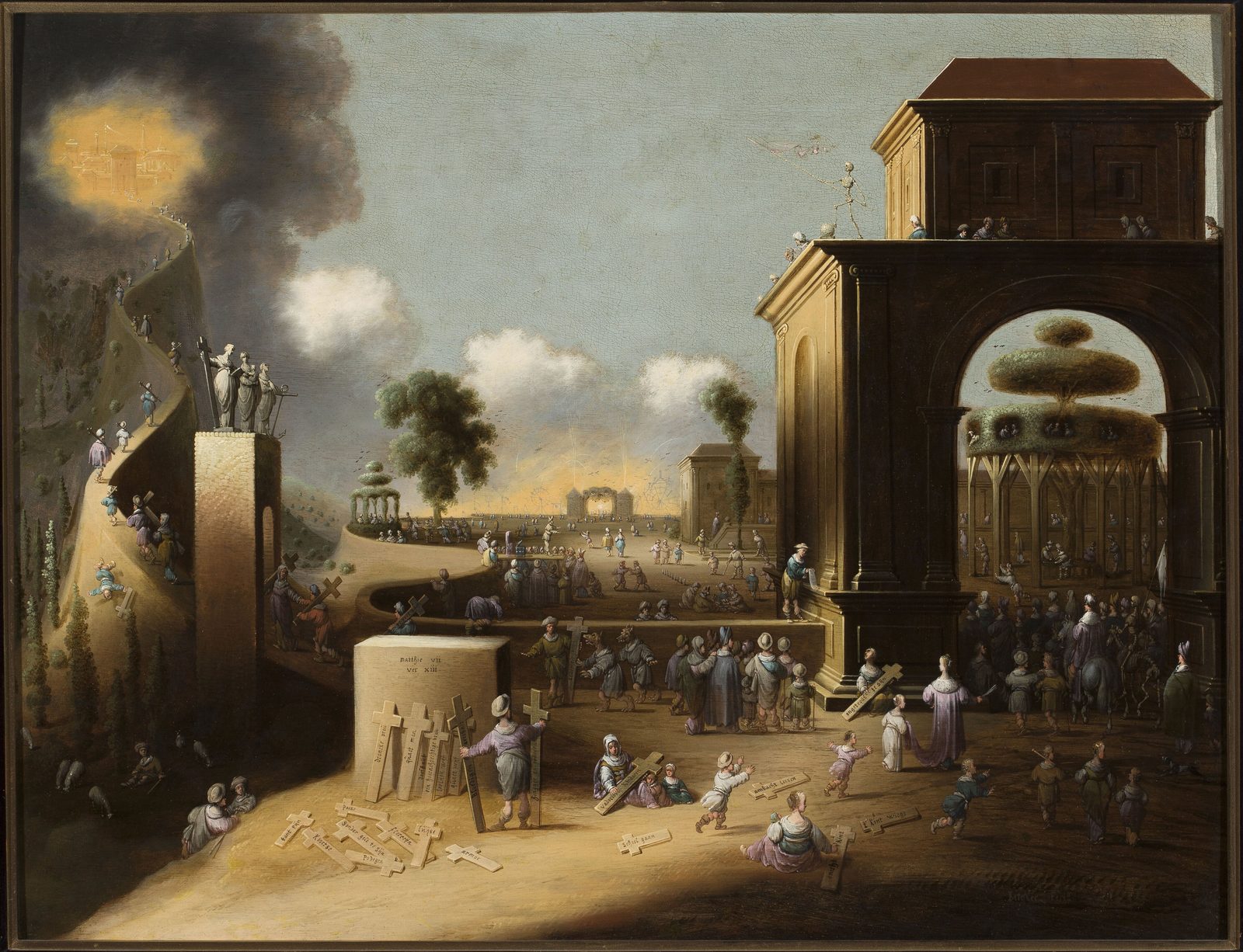
Narrow Road of Virtue and Wide Road of Sin. Jan Micker, not stated on the file page. National Museum in Warsaw. Public domain.