
Psalm 39
13 verses · Individual lament
You, indeed, have made my days as handbreadths, and my lifetime as nothing before You. Truly each man at his best exists as but a breath. Selah
Introduction
David, the Handbreadth, Book 1: The book of David, Poetry, Psalms Overview.
David wrote this psalm and directed it to Jeduthun, one of the three chief musicians he set over the service of song. It was made for performance. It comes from a man under God's discipline who had resolved to keep quiet while the wicked could hear him. It was written for Israelites who had to weigh their words in front of people who would use them. Listen for the smallest measure of length an Israelite used, applied to a whole life, and for the standing of a resident alien that the speaker claims at the end.
Context
- Who
- Israelites who had to weigh their words in front of people who would use them
- What
- A lament of a man who kept silent before the wicked and then spoke to God about how short a life is.
- Where
- A household under discipline, with the wicked near enough to hear; the psalm names no place.
- When
- The reign of David, about 1010 to 970 BC by the superscription, which names no event.
- Why
- To make it sayable to God that a life is brief, and to ask for the protection owed to a resident alien.
Historical context
The psalm is David's by its title and is directed to Jeduthun. Jeduthun is named at 1 Chronicles 25:1 as one of the three chief musicians David set over the service of song, so the psalm was written for performance by a named guild. The vow of verse 1 is to muzzle the mouth while the wicked are present. Verse 5 measures a life in handbreadths. A handbreadth was the width of four fingers, the smallest unit of length an Israelite used. Using it for a lifetime is using the smallest ruler in the toolbox. Verse 11 says discipline consumes what a man holds dear the way a moth eats cloth. Clothing was wealth, handed down and stored, and moth damage was the ordinary way stored wealth disappeared without anyone watching it go. Verse 12 calls the writer a foreigner and a sojourner with God.
Significance
For the first hearers the psalm made two things sayable. The first was that a life is short enough to be measured in the smallest unit there is. The second was that a man may say so out loud to God. Its plea rested on the sojourner's claim, which in Israel was a claim on the protection of the household one lived in.
This chapter in Jewish lifeWhat this chapter is in Jewish life and reading.
How it is read
The heading of this psalm names Jeduthun, and Rashi gives both a plain answer and a midrashic one:
to Jeduthun The name of one of the singers, and there was also a musical instrument called Jeduthun. According to the Midrash Aggadah (Song Rabbah 4:1 [4]): concerning the edicts (דתות) and concerning the distressing laws and decrees that are decreed upon Israel. (Rashi on Psalms 39:1:1)
He reads the psalm itself as the speech of Israel in exile holding its tongue under trouble, at Rashi on Psalms 39:2:1 and Rashi on Psalms 39:2:2, where the muzzle of the second line becomes a silence kept even from the words of the Torah out of fear. On the measured days of the sixth line he writes:
Behold...handbreadths The days of man are measured like a thing that is measured with handbreadths; so are man’s days limited. and my old age Heb. וחלדי, and our old age is as nothing before you. חלד is an expression of rust (חלודה), rodijjl in Old French; rust, old age. (Rashi on Psalms 39:6:1)
The prayer of the ninth line he reads as a prayer against the nations under the name of Esau:
do not make me the reproach of the ignoble Esau. Bring afflictions and pains upon him too, so he will not be able to say to me, “You are suffering, and we are not suffering.” This prayer was instrumental in bringing about the pains of illnesses upon the nations. (Rashi on Psalms 39:9:1)
A Christian reader meets the psalm as the prayer of one man about the shortness of his own life. This reading keeps the one man and sets the whole people inside him, which is the same move the Jewish commentators make on the servant of Isaiah. Ibn Ezra stands on this chapter at Ibn Ezra on Psalms 39:1:1, 39:3:1, 39:4:1, 39:5:1, 39:8:1, 39:9:1, 39:10:1 and 39:13:1 and Radak at Radak on Psalms 39:3:1, 39:4:1 and 39:5:1, and Sefaria holds no English version of those references, so this card cites them without quotation.
What the rabbis say
The corpus records 40 places where the rabbinic literature takes up a line of this psalm, 31 of them in the Midrash. Rashi points to one of them himself at Rashi on Psalms 39:1:1, citing the Midrash Aggadah at Shir HaShirim Rabbah 4:1 for the reading of the name Jeduthun as the decrees laid on Israel. The Midrash on the Psalms treats the psalm at Midrash Tehillim 1:4, 39:1, 77:1, 119:16 and 6:6, Kohelet Rabbah at Kohelet Rabbah 7:19:4 and 5:10:2 and Shir HaShirim Rabbah at Shir HaShirim Rabbah 4:4:1 and 1:1:6. The Talmud takes up lines of the psalm at Gittin 7a:1, Gittin 7a:6, Berakhot 5a:7, Jerusalem Talmud Shabbat 14:1:4, Jerusalem Talmud Kiddushin 1:7:4, Jerusalem Talmud Shabbat 1:2:5, Jerusalem Talmud Shekalim 2:5:6, Bava Metzia 59a:5 and Berakhot 32b:5.
Sources: Rashi, Rashi on Psalms, in The Judaica Press complete Tanach with Rashi, translated by A. J. Rosenberg, under a CC-BY licence; Ibn Ezra, Ibn Ezra on Psalms, cited at Ibn Ezra on Psalms 39:1:1, 39:3:1, 39:4:1, 39:5:1, 39:8:1, 39:9:1, 39:10:1 and 39:13:1; Radak, Radak on Psalms, cited at Radak on Psalms 39:3:1, 39:4:1 and 39:5:1; Midrash Tehillim, the Midrash on the Psalms, cited at Midrash Tehillim 1:4, 39:1, 77:1, 119:16 and 6:6; Shir HaShirim Rabbah, cited at Shir HaShirim Rabbah 4:4:1 and 1:1:6; The Talmud, cited at Gittin 7a:1, Gittin 7a:6, Berakhot 5a:7, Jerusalem Talmud Shabbat 14:1:4, Jerusalem Talmud Kiddushin 1:7:4, Jerusalem Talmud Shabbat 1:2:5, Jerusalem Talmud Shekalim 2:5:6, Bava Metzia 59a:5 and Berakhot 32b:5; MannaFest, the Sefaria corpus at scripts/data/sources/sefaria/psalms/39.json, fetched 2026-09-19, 2026.
Psalms 39:1-3
guard my mouth with a muzzle: The vow is to watch his ways and muzzle his mouth when the wicked are present. The silence holds so tightly that even good goes unsaid, and the sorrow is stirred by the holding. Then the heart grows hot, the fire burns, and he speaks.
Psalms 39:1
“He remembers that he had in particular covenanted against tongue-sins--that he would not sin with his tongue, that he would not speak amiss, either to offend God or offend the generation of the righteous, Ps. lxxiii.”
Matthew Henry · Commentary on the Whole Bible (1707-1721)puritan
1 more voice on this verseWhat preachers and commentators have said about this verse, in their own words.
Psalms 39:1
“Have no doubt about it, when people annoy and torment you when you are doing the right thing, those people are the lackeys of the wickedest sinner of all. They are slaves of the author of every evil deed. David saw this with prophetic eyes and recognized the face of the evil one. So he kept quiet. He had no wish whatever to do the will of the evil one. So he kept quiet. He had no wish whatever to do the will of him who ruins one's peace of mind. He simply said nothing.”
Ambrose of Milan · written before 397 · Commentaries on the Twelve Davidic Psalmspatristic
even from speaking good: Charles Spurgeon asked whether this silence neglected the duty of speaking well of God's name. Christ kept silence before the wicked yet spoke before Pilate. The Aramaic Targum, Adam Clarke noted, reads that he ceased from the words of the law.
Psalms 39:2
“I was dumb with silence. He was as strictly speechless as if he had been tongueless—not a word escaped him. He was as silent as the dumb. I held my peace, even from good. Neither bad nor good escaped his lips. Perhaps he feared that if he began to talk at all, he would be sure to speak amiss, and, therefore, he totally abstained. It was an easy, safe, and effectual way of avoiding sin, if it did not involve a neglect of the duty which he owed to God to speak well of his name.”
Charles Spurgeon · The Treasury of David, Vol. 2 (1870)Particular Baptist
2 more voices on this verse
Psalms 39:2
“If you know there is sin, be silent. Do not add to your guilt by denying it. If you are not aware of sin, be silent. You are secure in your innocence. The reports of other people cannot nail any sin to a conscience that knows itself to be innocent.”
Ambrose of Milan · written before 397 · Commentaries on the Twelve Davidic Psalmspatristic
Psalms 39:2
“I held my peace even from good. His silence was commendable; and the greater the provocation was the more praiseworthy was his silence. Watchfulness and resolution, in the strength of God's grace, will do more towards the bridling of the tongue than we can imagine, though it be an unruly evil.”
Matthew Henry · Commentary on the Whole Bible (1707-1721)puritan
as I mused, the fire burned: Readers weigh this fire differently. Matthew Henry called it impatience fed by brooding, while Thomas Aquinas read it as the heat of charity stirred in the heart. Adam Clarke drew the image from heaped vegetation that ferments until it breaks into flame.
Psalms 39:3
“My heart was hot within me. The friction of inward thoughts produced an intense mental heat. The door of his heart was shut, and with the fire of sorrow burning within, the chamber of his soul soon grew unbearable with heat. Silence is an awful thing for a sufferer, it is the surest method to produce madness. Mourner, tell your sorrow; do it first and most fully to God, but even to pour it out before some wise and godly friend is far from being wasted breath. While I was musing the fire burned.”
Charles Spurgeon · The Treasury of David, Vol. 2 (1870)Particular Baptist
1 more voice on this verse
Psalms 39:3
“In the Gospel it was written, after the Lord spoke to Cleopas, "Was not our heart burning within us when he opened the Scriptures to us?" Where will you burn? Where will "the coals of fire" be found in you who are never set on fire by the declaration of the Lord, never inflamed by the words of the Holy Spirit? Hear also … David … saying, "My heart burned within me, and in my meditation fire became inflamed." From where do you glow? Where is the fire kindled in you?”
Origen of Alexandria · written before 253 · Homilies on Leviticus 9:9.7patristic
Psalms 39:4-6
the measure of my days: The request is for the measure of his days, a lifetime set against the width of a hand. Each man at his best is a breath, and he goes about like a phantom. The riches he heaps up go to someone he cannot name.
Psalms 39:4
“But, addressing God, they are softened and subdued. make me to know mine end--experimentally appreciate. how frail I am--literally, "when I shall cease." 5, 6. His prayer is answered in his obtaining an impressive view of the vanity of the life of all men, and their transient state. Their pomp is a mere image, and their wealth is gathered they know not for whom.”
Jamieson, Fausset & Brown · Commentary Critical and Explanatory on the Whole Bible (1871)reformed
3 more voices on this verse
Psalms 39:4
“But, Lord, make me to know my end, means, "Lord, give me wisdom and grace to consider it ( Deut. xxxii. 29 ) and to improve what I know concerning it." The living know that they shall die ( Eccl. ix. 5 ), but few care for thinking of death; we have therefore need to pray that God by his grace would conquer that aversion which is in our corrupt hearts to the thoughts of death.”
Matthew Henry · Commentary on the Whole Bible (1707-1721)puritan
Psalms 39:4
“It is not that he was enquiring about his own death—death is not the end of one who will rise again—but rather his enquiry concerned that end of which the apostle speaks: "Afterwards there will be the end, when he shall have delivered up the kingdom to God and the Father". … Evil will fade to nothingness, and eternal good will take its place.… That, surely, is the true end. It is not the end of one person alone, but the end of all. Why then does David say "my end"?”
Ambrose of Milan · written before 397 · Commentaries on the Twelve Davidic Psalmspatristic
Psalms 39:4
“ACCORDING to the judgment of Calvin, and some of the ablest commentators, there is a kind of pettishness in this verse. The context appears to imply that David had grown impatient under the chastening hand of God. Job, under similar circumstances, longed to accomplish as a hireling, his day, and sought the repose of the grave. And so the Psalmist inquires how much longer he has to bear the ills and griefs of life, or when the goal shall be reached.”
Charles Spurgeon · written before 1892 · The Metropolitan Tabernacle Pulpit, Sermon No. 3414: “'Brief Life Is Here Our Portion'” (lightly modernized text, CCEL edition)Particular Baptist
made my days as handbreadths: A handbreadth, the width of four fingers, was one of the smallest natural measures, shorter than the foot or the cubit. Charles Spurgeon noticed the turn in the man who had asked for his end and now mourns how short life is.
Psalms 39:5
“God, who knows precisely the allotted days of each one of us, regards nothing as immeasurable. His knowledge embraces the measure of all things. To him nothing is beyond his understanding, nothing is unweighed, nothing is unmeasured, nothing is unnumbered. He says, "The very hairs of your head have been numbered." … We know that God is said to have measured the heavens with the palm of his hand22—the palm, from thumb to little finger, being the span by which a thing is measured and its length ascertained.”
Ambrose of Milan · written before 397 · Commentaries on the Twelve Davidic Psalmspatristic
1 more voice on this verse
Psalms 39:5
“Behold, thou hast made my days as an handbreadth. Upon consideration, the psalmist finds little room to bewail the length of life, but rather to bemoan its shortness. What changeful creatures we are! One moment we cry to be rid of existence, and the next instant beg to have it prolonged! A handbreadth is one of the shortest natural measures, being the breadth of four fingers; such is the brevity of life, by divine appointment; God hath made it so, fixing the period in wisdom.”
Charles Spurgeon · The Treasury of David, Vol. 2 (1870)Particular Baptist
every man goes about like a phantom: The Hebrew word behind phantom is tselem, which Albert Barnes explained as a shadow or image, the word also used for an idol. Augustine read it as the image of God, so that man bears that image and still frets in vain.
Psalms 39:6
“Surely every man walketh in a vain shew. Life is but a passing pageant. This alone is sure, that nothing is sure. All around us shadows mock us; we walk among them, and too many live for them as if the mocking images were substantial; acting their borrowed parts with zeal fit only to be spent on realities, and lost upon the phantoms of this passing scene. Worldly men walk like travellers in a mirage, deluded, duped, deceived, soon to be filled with disappointment and despair. Surely they are disquieted in vain.”
Charles Spurgeon · The Treasury of David, Vol. 2 (1870)Particular Baptist
1 more voice on this verse
Psalms 39:6
“Before thee - If compared with thee, and with thy everlasting duration. Vain shew - Hebrew. in a shadow or image; in an imaginary rather than a real life: in the pursuit of vain imaginations, in which there is nothing solid or satisfactory: man in and his life, and all his happiness in this world, are rather appearances and dreams, than truths and realities.”
John Wesley · Explanatory Notes upon the Old Testament (1765)evangelical
Psalms 39:7-9
My hope is in You: The question is answered in the same breath, and the hope is in the Lord. What he asks deliverance from is his transgressions, and with them the reproach of fools. The silence returns, held now before God's own hand.
Psalms 39:7
“Our hope and our patience is Christ; he is our redemption; he is our expectation.… Look on us, Lord, when you come in judgment; let your mercy look on us.… In the power of your mercy lies the substance of our soul and life. We must not fear physical death; rather, we should fear him who can save or destroy our soul. Our soul's substance is that virtue that God has poured into hearts made in the image of himself.”
Ambrose of Milan · written before 397 · Commentaries on the Twelve Davidic Psalmspatristic
2 more voices on this verse
Psalms 39:7
“And now, Lord, what wait I for? What is there in these phantoms to enchant me? Why should I linger where the prospect is so uninviting, and the present so trying? It were worse than vanity to linger in the abodes of sorrow to gain a heritage of emptiness.”
Charles Spurgeon · The Treasury of David, Vol. 2 (1870)Particular Baptist
Psalms 39:7
"Though I have sometimes foolishly promised myself this and the other from the world, I am now of another mind." 2. He takes hold of happiness and satisfaction in God: My hope is in thee. Note, When creature-confidences fail, it is our comfort that we have a God to go to, a God to trust to, and we should thereby be quickened to take so much the faster hold of him by faith.
Matthew Henry · Commentary on the Whole Bible (1707-1721)puritan
do not make me the reproach of fools: Charles Spurgeon marked the change here, as the sufferer stops dwelling on his sorrows and asks to be freed from his sins. Albert Barnes took fools in the sense of Psalm 14:1, men foolish because they are wicked. Adam Clarke thought they mocked his hope of pardon.
Psalms 39:8
“Deliver me from all my transgressions. How fair a sign it is when the psalmist no longer harps upon his sorrows, but begs freedom from his sins! What is sorrow when compared with sin! Let but the poison of sin be gone from the cup, and we need not fear its gall, for the bitter will act medicinally.”
Charles Spurgeon · The Treasury of David, Vol. 2 (1870)Particular Baptist
2 more voices on this verse
Psalms 39:8
“When David prays that God would pardon his sins, and not make him a reproach, it is to be taken as a prayer for peace of conscience ("Lord, leave me not to the power of melancholy, which the foolish will laugh at me for"), and as a prayer for grace, that God would never leave him to himself, so far as to do any thing that might make him a reproach to bad men.”
Matthew Henry · Commentary on the Whole Bible (1707-1721)puritan
Psalms 39:8
“It is not merely one lapse that he is confessing, for he prays to be forgiven all his iniquities. He knows that without God's forgiveness no one can be saved. For we were born in sin. We have inherited a stain. Our human condition has a congenital tendency to sin.”
Ambrose of Milan · written before 397 · Commentaries on the Twelve Davidic Psalmspatristic
I have become mute: Charles Spurgeon and Albert Barnes both rendered the verb as a present resolve, I am silenced and will not open my mouth. Spurgeon called it a nobler silence than the one in verse 2, sweetened by submission. Barnes set it beside the silent servant of Isaiah 53:7.
Psalms 39:9
“I was dumb, I opened not my mouth; because thou didst it. This had been far clearer if it had been rendered, "I am silenced, I will not open my mouth." Here we have a nobler silence, purged of all sullenness, and sweetened with submission. Nature failed to muzzle the mouth, but grace achieved the work in the worthiest manner. How like in appearance may two very different things appear! silence is ever silence, but it may be sinful in one case and saintly in another.”
Charles Spurgeon · The Treasury of David, Vol. 2 (1870)Particular Baptist
Psalms 39:10-11
Remove Your scourge from me: The petition asks for the scourge to be lifted, and it names God's hand as the force behind it. Discipline for iniquity eats what a man holds dear, the way a moth eats cloth. Each man is a vapor.
Psalms 39:10
“He only that inflicts the stroke can remove it; and we may then in faith, and with satisfaction, pray that our afflictions may be removed, when our sins are pardoned ( Isa. xxxviii. 17 ), and when, as here, the affliction is sanctified and has done its work, and we are humbled under the hand of God.”
Matthew Henry · Commentary on the Whole Bible (1707-1721)puritan
2 more voices on this verse
Psalms 39:10
“The strong hand strikes as though harshly, but it is swift to heal. If it is powerful to wound, it is also powerful when it comes to applying a remedy. As the Lord says, "I will strike, and I will heal." … This hand of the Lord took from Job all that he had and gave it all back again. In fact, he greatly added to Job's store of good things, even doubling what he had before. Do not be troubled because David says he has fainted. A person can faint and rise up stronger than before.”
Ambrose of Milan · written before 397 · Commentaries on the Twelve Davidic Psalmspatristic
Psalms 39:10
“Remove thy stroke away from me. Silence from all repining did not prevent the voice of prayer, which must never cease. In all probability the Lord would grant the psalmist's petition, for he usually removes affliction when we are resigned to it; if we kiss the rod, our Father always burns it. When we are still, the rod is soon still. It is quite consistent with resignation to pray for the removal of a trial.”
Charles Spurgeon · The Treasury of David, Vol. 2 (1870)Particular Baptist
consuming like a moth what he holds dear: Albert Barnes listed proof and reproof among the senses of the Hebrew word behind discipline. Adam Clarke pictured a culprit who grows pale as the evidence is proved against him. John Wesley called the moth's work secret and unnoticed.
Psalms 39:11
“From his own case, he argues to that of all, that the destruction of man's enjoyments is ascribable to sin. Consonant with the tenor of the Psalm, he prays for God's compassionate regard to him as a stranger here; and that, as such was the condition of his fathers, so, like them, he may be cheered instead of being bound under wrath and chastened in displeasure.”
Jamieson, Fausset & Brown · Commentary Critical and Explanatory on the Whole Bible (1871)reformed
1 more voice on this verse
Psalms 39:11
“Beauty - His comeliness and all his excellencies or felicities. Moth - As a moth consumeth a garment, to which God compares himself and his judgments, secretly and insensibly consuming a people, Isaiah li, 8.”
John Wesley · Explanatory Notes upon the Old Testament (1765)evangelical
Psalms 39:12-13
a foreigner dwelling with You: He asks God to hear the prayer, the cry for help and the weeping. The ground of the plea is that he lives with God as a foreigner, a stranger as his fathers were. The same claim stands in David's prayer at 1 Chronicles 29:15.
Psalms 39:12
“IF you read the whole verse, you will see that David used these words as an argument in prayer—"Hear my prayer, O Lord, and give ear unto my cry; hold not Your peace at my tears: for I am a stranger with You, and a sojourner, as all my fathers were." It is a grand thing to be able to argue with God in prayer! Faith grips the Angel of the Covenant, but it is by well-grounded arguments that we will wrestle with Him until we prevail.”
1 more voice on this verse
Psalms 39:12
What the psalmist means is: As long as I am in this body, I am unhappy. Who of us could say that? If we are octogenarians, we are afraid to die; if we are centenarians and sick besides, still we cling to life and beg for respite. Why do we do that? Because sin gnaws at our conscience. We know that if we leave our body, we are going not to Christ but to hell. On the contrary, what does the apostle say? "I desire to depart and to be with Christ."
Jerome · written before 420 · Homily on Psalm 119[120]patristic
Turn Your gaze away from me: Albert Barnes explained the Hebrew as a plea for God to look away, since His eye seemed fixed on the psalmist in displeasure. Matthew Henry read the request as a prayer to be kept alive until grace had made him fit to go.
Psalms 39:13
“Forgive me, so that I need no longer be a pilgrim and a wayfarer. Forgive me so that I may be called home from exile. If you forgive me, before I go from this place, I shall no longer be an exile and a pilgrim. Once you will have forgiven me, I will no longer be in foreign parts. I shall be a fellow citizen of your saints; I shall be with my ancestors, who were pilgrims before me and are now truly citizens. I shall be a member of God's household.”
Ambrose of Milan · written before 397 · Commentaries on the Twelve Davidic Psalmspatristic
1 more voice on this verse
Psalms 39:13
“But I rather take it as a pious prayer that God would continue him here till by his grace he had made him fit to go hence, and that he might finish the work of life before his life was finished.”
Matthew Henry · Commentary on the Whole Bible (1707-1721)puritan
How this psalm is built
The form: A psalm on the vanity of human life, prayed by a man who had tried to keep silent about it, as Delitzsch classes it.
The patterns in this chapter
| Device | What it does | Where to see it |
|---|---|---|
| The muzzle, and the fire that burns it off | Verse 1 puts a muzzle on his mouth while the wicked are present, verse 2 holds the silence so tightly that even good goes unsaid, and verse 3 lets the heart grow hot until the fire burns and he speaks. The first three verses are one movement, and the psalm exists because the silence failed.Charles Spurgeon, The Treasury of David, Vol. 2, 1870, on Psalm 39:3. | Psalm 39:1, Psalm 39:2, Psalm 39:3 |
| The measures of a life, all of them small | Verse 5 gives a lifetime as handbreadths and as nothing before God, and each man at his best as a breath. Verse 6 makes him a phantom walking about. Verse 11 makes him a vapour. The psalm never states the doctrine directly; it states the measurement four times.Albert Barnes, Notes on the Book of Psalms, 1832 to 1869, on Psalm 39:5. | Psalm 39:5, Psalm 39:6, Psalm 39:11 |
| The silence, taken up twice for different reasons | At verse 2 he is silent in front of the wicked and it does him harm. At verse 9 he is silent before God and gives the reason, because You have done this. The same act means opposite things depending on who is in the room.Matthew Henry, Commentary on the Whole Bible, 1710, on Psalm 39:7 to 13. | Psalm 39:2, Psalm 39:9 |
| The moth, put where a reader expects a hammer | Verse 11 says discipline consumes what a man holds dear the way a moth eats cloth. The image is of slow ruin in a stored garment rather than a blow, and it sits directly beside the word vapour, so the psalm pairs two pictures of things that go without anybody noticing.John Gill, Exposition of the Old Testament, 1748 to 1763, on Psalm 39:11. | Psalm 39:11 |
| The two Selahs, at the end of each measurement | Selah stands after verse 5 and after verse 11, and both verses end on the same word, a breath and a vapour. The pauses fall where the psalm has just weighed a human life, so the marks are placed on the psalm's two hardest sentences.Franz Delitzsch, Biblical Commentary on the Psalms, on Psalm 39:5. | Psalm 39:5, Psalm 39:11 |
The pattern inside the psalm
6 more paragraphs on the patterns
The psalm's claim at verse 12, that the writer is a foreigner and a sojourner with God, is the same claim David makes in public prayer at 1 Chronicles 29:15. Hebrews 11:13 takes the same status as the mark of faith in the patriarchs, so the psalm sits inside a line of thought that runs from Genesis to the New Testament.
Verse 6 has a sentence that has entered ordinary speech: he heaps up riches and does not know who will gather them. The same observation drives Ecclesiastes 2:18 to 21 and the parable at Luke 12:20.
Inside the psalm the answer is given before the argument ends. Verse 7 asks what he waits for and answers in the same breath, my hope is in You. Everything afterwards is spoken from that answer, including the confession at verse 8 and the silence at verse 9.
The psalm is read as a companion to Psalm 90, which asks God to teach us to number our days. Psalm 39 asks for the number and Psalm 90 asks for the wisdom to use it.
The debated concept
Verse 13 asks God to look away so the writer may smile again before he departs, which is the opposite of what the psalms usually ask. Matthew Henry reads it as a request for the chastening to lift rather than for God's presence to withdraw, since the psalm has just called the man a stranger in God's own house. John Gill reads it as the plain request of a man at the end of his strength. Charles Spurgeon grants that the words are hard and holds that the psalm was left as it stands so that a sufferer would have them. The psalm gives no answer, and the commentators do not supply one.
Keep studying
Sources for this chapter
The summary
Jamieson, Fausset & Brown, Commentary Critical and Explanatory; John Calvin, Commentaries; John Wesley, Notes on the Old Testament and Matthew Henry, Complete Commentary.
The form and classifications
Albert Barnes, Notes on the Book of Psalms, 1832 to 1869, on Psalm 39:12; Charles Spurgeon, The Treasury of David, Vol. 2, 1870, on Psalm 39:3; Franz Delitzsch, Biblical Commentary on the Psalms, on Psalm 39 and Matthew Henry, Commentary on the Whole Bible, 1710, on Psalm 39.
The exposition
Adam Clarke, Commentary on the Bible; Albert Barnes; Augustine of Hippo, Exposition on Psalm 39; Charles Spurgeon, The Treasury of David; Franz Delitzsch, Biblical Commentary on the Psalms; John Gill, Exposition of the Old Testament; John Wesley, Explanatory Notes upon the Old Testament; Matthew Henry, Commentary on the Whole Bible and Thomas Aquinas, Exposition on the Psalms of David.
The painting
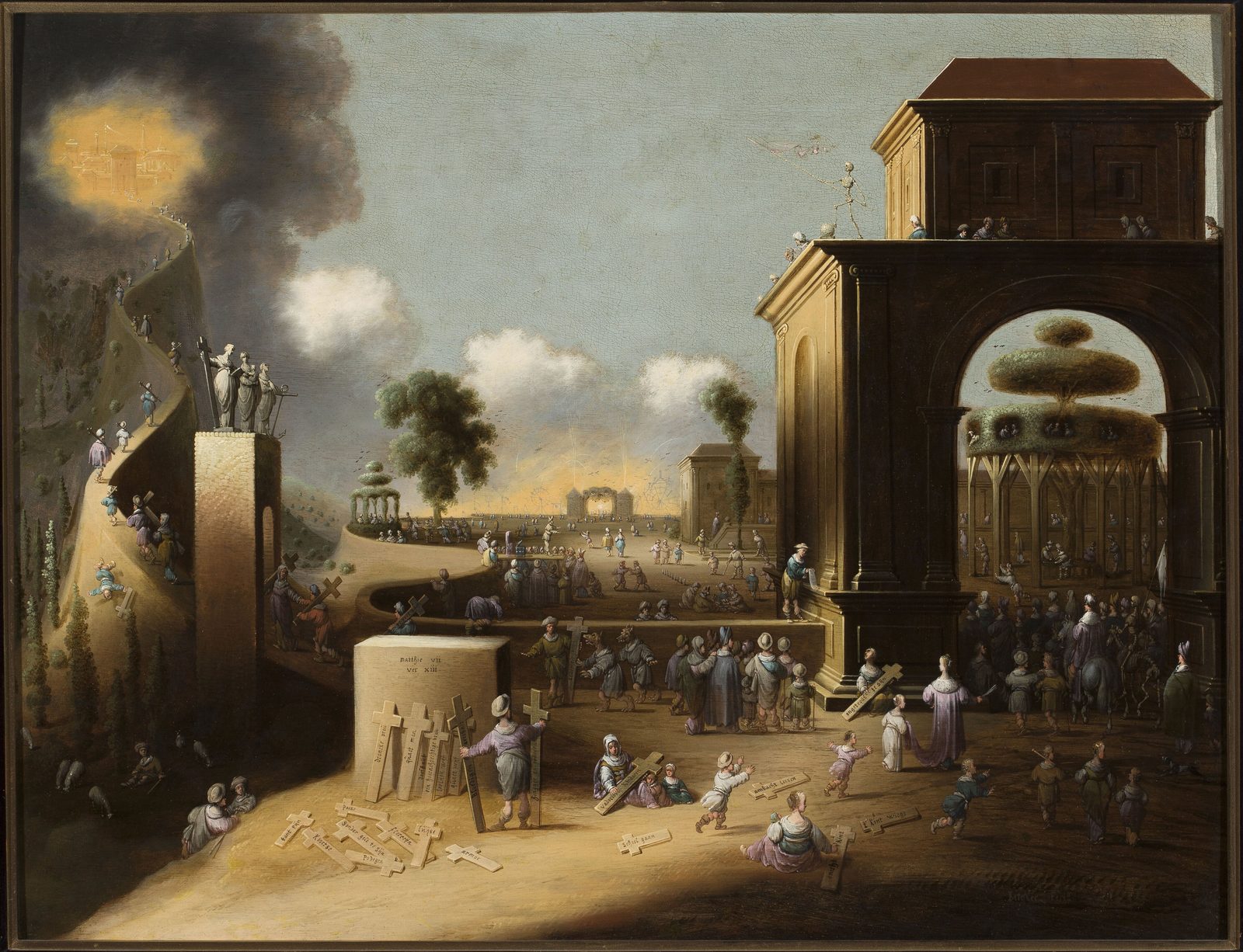
Narrow Road of Virtue and Wide Road of Sin. Jan Micker, not stated on the file page. National Museum in Warsaw. Public domain.