
Psalm 30
12 verses · Psalm of thanksgiving
You turned my mourning into dancing; You peeled off my sackcloth and clothed me with joy,
Introduction
David, the Dedication Song, Book 1: The book of David, Poetry, Psalms Overview.
The heading calls this a song for the dedication of the house and names David as its writer. Which house is meant has never been settled, and the psalm itself speaks of a man brought back from the edge of death. He had grown sure of himself in good years, fell ill, cried out and was restored, and he sings the whole story at a public ceremony. Listen for the confession of his own overconfidence, for the old prayer he quotes from his sickbed, and for the pairs of opposites that measure how short the hard season was against the long mercy that followed.
Context
- Who
- Israelites marking a new house with sacrifice and thanksgiving
- What
- A thanksgiving for recovery from a sickness that brought the singer near to death.
- Where
- A dedication ceremony for a house, which the heading names without saying which house.
- When
- The reign of David, about 1000 to 970 BC by the superscription.
- Why
- To give thanks in public for a life spared and to confess the pride that came before the fall.
Historical context
Dedicating a building was a real ceremony in Israel, and the Law excused a man from military service until he had dedicated his new house. Which house the heading means has never been settled. Being pulled up from Sheol and spared the descent into the Pit, in verse 3, is the language of illness, and Israelites buried their dead in rock-cut chambers, so going down was literal. The sackcloth peeled off in verse 11 was coarse goat-hair cloth worn for mourning, and taking it off announced to a whole village that the season of grief had ended. The confession of verse 6 is the sentence of a man with good years and a settled kingdom, who took the gift for a guarantee.
Significance
The psalm was sung at a threshold, and it puts the singer's own near death into the dedication rather than keeping the two apart. Its central line gave Israel a measure for both: God's anger is fleeting and his favour lasts a lifetime, and weeping may stay the night while joy comes in the morning.
This chapter in Jewish lifeWhat this chapter is in Jewish life and reading.
What is done
The heading of this psalm names a dedication, and the psalm is widely said at Hanukkah, the feast of the dedication, and in the daily morning service. That is the writer's reading. No file in this repository ties this psalm to the feast, and the tie is marked as the writer's reading until a source is filed. What this site does carry is the feast itself, at /featured/1-maccabees/hanukkah, and the door to it stands there rather than here. Rashi is quoted here from the Judaica Press Tanach with Rashi. He reads the heading as an instruction for a different occasion, a song "which the Levites will say at the dedication of the House in the days of Solomon" (Rashi on Psalms 30:1:1). What a dedication was in Israel, and which house the heading refers to, are owed a page under docs/lanes/FEATURE-PAGES-OWED.md.
How it is read
Ibn Ezra sets out the whole argument over the heading, and his note is the fullest in the corpus on this chapter. He is quoted here from the translation of Rabbi Mike Feuer in the Jerusalem Anthology. He reports that some refer the psalm to the dedication of the First Temple and some to the Second or the Third, "because he compared the time of exile to a time of sickness". His own reading is that David wrote it at the dedication of his own house, the House of Cedars. His reason is an argument from silence in the text itself, "because the psalm does not mention the House of God" (Ibn Ezra on Psalms 30:1:1). He then carries a third reading in the name of Rabbi Moshe. David mourned when Nathan told him he would not build the house, and was clothed with joy when he heard that Solomon would. Ibn Ezra draws a conclusion from that about grief itself, that suffering of the soul is like suffering of the body and in one way worse, and he proves it from Proverbs.
Rashi reads the psalm as a man's recovery from sin rather than from sickness. At the second verse he explains what the enemies would have rejoiced over. They said "David has no share in the world to come", and they were answered when the doors opened for the Ark, which showed that God had forgiven him (Rashi on Psalms 30:2:2). That ties this psalm to the gates of the twenty-fourth, where the doors clung shut until Solomon appealed to the kindness of David his father. At the third verse Rashi reads the healing as pardon rather than as medicine, and proves it from Isaiah (Rashi on Psalms 30:3:1). At the fourth he takes the pit as Gehinnom (Rashi on Psalms 30:4:1). At the seventh he gives the psalm's turn as a lesson about confidence. In his tranquillity David thought he would never falter, and then learned that "the matter is not in my power", and was frightened the moment God hid his face (Rashi on Psalms 30:7:1).
The last verse carries the reading a Christian reader will find most unexpected, and it is the pattern the founder's order names. Rashi reports that "our Sages explained the entire psalm as referring to Mordecai, Esther, and Haman", and he names the work where that stands (Rashi on Psalms 30:12:1). He then hands out the parts line by line. The words about tranquillity are Haman's, the call to God is Esther's, and the turning of the lament into dancing belongs to Mordecai and all Israel (Rashi on Psalms 30:12:2). On that reading a psalm of personal recovery becomes the script of Purim, with three speakers. The rabbis teach it, and this site reports it as their teaching rather than as a fact of the text. The corpus holds locators for the same reading on this chapter, at Esther Rabbah 10:5 and in two entries of Sifrei Aggadah on Esther. Rashi's own last word on the psalm is a comfort a reader can use. God's wrath "lasts but a short moment", and "there is long life in appeasing and placating Him" (Rashi on Psalms 30:6:1 and 30:6:2). Ibn Ezra and Radak comment on much of the rest, and the corpus carries those refs without English text. They stand here cited and unquoted at Ibn Ezra on Psalms 30:3:1, 30:4:1, 30:5:1, 30:7:1, 30:8:1, 30:9:1, 30:10:1 and 30:13:1, and at Radak on Psalms 30:8:1, 30:10:1 and 30:11:1.
What the rabbis say
The corpus carries forty locators on this psalm and the text of none, so each is cited and linked here rather than quoted. Eight are Talmudic. They stand at Shevuot 15b:8 and Jerusalem Talmud Bikkurim 3:4:1 on the second verse, and at Avodah Zarah 4b:6 with Berakhot 7a:15 on the sixth. Four more stand at Berakhot 55b:8 on the twelfth verse, Jerusalem Talmud Berakhot 5:1:16 on the twelfth and thirteenth, Megillah 4a:10 on the thirteenth, and Tractate Soferim 14:18 on the same verse.
The reading of the psalm against the book of Esther leaves a trail through the locators. Esther Rabbah 10:5 stands on the eleventh verse, and two entries of Sifrei Aggadah on Esther stand on the second and twelfth. An entry of Otzar Midrashim on Purim stands on the twelfth. Two entries of Ein Yaakov on the tractate for the scroll of Esther stand on the thirteenth verse, at Megillah 1:5 in the Glick Edition and at Megillah 1:5.
The first verse draws the songs of the Exodus, because the psalm is a song of dedication. On it the corpus carries Mekhilta DeRabbi Shimon Ben Yochai 15:1, Mekhilta DeRabbi Yishmael, Shirah 1:5, Midrash Lekach Tov on Exodus 15:1:4, Bamidbar Rabbah 12:9, Bereshit Rabbati on Bereshit 64 and Ein Yaakov, Shevuot 2:4.
The tenth verse, where the psalm asks what gain there is in the speaker's blood, carries five. They are Midrash Tanchuma, Tetzaveh 4:1, Midrash Tehillim 10:5 and 38:1, Pesikta DeRav Kahana 8:4 and Vayikra Rabbah 28:6. One more stands at Vayikra Rabbah 28:7 on the eleventh and twelfth verses. On the fourth verse the corpus carries Bamidbar Rabbah 10:2, Kohelet Rabbah 4:3:1, Midrash Tanchuma, Nasso 24:1 and Shemot Rabbah 8:1. The rest are single. They are Midrash Tanchuma, Vaera 17:2 and 7:2 on the second and third verses, Yalkut Shimoni on Torah 643:17 on the fifth, and Midrash Lekach Tov on Numbers 23:8:1 on the sixth. Two more stand on the sixth verse, at Ein Yaakov, Berakhot 1:32 in the Glick Edition and Berakhot 1:42. Three close the chapter, at Midrash Tehillim 119:5 on the seventh verse, and Ein Yaakov, Rosh Hashanah 1:7 in the Glick Edition with Rosh Hashanah 1:9 on the ninth. What each of them teaches is a saying of the rabbis, and is reported as theirs wherever this site quotes one. The quotations wait on a fetch that carries the text.
Sources: Rashi, Rashi on Psalms 30:1:1 to 30:12:2, the Judaica Press complete Tanach with Rashi, translated by A. J. Rosenberg; Ibn Ezra, Ibn Ezra on Psalms 30:1:1, translated by Rabbi Mike Feuer in the Jerusalem Anthology, and on Psalms 30:3:1 to 30:13:1 cited by ref because the corpus carries no English text; Radak, Radak on Psalms 30:8:1, 30:10:1 and 30:11:1, cited by ref because the corpus carries no English text; MannaFest, Hanukkah, at /featured/1-maccabees/hanukkah, and the dedication of a house row of docs/lanes/FEATURE-PAGES-OWED.md; The Sefaria corpus, scripts/data/sources/sefaria/psalms/30.json, the 8 Talmud and 32 Midrash locators of this chapter.
I will exalt You, O LORD: The rescue is already done: lifted up, healed, pulled up from Sheol. The Pit beside it is the grave, and the psalm says God spared him from going down into it. The man who sings was close to death.
Psalms 30:1
“I will extol thee. I will have high and honourable conceptions of thee, and give them utterance in my best music. Others may forget thee, murmur at thee, despise thee, blaspheme thee, but "I will extol thee, "for I have been favoured above all others. I will extol thy name, thy character, thine attributes, thy mercy to me, thy great forbearance to my people; but, especially will I speak well of thyself; "I will extol thee, "O Jehovah; this shall be my cheerful and constant employ. For thou hast lifted me up.”
Charles Spurgeon · The Treasury of David, Vol. 2 (1870)Particular Baptist
Psalms 30:2
“O Lord my God, I cried unto thee, and thou hast healed me. David sent up prayers for himself and for his people when visited with the pestilence. He went at once to head quarters, and not roundabout to fallible means. God is the best physician, even for our bodily infirmities. We do very wickedly and foolishly when we forget God. It was a sin in Asa that he trusted to physicians and not to God.”
Charles Spurgeon · The Treasury of David, Vol. 2 (1870)Particular Baptist
1 more voice on this verse
Psalms 30:2
“For as much as someone directs their intention towards the Lord, they elevate the Lord even more, and they themselves are elevated. Hence, he says: I will exalt you, O Lord, for you have lifted me up. For the holy person exalts the Lord, while the sinner humbles Him.”
Ambrose of Milan · written before 397 · On Isaac and the Soul, Chapter VII, 57patristic
Psalms 30:3
“O Lord, thou hast brought up my soul from the grave. Mark, it is not "I hope so; "but it is, "Thou hast; thou hast; thou hast" —three times over. David is quite sure, beyond a doubt, that God has done great things for him, whereof he is exceeding glad. He had descended to the brink of the sepulchre, and yet was restored to tell of the forbearance of God; nor was this all, he owned that nothing but grace had kept him from the lowest hell, and this made him doubly thankful.”
Charles Spurgeon · The Treasury of David, Vol. 2 (1870)Particular Baptist
2 more voices on this verse
Psalms 30:3
“No one is able to exalt God unless God has lifted him up. For we are lifted up on high through the cross of Christ, who said, "When I will have been lifted up, I will draw all to me." We exalt the Lord who himself exalted the Father, and as much as he has been in him, he shows the Father to the ones who believe. He teaches that there are certain invisible enemies of the human spirit who envy the salvation handed over to them by God.”
Origen of Alexandria · written before 253 · Selections from the Psalms 30:2patristic
Psalms 30:3
“The more imminent our dangers have been, the more eminent our deliverances have been, the more comfortable are they to ourselves and the more illustrious proofs of the power and goodness of God.”
Matthew Henry · Commentary on the Whole Bible (1707-1721)puritan
O you His saints: The thanks widen from one man to all the saints, who are told to praise His holy name. Verse 5 sets two spans against each other, an anger that is over quickly and a favour that lasts a lifetime. The night of weeping is real, and so is the morning.
Psalms 30:4
“One does not sing to the Lord by simply uttering the words of the psalm with his mouth, but all who send up the psalmody from a clean heart and who are holy, maintaining righteousness toward God, these are able to sing to God, harmoniously guided by the spiritual rhythms. How many stand there, coming from fornication? How many from theft? How many concealing in their hearts deceit? How many lying? They think they are singing, although in truth they are not singing. For the Scripture invites the saint to the singing of psalms.”
Basil of Caesarea · written before 379 · HOMILIES on the PSALMS 14:3 (PS 30)patristic
2 more voices on this verse
Psalms 30:4
“Sing unto the Lord, O ye saints of his. "Join my song; assist me to express my gratitude." He felt that he could not praise God enough himself, and therefore he would enlist the hearts of others. Sing unto the Lord, O ye saints of his. David would not fill his choir with reprobates, but with sanctified persons, who could sing from their hearts. He calls to you, ye people of God, because ye are saints: and if sinners are wickedly silent, let your holiness constrain you to sing.”
Charles Spurgeon · The Treasury of David, Vol. 2 (1870)Particular Baptist
Psalms 30:4
“They believe him to be a God of unspotted purity; and therefore let them sing to him; "Let them give thanks at the remembrance of his holiness; let them praise his holy name, for holiness is his memorial throughout all generations." God is a holy God; his holiness is his glory; that is the attribute which the holy angels, in their praises, fasten most upon, Isa. vi.”
Matthew Henry · Commentary on the Whole Bible (1707-1721)puritan
Psalms 30:5
“If weeping endureth for a night, and it be a wearisome night, yet as sure as the light of the morning returns after the darkness of the night, so sure will joy and comfort return in a short time, in due time, to the people of God; for the covenant of grace is as firm as the covenant of the day. This word has often been fulfilled to us in the letter.”
Matthew Henry · Commentary on the Whole Bible (1707-1721)puritan
2 more voices on this verse
Psalms 30:5
“For his anger endureth but a moment. David here alludes to those dispensations of God's providence which are the chastisement ordered in his paternal government towards his erring children, such as the plague which fell upon Jerusalem for David's sins; these are but short judgments, and they are removed as soon as real penitence sues for pardon and presents the great and acceptable sacrifice. What a mercy is this, for if the Lord's wrath smoked for a long season, flesh would utterly fail before him.”
Charles Spurgeon · The Treasury of David, Vol. 2 (1870)Particular Baptist
Psalms 30:5
“Relatively, the longest experience of divine anger by the pious is momentary. These precious words have consoled millions. What particular prosperity is meant we do not know; perhaps his accession to the throne.”
Jamieson, Fausset & Brown · Commentary Critical and Explanatory on the Whole Bible (1871)reformed
In prosperity I said: In prosperity he said he would never be shaken. Verse 7 gives the ground of that strength, the LORD's own favour, which had made his mountain stand strong. When God hid His face, the confidence went and he was dismayed.
Psalms 30:6
As the prosperity of a city is dependent on the supply of goods for sale in the market, and as we say that a country is prosperous that produces much fruit, so also there is a certain prosperity of the soul when it has been filled with works of every kind. It is necessary first for it to be laboriously cultivated and then to be enriched by the plentiful streams of heavenly waters, so as to bear fruit thirtyfold, sixtyfold and a hundredfold and to obtain the blessing that says, "Blessed shall be your barns and blessed your stores."
Basil of Caesarea · written before 379 · HOMILIES on the PSALMS 14:5 (PS 30)patristic
Psalms 30:7
“Lord, by thy favour thou hast made my mountain to stand strong. He ascribed his prosperity to the Lord's favour—so far good, it is well to own the hand of the Lord in all our stability and wealth. But observe that the good in a good man is not unmingled good, for this was alloyed with carnal security. His state he compares to a mountain, a molehill would have been nearer—we never think too little of ourselves.”
Charles Spurgeon · The Treasury of David, Vol. 2 (1870)Particular Baptist
3 more voices on this verse
Psalms 30:7
“If God hide his face, a good man is certainly troubled, though no other calamity befal him; when the sun sets night certainly follows, and the moon and all the stars cannot make day. When his mountain was shaken he lifted up his eyes above the hills. Prayer is a salve for every sore; he made use of it accordingly.”
Matthew Henry · Commentary on the Whole Bible (1707-1721)puritan
Psalms 30:7
God is said to turn away his face when in times of troubles he permits us to be delivered up to trials, in order that the strength of him who is struggling may be known.… We pray always for the face of God to shine on us, in order that we may be in a state becoming to a holy person, gentle and untroubled in every way, because of our readiness for the good. "I am ready," he says, "and am not troubled."
Basil of Caesarea · written before 379 · HOMILIES on the PSALMS 14:6 (PS 30)patristic
Psalms 30:7
“Mountain - My kingdom: kingdoms are usually called mountains in prophetical writings.”
John Wesley · Explanatory Notes upon the Old Testament (1765)evangelical
To You, O LORD, I called: The plea argues from God's own praise: dust cannot speak of His faithfulness. Hezekiah makes the same case on his sickbed at Isaiah 38:18 and 19, that the dead do not praise God. Verse 10 asks plainly for mercy and help.
Psalms 30:8
“I cried to thee, O Lord. Prayer is the unfailing resource of God's people. If they are driven to their wit's end, they may still go to the mercyseat. When an earthquake makes our mountain tremble, the throne of grace still stands firm, and we may come to it. Let us never forget to pray, and let us never doubt the success of prayer. The hand which wounds can heal: let us turn to him who smites us, and he will be entreated of us. Prayer is better solace than Cain's building a city, or Saul's seeking for music.”
Charles Spurgeon · The Treasury of David, Vol. 2 (1870)Particular Baptist
Psalms 30:9
“The promises of God's covenant cannot be performed to the dust. "Lord," says David, "if I die now, what will become of the promise made to me? Who shall declare the truth of that?" The best pleas in prayer are those that are taken from God's honour; and then we ask aright for life when we have that in view, that we may live and praise him.”
Matthew Henry · Commentary on the Whole Bible (1707-1721)puritan
2 more voices on this verse
Psalms 30:9
“In this verse we learn the form and method of David's prayer. It was an argument with God, an urging of reasons, a pleading of his cause. It was not a statement of doctrinal opinions, nor a narration of experience, much less a sly hit at other people under pretence of praying to God, although all these things and worse have been substituted for holy supplication at certain prayer meetings. He wrestled with the angel of the covenant with vehement pleadings, and therefore he prevailed.”
Charles Spurgeon · The Treasury of David, Vol. 2 (1870)Particular Baptist
Psalms 30:9
“What profit is there in my blood?.... Should that be shed, and he die by the hands of his enemies, through divine permission: death is not profitable to a man's self by way of merit; it does not atone for sin, satisfy justice, and merit heaven; even the death of martyrs, and of such who shed their blood, died in the cause of Christ, and for his sake, is not meritorious; it does not profit in such sense: there is profit in no blood but in the blood of Christ, by which peace is made, pardon procured, and redemption obtained.”
Psalms 30:10
“Hear, O Lord, and have mercy upon me. A short and comprehensive petition, available at all seasons, let us use it full often. It is the publican's prayer; be it ours. If God hears prayer, it is a great act of mercy; our petitions do not merit a reply. Lord, be thou my helper. Another compact, expressive, ever fitting prayer.”
Charles Spurgeon · The Treasury of David, Vol. 2 (1870)Particular Baptist
1 more voice on this verse
Psalms 30:10
“He prayed for mercy to pardon ( Have mercy upon me ), and for grace to help in time of need-- Lord, be thou my helper. On these two errands we also may come boldly to the throne of grace, Heb. iv.”
Matthew Henry · Commentary on the Whole Bible (1707-1721)puritan
turned my mourning into dancing: Mourning is turned into dancing, the sackcloth comes off, and joy is put on in its place. Sackcloth was the coarse cloth a mourner wore, and God takes it off him himself. Verse 12 gives the purpose, a heart that sings forever.
Psalms 30:11
“Observe the contrast, God takes away the mourning of his people; and what does he give them instead of it? Quiet and peace? Aye, and a great deal more than that. Thou hast turned for me my mourning into dancing. He makes their hearts to dance at the sound of his name. He takes off their sackcloth. That is good. What a delight to be rid of the habiliments of woe! But what then? He clothes us. And how? With some common dress? Nay, but with that royal vestment which is the array of glorified spirits in heaven.”
Charles Spurgeon · The Treasury of David, Vol. 2 (1870)Particular Baptist
2 more voices on this verse
Psalms 30:11
“The joy of God is not found in just any soul but, if someone has mourned much and deeply his own sin with loud lamentations and continual weepings, as if he were bewailing his own death, the mourning of such a one is turned into joy.… The mourning garment, which he put on when bewailing his sin, is torn, and the tunic of joy is placed around him and the cloak of salvation, those bright wedding garments, with which if one is adorned, he will not be cast out from the bridal chamber.”
Basil of Caesarea · written before 379 · HOMILIES on the PSALMS 14:7 (PS 30)patristic
Psalms 30:11
“The sackcloth with which, in a humble compliance with the divine Providence, he had clad himself, was loosed; his griefs were balanced; his fears were silenced; his comforts returned; and he was girded with gladness: joy was made his ornament, was made his strength, and seemed to cleave to him, as the girdle cleaves to the loins of a man.”
Matthew Henry · Commentary on the Whole Bible (1707-1721)puritan
Psalms 30:12
“To the end —namely, with this view and intent— that my glory —that is, my tongue or my soul— may sing praise to thee, and not be silent. It would be a shameful crime, if, after receiving God's mercies, we should forget to praise him. God would not have our tongues lie idle while so many themes for gratitude are spread on every hand. He would have no dumb children in the house. They are all to sing in heaven, and therefore they should all sing on earth.”
Charles Spurgeon · The Treasury of David, Vol. 2 (1870)Particular Baptist
2 more voices on this verse
Psalms 30:12
“When you granted me pardon because of my repentance and led me back into glory, taking away the shame of my sins, for this I shall give praise to you for all eternity. In fact, what space of time could be so great, that it could produce in my soul forgetfulness of such mighty benefits?”
Basil of Caesarea · written before 379 · Homilies on the Psalms 14:8 (Ps 30)patristic
Psalms 30:12
“Though "my" is supplied before "glory" it is better as in Ps 16:9, to receive it as used for tongue, the organ of praise. The ultimate end of God's mercies to us is our praise to Him.”
Jamieson, Fausset & Brown · Commentary Critical and Explanatory on the Whole Bible (1871)reformed
How this psalm is built
The form: A thanksgiving for recovery from a sickness that had brought a man to the borders of the grave, as Barnes classes it.
The patterns in this chapter
| Device | What it does | Where to see it |
|---|---|---|
| The three things God has done, counted at the start | Verses 1 to 3 open clause after clause with what God has done: You have lifted me up, You healed me, You pulled me up from Sheol, You spared me. Spurgeon counts the repetition and makes it the point of the passage, since the man does not say he hopes so but says You have three times over. Matthew Henry reads the lifting of verse 1 as double, out of the pit where he was sinking and up to the throne of Israel.Charles Spurgeon, The Treasury of David, Vol. 2, 1870, on Psalm 30:3. | Psalm 30:1, Psalm 30:2, Psalm 30:3 |
| The pairs that measure the two seasons | Verse 5 sets four things in two pairs: anger against favour, a moment against a lifetime, weeping at night against joy in the morning. Verse 11 makes two more of the same kind, mourning turned to dancing and sackcloth exchanged for joy. Jamieson, Fausset and Brown hold that the longest experience of God's anger by His people is momentary when measured against the favour, and they note that the word rendered dancing names a lute, whose cheerful notes stand against the sound of wailing. Spurgeon reads verse 11 as an exchange rather than a mere removal, since the mourner is clothed again and not only stripped.Jamieson, Fausset and Brown, Commentary Critical and Explanatory on the Whole Bible, 1871, on Psalm 30:5. | Psalm 30:5, Psalm 30:11 |
| The old prayer quoted inside the new song | The psalm speaks to God at verse 1, turns at verse 4 to call the saints to sing, and turns again at verse 8, where the man repeats the words he used while the trouble was on him. Verses 9 and 10 are that earlier prayer set down as it was spoken. Spurgeon reads it as the form and method of the praying: an argument with God and an urging of reasons rather than a statement of opinions. Matthew Henry names the reason it urges, that the promises of God cannot be kept to the dust, and holds that the best pleas in prayer are those taken from God's honour.Charles Spurgeon, The Treasury of David, Vol. 2, 1870, on Psalm 30:9. | Psalm 30:4, Psalm 30:8, Psalm 30:9, Psalm 30:10 |
| The same address at both ends | Verse 2 calls God by the words O LORD my God and asks for help, and verse 12 calls Him by the same words and promises thanks forever. The question of verse 9, whether the dust will praise God, is answered by the purpose clause of verse 12, that the heart may sing and not be silent. Jamieson, Fausset and Brown read the word glory there as the tongue, the organ of praise, as at Psalm 16:9, and take the praise of God as the end His mercies are given for.Jamieson, Fausset and Brown, Commentary Critical and Explanatory on the Whole Bible, 1871, on Psalm 30:12. | Psalm 30:2, Psalm 30:9, Psalm 30:12 |
The structure
The psalm opens with three things God has done, stated in clause after clause, which Spurgeon counts as You have said three times over. Verse 5 sets four things in two pairs and verse 11 makes two more of the same kind. The address O LORD my God stands at verse 2 and again at verse 12, so the psalm is framed by the way the man names God, and the question of verse 9 about the dust is answered by the purpose clause of verse 12.
4 more paragraphs on the patterns
Where it stands in the Psalter
Albert Barnes sends the reader from the Pit of verse 3 to his notes on Psalm 28:1, where the same word stands, and from the grave of that verse to Isaiah 14:9 and Psalm 6:5. He takes the enemies who were not allowed to rejoice at verse 1 back to Psalm 41:5, where they wait for a sick man to die. Jamieson, Fausset and Brown read the word glory at verse 12 as the tongue, the organ of praise, as at Psalm 16:9.
The argument the prayer makes
Jamieson, Fausset and Brown set verses 9 and 10 beside Isaiah 38:18, where Hezekiah pleads in the same way that the grave cannot praise God, and they explain the mourning of verse 11 from Amos 5:16, where wailing is the public sound of grief. Matthew Henry names the reason the plea urges, that the promises of God cannot be kept to the dust, and holds that the best pleas in prayer are those taken from God's honour. A feature page on Sheol and the Pit in the Psalms is owed and listed in the lane's register of pages owed.
How the fathers read it
Origen takes the lifting up of verse 1 as the lifting up of the cross, and says that no one can exalt God unless God has first lifted him up. Augustine hears the whole Christ speaking from verse 1, reads the healing of verse 2 as a body no longer carried about enfeebled by mortality, and reads the weeping of verse 5 as the long evening God's people wait through until the morning of the resurrection.
The pattern inside the psalm
The reversals all run one way. The man goes down and is brought up, he is silent in dismay and ends up singing, he wears sackcloth and is clothed with joy. Matthew Henry states the rule behind them: as sure as the light of the morning returns after the darkness of the night, joy and comfort return in due time to the people of God, because the covenant of grace is as firm as the covenant of the day.
Keep studying
Sources for this chapter
The summary
Jamieson, Fausset & Brown, Commentary Critical and Explanatory; John Calvin, Commentaries; John Wesley, Notes on the Old Testament and Matthew Henry, Complete Commentary.
The form and classifications
Adam Clarke, Commentary on the Bible, 1832, on Psalm 30:6; Albert Barnes, Notes, Explanatory and Practical, on the Old and New Testaments, 1832 to 1869, on Psalm 30:2 and Augustine of Hippo, Exposition on Psalm 30, 430, on Psalm 30:1.
The exposition
Albert Barnes, Notes on the Book of Psalms; Charles Spurgeon, The Treasury of David; Franz Delitzsch, Biblical Commentary on the Psalms; John Gill, Exposition of the Old Testament and Matthew Henry, Commentary on the Whole Bible.
The painting
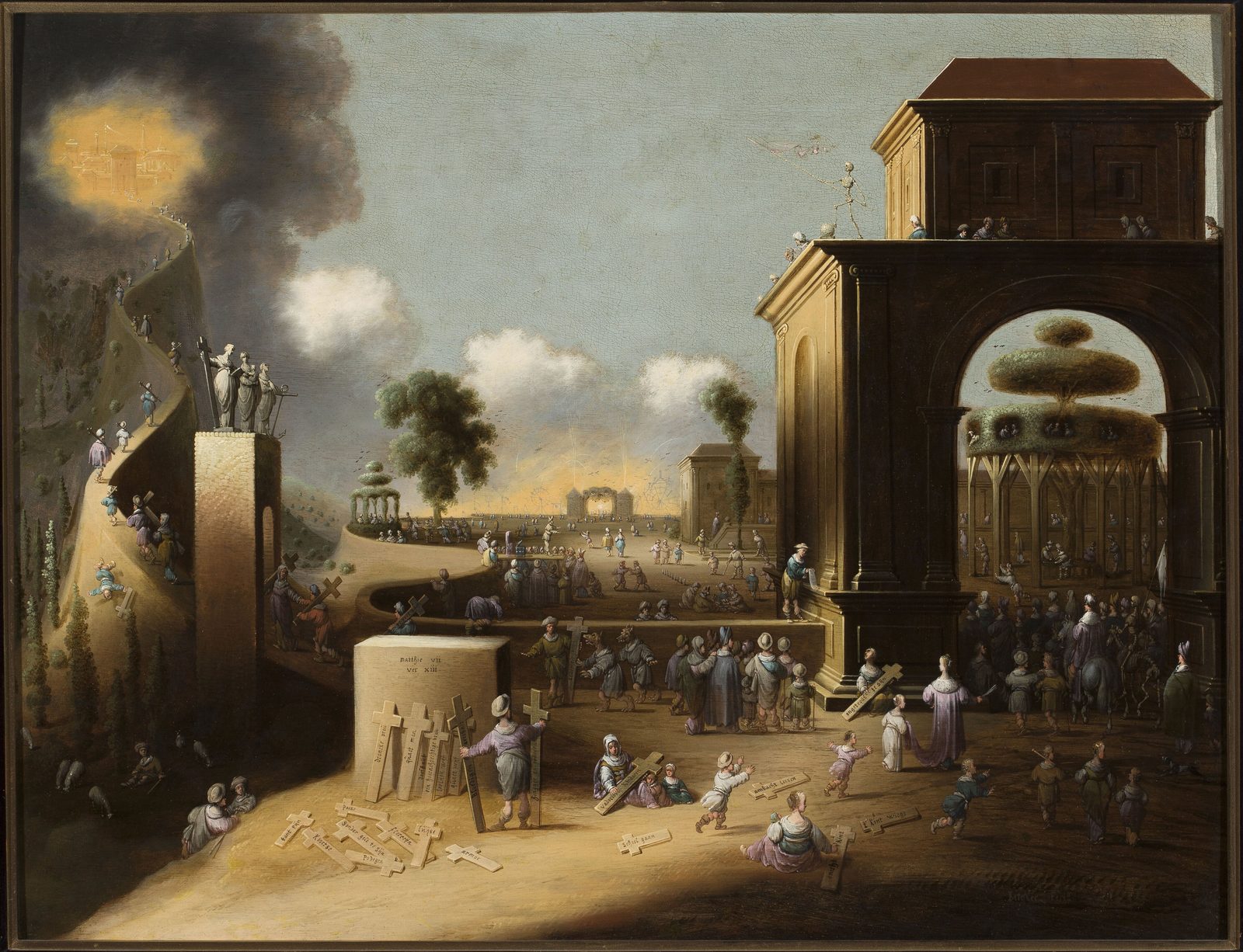
Narrow Road of Virtue and Wide Road of Sin. Jan Micker, not stated on the file page. National Museum in Warsaw. Public domain.